Last updated: March 4, 2026
Modern cardiology practices face operational hurdles that directly reduce revenue and strain patient safety workflows. Fragmented device manufacturer portals create data silos and force staff to juggle separate logins for each OEM system. This manual work burns clinical time and increases the chance of missed critical events.
Alert fatigue adds another layer of risk. Traditional monitoring systems flood teams with non-actionable notifications that hide true emergencies. AI algorithms in modern MCT platforms automatically flag abnormalities like AFib or tachycardia, reducing alert fatigue through streamlined analysis, while certified technicians validate events and cut false alarms.
Revenue leakage occurs when practices miss billable events or fail to produce compliant documentation for complex remote monitoring CPT codes. Cardiac remote patient monitoring studies demonstrate substantial cost savings with a net amount of $390,296, representing a 173% return on investment when programs run on structured, automated workflows.
The following platforms rank #2-7 based on comprehensive analysis. Murj (#2) delivers strong workflow automation but lacks full vendor-neutrality. PaceMate (#3) offers cloud-based functionality and incorporates the PaceArt acquisition. Implicity (#4) focuses on AI-powered alert filtering. Rhythm Management Group (#5) combines software with monitoring services. Octagos (#6) emphasizes AI-driven filtering and EHR integrations. Legacy solutions like Paceart (#7) remain constrained by on-premise architecture.
The 2026 CPT code updates are effective January 1, 2026, and streamline reporting for advanced digital health services. These changes clarify complex procedures and align coding with current digital monitoring technology.
CPT Code | Description & 2026 Updates | Key Requirements | Platform Automation Benefits |
93298 | Interrogation device evaluation, remote | 30-day minimum monitoring, physician interpretation | Automated data capture and report generation |
93299 | Remote monitoring, 30-day period | Technical component, data transmission verification | Continuous connectivity monitoring and documentation |
99454 | Remote physiological monitoring treatment | 16+ days of data collection monthly | Automated compliance tracking and billing triggers |
99453/99457 | RPM setup and management | Patient education, device provisioning | Streamlined onboarding and care management workflows |
Modern arrhythmia monitoring platforms capture these billable events automatically and maintain audit trails for compliance. The 2026 documentation standards favor platforms that generate complete reports with minimal manual work from staff.
The arrhythmia monitoring market now favors vendor-neutral platforms over OEM-specific systems. Automated interval-billing in cardiac monitoring improves billing accuracy, increases billable intervals per patient, and reduces unnecessary transmissions and denial rates.
Platform | Vendor-Neutral & AI Triage | EHR Integrations | Reported ROI |
Rhythm360 (#1) | Full vendor-neutrality, 80% alert fatigue reduction | Epic, Cerner, Athenahealth bi-directional | 300% revenue increase |
Murj (#2) | Limited vendor-neutrality, workflow automation | Basic EHR connectivity | Moderate efficiency gains |
PaceMate (#3) | Cloud-based, PaceArt integration | Standard HL7 interfaces | Organizational improvements |
Implicity (#4) | AI-powered alert filtering focus | Select EHR partnerships | Reduced false positives |
Octagos (#5) | AI-driven filtering, bi-directional EHR | Multiple EHR connections | Workflow optimization |
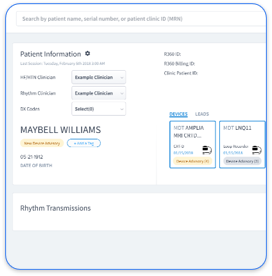
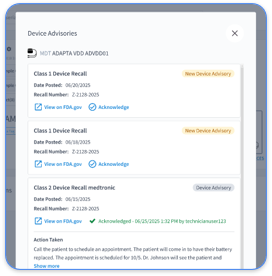
EKORA's Devices module is manufacturer-agnostic, integrating data from Medtronic, Abbott, Biotronik, and Boston Scientific into a single vendor-neutral record. This approach reflects a broader industry move toward unified platforms that remove OEM data silos.
The most effective platforms pair broad vendor-neutrality with advanced AI. Over six months, wireless ECG monitoring observed a 28% reduction in readmissions and improved medication adherence through AI-generated alerts. These results highlight both clinical and financial gains from intelligent monitoring systems.
Rhythm360 delivers a vendor-neutral arrhythmia monitoring platform that combines broad device support with deep automation. The platform achieves greater than 99.9% data transmissibility through redundant data feeds, computer vision, and AI-powered extrapolation. This design helps prevent missed critical events caused by technical failures.

Key differentiating features include:
A real-world case illustrates this impact. A critical Saturday morning atrial fibrillation event was flagged by Rhythm360’s AI triage system. The patient started anticoagulants by Saturday afternoon, which likely prevented a stroke. This sequence shows how integrated detection, notification, and response protect patients and revenue.
Remote cardiac monitoring initiatives find each dollar spent on RPM yields $3+ in savings by preventing admissions. Rhythm360 builds on this by delivering 300% revenue increases through stronger billing capture and streamlined workflows.
Schedule a demo today to see how Rhythm360’s vendor-neutral platform improves efficiency while helping ensure no critical events are missed.
Rhythm360 follows a structured implementation process that supports rapid deployment with limited workflow disruption.
Practices that adopt Rhythm360 often see 80% reductions in critical alert response times and 300% increases in captured revenue from automated billing. Studies show a 65% decrease in hospital admissions for enrolled cardiovascular patients, which reinforces both clinical and financial value.
The SaaS-based pricing model scales with practice size and usage. This structure aligns costs with realized benefits and gives small and large practices access to enterprise-level capabilities without heavy upfront spend.
Rhythm360 captures all required documentation elements for CPT codes 93298, 93299, and 99454, including 2026 enhancements. The platform maintains detailed audit trails, generates compliant reports, and tracks billing intervals through automated monitoring and alerts.
Murj offers workflow automation, while Rhythm360 adds full vendor-neutrality across major device manufacturers and more advanced AI triage. Rhythm360 reduces alert fatigue by 80% and provides deeper, bi-directional EHR integrations. These capabilities support a proven 300% ROI that exceeds typical gains from competing platforms.
Rhythm360’s integrated HF/HTN Remote Physiological Monitoring service line delivers turnkey implementation with automated billing support for relevant CPT codes. Practices can launch profitable RPM services quickly and monitor multiple chronic conditions from a single dashboard.
Rhythm360’s AI combines multiple data sources and redundant feeds to reach greater than 99.9% transmissibility. Advanced algorithms separate clinically significant events from routine variations. The platform achieves an 80% reduction in alert fatigue while maintaining high sensitivity for critical arrhythmias.
Most practices see measurable ROI within the first month through better billing capture and lower administrative overhead. The 300% revenue increase usually appears within three to six months as staff adopt the workflows and automation reaches full scale.
The comparison of leading arrhythmia monitoring platforms shows that Rhythm360 addresses the core challenges facing cardiology practices. Competitors solve parts of the problem, but Rhythm360 combines vendor-neutrality, advanced AI triage, seamless EHR integration, and documented 300% ROI.
Fragmented OEM portals and manual billing create major opportunity costs for cardiology groups. The 2026 CPT updates raise the bar on documentation and compliance, which increases the value of automated, intelligent monitoring platforms.
Stop revenue leakage and schedule a Rhythm360 demo now to see how vendor-neutral arrhythmia monitoring can improve efficiency, support compliance, and deliver measurable financial gains while strengthening patient outcomes.