Last updated: August 24, 2026
Every billable remote monitoring encounter starts with a valid practitioner order and documented patient consent. Auditable RPM billing requires documented patient consent before monitoring begins, a valid practitioner order on file, use of an FDA-cleared device with automatic electronic transmission, and a signed HIPAA Business Associate Agreement with any vendor handling patient data. Missing any of these elements ranks among the most common audit triggers for remote monitoring claims.
Rhythm360 captures consent and order details at intake and timestamps each element within the patient record. The platform’s integrated communication hub, powered by a Twilio framework, logs all patient-facing communications, including consent confirmations, and creates a complete, retrievable audit trail from day one. Documentation for RPM billing should include each patient’s device provisioning details, FDA clearance records, and the full transmission history for the billing period.
Once a patient is enrolled, Rhythm360 aggregates transmission data from all major device manufacturers, including Medtronic, Abbott, Boston Scientific, and Biotronik, into a single dashboard. Rhythm360 aggregates CIED and RPM data from all major OEM manufacturers into a single dashboard, eliminating the need for multiple device-maker logins.
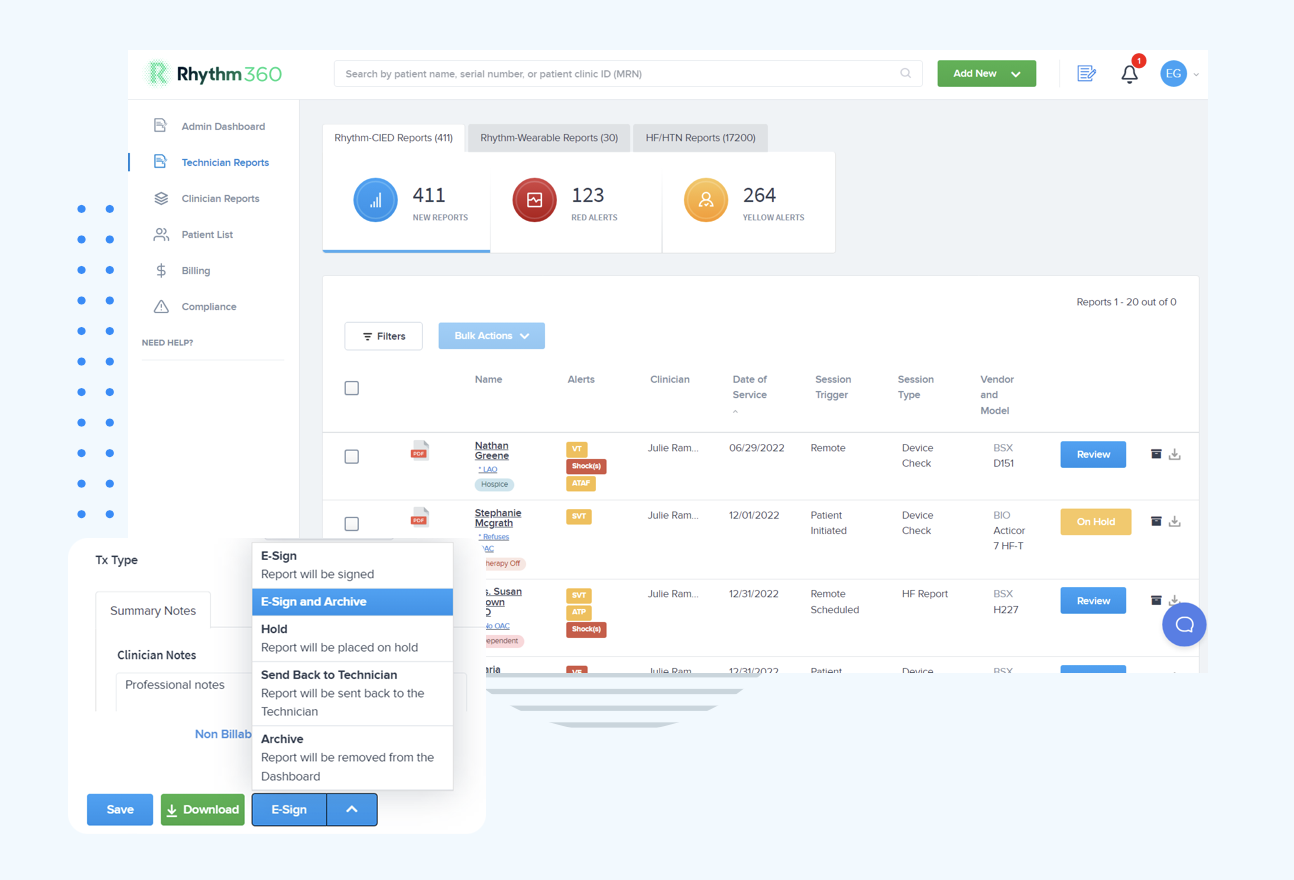
Rhythm360 resolves multi-portal fragmentation through API, HL7, XML, and PDF parsing via computer vision. These ingestion methods feed a redundant architecture that achieves greater than 99.9% data transmissibility even when individual OEM servers experience outages. Because transmissions are not lost, the platform maintains a single source of truth for the entire device population and removes the administrative burden that drives staff burnout and billing errors in practices managing multi-OEM device panels.
See how Rhythm360 consolidates every OEM feed into one compliant billing workflow.
With unified data flowing into the platform, Rhythm360 runs automated day counting and code qualification, the step where most manual workflows fail. CPT code 99454 requires data transmission on at least 16 separate days within a strict 30-day period and is explicitly time-based, not volume-based. Rhythm360 tracks unique transmission days in real time and routes each patient to the correct code automatically.
The 2026 CMS Physician Fee Schedule introduced two codes that expand the billable universe for practices. CPT 99445 covers device supply for remote patient monitoring when patients transmit physiologic readings on 2–15 unique days per month and is mutually exclusive with CPT 99454, which requires 16 or more days; both codes reimburse at the national average rate of approximately $47. Automated RPM workflows should count unique transmission days in real time and, when the 16-day threshold is not met, route the claim to the appropriate lower-duration code such as 99445 rather than forcing an invalid 99454 submission.
For CIED-specific monitoring, CPT 93298 covers remote interrogation device evaluation of a subcutaneous cardiac rhythm monitor (implantable loop recorder) for a period of up to 30 days and may be billed globally or split with modifier TC. No 2026 Medicare change to a 2–15 day minimum is documented. Rhythm360’s AI triage surfaces only transmissions that meet billable thresholds and prevents premature or non-qualifying claim submissions.
High alert volume creates a structural problem in CIED monitoring. A cross-manufacturer analysis of 2,659 rhythm episodes from 1,710 patients with ICMs from Medtronic, Biotronik, Abbott, and Boston Scientific found that even in AI-equipped devices, 32.9% of episodes were non-actionable.
Rhythm360’s AI alert triage layer filters non-actionable transmissions before they reach the clinical review queue and cuts critical-event response times by 80%, with reported examples reducing times from 4 hours to 45 minutes. Clinicians receive prioritized notifications for events that require action, such as new-onset AFib, ventricular tachycardia, lead malfunction, or ERI indicators. Routine transmissions are processed and documented without consuming physician time.
Each reviewed transmission generates a compliant interpretation note that addresses device function, programmed parameters, and actionable findings and satisfies the minimum documentation required for remote monitoring billing, including patient demographics, device type and manufacturer, dates of the monitoring period, and a clinician interpretation note. The University of Chicago Medicine, operating on Rhythm360, reviewed more than 73,000 reports annually through Rhythm360 in calendar year 2025 and demonstrated the platform’s capacity to sustain high-volume clinical review without degrading billing compliance.
Billing windows in CIED monitoring leave little room for error. The Monitoring Gap occurs when a CIED transmission arrives, a clinician reviews it and makes care decisions, but billing documentation is not completed within the 90-day cycle window, causing the billable event to expire. For a cardiac monitoring program, the gap between CMS-allowed billing time and actual monitoring time can represent significant uncollected revenue on patients the practice already serves.
Rhythm360 addresses this through automated mid-cycle reviews that flag patients approaching the end of a billing window without a qualifying claim. An automated RPM platform that flags patients below the 16-day transmission threshold before claims generation prevents denials by ensuring CPT 99454 is only billed when requirements are met. The platform also monitors for the most common audit triggers, including missing consent documentation, expired physician orders, and insufficient time log detail for management codes.
Clean charge capture depends on billing-ready documentation reaching the revenue cycle without manual re-entry. Rhythm360 supports bi-directional EHR integration with Epic, Cerner, athenahealth, eClinicalWorks, Greenway Health, and GE Centricity via HL7 messaging and SMART on FHIR-style APIs, enabling automated documentation and data write-back directly into clinical workflows.
When an OCR, payer, or CMS review begins, an EHR must demonstrate who accessed what, when, where, and what changed, a requirement that vendor-neutral platforms must satisfy through clean, auditable write-back into systems like Epic or Oracle Cerner. Rhythm360 writes discrete CPT data and maintains timestamped logs of every transmission, review, and charge event. Audit-ready documentation is generated in real time rather than reconstructed at the end of each cycle. As one University of Chicago Medicine physician confirmed after implementation, “We have improved billing and accountability for our patients after the integration.”
Request a walkthrough of Rhythm360’s bi-directional EHR write-back and audit trail capabilities.
The downstream financial impact of automating steps 1 through 6 is measurable. The revenue gains cited in the Key Takeaways, up to 300% increases, result from optimized CPT code capture and improved staff efficiency. The 2026 reimbursement landscape amplifies this opportunity. CPT 99470, introduced in 2026, reimburses treatment management services for 10–19 minutes of clinical staff engagement per month at a national average rate of $26, replacing prior uncompensated work that fell below the 20-minute threshold required for CPT 99457.
A practice with 200 RPM-enrolled patients that previously billed only 140 patients under pre-2026 thresholds can now generate approximately $4,690 in additional monthly revenue by billing the remaining 60 patients under 99445 and 99470 at a combined $78.16 per patient per month. A 2025 Health Affairs study tracking 754 primary care practices found that RPM-adopting practices experienced a 20% increase in Medicare revenue compared to matched controls, with most of the increase from direct RPM billing and roughly a quarter from additional outpatient visits and care management services.
The revenue gains described above depend on closing every gap in the transmission-to-charge workflow. The following checklist identifies the most common points of revenue leakage in cardiology remote monitoring programs and maps each one to the specific Rhythm360 automation that prevents it.
Cardiology practices lose revenue through seven recurring failure points, each representing a breakdown in the transmission-to-charge workflow. The checklist below maps each failure point to the Rhythm360 capability that prevents it and shows how the platform’s design addresses structural causes of revenue loss.
The table below maps each billable CPT code to the specific Rhythm360 automation that captures it and the 2026 national average reimbursement rate. This mapping shows how the platform’s workflow ensures that every qualifying transmission generates the correct code without manual intervention and reduces code-selection errors, a leading cause of claim denials in remote monitoring programs.
| CPT Code | Rhythm360 Action | 2026 National Average Reimbursement |
|---|---|---|
| 93294 | Tracks 90-day professional component cycle for single/dual-chamber pacemakers and generates a compliant interpretation note at review | Varies by locality; RVU-based |
| 93296 | Automatically pairs technical component billing with 93294/93295; reimbursement for CPT 93296 increased by 63% under revised 2026 RVU calculations | Revised upward under 2026 RVU update |
| 93298 | Flags ILR/ICM transmissions for remote interrogation device evaluation of a subcutaneous cardiac rhythm monitor (implantable loop recorder) for a period of up to 30 days that may be billed globally or split with modifier TC; no 2026 Medicare change to a 2–15 day minimum is documented | Varies by locality; RVU-based |
| 99454 | Counts unique transmission days in real time and submits a claim when the 16-day threshold is confirmed within the 30-day window | ~$47–$48 national average |
| 99445 (new 2026) | Automatically routes patients with 2–15 transmission days to this code instead of forcing an invalid 99454 submission | ~$47 national average |
| 99470 (new 2026) | Aggregates documented management minutes and captures 10–19 minute engagement periods previously uncompensated below the 99457 threshold | ~$26 national average |
The CPT-to-platform mapping above shows what Rhythm360 automates. The questions below explain how the platform delivers that automation in real-world practice environments, from EHR integration timelines to mobile access and audit readiness under 2026 OIG scrutiny.
Rhythm360 applies updated billing logic that reflects the 2026 CMS Physician Fee Schedule, including the new mutually exclusive codes 99445 and 99470. The platform counts unique transmission days in real time and automatically selects the correct code, 99454 for 16 or more days and 99445 for 2 to 15 days, which prevents invalid submissions. For CIED-specific codes such as 93294 through 93298, the platform tracks device-specific monitoring cycles, pairs professional and technical components, and generates interpretation notes that satisfy documentation requirements. All billing logic is updated as CMS guidance evolves, so practices do not need to manually retrain staff on code threshold changes.
Rhythm360’s implementation process, including EHR integration setup, typically takes from a few days to a few weeks depending on the complexity of the practice’s existing infrastructure. Bi-directional integrations are available for Epic, Cerner, athenahealth, eClinicalWorks, Greenway Health, and other systems via HL7 and SMART on FHIR-style APIs. The onboarding process minimizes disruption to existing clinical workflows, and the platform does not require a single “super-user” to function, which reduces dependency on any one staff member and supports business continuity from the first day of go-live.
Rhythm360 includes a secure, HIPAA-compliant mobile application that allows clinicians to review transmissions, sign reports, and coordinate care from their smartphones. This capability is particularly relevant for on-call scenarios, such as when an AI alert surfaces a critical arrhythmia on a weekend and the responsible clinician needs to initiate anticoagulation protocols or coordinate device reprogramming without returning to a workstation. All mobile activity is logged within the patient record with a full audit trail and maintains the same documentation integrity as desktop-based review.
Rhythm360 uses a redundant data feed architecture as a fail-safe against OEM server outages. If a manufacturer’s server is unavailable, the platform’s AI-powered gap-filling and computer vision technology work to maintain data continuity and support the transmissibility rate described in Step 2. This matters for billing because a missed transmission can push a patient below the threshold for a qualifying code, a problem that Rhythm360’s redundancy layer is specifically designed to prevent.
The HHS Office of Inspector General identified substantial growth in Remote Patient Monitoring services as a compliance risk area in its Fall 2025 Semiannual Report to Congress. Rhythm360 addresses this directly through auditable documentation generated at every step of the monitoring workflow, including timestamped consent records, practitioner orders, transmission logs, interpretation notes, and EHR write-back confirmations. Because documentation is created in real time rather than reconstructed at billing, practices using Rhythm360 maintain a continuously audit-ready record that satisfies the transparency requirements CMS and OIG have signaled as priorities for 2026 oversight activity.
Every CIED transmission represents a clinical obligation and a billing opportunity. When those transmissions flow through disconnected OEM portals and manual documentation processes, both obligations go unmet, patients face delayed responses to critical events, and practices absorb permanent revenue loss on work already performed. Rhythm360 closes that gap by automating the full transmission-to-charge workflow, from order intake and vendor-neutral data ingestion through AI triage, charge reconciliation, EHR write-back, and payment posting.
The 2026 CMS code updates, including 99445, 99470, and revised RVUs for 93296, expand the revenue available to practices that have the billing infrastructure to capture it. Rhythm360 is built to capture that revenue compliantly on every cycle.
Book a demo to see how Rhythm360 turns every transmission into a clean, compliant CPT charge.