

Last updated: October 5, 2026
Talk With Rhythm360 About Your Monitoring Workflow
This ordered workflow converts arrhythmia detection into faster clinical action. Each stage has a defined function, owner, and time target.
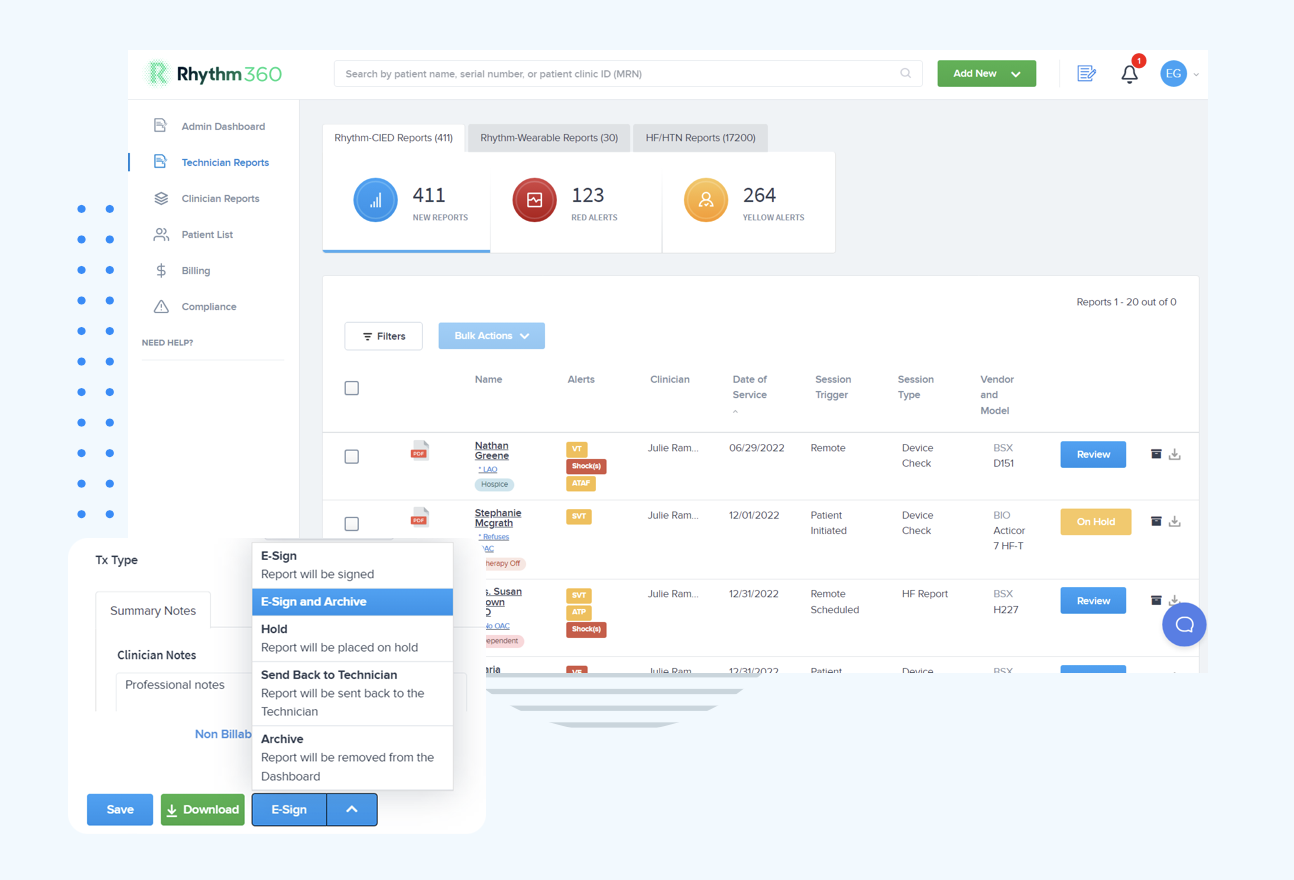
Rhythm360 runs this entire workflow in a single vendor-neutral platform. The system consolidates data from all major device manufacturers and applies AI-powered alert triage so that no stage depends on manual handoffs between disconnected systems.
See How Rhythm360 Handles End-To-End Monitoring
Continuous cellular telemetry for ambulatory patients and CIED remote monitoring for device patients form the detection foundation. The TRUST trial demonstrated that remote monitoring shortened median time from arrhythmia detection to medical intervention to 1 day versus 35.5 days in the ambulatory care group. A complete detection layer tracks specific parameters so that no actionable event slips through.
Rhythm360 reaches greater than 99.9% data transmissibility through redundant data feeds, computer vision, and AI-powered extrapolation. This design keeps a failed OEM server or a missed transmission from creating a gap in the patient record. University of Chicago Medicine reviewed more than 73,000 reports annually through Rhythm360 in calendar year 2025, averaging more than 18,000 reports per quarter. That volume demonstrates the platform’s ability to sustain high-throughput detection while preserving data fidelity.
Once detection is reliable, the next bottleneck is alert prioritization. The 2023 HRS or EHRA or APHRS or LAHRS Expert Consensus Statement, developed in collaboration with and endorsed by the ACC and AHA, expects clinics to maintain structured escalation protocols so that high-urgency alerts trigger an immediate response and lower-urgency alerts reach the appropriate clinician within a defined window. A red, yellow, and green framework turns that expectation into daily practice.
A peer-reviewed study of 384,796 transmissions found that 57% were dismissed as nonactionable and 31% were routine billable. Only 13% were critical alerts that required immediate attention. Rhythm360’s AI-powered alert triage filters nonactionable noise before it reaches the clinical queue. The system directs attention to the small subset of transmissions that require a response and reduces alert fatigue across the care team.
Alert tiers only improve response time when each tier has a clear owner and deadline. Every alert tier requires a named reviewer and an explicit time target. A RACI-style ownership model removes ambiguity about who acts and by when.
Real-world benchmarks from high-performing remote monitoring programs confirm that alert transmissions should be reviewed within one business day and non-alert transmissions within three business days. Rhythm360’s centralized dashboard surfaces every pending transmission with its assigned tier, owner, and elapsed time. Automated reporting removes the manual documentation burden that often slows review in legacy workflows. As Andrew Beaser, MD, Associate Professor of Medicine at University of Chicago Medicine, noted, “I am more likely to sign off on these while in meetings because I can easily access them on my phone.”
Timely patient contact after alert review often represents the weakest and least documented stage. Contact protocols should match the alert tier so that high-risk patients hear from the team quickly and every outreach appears in the record.
Rhythm360’s integrated Twilio-powered communication hub supports both automated and manual patient messaging. Every interaction, including phone call logs, appears in a full audit trail within the patient record. Physicians and other providers share responsibility for documenting all patient interactions, remote or otherwise, in the medical record, with reviewed transmissions documented according to clinical and regulatory requirements. Timely, documented contact also prevents adverse outcomes. As Dr. Beaser explained, “We are able to address these issues earlier; rather than waiting for a 3-month visit, we can call patients in for evaluation.”
Off-hours response often becomes the most common failure point in arrhythmia monitoring programs. The JHRS consensus statement states that remote monitoring does not function as an emergency response system, which makes clinic design and staffing the true determinants of response time. Device transmissions frequently synchronize overnight, so alerts arrive in the morning queue. Without 24 or 7 coverage, those alerts can sit unreviewed until Monday.
A defensible off-hours escalation design includes several concrete elements.
Rhythm360’s HIPAA-compliant mobile app allows clinicians to review transmissions, sign reports, and coordinate care from anywhere. The platform’s optional 24 or 7 or 365 CCT oversight layer provides a staffed escalation backstop for programs that need weekend response parity without adding permanent headcount. For more detail on building a scalable monitoring workflow, see Streamlined Arrhythmia Monitoring For Busy Cardiology Teams.
Clinical intervention such as anticoagulation initiation, device reprogramming, or an urgent clinic visit represents the outcome that the preceding five stages support. The team must document treatment in the EHR and feed that information back into the monitoring system. This feedback loop allows the intervention to shape future alert thresholds and transmission schedules.
Rhythm360 provides bi-directional EHR integration with Epic, Cerner, Athenahealth, eClinicalWorks, and other systems. Treatment decisions recorded in the EHR appear in the patient’s monitoring profile. This connection closes the loop between detection and clinical action and prevents the same event from generating redundant alerts in later transmissions.
A response-time reduction program needs measurable proof of impact. The following KPI map links each stage of the workflow to a trackable interval.
Rhythm360’s analytics dashboard tracks each of these intervals at the patient and population level. The system generates audit-ready data that practice administrators can use to report response-time improvement to clinical leadership. For a deeper look at measurable outcomes, see Improve Cardiac Implant Monitoring Response Times In 2026 and Workflow Automation Cuts Cardiac Response Times By 80%.
Review Your Response-Time Metrics With Rhythm360
Vendor-neutral data consolidation removes a major structural source of delay. When a device technician must log into separate portals for Medtronic CareLink, Boston Scientific Latitude, Abbott Merlin.net, and Biotronik Home Monitoring before seeing a single patient’s status, the alert-to-review interval expands before clinical judgment even begins. CIED data often sits in proprietary formats that do not interoperate, which forces clinics to adopt time-consuming workflows and assign staff to repetitive data management tasks just to see a complete patient panel.
Rhythm360 unifies data from all major device manufacturers into a single source of truth using API, HL7, XML, and PDF parsing through computer vision. This consolidation removes manual logins and shortens the time between event detection and clinical review. Other platforms in the remote monitoring space, including Murj, Implicity, Rhythm Management Group, and Octagos, address parts of this operational challenge.
Arrhythmia monitoring reduces cardiac response times when every alert has a predetermined clinical destination, owner, and time target across all six stages. Detect, Prioritize, Review, Contact, Escalate, and Treat function as a single connected system rather than isolated tasks.
Rhythm360 provides a unified, vendor-neutral platform that runs this workflow from end to end. The system combines greater than 99.9% data transmissibility, AI-powered triage, integrated communication, mobile access, and bi-directional EHR documentation without adding headcount or manual handoffs.
Start Designing Your Six-Stage Workflow With Rhythm360





