Modern cardiology practices operate in an environment where manual workflows often cannot keep pace with device volume and clinical demand. Fragmented OEM device portals create interoperability gaps even with standards like ISO/IEEE 11073-10103:2014, which forces manual data transfer, verification, and review. Staff log into multiple portals, copy information into the EHR, and monitor separate inboxes, which increases both workload and the chance of missed events.
The clinical impact includes delayed recognition of significant arrhythmias, a higher risk of stroke or hospitalization, and inconsistent documentation of interventions. Operationally, many practices lose revenue because billable remote monitoring services are not fully captured. Teams also face high levels of alert fatigue and administrative overload, which contribute to burnout and turnover.
Workflow automation addresses these issues by centralizing data, standardizing processes, and introducing rules-based or AI-supported triage. Automated systems can shorten response times for high-risk events, reduce unnecessary alerts, and support consistent CPT code documentation. For 2026, automation is less a technology upgrade and more a requirement for safe, scalable arrhythmia care.
Leadership alignment sets the stage for successful automation. Physician-owners and administrators need a shared understanding that automation shifts arrhythmia care from manual, reactive work to structured, proactive workflows with measurable outcomes in safety, efficiency, and financial performance.
Technology readiness focuses on integration and security. Practices benefit from platforms that connect directly with the EHR, use secure cloud infrastructure, and handle PHI under robust compliance controls. Rhythm360 offers a vendor-neutral architecture and an onboarding process that typically completes within days to a few weeks, including EHR integration, without heavy IT lift from the practice.
Clear goals give the project direction. Useful targets include decreases in critical alert response time, improved CPT code capture, reduced time spent in OEM portals, and higher patient compliance with monitoring protocols. These metrics help teams evaluate progress and refine workflows over time.
Unified data is the foundation of automated arrhythmia monitoring. Instead of juggling multiple OEM portals, practices can route all data into a single platform. Rhythm360 ingests and normalizes information from major CIED manufacturers through APIs, HL7, XML, and computer vision that parses PDF reports.
A redundant data feed design helps Rhythm360 maintain more than 99.9% data transmissibility, so monitoring continues even when individual OEM services experience downtime. Third-party platforms that consolidate device data show improvements in clinical workflows and efficiency by reducing manual follow-up and supporting automated data integration.
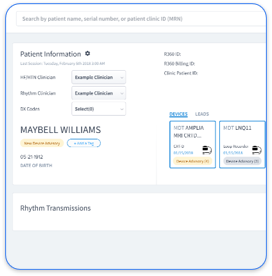
Once data is centralized, staff access a single dashboard for each patient’s device history and alerts. This reduces manual logins, cut-and-paste work, and the risk of inconsistent information across systems.
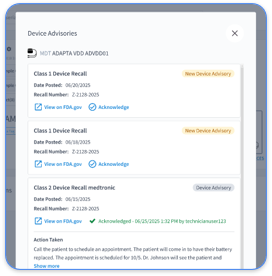
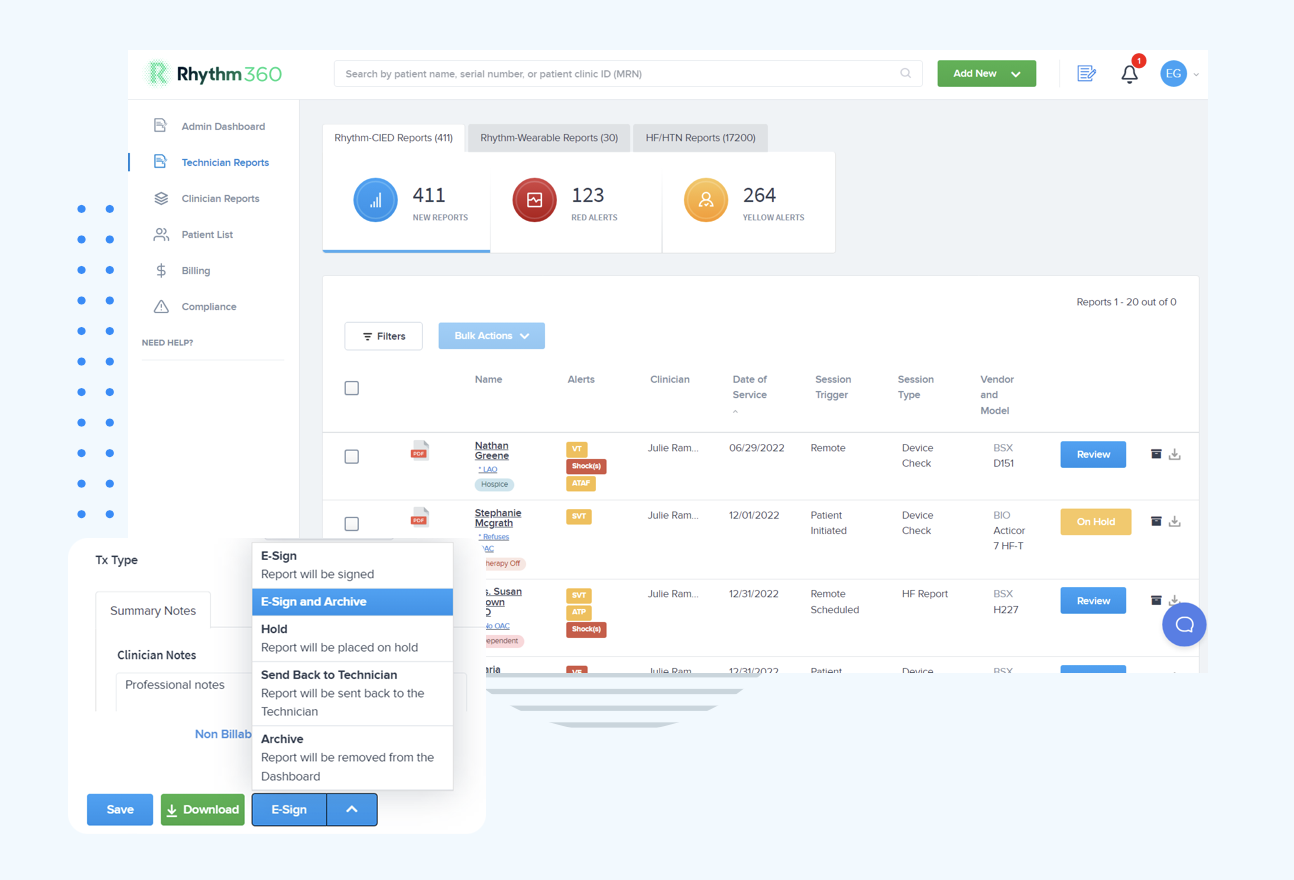
AI-supported alert triage helps teams focus on clinically meaningful events. Rhythm360 analyzes incoming transmissions, filters non-actionable alerts, and flags high-priority issues such as ventricular fibrillation, new-onset atrial fibrillation, and potential lead problems. Routine checks and urgent events move into standardized reports in near real time.
AI tools in arrhythmia care still face challenges, including limited external validation and opaque decision logic in some models, so explainability and clear thresholds remain important. Rhythm360 structures alerts in ways that support clinician review rather than replacing it.
With fewer low-value alerts and clearer prioritization, staff experience less alert fatigue and can respond more quickly to critical events. Many practices see large gains in response time once manual triage steps are reduced.
Accurate, automated billing workflows protect reimbursement for remote monitoring. Rhythm360 tracks and documents billable events for CIED monitoring (CPT 93298, 93299) and RPM services (99453, 99454, 99457) based on usage and timing rules.
The platform generates records that align with billing requirements, which lowers the chance of denials for incomplete documentation. Automated reports also show captured versus potential revenue so administrators can identify gaps in documentation or workflow.
Practices often uncover significant missed revenue once monitoring volumes scale. Structured automation helps recover that value by making CPT capture routine rather than dependent on manual tracking.
Efficient communication workflows keep patients engaged while reducing staff workload. Rhythm360 uses an integrated Twilio framework to support automated and manual patient messaging, with every interaction logged in the patient record. Messages can include transmission reminders and tailored outreach for high-risk groups, such as patients with heart failure.
Team members review previous automated messages before making calls, which prevents duplication and shortens each interaction. The communication history also supports audit needs and quality improvement initiatives.
Clear, consistent outreach usually improves adherence to monitoring schedules and follow-up plans. Better adherence strengthens both clinical outcomes and the completeness of billable monitoring data.
Actionable analytics complete the automation picture. Rhythm360 provides dashboards that track patient compliance, alert volumes, response times, CPT-related revenue, and key workload indicators.
By reviewing these metrics, leaders can spot trends such as rising non-compliance, bottlenecks in triage, or underutilized billable services. Changes to staffing, scheduling, or protocols can then target the documented issues instead of relying on anecdotal feedback.
Structured review of these reports on a monthly or quarterly basis supports ongoing optimization of the monitoring program.
Teams that want to explore this approach in more detail can schedule a Rhythm360 demo and review the reporting workflows in a live environment.
Feature/Capability | Manual protocols and legacy systems | Rhythm360 automated workflow |
Data consolidation | Multiple OEM portal logins and manual data entry | Single vendor-neutral platform with automated data harmonization |
Alert management | High alert fatigue, manual triage, and a higher risk of missed events | AI-supported triage, prioritized alerts, and significantly faster response |
CPT code capture | Manual tracking and frequent revenue leakage | Automated documentation with visibility into missed opportunities |
EHR integration | Limited connectivity and manual transcription | Bi-directional integration that reduces double entry |
Clinical impact becomes visible soon after implementation. Practices using platforms like Rhythm360 often see marked reductions in response time for urgent alerts, which supports faster clinical decisions and better protection for high-risk patients.
Operational gains appear in staff schedules and task lists. Time spent logging into portals, downloading reports, and re-entering data decreases, so nurses and technicians can redirect effort toward direct patient support and clinical coordination.
Financial outcomes improve as automated CPT tracking surfaces billable work that once went unrecorded. Some practices report large percentage increases in captured revenue when they shift from manual processes to structured, rules-based documentation.
One typical scenario illustrates this difference. A Rhythm360-enabled practice receives a new-onset atrial fibrillation alert for a high-risk patient early on a weekend. The triaged alert rises to the top of the queue, the on-call clinician reviews data via mobile access, and anticoagulation is started the same day. In a manual process that relies on delayed report review, this event might not be addressed until regular office hours.
Automation platforms also support expansion beyond CIED monitoring. Rhythm360 includes tools for broader chronic disease management, so practices can add service lines for conditions such as heart failure and hypertension while using the same core workflows and reporting structure.
Ongoing optimization keeps these workflows effective. Pilot testing with standardized tools such as the System Usability Scale (SUS) helps teams identify usability issues and refine configuration before broad rollout. Regular feedback cycles with clinicians and staff keep the system aligned with changing practice needs.
Practices that invest in this infrastructure now are better positioned to adopt future advances in AI models, device capabilities, and reimbursement frameworks without rebuilding their monitoring process from the ground up.
Platforms like Rhythm360 apply rules and AI-supported models to incoming transmissions, filter out routine or non-actionable alerts, and highlight critical events such as ventricular tachycardia or new-onset atrial fibrillation. Clinicians see prioritized alerts with structured summaries instead of raw data streams, which shortens the path from event detection to review and intervention and can reduce response times by a large margin.
Different OEMs use distinct data formats and access portals, which fragment information. Rhythm360 addresses this by using APIs, HL7 interfaces, XML feeds, and computer vision that converts unstructured PDFs into structured data. The platform then maps everything into a single standardized format, so clinicians work from one consolidated view rather than reconciling multiple sources.
Automation supports CPT compliance by tracking time-based and activity-based criteria for codes such as 93298 and 93299 for CIED monitoring and 99453, 99454, and 99457 for RPM. Rhythm360 records these events automatically and generates documentation that aligns with audit requirements. As a result, practices can bill confidently for services they already provide and reduce missed revenue due to incomplete or inconsistent manual records.
Longer ambulatory ECG monitoring windows provide more data points for AI models that estimate atrial fibrillation burden. When automated platforms process these extended datasets, they can deliver more stable estimates that support decisions about stroke risk, rhythm control strategies, and monitoring intensity, while also strengthening the clinical justification behind related billing.
Arrhythmia monitoring that depends on manual data entry, fragmented portals, and ad hoc billing processes creates clinical risk and financial uncertainty. An automated, vendor-neutral platform reduces those risks by centralizing data, structuring alert triage, and embedding CPT documentation into daily workflows.
Rhythm360 provides this framework for 2026, with capabilities for unified device data, prioritized alert management, automated billing support, and comprehensive reporting. These tools help practices respond more quickly to critical events, reduce administrative load, and improve revenue integrity.
Practices that want to streamline arrhythmia monitoring and support better outcomes can schedule a Rhythm360 demo and see how an automated workflow fits their existing clinical and operational processes.