

Automated cardiac device reporting uses technology to ingest, normalize, triage, and deliver transmitted data from cardiac implantable electronic devices (CIEDs) directly to a clinician dashboard without manual steps. CIEDs include pacemakers, implantable cardioverter-defibrillators (ICDs), cardiac resynchronization therapy devices (CRTs), and implantable loop recorders (ILRs). Transmitted metrics include atrial fibrillation burden, ventricular arrhythmia episodes, delivered shocks, lead impedance values, battery voltage, estimated replacement indicators (ERI/RRT), and device-sensed physiological parameters.
In a fully automated workflow, data flows from the implanted device through the manufacturer network into a vendor-neutral aggregation layer. That layer parses API feeds, HL7 messages, XML files, and unstructured PDFs with computer vision. It then surfaces a normalized, actionable report to the reviewing clinician. No staff member needs to log into a single OEM portal.
Practices that implant devices from more than one manufacturer face a structural interoperability problem. Each OEM uses a proprietary portal with its own login credentials, data format, alert threshold configuration, and report layout. A device technician managing 400 active CIED patients across four manufacturers must complete four separate authentication sequences, reconcile four inconsistent data schemas, and manually transcribe findings into the EHR every monitoring day.
Single-source data feeds also create reliability risk. When an OEM server experiences downtime or a patient’s home communicator loses connectivity, the transmission gap may go unnoticed in a manual workflow. Emerging research on remote monitoring program design identifies transmission reliability and alert prioritization as the two most consequential variables in CIED program outcomes. Neither variable can be fully addressed within a siloed OEM portal architecture. Vendor-neutral platforms like Rhythm360 solve these structural problems by consolidating data flows, automating triage, and maintaining redundant feeds, which turns a fragmented multi-portal workflow into a unified system.
Rhythm360 replaces the manual login loop with a single, normalized data environment. The workflow contrast is direct.
Fragmented workflow: Staff logs into four OEM portals, reviews or downloads reports in four formats, manually enters findings into the EHR, tracks billable events in a separate spreadsheet, and submits claims with incomplete documentation.
Rhythm360 workflow: First, all OEM data feeds are ingested simultaneously via API, HL7, XML, and PDF parsing through computer vision. Because multiple feeds enter in parallel, redundant data sources act as a fail-safe when any single OEM source is unavailable. Once ingested, the data is normalized into a unified schema and displayed on a single dashboard, which removes the need to reconcile multiple formats. When transmission gaps occur despite redundancy, AI-powered logic identifies missing data points and applies extrapolation to maintain continuity. Finally, bi-directional EHR integration pushes finalized reports directly into Epic, Cerner, Athenahealth, eClinicalWorks, or Greenway Health records. This workflow supports greater than 99.9% transmissibility across the monitored population, a reliability threshold that manual multi-portal management cannot reach.
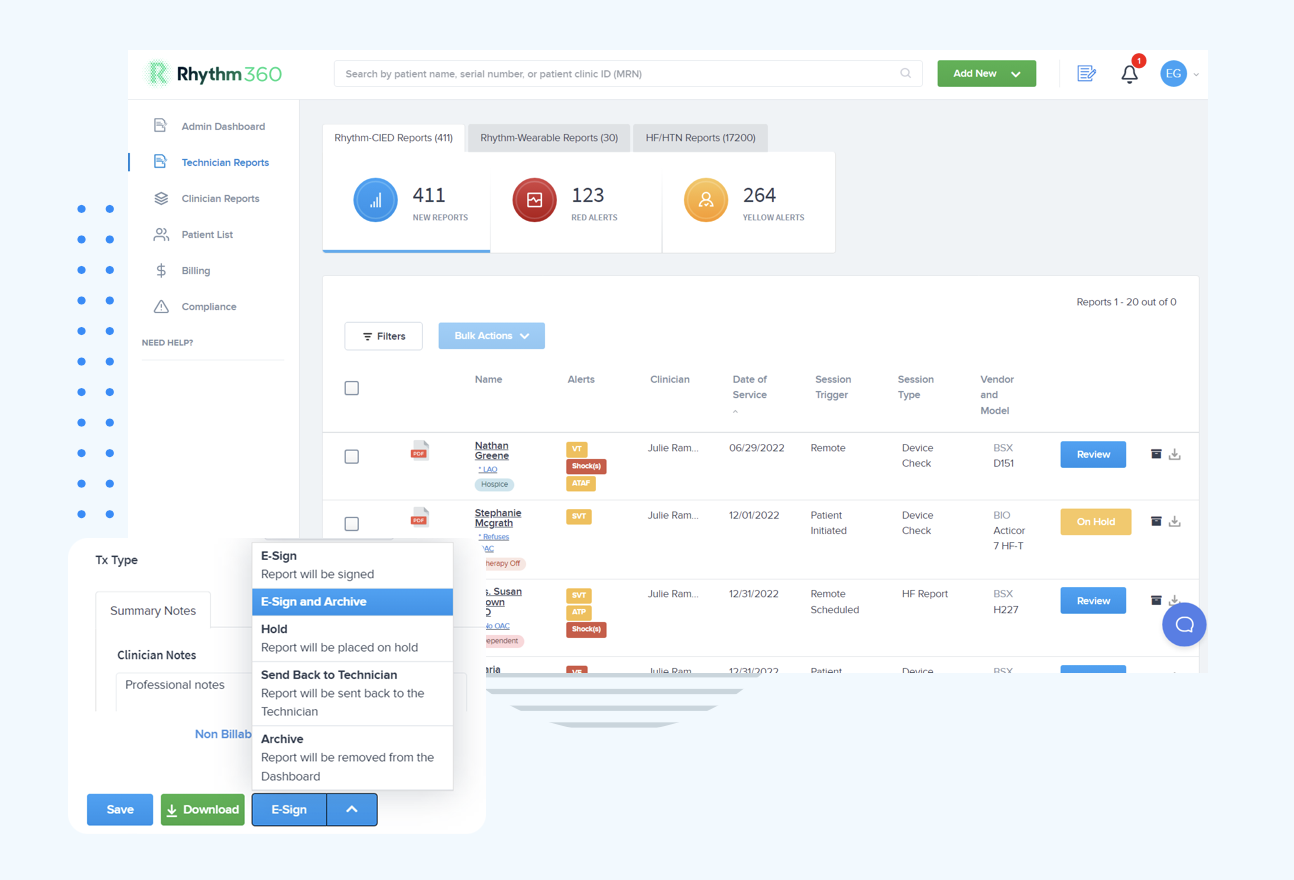
Legacy OEM portals generate alert volumes that exceed the review capacity of most clinical teams. Most transmitted alerts are non-actionable, such as routine device checks, minor parameter fluctuations, or connectivity confirmations. These alerts arrive in the same queue as ventricular fibrillation episodes and lead fracture warnings. Clinicians experience alert fatigue and often delay review because the signal-to-noise ratio remains too low.
Rhythm360’s AI-powered alert triage layer filters non-actionable notifications and stratifies remaining alerts by clinical urgency before they reach the reviewing clinician. As Andrew Beaser, MD, at the University of Chicago Medicine, notes, “Decision support, including AI-assisted decision support, will become increasingly important as data volumes grow.” UCM processed more than 73,000 reports annually through Rhythm360 in calendar year 2025, averaging more than 18,000 reports per quarter. That volume would be operationally unmanageable without automated triage.
Practices using Rhythm360 reduce critical alert response times by up to 80%. Optional 24/7/365 oversight by certified cardiac technicians (CCTs) supervised by physicians adds another clinical safety layer for programs that require continuous coverage.
Remote CIED monitoring generates reimbursable events under a defined set of CPT codes. Code 93298 covers remote interrogation of a subcutaneous cardiac rhythm monitor system (implantable loop recorder) with analysis, review(s), and report(s). Code 93299 covers remote interrogation of an implantable cardiovascular physiologic monitor system or subcutaneous cardiac rhythm monitor system. Code 99454 covers remote physiologic monitoring device supply with daily recording(s) or programmed alert(s) transmission, each 30 days, when data is transmitted on at least 16 days. Each code carries specific documentation and frequency requirements that must be met for a claim to clear adjudication.
Manual workflows often miss or underdocument billable events when staff juggle transmission review across multiple portals. Rhythm360 automates CPT code capture by tracking transmission dates, report completion timestamps, and physician sign-off within a single auditable record. The administrative dashboard surfaces captured and potential revenue in real time so billing staff can identify and close documentation gaps before claim submission. Practices implementing Rhythm360 have increased revenue generation by as much as 300% through better CPT code capture and fewer claim rejections. As Gaurav A. Upadhyay, MD, FACC, FHRS, at UCM, states, “We have improved billing and accountability for our patient after the integration.”
A patient with a dual-chamber ICD transmits on a Saturday morning. The transmission contains a new-onset AFib episode with a burden exceeding six hours and a rapid ventricular response. In a fragmented OEM portal environment, that transmission often sits unreviewed until Monday.
In Rhythm360, the AI triage layer flags the event as high priority within minutes of ingestion. The on-call clinician receives a prioritized notification on the HIPAA-compliant mobile app, reviews the full transmission report, and initiates anticoagulation protocols by Saturday afternoon. A potential cardioembolic stroke is averted.
This scenario reflects the core clinical value of automated cardiac device reporting. The platform converts a passive data archive into an active safety net that runs continuously, regardless of day or staffing level. The mobile app allows clinicians to review transmissions, sign reports, and coordinate care from any location, which removes dependence on a specific workstation or on-call coverage pattern.
Experience the mobile alert workflow firsthand in a live demo.
| Capability | OEM Portals (Combined) | Rhythm360 |
|---|---|---|
| Login complexity | Separate credentials per manufacturer (4+ logins for multi-OEM practices) | Single unified login across all OEMs |
| AI alert triage | Manufacturer-specific threshold alerts, no cross-vendor prioritization | AI-powered triage with cross-vendor alert stratification, optional CCT oversight |
| Mobile access | Limited or portal-dependent, no unified mobile review | HIPAA-compliant mobile app for transmission review, report signing, and care coordination |
| Billing support | No automated CPT code capture or documentation tracking | Automated CPT code capture (93298, 93299, 99454) with auditable documentation and real-time revenue dashboard |
Three capability categories carry the most operational weight when you evaluate any vendor-neutral CIED monitoring platform. Bi-directional EHR integration determines whether the platform truly reduces manual data entry or simply relocates it. Rhythm360 supports Epic, Cerner, Athenahealth, eClinicalWorks, and Greenway Health via HL7, with data flowing in both directions.
Mobile access determines whether critical alert review stays tied to a physical workstation. The Rhythm360 mobile app removes that constraint entirely. Optional CCT oversight determines whether a practice can extend monitoring coverage beyond its internal staffing capacity. Rhythm360’s optional 24/7/365 certified cardiac technician service provides that extension without additional FTE hiring.
Implementation disruption often slows platform adoption. Rhythm360’s onboarding process, including EHR integration configuration, typically takes from a few days to a few weeks, depending on practice size and existing infrastructure. The SaaS-based pricing model scales with clinic size and platform usage, which avoids high upfront costs and rigid licensing structures associated with legacy on-premise systems.
Staff training focuses on minimizing workflow interruption. The single-dashboard architecture shortens the learning curve compared with maintaining proficiency across four or more OEM portals at once. The combined effect is a faster path to operational benefit with lower transition risk than most practices expect.
Get a customized implementation timeline and pricing estimate for your practice.
The U.S. remote patient monitoring market continues to grow, driven by rising CIED implant volumes and expanding CMS reimbursement for remote physiological monitoring. Current research on RPM program design identifies data reliability, alert prioritization, and billing compliance as the three structural determinants of program sustainability. Rhythm360’s documented outcomes, including the alert response improvements and revenue gains detailed earlier, align directly with those determinants.
The University of Chicago Medicine’s high-volume experience, described above, provides real-world validation of the platform’s scalability at an academic medical center level.
Fragmented OEM portals create a structural liability that costs cardiology practices clinical response time, staff capacity, and recoverable revenue every monitoring day. Automated cardiac device reporting through a vendor-neutral, AI-powered platform like Rhythm360 consolidates those moving parts into a single source of truth. Practices gain one login, one dashboard, one auditable record, and one billing workflow that captures every reimbursable event.
The shift from fragmented to unified reporting does more than modernize technology. It strengthens patient safety.
Rhythm360 supports bi-directional integration with Epic, Cerner, Athenahealth, eClinicalWorks, Greenway Health, and additional systems via HL7. Bi-directional integration means data flows both ways. Finalized CIED reports push into the EHR patient record, and relevant patient demographic or scheduling data can be pulled into Rhythm360. Integration setup is included in onboarding and typically takes from a few days to a few weeks, depending on the EHR environment and practice size.
Rhythm360 simplifies training by consolidating tools. Staff who currently maintain working knowledge of four or more OEM portal interfaces move to a single, standardized dashboard. The learning curve for one unified interface is substantially lower than the cumulative effort of staying proficient across multiple proprietary systems. RhythmScience provides onboarding support that helps minimize disruption to existing workflows during the transition period.
Rhythm360 automates documentation and tracking for the primary remote CIED monitoring codes. These include 93298 for remote interrogation of a subcutaneous cardiac rhythm monitor system (implantable loop recorder) with analysis, review(s), and report(s), 93299 for remote interrogation of an implantable cardiovascular physiologic monitor system or subcutaneous cardiac rhythm monitor system, and 99454 for remote physiologic monitoring device supply with daily recording(s) or programmed alert(s) transmission, each 30 days, when data is transmitted on at least 16 days.
The platform also supports RPM service line codes, including 99453 and 99457, for practices managing heart failure and hypertension patients. The administrative dashboard tracks transmission dates, report completion, and physician sign-off so each claim meets payer documentation requirements before submission.
Rhythm360 uses a redundant data feed architecture to address this risk. If a primary OEM data source becomes unavailable because of server downtime or connectivity issues, the redundant feed system activates to maintain data continuity. AI-powered extrapolation fills gaps when transmission data is incomplete. This infrastructure supports the platform’s greater than 99.9% transmissibility rate, a reliability level that single OEM portal feeds cannot match.
Rhythm360 supports these practices through optional 24/7/365 oversight by certified cardiac technicians (CCTs) supervised by physicians. This service allows practices without dedicated in-house device staff, or those seeking to extend coverage beyond business hours, to maintain continuous monitoring without additional FTE hiring. The CCT oversight layer integrates directly with the platform’s alert triage system so high-priority events are reviewed and escalated regardless of time or day.





