Last updated: July 13, 2026
Legacy remote monitoring systems flood teams with non-actionable notifications. Device technicians and nurses spend hours each day triaging transmissions that require no clinical response. Meanwhile, genuinely critical events such as new-onset atrial fibrillation, ventricular tachycardia, lead malfunction, or significant weight gain can get buried in the queue. Missed weekend alerts often occur when staff rely on manual, portal-by-portal review.
AI-powered alert triage directly addresses this overload. In the LINK-HF2 trial of an AI-enabled remote monitoring platform for heart failure, 95% of AI-generated alerts were reviewed by clinicians within 24 hours, and 26.7% led to clinical actions such as therapy adjustment. At a system level, a study presented at THT 2026 found that red alerts were triaged via an AI platform with high review rates within 48 hours, with many resolved by LVNs and RNs and minimal escalations to HF cardiologists.
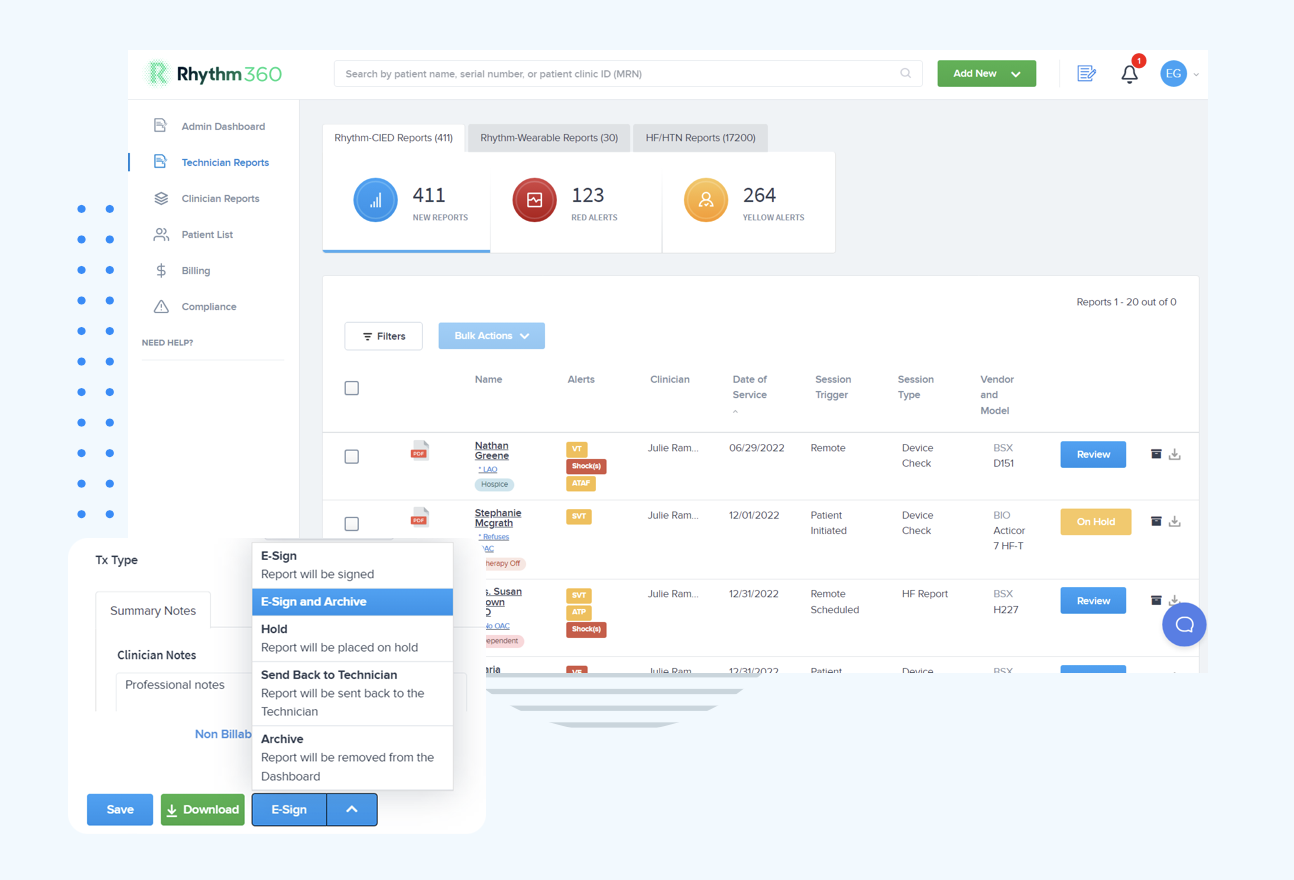
Connectivity gaps make alert fatigue worse. When an OEM server is intermittently unavailable, transmissions can fail silently and staff must manually reconcile missing data. Rhythm360 addresses this with redundant data feeds, computer vision-based PDF parsing, and AI-powered extrapolation, achieving greater than 99.9% data transmissibility. Clinicians work from a single dashboard that shows a complete, prioritized alert queue, not four separate portal inboxes, and Rhythm360 clients have reported up to an 80% reduction in critical alert response times.
University of Chicago Medicine reviewed more than 73,000 reports annually through Rhythm360 in calendar year 2025, averaging more than 18,000 reports per quarter, with stable dismissal rates that demonstrate scalable monitoring in a high-volume environment. Andrew Beaser, MD, Associate Professor of Medicine at UCM, noted that "decision support, including AI-assisted decision support, will become increasingly important as data volumes grow."
Guideline-directed medical therapy tracking remains a persistent challenge in heart failure management. Patients on optimal GDMT regimens that include beta-blockers, ACEi, ARB or ARNI, SGLT2 inhibitors, and MRAs have measurably better outcomes. Titration requires timely physiologic data, and fragmented portals rarely deliver that data reliably.
Automated workflows that connect remote monitoring data with clinical decision support change this reality. A nonrandomized study presented at THT 2026 found that an AI-enabled virtual HF care platform increased adherence to beta-blockers, ACEi or ARNI, and SGLT2i (P < 0.001 for all). The ASSIST-HF trial showed that a supervised generative-AI-supported virtual assistant can safely accelerate GDMT optimization in newly diagnosed HFrEF patients within 12 weeks, with lower NT-proBNP levels and fewer hospitalizations in the AI-guided arm.
CMS 31-day reporting compliance creates a parallel operational requirement. Practices that track transmission windows manually often miss the 16-day active monitoring threshold for CPT 99454, which triggers claim denials. Rhythm360's automated workflow logs transmission events, timestamps clinician review, and flags patients approaching compliance windows before a billing cycle closes. This automation removes the manual tracking burden that commonly causes documentation gaps.
As Andrew Beaser, MD, at UCM explained: "We are able to address these issues earlier; rather than waiting for a 3-month visit, we can call patients in for evaluation." That shift from reactive to proactive management reflects the practical impact of integrating GDMT tracking with automated remote monitoring workflows.
A practice implanting devices from Medtronic, Boston Scientific, Abbott, and Biotronik must maintain separate logins, learn four distinct portal interfaces, and reconcile data in four different formats before any clinical review can begin. This situation represents a structural barrier to safe, scalable monitoring, not just a minor workflow inefficiency. A 2026 joint scientific statement from the Heart Failure Society of America and the American Association of Heart Failure Nurses identifies lack of interoperability between systems as one of the primary challenges to widespread implementation of integrated health technologies in heart failure management.
Rhythm360 resolves this barrier by ingesting data from all major OEM portals, including Medtronic CareLink, Abbott Merlin.net, Boston Scientific Latitude, and Biotronik Home Monitoring, through API, HL7, XML, and computer vision-based PDF parsing. The platform normalizes transmissions into a single triage queue and connects that queue with bi-directional EHR integration across Epic, Cerner, Athenahealth, eClinicalWorks, and Greenway Health.
Implementation of a consolidated multi-vendor architecture follows a phased approach. Phase 1 focuses on real-time capture and CPT or CCM conflict resolution. Phase 2 adds device vendor portal integration and 90-day cycle management. Phase 3 delivers month-end claim generation with OIG-ready documentation packets. Rhythm360's onboarding process, including EHR integration, typically takes from a few days to a few weeks.
Revenue leakage in heart failure device clinics occurs systematically, not incidentally. Manual cardiology RPM workflows routinely lose 15–30% of billable 99457 and 99458 minutes because of incomplete time logs, and a 500-patient cardiology RPM program can leave $400,000 or more per year unbilled when the 20-minute rule, 16-day transmission rule, and 90-day device interrogation cycles are tracked manually.
A cardiology practice with a 500-patient RPM panel that moves from 65% to 90% capture on CPT 99457 adds approximately 1,500 claims per year, generating roughly $72,000 annually at $48 per claim. When stacked across the full CPT code set, a 500-patient cardiology CCM and RPM program typically sees substantial incremental captured revenue from automation. Rhythm360 automates report generation, timestamps clinician review, and pairs each remote interrogation event with its correct 90-day billing cycle, capturing CPT codes 93298, 93299, 99453, 99454, 99457, and 99458 without requiring staff to track compliance windows manually.
Gaurav A. Upadhyay, MD, at UCM, observed: "We have improved billing and accountability for our patients after the integration."
The following table shows how Rhythm360's core automation features translate into measurable clinic outcomes, connecting specific mechanisms to financial and operational improvements.
| Rhythm360 Feature | Mechanism | Clinic Outcome | Reported Result |
|---|---|---|---|
| AI-powered alert triage | Filters non-actionable transmissions, prioritizes critical events | Reduced alert fatigue and faster response | Up to 80% reduction in critical alert response times |
| Automated CPT documentation | Logs timestamps, review events, and 90-day interrogation cycles automatically | Increased billable event capture | Significant incremental annual revenue on a 500-patient panel |
| Multi-vendor data consolidation | Single normalized triage queue from all OEM portals via API, HL7, XML, and computer vision | Eliminated redundant logins and manual reconciliation | 73,000+ reports reviewed annually at UCM with stable dismissal rates |
| Bi-directional EHR integration | Pushes normalized data to Epic, Cerner, Athenahealth, eClinicalWorks, and Greenway Health via HL7 | Eliminated manual transcription, improved billing accountability | Up to 300% increase in revenue generation reported by Rhythm360 clients |
Schedule a demo to see Rhythm360's automated CPT capture and billing documentation in action.
The following workflow outlines a typical daily operating cadence for a cardiology clinic using Rhythm360. Timestamps are approximate and vary by panel size and staffing model.
AI alert triage analyzes incoming transmissions against clinical thresholds and historical patient data to separate actionable events from routine or non-actionable notifications. Instead of presenting every transmission in chronological order, the system ranks alerts by clinical urgency, placing ventricular arrhythmias, device malfunctions, and significant physiologic changes at the top of the queue while suppressing or batching low-priority items. Clinicians then spend their review time on events most likely to require intervention. Rhythm360's AI triage layer, combined with optional 24/7 oversight by certified cardiac technicians supervised by physicians, has enabled clients to reduce critical alert response times by up to 80%. A critical event flagged on a Saturday morning can receive a clinical response such as anticoagulation initiation, device reprogramming, or an urgent patient call within the same day instead of waiting for Monday's manual review.
Rhythm360 includes a secure, HIPAA-compliant mobile application that gives clinicians full access to the monitoring dashboard from any smartphone. On-call electrophysiologists, NPs, and PAs can review transmission details, view AI-generated alert summaries, sign reports, and coordinate care without staying tethered to a clinic workstation. All actions taken through the mobile app are logged with a full audit trail within the patient record, which preserves documentation integrity for billing and compliance. This capability is particularly relevant for weekend and after-hours coverage, where lack of mobile access often drives delayed responses to critical events.
Automated workflows in Rhythm360 capture documentation supporting a range of CPT codes relevant to heart failure and CIED monitoring. For remote physiological monitoring, the platform logs the data required for CPT 99453 for device setup and patient education, 99454 for device supply with daily recordings for 16 or more days in a 30-day period, 99457 for the first 20 minutes of RPM treatment management, and 99458 for each additional 20 minutes. For CIED-specific remote interrogation, the platform tracks the 90-day billing cycles required for CPT 93298 for remote interrogation of an implantable cardiovascular monitor and 93299 for remote interrogation of an implantable loop recorder. Timestamps, clinician review records, and transmission data are automatically paired with the correct billing cycle and pushed to the EHR, creating OIG-ready documentation without manual entry by clinical staff.
Implementation timelines vary based on the number of OEM connections required and the complexity of the existing EHR environment, but most practices complete onboarding within the timeframe noted earlier. The implementation follows a phased approach. The first phase establishes real-time data capture and CPT compliance tracking. The second phase adds device vendor portal integrations for Medtronic CareLink, Abbott Merlin.net, Boston Scientific Latitude, and Biotronik Home Monitoring with 90-day cycle management. The third phase activates automated month-end claim generation with complete documentation packets. Clinician engagement during implementation strongly influences the timeline, and practices that designate a clinical lead for workflow configuration and staff training consistently achieve faster time-to-value. The SaaS-based pricing model scales with clinic size and platform usage, so practices do not pay for capacity they have not yet activated.
Fragmented OEM portals, manual alert review, incomplete CPT documentation, and disconnected GDMT tracking represent interconnected consequences of a single structural gap, which is the absence of a unified, automated heart failure management workflow. A 2026 meta-analysis of randomized trials found that remote monitoring reduced HF hospitalizations and all-cause mortality compared with standard care, and those outcomes depend on reliable and timely monitoring infrastructure.
Rhythm360 delivers that infrastructure as a vendor-neutral, HIPAA-compliant platform that consolidates multi-vendor CIED and RPM data into one AI-powered dashboard, automates CPT documentation, supports mobile clinical review, and integrates bi-directionally with major EHR systems. Clients have reported the response-time improvements and revenue gains detailed throughout this article, with some practices seeing up to a 300% increase in captured revenue. The platform also supports expansion into hypertension RPM service lines, giving practices a scalable path to additional recurring revenue without adding staff or systems.