

Last updated: July 13, 2026
A complete automated pacemaker report generation system spans six functional layers: data ingestion from all major original equipment manufacturers (OEMs), normalization across disparate data formats, AI-powered alert triage, structured report generation, bi-directional EHR integration, and mobile review with clinician sign-off. Each layer addresses a specific failure point in the fragmented, multi-portal workflows that most cardiology practices still operate today.
Rhythm360 by RhythmScience is a vendor-neutral, HIPAA-compliant platform that executes all six layers within a single cloud-based environment. University of Chicago Medicine reviewed more than 73,000 reports annually through Rhythm360 in calendar year 2025, averaging more than 18,000 reports per quarter, which demonstrates the platform's capacity to support high-volume clinical environments at scale.
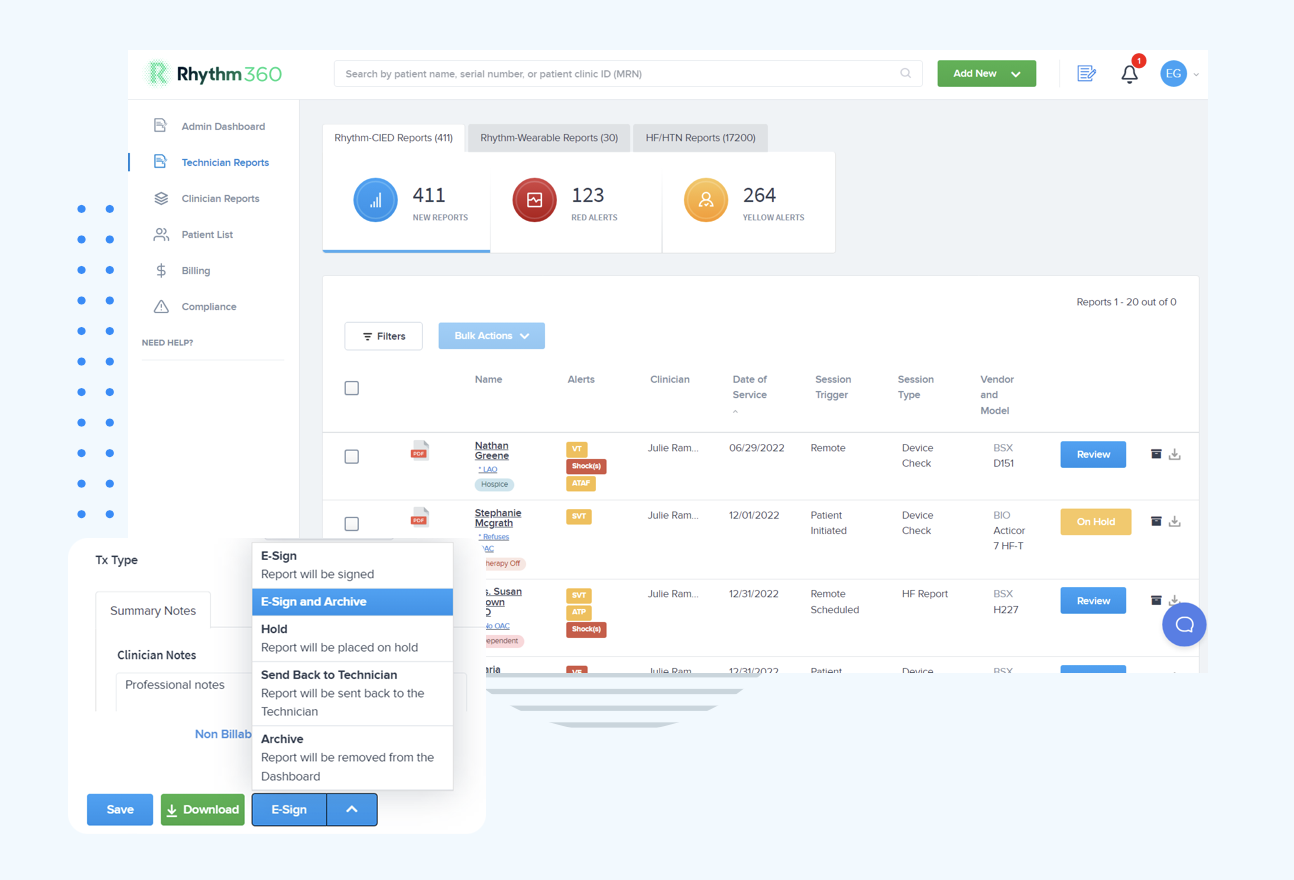
Schedule a demo to see how automated pacemaker report generation works inside Rhythm360.
This section explains how Rhythm360 achieves the transmissibility rates and response-time improvements described above by using a six-layer workflow that replaces fragmented manual processes. The following sequence describes the end-to-end workflow from device transmission to signed clinical report.
The table below illustrates the standard fields included in an automated pacemaker report and the associated CPT codes that the documented data supports for billing purposes.
| Report Field | Example Value | Clinical Relevance | Associated CPT Code(s) |
|---|---|---|---|
| Patient Demographics | Name, DOB, MRN, insurance | Required for claim submission and audit documentation | All CIED remote codes |
| Device Type & Manufacturer | Dual-chamber pacemaker, Medtronic | Determines applicable CPT code family | 93294, 93296 |
| Monitoring Period Dates | June 1–July 1, 2026 | Confirms 30-day minimum for pacemaker/ICD billing eligibility | 93294, 93295 |
| Battery/Longevity Status | ERI not reached; estimated 4.2 years remaining | Flags devices approaching elective replacement indicator | 93294, 93296 |
| Lead Impedance Values | RV: 512 Ω, RA: 489 Ω | Detects lead fracture or insulation breach | 93294, 93296 |
| Pacing Percentage | RV pacing: 94% | Informs programming decisions and upgrade candidacy | 93294 |
| Detected Arrhythmias | AF burden: 12% over 30 days | Triggers anticoagulation review; supports clinical interpretation note | 93294, 93296 |
| Clinician Interpretation Note | Signed attestation of device function and findings | Mandatory documentation for professional component billing | 93294, 93295 |
| ICD Shock/ATP Events | 0 shocks; 1 ATP episode | Identifies therapy delivery requiring clinical review | 93295, 93296 |
Accurate CPT code assignment is a prerequisite for reimbursement in remote CIED monitoring. The 2026 billing landscape includes both long-standing device-specific codes and newly introduced remote physiologic monitoring codes.
The primary CIED-specific codes are:
The 2026 AMA CPT update also introduced new remote physiologic monitoring codes relevant to practices managing heart failure and hypertension alongside CIEDs:
Audit-ready documentation for device supply codes requires written patient consent, a physician order with medical necessity, automated transmission logs confirming qualifying data days, and linked ICD-10 diagnosis codes. Rhythm360's automated report generation captures and organizes this documentation at the point of transmission, which reduces the administrative burden of claim preparation.
The operational difference between manual multi-portal workflows and a unified automated platform is measurable across clinical, staffing, and financial dimensions.
| Metric | Manual Multi-Portal Workflow | Automated Platform (Rhythm360) |
|---|---|---|
| Alert response time | Hours to days depending on staff availability and weekend coverage | Significant reduction in critical alert response times compared with manual workflows |
| Data transmissibility | Variable, dependent on individual OEM portal uptime and staff retrieval | Aligned with the greater than 99.9% rate reported for high-volume Rhythm360 users |
| Revenue capture | Incomplete CPT documentation leads to missed and rejected claims | Up to 300% increase in revenue generation through more complete CPT capture |
| Report volume scalability | Limited by staff headcount and manual entry capacity | Scales to the volume demonstrated at University of Chicago Medicine |
| Device advisory identification | Dependent on manufacturer notifications with gaps in affected patient lists | Automated platforms can identify additional affected patients missing from manufacturer advisory lists, enabling timely clearance for highest-risk patients |
| Weekend and after-hours coverage | Staffing gaps and technician turnover create coverage failures | 24/7/365 optional CCT oversight with mobile sign-off capability |
The clinical impact extends beyond operational metrics. Clinicians at University of Chicago Medicine reported the ability to address issues earlier, calling patients in for evaluation instead of waiting for a 3-month visit. This shift from reactive to proactive care directly reduces adverse event risk.
Platform selection for automated pacemaker report generation shapes long-term clinical and financial outcomes.
Vendor neutrality is the foundational requirement. Practices that implant devices from more than one manufacturer, such as Medtronic, Boston Scientific, Abbott, and Biotronik, cannot rely on any single OEM portal to provide a complete patient population view. A vendor-neutral platform ingests data from all manufacturers into a single normalized record, which eliminates the fragmented login problem and the data silos that accompany it.
AI alert filtering determines whether a platform reduces or compounds alert fatigue. Systems that surface every transmission as an actionable notification shift the burden of triage back to clinical staff. Effective AI triage filters non-actionable transmissions while escalating clinically significant events with sufficient context for immediate decision-making.
Mobile workflow capability is a practical requirement for after-hours and weekend coverage. A HIPAA-compliant mobile application that supports report review, annotation, and sign-off removes the dependency on physical workstation access during time-sensitive events.
Implementation timeline affects how quickly benefits appear. Rhythm360's onboarding process, including EHR integration setup, typically takes from a few days to a few weeks, which reduces disruption to existing clinical operations.
Common pitfalls in platform selection include underestimating the cost of fragmented logins across OEM portals, accepting alert fatigue as an unavoidable condition, and overlooking missed billable events when evaluating total cost of ownership. Practices that have implemented Rhythm360 report improved billing accountability and a more integrated review of data from trained personnel as direct outcomes of consolidation.
Other platforms in the cardiac device management space address portions of the remote monitoring workflow. Practices evaluating options should assess each platform's data ingestion breadth, AI triage methodology, EHR integration depth, and billing documentation capabilities against their specific patient population and operational requirements.
Post-implementation measurement should span three domains to capture the full return on a platform investment.
Clinical metrics to track include:
Operational metrics to track include:
Financial metrics to track include:
Fragmented OEM portals, manual data retrieval, and incomplete CPT documentation are not inevitable features of cardiac device management. They reflect workflows that predate modern automation capabilities. In 2026, automated pacemaker report generation represents a clinically validated, operationally measurable, and financially material improvement over the status quo.
Rhythm360 delivers a unified platform that ingests data from all major CIED manufacturers, normalizes it with greater than 99.9% transmissibility, applies AI-powered triage to reduce alert fatigue, generates structured reports mapped to CPT billing requirements, integrates bi-directionally with major EHR systems, and enables mobile review and sign-off from anywhere. The result is faster response to critical events, reduced administrative burden on clinical staff, and improved capture of billable monitoring activity.
Automated pacemaker report generation is a software-driven process in which a platform continuously ingests transmission data from cardiac implantable electronic devices, normalizes it across manufacturers, applies clinical logic to triage alerts, and produces structured clinical reports without requiring staff to manually log into individual OEM portals. In a manual workflow, a device technician or clinical staff member must access separate portals for each manufacturer, including Medtronic, Boston Scientific, Abbott, Biotronik, and others, retrieve data individually, reconcile discrepancies, and manually enter findings into the EHR. Automated platforms eliminate these steps by consolidating all data into a single normalized record, generating reports in near-real time, and writing completed reports directly back to the patient's chart via EHR integration. The practical effect is a significant reduction in staff time per report, faster identification of critical events, and more complete CPT billing documentation.
Remote pacemaker monitoring in 2026 is billed primarily under CPT 93294 for professional interpretation for single- or dual-chamber pacemakers and CPT 93296 for the technical component for pacemaker, ICD, or ILR monitoring. ICD monitoring uses CPT 93295 for the professional component. All three codes require a minimum 30-day monitoring period in a calendar year and a documented clinician interpretation note addressing device function, programmed parameters, and any actionable findings. Required documentation also includes patient demographics, device type and manufacturer, and the dates of the monitoring period. For practices managing heart failure or hypertension patients alongside CIED patients, the 2026 CPT updates introduced CPT 99445 for 2–15 days of remote physiologic monitoring device supply and CPT 99470 for 10–19 minutes of treatment management services per month, which expand billing eligibility for shorter monitoring windows. Rhythm360's automated report generation captures and organizes this documentation at the point of transmission, supporting audit-ready claim preparation.
AI-powered alert triage evaluates each incoming transmission against a set of clinical thresholds and learned patterns to classify alerts as actionable or non-actionable before they reach clinical staff. Non-actionable transmissions, such as routine checks with no abnormal findings or minor parameter fluctuations within expected ranges, are filtered or deprioritized. Clinically significant events, including new-onset atrial fibrillation, ventricular tachycardia, lead impedance anomalies, ERI/RRT indicators, or significant AF burden changes, are escalated with the contextual data needed for immediate clinical decision-making. The key distinction from simple threshold-based alerting is that AI triage incorporates patient-level context and multi-parameter pattern recognition, which reduces the proportion of false-positive alerts that contribute to fatigue. Rhythm360's AI triage system aligns with the response-time improvements and data reliability reported for high-volume users, supported by redundant data feeds that prevent transmission gaps from creating blind spots in the monitored population.
Rhythm360's implementation process, including EHR integration setup, typically takes from a few days to a few weeks depending on the complexity of the practice's existing infrastructure and the EHR systems in use. Rhythm360 supports bi-directional integration with Epic, Cerner, Athenahealth, eClinicalWorks, Greenway Health, and other systems via HL7 v2, FHIR R4, and CDA formats. The platform's integration layer handles data normalization and format transformation, so practices do not need to modify their existing EHR configuration to receive automated pacemaker reports in the correct chart location. The onboarding process is designed to minimize disruption to ongoing clinical operations, and the SaaS-based pricing model scales with clinic size and platform usage, which avoids large upfront implementation fees.
Practices implementing Rhythm360 have documented faster response times for critical patient alerts and substantial increases in revenue generation through more complete CPT code capture, improved staff efficiency, and the addition of new remote physiologic monitoring service lines. At the clinical level, the shift from manual to automated workflows enables earlier identification of device abnormalities and arrhythmias, allowing clinicians to intervene before a scheduled follow-up visit rather than discovering issues at a 3-month appointment. At the operational level, consolidating all OEM data into a single platform reduces the administrative burden on device technicians and clinical staff, decreasing the risk of burnout and improving staff retention. At the financial level, automated documentation of monitoring periods, transmission logs, and clinician interpretation notes supports more complete and defensible CPT billing, reducing claim denials and capturing previously missed billable events across the monitored patient population.





