Last updated: September 21, 2026
See How Rhythm360 Strengthens Cardiology Revenue
Cardiology billing automation works across four layers, and each one closes a specific revenue gap.
Front-End Clearance: This layer automates real-time insurance verification and prior authorization tracking for cardiac imaging (stress tests, echocardiography) and EP procedures (ablation, device implantation). It matters because prior authorization is a top operational bottleneck: 71% of health system respondents ranked it in their top three. CMS-0057-F, effective January 1, 2026, requires impacted payers to decide standard prior authorization requests within 7 calendar days and expedited requests within 72 hours. Catching authorization gaps here prevents CO-15 and CO-197 denials before they occur.
Mid-Cycle Coding: This layer uses AI-assisted assignment of complex cardiovascular CPT and ICD-10 codes, including EP ablation coding, modifier and bundling edits, and cardiology-specific coding expertise that generalist billers lack. Computer-assisted coding can cut coding errors by 30 to 40 percent and accelerate coder throughput 2 to 3 times.
Back-End Scrubbing: This layer applies predictive edits that flag high-risk claims before submission, including denial prevention logic for device-type mismatch denials and professional or technical component splits. Advanced claims scrubbing tools use payer-specific rule engines that include commercial vs. Medicare vs. Medicaid logic, plan-level variations, and MAC-specific LCD enforcement.
Device Integration: This layer automates ingestion of remote cardiac monitoring data from CIEDs and converts device transmissions into billable events. Rhythm360's vendor-neutral platform automates this process across all major manufacturers, which removes multiple OEM portal logins and reduces transcription risk.
The table below shows how each automation layer supports cardiology workflows and which CPT codes it typically affects, so you can spot gaps in your current process.
| Automation Layer | Cardiology-Specific Function | Example CPT Codes |
|---|---|---|
| Front-End Clearance | Prior auth for cardiac imaging and EP procedures | 93306, 93015, 93653 |
| Mid-Cycle Coding | EP ablation coding, modifier application | 93653, 93654, 93656 |
| Back-End Scrubbing | Device-type mismatch prevention, TC/26 splits | 93294, 93295, 93296 |
| Device Integration | CIED data ingestion to billable event | 93297, 93298, 99454, 99457 |
Review Your Four Automation Layers With Rhythm360
Those four layers only work when the platform understands cardiology's billing mechanics. General medicine platforms often miss device-specific rules that govern CIED and RPM reimbursement, so the next evaluation step focuses on cycle and code accuracy.
The 90-Day Pacemaker/ICD Cycle: CPT codes 93294 (pacemaker professional), 93295 (ICD professional), and 93296 (pacemaker or ICD technical) follow a 90-day billing cycle. These codes are reported no more than once every 90 days per qualifying device and should not be reported if the monitoring period is less than 30 days.
The 30-Day Physiologic Monitor And Loop Recorder Cycle: CPT 93297 applies to implantable cardiovascular physiologic monitors, while CPT 93298 applies specifically to subcutaneous cardiac rhythm monitors and implantable loop recorders (ILRs). These codes are device-specific rather than a professional or technical pair. Each is billable once per 30 days and can be billed global, with modifier -26, or with modifier -TC.
Device-Type Mismatch Denials: Using 93295 for an ILR instead of 93297, or billing 93298 for a device it does not apply to, results in automatic denial on payer claim review. Rhythm360 tracks device-specific CPT pairings at the platform level to prevent these denials. When you evaluate vendors, ask directly how they handle device-type CPT matching and whether their logic differentiates by device family.
Seven recurring mistakes account for most cardiology revenue leakage, and automation directly addresses each one.
Use this checklist to compare automated billing support solutions for your cardiology practice.
Cardiology practices must decide how much of the revenue cycle they want to manage internally before selecting a billing support model.
Software-Only Model: This model fits practices with strong internal billing teams that want automation tools while keeping full control. A software-only model works best for practices with a stable, experienced billing team, a clean claim rate above 95%, and a desire for direct control over patient interactions and financial data. The practice owns workflows, staffing, and exception handling.
Service-Bundled Model: This model fits practices that prefer full outsourcing of billing operations. Most outsourced RCM providers charge between 4% and 9% of net monthly collections. The vendor manages coding, claim submission, denial management, and A/R follow-up.
Hybrid Model: This model fits practices that want software plus optional clinical oversight. The practice keeps front-end patient interactions while the vendor supports complex coding, denial documentation, and device data integration. A hybrid model works well for groups with a capable internal leader but limited capacity in specific revenue-cycle functions.
Rhythm360 operates as a hybrid-capable platform with optional 24/7/365 oversight by certified cardiac technicians (CCTs) supervised by physicians, alongside automated billing documentation. This approach lets practices scale oversight up or down based on internal capacity while keeping their existing billing staff in place.
Explore Hybrid Oversight Options With Rhythm360
Three trends are reshaping how cardiology practices think about billing automation and revenue capture in 2026.
AI-Assisted Coding Validation: AI systems now read clinical documentation and suggest CPT, ICD-10, and modifier selections before claims go out. An HFMA/AKASA survey found that 80% of health systems were exploring, piloting, or implementing generative AI for revenue cycle management in 2025. Separately, 74% of health system respondents said they prioritized denial prevention over post-denial recovery, which signals a shift toward catching errors upstream.
Payer-Specific Edit Logic: Advanced scrubbing tools apply payer-specific rule engines that include commercial vs. Medicare vs. Medicaid logic, plan-level variations, and MAC-specific LCD enforcement. Medicare Advantage denial rates in cardiology reached 8.2%, nearly double the 4.4% traditional Medicare rate, with CARC 197 (authorization or pre-certification absent) representing roughly 38% of all Medicare Advantage denials.
Device-Data Integration As A Revenue Line: Remote monitoring has shifted from a clinical convenience to a significant revenue stream. For cardiology practices with large device and monitoring populations, the gap between CMS-allowed billing hours and actual monitoring time can represent hundreds of thousands of dollars in annual uncollected revenue. Practices that automate CIED data ingestion capture billable events that manual workflows miss.
Rhythm360's AI-powered data reliability directly supports these trends, achieving greater than 99.9% transmissibility through redundant data feeds, computer vision, and AI-powered extrapolation. University of Chicago Medicine reviewed more than 73,000 reports annually through Rhythm360 in calendar year 2025, averaging more than 18,000 reports per quarter. This volume demonstrates the platform's scalability for high-volume cardiology remote monitoring. As one UCM clinical leader noted after implementation, "We have improved billing and accountability for our patients after the integration."
Last updated: September 2026
Rhythm360 brings cardiac device data management and complex cardiovascular billing into a single platform, combining vendor-neutral data ingestion, automated CPT code capture, and optional clinical oversight.
The table below summarizes core Rhythm360 capabilities that matter most when you evaluate cardiology billing and device-data platforms.
| Capability | Rhythm360 |
|---|---|
| Vendor-Neutral CIED Integration | Yes, all major OEMs |
| Automated CPT Capture (93294–93298) | Yes |
| Bi-Directional EHR Integration | Epic, Cerner, athenahealth, eClinicalWorks, Greenway |
| Optional CCT Oversight | 24/7/365 available |
Vendor-Neutral Platform: Rhythm360 consolidates CIED and RPM data from Medtronic, Boston Scientific, Abbott, Biotronik, and other manufacturers into a single dashboard. This approach removes multiple OEM portal logins and reduces data silos.
AI-Powered Alert Triage: The platform filters non-actionable noise and prioritizes clinically significant events, which reduces alert fatigue and supports faster responses to critical alerts. As one UCM clinician observed, "Decision support, including AI-assisted decision support, will become increasingly important as data volumes grow."
Automated CPT Code Capture: Rhythm360 automatically tracks device-specific CPT pairings. It manages 90-day cycles for pacemakers and ICDs (93294, 93295, 93296) and 30-day cycles for physiologic monitors and loop recorders (93297, 93298). This approach prevents device-type mismatch denials and captures unbilled technical components, increasing profitability by as much as 300%.
Bi-Directional EHR Integration: Rhythm360 integrates with Epic, Cerner, athenahealth, eClinicalWorks, and Greenway Health so device data and billing documentation flow into existing systems without duplicate entry.
Secure Mobile Access: The HIPAA-compliant mobile app lets clinicians review transmissions, sign reports, and coordinate care from anywhere, which supports continuity of care during on-call coverage.
Turnkey HF/HTN RPM Service Lines: Rhythm360 supports automated billing documentation for CPT codes 99453, 99454, and 99457. Practices can launch remote monitoring services for heart failure and hypertension patients with minimal additional logistics.
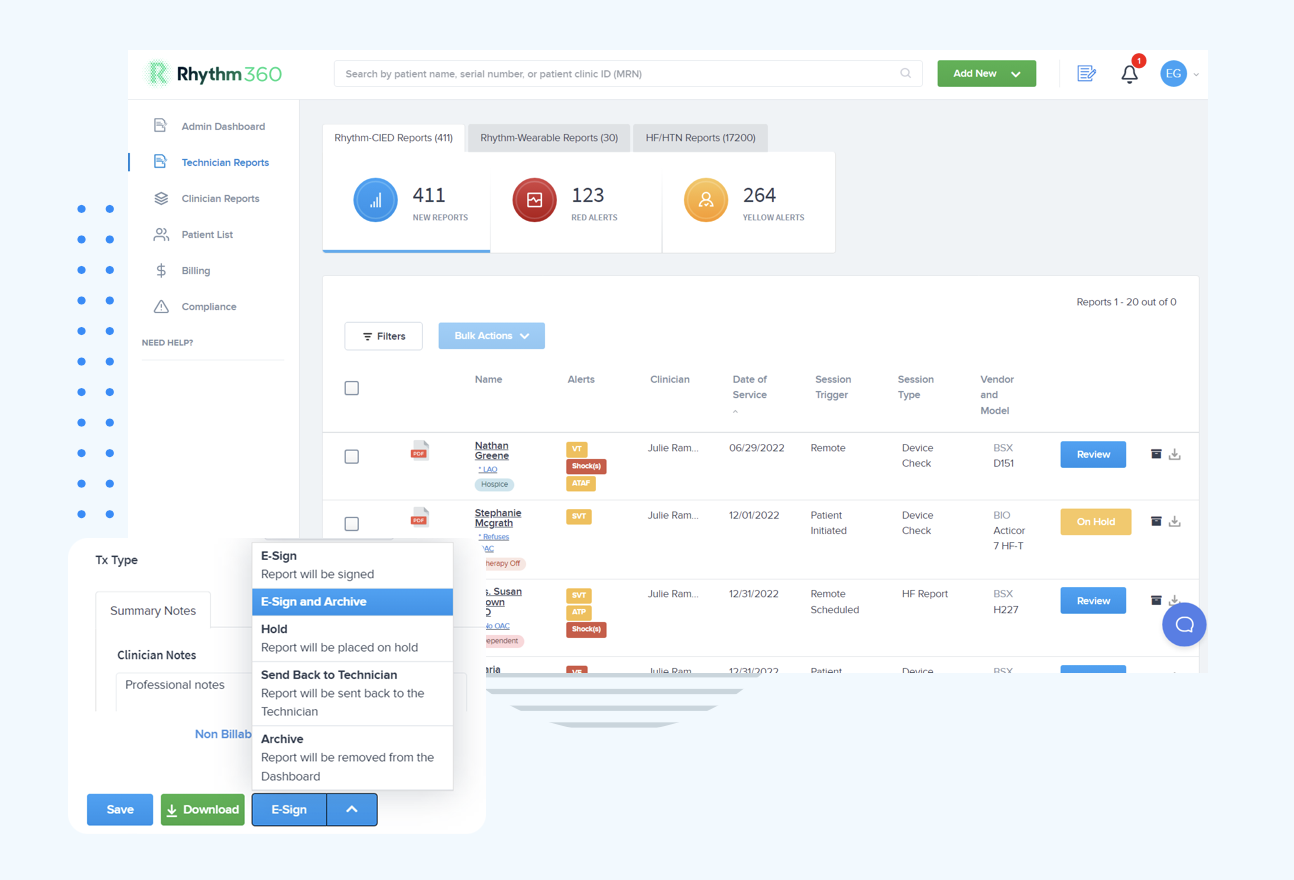
See Rhythm360's Cardiology Workflow In Action
Common billing mistakes in cardiology practices include manual data entry from multiple OEM portals, missed billing cycles for CIED and RPM codes (93294–93298, 99454, 99457), limited prior authorization automation for cardiac imaging and EP procedures, alert fatigue that hides critical events, and revenue leakage from unbilled technical components. Device-type mismatch denials are a particularly costly and preventable error category. Rhythm360 addresses these issues by consolidating device data, tracking billable events, and automating CPT code capture with device-specific pairing logic.
Prior authorization automation for cardiac imaging and EP procedures uses payer-specific rules to identify when authorization is required, assemble clinical evidence, track submission status, and flag expiring authorizations before they cause denials. As noted earlier, CMS-0057-F sets decision timelines for impacted payers, and Rhythm360 helps teams track submissions against those deadlines. The platform streamlines prior authorization tracking, reduces administrative burden, and helps prevent CO-15 and CO-197 denials before procedures occur.
Capturing revenue from CIED and remote patient monitoring billing requires automated tracking of device-specific CPT codes and billing cycles. The 90-day pacemaker or ICD cycle uses codes 93294 (pacemaker professional), 93295 (ICD professional), and 93296 (pacemaker or ICD technical). The 30-day cycle covers implantable cardiovascular physiologic monitors under CPT 93297 and subcutaneous cardiac rhythm monitors and implantable loop recorders under CPT 93298. Each code is billable once per 30 days and can be billed global, with modifier -26, or with modifier -TC. RPM services for heart failure and hypertension use codes 99453, 99454, and 99457. Rhythm360 tracks these codes and generates compliant billing documentation so billable events within each cycle are captured instead of lost.
Leading trends in cardiology billing automation for 2026 include AI-assisted coding validation that suggests CPT and ICD-10 codes before claim submission, payer-specific edit logic that applies commercial vs. Medicare vs. Medicare Advantage rules at the claim level, and the growth of device-data integration as a recurring revenue line. Prior authorization automation has also become a priority as CMS-0057-F and rising Medicare Advantage denial rates increase pressure on practices. Rhythm360's AI-powered data reliability, vendor-neutral CIED integration, and automated CPT cycle tracking support these trends and help practices capture revenue that manual workflows miss.
Cardiology practices see the strongest results when they use integrated platforms that manage multiple layers of billing automation at once, rather than isolated tools for prior authorization, claim scrubbing, or device data consolidation. Fragmented OEM portals, missed CIED billing cycles, and device-type mismatch denials represent structural issues that respond best to unified workflows.
Rhythm360 consolidates CIED and RPM data from all major manufacturers, automates CPT code capture for complex cardiology billing, and delivers the alert-triage capability described earlier. The platform's bi-directional EHR integration, AI-powered workflows, and secure mobile access give teams accurate, actionable data at every point in the care and billing process, supporting the revenue-capture gains described above.
Talk With Rhythm360 About Your Cardiology Revenue Goals