

The RPM billing framework for cardiology centers on several CPT codes: 99453 (initial setup and patient education), 99454 (device supply for 16-30 days), the new 99445 (device supply for 2-15 days), 99457 (first 20 minutes of treatment management), 99458 (each additional 20 minutes), and CIED-specific codes 93298 and 93299. The 16-day rule requires data collection for at least 16 unique days within a 30-day window for CPT 99454, with data automatically uploaded rather than handwritten logs.
The billing flow follows a simple path: device data, AI normalization, automated documentation, and then revenue capture. Complexity increases in cardiology when patients use multiple monitoring devices, transmit on different schedules, and live with co-morbid conditions that require both RPM and Chronic Care Management (CCM) billing. CPT codes 99445 and 99454 are not additive, so providers bill only one based on the number of days of data transmission per 30 days.
Rhythm360’s vendor-neutral platform simplifies this framework by consolidating data from all major CIED manufacturers and physiological monitoring devices into a single source of truth. The platform counts qualifying days accurately and selects the correct CPT code automatically based on real transmission patterns.
Cardiology practices now move from manual OEM portal work to AI-powered automation for RPM billing and monitoring. Traditional workflows force staff to log into separate portals for Medtronic CareLink, Abbott Merlin.net, Boston Scientific Latitude, and Biotronik Home Monitoring, which creates data silos and a heavy administrative load.
Market competitors such as Prevounce and ThoroughCare provide generic RPM tools that lack cardiology-specific capabilities for CIED integration and multi-device patient management. These platforms do not fully support arrhythmia detection workflows, device parameter tracking, or the complex billing rules for patients with both implantable devices and chronic cardiac conditions.
The 2026 move toward AI-driven data normalization closes critical gaps in transmissibility and alert management. Compliance requirements include maintaining device transmission logs for at least 2 days for 99445 and detailed time tracking, which makes manual processes unrealistic for practices monitoring hundreds of cardiac patients.
Rhythm360’s AI-powered platform achieves >99.9% transmissibility using redundant data feeds, computer vision, and intelligent gap-filling algorithms. This performance positions cardiology practices for success as regulatory expectations continue to tighten.
Clear knowledge of each CPT code’s requirements and reimbursement rate supports higher revenue and stronger compliance. The table below summarizes the 2025-2026 billing structure for cardiac RPM:
CPT Code | Requirement | 2026 Reimbursement | Cardiology Example |
99453 | Initial setup | $21.71 | CIED patient education |
99454 | 16-30 days of data | $52.11 | Heart failure daily weights |
99445 | 2-15 days of data | $52.11 | Short post-AFib monitor |
99457 | 20 min management | $52 | Monthly CIED review |
Critical billing rules include the mutual exclusivity of 99445 and 99454, so practices must select one code based on actual transmission days. CMS guidelines specify that RPM and CCM can be billed concurrently when supported by distinct documentation, and CIED monitoring codes 93298 and 93299 can be billed with RPM codes when appropriate.
The proprietary Cardiology RPM Billing Flowchart maps the decision tree for automated and manual billing paths. It highlights the complexity of handling multiple device types, inconsistent transmission patterns, and concurrent chronic conditions. Practices ready to tighten compliance can schedule a demo to see how Rhythm360 automates these billing decisions.
Cardiology practices encounter unique RPM billing challenges due to multiple device manufacturers, varied transmission schedules, and the urgency of cardiac monitoring. Administrative staff feel constant pressure from logging into separate OEM portals, tracking transmission days by hand, and enforcing the 16-day rule while managing alert fatigue from non-actionable notifications.
Missed billing windows create major revenue loss, especially when patients transmit inconsistently or when staff cannot reconcile data across several devices. Clinical risk also rises when teams juggle administrative work while trying to catch critical events such as new-onset atrial fibrillation or device malfunction.
These inefficiencies drive staff burnout, particularly for specialized device technicians who spend large portions of their day on manual data entry and portal navigation. Without a unified dashboard for population health, teams struggle to spot trends, maintain compliance, and capture every eligible billing opportunity.
The choice between manual and automated RPM billing directly affects time, risk, and financial performance. Manual workflows consume significant staff hours for data retrieval, documentation, and claim submission. Automated solutions deliver faster processes, lower error rates, and stronger compliance.
Aspect | Manual Process | Automated (Rhythm360) |
Compliance Risk | High audit exposure | Audit-ready documentation |
Revenue Capture | Significant leakage | Up to 300% increase |
Staff Efficiency | Time-intensive | About 80% time reduction |
Alert Management | Alert fatigue | AI-prioritized alerts |
Build-versus-buy decisions must reflect cardiology’s specific needs, including CIED data integration, multi-device patient management, and cardiac alert triage expertise. EHR integration often adds complexity for practices that attempt in-house development, so vendor-neutral platforms like Rhythm360 usually offer a more practical path.
Rhythm360 solves cardiology RPM challenges with AI-powered data ingestion, automated CPT code documentation, and smooth EHR integration. Computer vision and OCR capabilities reach >99.9% transmissibility by processing diverse data formats from all major CIED manufacturers and physiological monitoring devices.
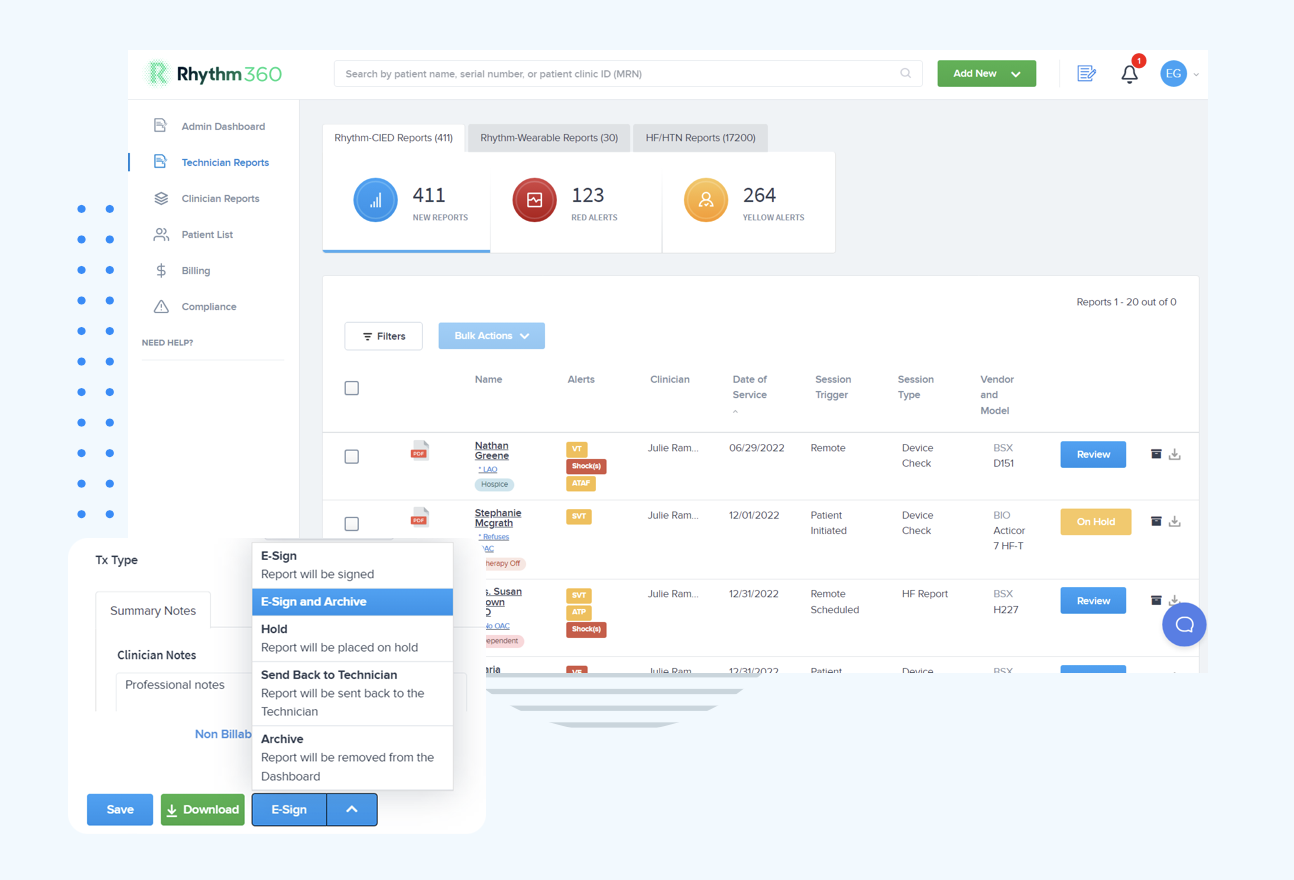
Key capabilities include automated CPT documentation for both 99445 and 99454 based on real transmission patterns, bi-directional EHR sync with Epic and Cerner, and support for CIED, heart failure, and hypertension monitoring. The AI alert triage engine cuts response times for critical events by 80% and filters non-actionable alerts to reduce fatigue.
The mobile application gives clinicians secure, HIPAA-compliant access to review transmissions, sign reports, and coordinate care from any location. Revenue-focused features include automated billing capture, compliance tracking, and detailed reporting that uncovers and recovers previously lost revenue.
Schedule a demo to see how Rhythm360’s automated chronic disease billing can reshape your cardiology revenue cycle and clinical workflows.
Successful RPM automation starts with a clear assessment of patient volume, OEM device mix, and current revenue leakage. Practices should review billing capture rates, staff time spent on manual tasks, and existing compliance documentation to set baseline metrics for improvement.
Rhythm360’s onboarding usually takes days to weeks and includes EHR integration, staff training, and migration of patients from legacy systems. Mobile app deployment gives clinicians immediate access, while vendor-neutral ingestion begins capturing transmissions from all supported device manufacturers at once.
Pre-implementation planning should identify high-priority patient groups, define clinical workflows for alert management, and align with billing staff on new automated CPT generation and submission steps.
Even seasoned cardiology teams often underestimate the difficulty of vendor-neutral data integration and nuanced cardiac alert management. Generic RPM tools rarely meet the demands of CIED monitoring, arrhythmia detection, and multi-device patient oversight that cardiology requires.
OEM data silos continue to slow operations, even for experienced staff, and preparation for 2026 billing changes requires detailed knowledge of cardiac monitoring patterns and evolving compliance rules.
Automated RPM billing systems track data transmission patterns in real time and calculate qualifying days for CPT 99454 (16-30 days) or 99445 (2-15 days). The system stores detailed logs of transmission dates, device types, and data quality to support audit-ready documentation. AI-powered platforms like Rhythm360 connect with all major CIED manufacturers and physiological monitoring devices, remove manual day counting, and lower compliance risk through automated documentation.
Yes, RPM codes such as 99454 and CIED monitoring codes 93298 or 93299 can be billed together when supported by separate documentation and clinical services. RPM covers physiological monitoring such as weight, blood pressure, and activity. CIED codes focus on device functions such as arrhythmia detection, battery status, and lead integrity. Documentation must clearly show distinct clinical value and time for each service.
The main 2026 change introduces CPT 99445 for device supply and data collection over 2-15 days in a 30-day period, reimbursed at the same rate as 99454. This fills prior gaps where shorter monitoring periods did not qualify for billing. CPT 99470 also supports billing for 10-minute treatment management sessions. These updates help cardiology practices that manage patients with variable monitoring needs, medication titration, or short post-procedural observation.
Yes, RPM and Chronic Care Management (CCM) codes can be billed in the same month for one patient when services remain distinct, and documentation reflects that separation. RPM focuses on device-based physiological monitoring. CCM covers broader care coordination, medication management, and care planning. Cardiology teams often combine these services for heart failure patients who need both remote monitoring and intensive care coordination.
Rhythm360 functions as a leading vendor-neutral solution built specifically for cardiology practices. Unlike generic RPM platforms, Rhythm360 integrates with Medtronic, Abbott, Boston Scientific, and Biotronik, provides AI-based cardiac alert triage, and automates CPT selection based on real transmission data. The platform’s >99.9% transmissibility rate, 80% reduction in alert response times, and tight EHR integration make it a strong choice for cardiology practices that want higher revenue and reliable compliance.
The 2025-2026 CMS billing updates create new challenges and new revenue opportunities for cardiology RPM programs. The arrival of CPT 99445 for shorter monitoring periods, combined with the ongoing 16-day requirement for 99454, requires sophisticated automation to maintain compliance and capture every eligible claim.
Rhythm360’s vendor-neutral, AI-driven platform delivers the cardiology-specific capabilities needed to manage this complexity while improving efficiency, compliance, and revenue. Transform your cardiology RPM billing and clinical workflows by scheduling a demo today and see how automated chronic disease billing can elevate your practice operations.





