Last updated: September 30, 2026
See How Rhythm360 Cuts Alert Response Times
Remote heart failure monitoring captures daily weight, blood pressure, heart rate, and SpO2 from non-invasive devices. In selected NYHA Class III patients, it also captures pulmonary artery pressure via implantable hemodynamic sensors such as CardioMEMS. Together these continuous physiologic signals create a lead-time window between early fluid accumulation and overt decompensation, a window a quarterly office visit cannot provide.
The clinical value of that lead time is best established for implantable hemodynamic monitoring. The CHAMPION trial (Abraham et al., 2011) enrolled 550 NYHA Class III patients with a prior HF hospitalization. At 6 months, the pulmonary artery pressure-guided group saw a statistically significant 30% reduction in HF hospital readmissions versus standard care (HR 0.72; 95% CI 0.60–0.85; p=0.0002). Andrew Beaser, MD, Associate Professor of Medicine at the University of Chicago Medicine, described the practical result after implementing Rhythm360: “We are able to address these issues earlier; rather than waiting for a 3-month visit, we can call patients in for evaluation.”
The evidence base carries important caveats. CMS characterized the broader evidence for intensive tele-management approaches to heart failure as remaining in a state of equipoise, while separately determining that the evidence is sufficient to cover implantable pulmonary artery pressure sensors for heart failure management under Coverage with Evidence Development, and the 2022 ACC/AHA HF guidelines describe its usefulness as uncertain in selected patients. Earlier detection only translates into better outcomes when staff review the data and act on it, which requires a defined triage and escalation workflow.
Earlier detection only matters when it prevents the decompensation it is meant to catch. Remote heart failure monitoring is associated with reduced hospitalizations, and the magnitude and consistency of that reduction depend on the technology used and the patient population enrolled. Practices should evaluate evidence by technology type rather than treating all remote monitoring as equivalent.
For implantable hemodynamic monitoring, the evidence is strongest. Beyond the CHAMPION trial, the CardioMEMS Post-Approval Study (Shavelle et al., 2020; n=1,200) found HF-related hospitalization rates significantly lower at one year compared with the year before implantation (0.54 vs. 1.25 events/participant-year; HR 0.43; p<0.0001). The MONITOR-HF trial (Brugts et al., 2023; n=348) similarly showed significantly fewer HF-related hospitalizations in the CardioMEMS group versus standard care (HR 0.56; p=0.005).
For non-invasive telemonitoring, a 2026 meta-analysis of 15 RCTs (n=8,043) published in the Journal of Public Health found no statistically significant reduction in HF-specific admissions (OR 0.74; 95% CI 0.55–1.01; p=0.05) but a significant 27% relative reduction in cardiovascular mortality (HR 0.73; 95% CI 0.56–0.95; p=0.021). Hospitalization reduction depends on patient selection, adherence, and timely clinical intervention. For more on selecting the right approach, see Best Practices for Remote Monitoring in Heart Failure.
Remote heart failure monitoring accelerates GDMT optimization by giving clinicians daily vitals, weights, and symptom data between visits. These data support titration decisions that would otherwise wait for the next scheduled appointment. Standardized telemonitored titration protocols compress the time to optimal therapy and reduce the clinical inertia that delays dose escalation in routine care.
The TELEFASTER-HF study, published in Open Heart (2026) by Hamah Saed, Winstedt Thomas, and colleagues at the University of Gothenburg and Sahlgrenska University Hospital, compared a standardized home-based telemonitored GDMT titration strategy (n=60) against a standard-of-care cohort (n=65). The telemonitored group showed increased achievement of ≥50% target dosing, with 43% on all four GDMT drug classes at target doses at 6 months. Median time to optimal medical therapy was 48 days in the telemonitored cohort versus 321 days in standard care (HR 16.1; 95% CI 8.3–31.2; p<0.001). The study authors caution that hospitalization findings remain exploratory pending adequately powered prospective randomized trials, but the GDMT titration signal is robust and consistent across multiple timepoints.
A defined operating model is what turns remote heart failure monitoring technology into outcomes. Practices that achieve the clinical and financial benefits described in this article run a repeatable six-step loop that converts raw patient data into documented clinical action.
The loop matters because each step depends on the one before it. A threshold alert has value only when staff review it, and an intervention supports quality reporting only when documented. The six steps are:
Staffing roles across this loop typically include RNs for initial triage, APPs for medication titration decisions, and CCTs for device-specific data interpretation. The way those roles divide the work determines how the loop handles volume. If alert management and escalation protocols are poorly defined, the same staff who should be triaging critical events end up buried in non-actionable notifications. Disadvantages of Remote Patient Monitoring for Heart Failure covers that failure mode in detail.
Rhythm360 is the vendor-neutral, AI-powered platform that consolidates data from all major device manufacturers into a single dashboard, supports alert triage, and reduces critical alert response times by up to 80%. Optional CCT oversight is available for practices that need 24/7/365 coverage. University of Chicago Medicine reviewed more than 73,000 reports annually through Rhythm360 in calendar year 2025, averaging more than 18,000 reports per quarter. That volume demonstrates the scalability of a well-structured operating model.
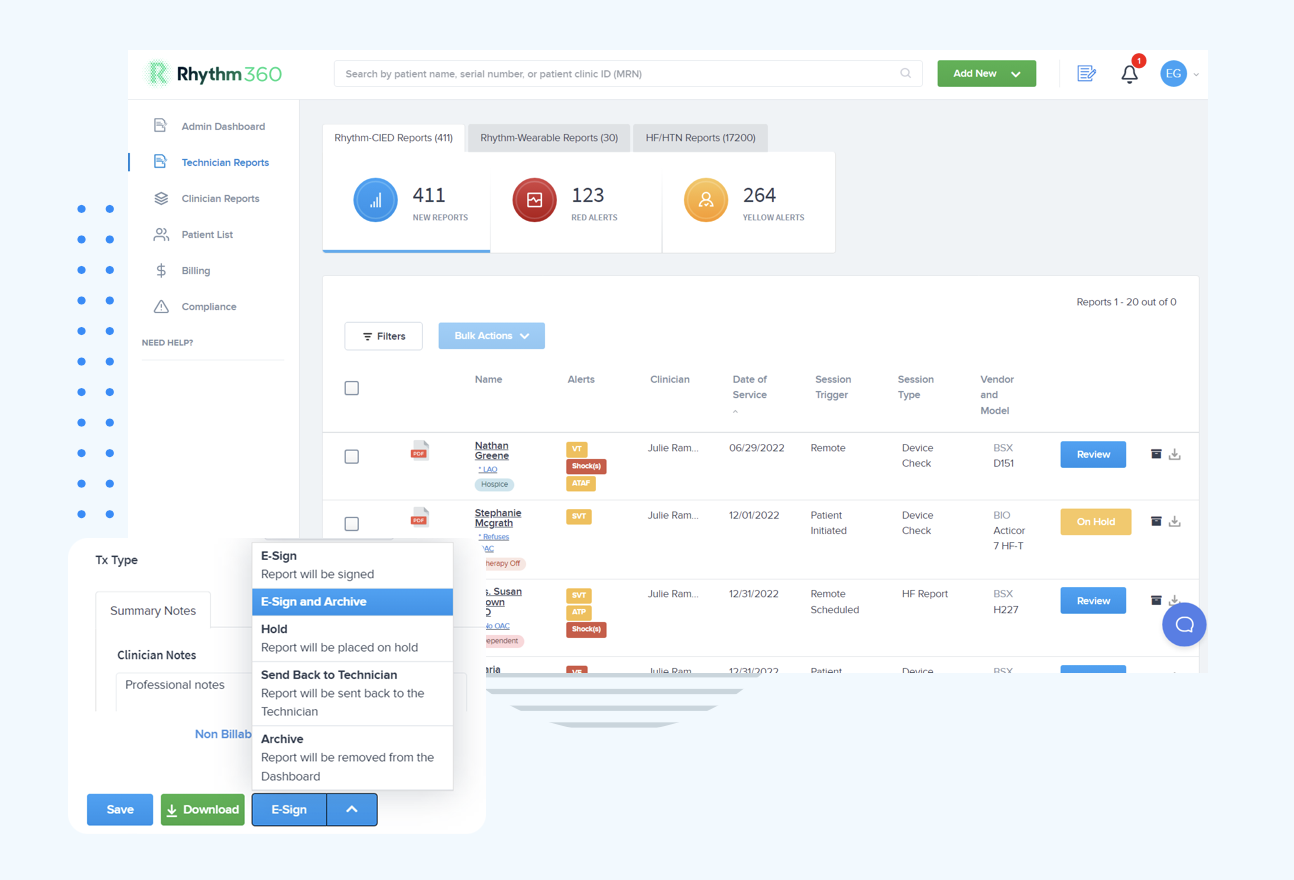
See How Rhythm360 Supports A Six-Step Operating Loop
The operating model described above only survives when the revenue it generates covers the staff and platform it requires. That connection makes reimbursement the next question for every practice.
CMS covers remote patient monitoring (RPM) for both chronic and acute conditions when the patient uses an FDA-defined medical device that digitally uploads data and transmits at least 2 days every 30 days. Connected blood pressure cuffs, weight scales, pulse oximeters, and cardiac implantable electronic devices all qualify. Medicare began covering remote patient monitoring in 2018, and CMS reports that the number of patients receiving RPM has increased significantly each year since then.
CMS defines three components of RPM: education and setup, device supply, and treatment and management, each paid separately at the same rate regardless of device type. Practices must deliver all three components to capture the full reimbursement available.
Each component maps to its own CPT code, so a gap in any one of them shows up as missing revenue:
These are device-specific codes. Code 93297 applies to physiologic monitors and 93298 applies to rhythm monitors; they do not form a professional and technical pair.
Documentation requirements for audit readiness follow the FCSO RPM documentation checklist (updated September 2, 2026). The checklist requires:
Practices that close documentation gaps consistently capture more of the revenue the program generates. As Gaurav A. Upadhyay, MD, at the University of Chicago Medicine observed after implementing Rhythm360: “We have improved billing and accountability for our patients after the integration.” Rhythm360's automated CPT code capture and documentation support helps practices recover previously lost revenue, with profitability increases of up to 300% reported by clients.
Patient selection and technology fit determine how much clinical and financial value a remote heart failure monitoring program delivers. Matching the monitoring modality to the patient's clinical profile is the first operational decision a practice makes, and it shapes every downstream outcome.
Non-invasive monitoring using connected weight scales, blood pressure cuffs, and pulse oximeters is appropriate for a broad HF population, is lower cost, and requires no procedure. It is the entry point for most RPM programs and supports GDMT titration, symptom tracking, and early decompensation detection. That same 2026 meta-analysis found the greatest HF admission reduction with non-invasive telemonitoring in patients with a history of a single prior admission, suggesting non-invasive telemonitoring is most effective earlier in the disease course.
Implantable hemodynamic monitoring via CardioMEMS is indicated for individuals who have undergone hospitalization for NYHA Class III heart failure in the past year, with FDA approval expanded in February 2022 to include NYHA Class II heart failure. The evidence for hospitalization reduction is stronger in this population, but the 2022 ACC/AHA guidelines characterize its usefulness as uncertain, and CMS currently covers it only under Coverage with Evidence Development. For a detailed device-by-device comparison, see Best Remote Heart Failure Monitoring Devices 2026 Guide.
A well-run remote heart failure monitoring program generates measurable practice performance data such as readmission rates, GDMT achievement rates, alert response times, and CPT capture rates. These metrics connect directly to quality reporting requirements and population health goals.
The 2024 ACC/AHA HF quality measure update adds new performance and quality measures tied to GDMT optimization. These include initiation in hospitalized patients and optimization prior to intervention for chronic secondary severe mitral regurgitation. The measures focus on GDMT initiation and optimization and do not explicitly address structured follow-up or readmission prevention. Practices that run the operating loop described in Benefit 4 accumulate the documentation and outcome data needed to demonstrate performance on these measures. Remote monitoring also supports pre-discharge and early post-discharge follow-up workflows, which the 2024 ESC focused update identifies as a Class I priority for patients hospitalized with heart failure.
Rhythm360 provides a unified view of the HF and CIED patient population, aggregating data across device manufacturers and monitoring modalities into a single dashboard. The operational discipline of unified data, alert triage, escalation, and documentation converts population-level monitoring into measurable quality outcomes.
The benefits above raise practical questions about cost, profitability, and operational risk. The answers below address the three most common concerns practices raise before launching a program.
Program costs vary by patient volume, device mix, staffing model, and platform. On the revenue side, practices bill separately for device setup, monthly device supply, and monthly treatment management under the RPM CPT code set, plus device-specific codes for implantable monitors. On the expense side, costs include the monitoring platform, device procurement or rental, and staff time for triage and documentation. Practices that capture all billable CPT codes with complete documentation consistently report that reimbursement covers program operating costs, and the margin depends on documentation discipline and the efficiency of the operating model. No standardized national cost figure exists because program design varies significantly across practice types and patient populations.
Remote patient monitoring can be profitable, and profitability follows the same pattern as hospitalization reduction. The practices that achieve the strongest financial returns consistently bill all three RPM components (setup, device supply, and treatment management), maintain audit-ready documentation for every 30-day period, match CPT codes to the correct device class, and manage alert volume efficiently enough that staff time per patient remains predictable. Practices that rely on manual workflows, miss the 16-day transmission threshold for CPT 99454, or fail to document interactive communication for CPT 99457 leave significant reimbursement uncaptured. Platform automation that tracks transmission days, flags documentation gaps, and generates compliant reports directly affects whether the program runs at a margin or at a loss.
Alert fatigue is the most consistently reported operational disadvantage of remote patient monitoring. When monitoring platforms generate high volumes of non-actionable notifications, clinical staff spend time reviewing alerts that do not require intervention, which erodes efficiency and can cause genuinely critical alerts to be deprioritized or missed. The mitigation is a combination of well-defined alert thresholds calibrated to the patient population, a tiered escalation protocol that routes alerts to the appropriate staff level, and AI-powered triage that filters non-actionable noise before it reaches the clinical queue. Practices that implement these protocols report significantly lower per-alert review times and higher confidence that critical events are not being missed.
Practices can assemble the components of a remote heart failure monitoring program individually, including devices, staff, billing codes, and documentation templates. The operational discipline of unified data from all device manufacturers, consistent alert triage, defined escalation protocols, audit-ready documentation, and reliable CPT capture determines whether those components produce results. Rhythm360 is the vendor-neutral, AI-powered platform that operationalizes that discipline in a single dashboard, from the first patient transmission to the signed report and submitted claim.
See Rhythm360 In A Remote HF Workflow Demo