Last updated: September 25, 2026
Schedule a Demo with Rhythm360
Symptom frequency is the primary driver of arrhythmia monitoring modality for most patients. Start with the clinical question, then match the device to how often symptoms occur.
These four device categories form the core toolkit for ambulatory arrhythmia monitoring. The table below links each category to wear duration, review timing, and symptom pattern so you can see how modality follows symptom frequency at a glance.
| Device Category | Wear Duration | Review Timing | Best For |
|---|---|---|---|
| Holter Monitor | 24–48 hours | After wear period | Daily or near-daily symptoms |
| Patch Monitor | 7–14 days | Asynchronous | Symptoms several times a month |
| Mobile Cardiac Telemetry | Up to 30 days | Near-real-time | Sparse or unpredictable symptoms |
| Implantable Loop Recorder | Up to 3 years | Asynchronous with alerts | Rare, infrequent, or cryptogenic events |
FDA-cleared ambulatory ECG patch monitors, such as the AT-Patch ECG Analysis System (K203638), are intended for continuous long-term ECG recording of up to 14 days, though the FDA clearance covers the recording function and the device itself does not include automated ECG analysis. The iRhythm Zio XT Patch is a widely cited example in payer policies as a continuous recording device with longer recording periods. Patch strengths include extended wear time, patient comfort, and high diagnostic yield. The trade-off is delayed review because data is analyzed after the wear period instead of in real time.
MCT devices provide near-real-time detection with 24/7 attended surveillance, and the receiving station must be staffed on a 24-hour basis with at least an EKG technician who has immediate access to a physician. Examples include Philips MCOT and iRhythm Zio AT. These systems excel at real-time alerting for critical events and support high-risk patients who need rapid intervention. They carry higher costs and require attended monitoring infrastructure, which practices must plan for.
ILRs are subcutaneous devices implanted for long-term cardiac rhythm monitoring, typically for up to 3 years, though newer devices and battery life can allow monitoring for 4 to 6 years. Examples include Medtronic Reveal LINQ and Abbott Confirm Rx. ILRs offer the longest monitoring duration and capture rare events that external monitors miss. They require an implantation procedure and fit specific clinical scenarios, so most practices reserve them for targeted use.
The patch versus MCT choice shapes both clinical responsiveness and operational workload. Payer policy distinguishes asynchronous continuous recording devices such as the Zio XT from mobile cardiac outpatient telemetry devices such as the Zio AT and CardioNet MCOT, which transmit ECG-triggered and patient-selected events to a remote attended surveillance center.
The distinction starts with wear duration and review timing. Patch monitors typically wear for 7–14 days with asynchronous review after the wear period, while MCT devices can run up to 30 days with near-real-time transmission. That timing difference determines when data becomes actionable, because asynchronous systems identify critical events only after device return, and near-real-time systems route events immediately to an attended surveillance center for rapid clinical response.
Staffing requirements also diverge. Near-real-time systems require 24/7 attended monitoring stations staffed with at least an EKG technician who has immediate access to a physician, and answering services or automated computer-dialed relays do not satisfy this requirement. Practices need to confirm whether they will staff this function internally or partner with a service.
Symptom pattern and urgency then complete the decision. Patch monitors align with symptoms that occur several times a month and tolerate retrospective review. MCT fits sparse or unpredictable symptoms when clinical urgency calls for same-day notification and intervention.
Practice management and integration platforms turn raw device transmissions into usable clinical information and billable documentation. These systems consolidate data from multiple manufacturers, streamline workflow, and connect directly to the EHR.
Rhythm360 is a vendor-neutral, HIPAA-compliant, cloud-based remote patient monitoring platform. It ingests and normalizes data from major CIED manufacturers such as Medtronic, Boston Scientific, Abbott, Biotronik, and others into a single source of truth. The platform serves cardiology practices, electrophysiology clinics, and integrated health systems that manage patients with cardiac implantable electronic devices and chronic conditions.
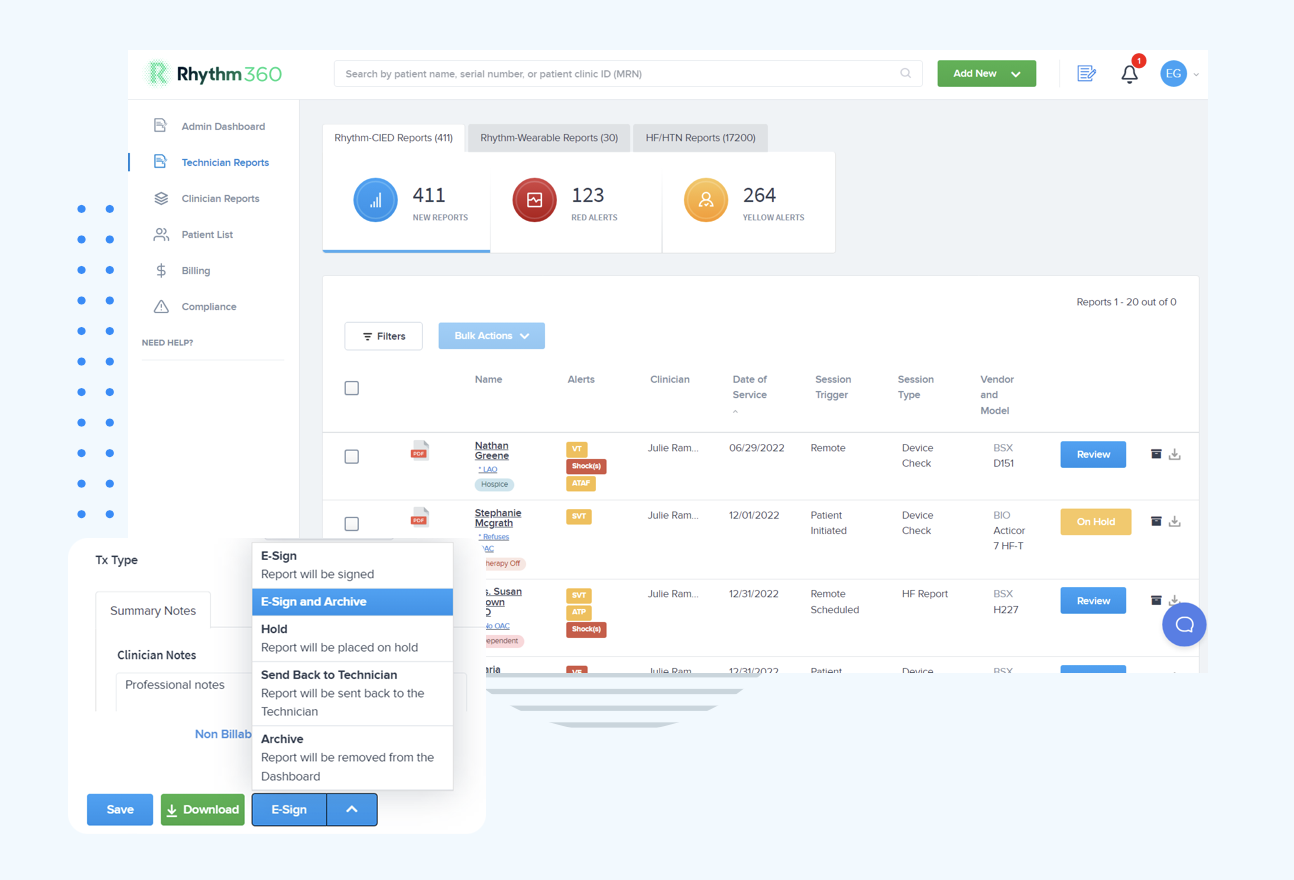
Key capabilities include:
University of Chicago Medicine reviewed more than 73,000 reports annually through Rhythm360 in calendar year 2025, averaging more than 18,000 reports per quarter. “We have improved billing and accountability for our patients after the integration.”
See Rhythm360’s Vendor-Neutral Platform in Action
Rhythm360 operates in a broader ecosystem of cardiac device management platforms. Practices performing due diligence will also encounter options such as Murj, Implicity, Rhythm Management Group, and Octagos, and should evaluate each against their workflow, integration, and billing requirements.
EHR integration and CPT billing mechanics form the operational backbone of an arrhythmia monitoring program. Addressing these elements before contract signature prevents workflow disruption and revenue loss later.
Cardiac monitoring platforms typically connect to EHR systems through three primary methods:
Rhythm360 offers bi-directional integrations with Epic, Cerner, Athenahealth, eClinicalWorks, Greenway Health, and others via HL7. The onboarding process, including integration setup, usually takes from a few days to a few weeks. The limited ability to integrate cardiovascular digital biomarker data into electronic medical records has been identified as a key gap in the field, so platform interoperability now functions as a core requirement rather than an afterthought.
CPT capture for arrhythmia monitoring follows two distinct billing cycles that map to different device types.
90-Day Cycle (Pacemakers and ICDs):
30-Day Cycle (Physiologic Monitors and Loop Recorders):
Practices that inherited a 90-day billing calendar from pacemaker and defibrillator codes underbill 93298 badly: twelve reporting periods a year become four. Rhythm360’s automated CPT code capture and documentation helps practices align billing with device type and cycle length, which can increase profitability by as much as 300%.
Data ownership and interoperability determine how easily a practice can use, retain, and migrate its monitoring data. Evaluating these factors early prevents vendor lock-in and unexpected switching costs.
Key evaluation criteria include:
Those criteria all depend on whether the platform supports open standards. Adherence to standardized communication protocols such as HL7, FHIR, and IEEE 11073 ensures interoperability and consistent data exchange in connected ECG and monitoring systems. A vendor-neutral platform like Rhythm360 builds on these standards to consolidate data from all manufacturers into a single source of truth and reduce reliance on any single OEM portal.
Consumer ECG wearables enhance patient engagement and symptom documentation but do not replace medical-grade ambulatory monitoring. PPG-based smartwatch AF detection is vulnerable to motion artifacts, ambient light interference, ectopic beats, and poor signal quality, and wearables only measure during active wear time, so they can miss episodes and provide an incomplete estimate of AF burden.
An AF diagnosis requires at least 30 seconds of AF on a single-lead or continuous ECG tracing reviewed by a clinician. Consumer alerts alone do not meet that bar, so clinician-reviewed ECG tracings must guide treatment decisions. Practices can position wearables as tools for early signal and patient education while reserving diagnostic weight for medical-grade devices.
Arrhythmia monitoring decisions work best when practices follow a clear framework that connects symptom patterns, operational capacity, and financial impact. The criteria below provide a practical checklist.
Device and platform choices should be made together so the practice builds a coherent monitoring algorithm instead of chasing a single “best” device in isolation.
Explore How Rhythm360 Fits Your Monitoring Workflow
The most effective device depends on symptom frequency and the specific clinical question. For daily symptoms, a 24–48 hour Holter monitor provides comprehensive assessment. For symptoms occurring several times a month, a 7–14 day patch monitor captures arrhythmias that shorter monitoring would miss. For sparse or unpredictable symptoms that require near-real-time detection, 30-day mobile cardiac telemetry is appropriate. For rare or cryptogenic events, an implantable loop recorder is warranted. Current AF guidance requires a clinician-reviewed ECG tracing to establish an AF diagnosis, so device selection should always support clinician interpretation.
The choice between patch and MCT comes down to urgency and symptom pattern. If symptoms occur often enough that a retrospective read is acceptable, a patch offers a simpler path. If a critical event needs a same-day response, MCT’s attended surveillance makes that response possible. The full breakdown appears in the Patch vs. MCT section above.
CPT codes 93294, 93295, and 93296 apply to pacemakers and implantable defibrillators on a 90-day billing cycle. Code 93294 is the professional component for pacemaker systems, 93295 is the professional component for defibrillator systems, and 93296 is the technical component covering remote data acquisition, technician review, and distribution of results for both pacemaker and ICD systems. CPT codes 93297 and 93298 are device-specific codes that each run on a 30-day billing cycle. Code 93297 covers implantable cardiovascular physiologic monitors such as CardioMEMS, and 93298 covers subcutaneous cardiac rhythm monitors such as implantable loop recorders. Each of 93297 and 93298 is billable once per 30 days and can be billed global, with a -26 modifier for the professional component, or with a -TC modifier for the technical component.
Consumer wearables cannot replace medical-grade ambulatory monitoring. Current AF guidance requires a clinician-reviewed ECG tracing to establish an AF diagnosis. PPG-based smartwatch AF detection is vulnerable to motion artifacts, ambient light interference, ectopic beats, and poor signal quality, and wearables only measure during active wear time, so they can miss episodes and provide an incomplete estimate of AF burden. Consumer alerts can prompt evaluation, but clinician-reviewed ECG tracings must guide treatment decisions.
A cardiology practice should evaluate any cardiac monitoring platform against six operational criteria: vendor neutrality across major CIED manufacturers, bi-directional EHR integration via HL7 or FHIR, automated CPT code capture that correctly maps device type to billing cycle, AI-powered alert triage that reduces non-actionable notifications, data ownership provisions including raw ECG export and retention policies, and scalable staffing support such as optional CCT oversight. Practices that consolidate these capabilities into a single platform reduce administrative overhead, close billing gaps, and lower the risk of missing clinically significant events.
Arrhythmia monitoring works best when device selection and platform selection move together as one strategy. Practices that separate those choices often end up juggling fragmented OEM portals, chasing billing gaps, and worrying about missed critical events.
Rhythm360 brings device data from all major CIED manufacturers into a single source of truth, automates CPT code capture across both 90-day and 30-day billing cycles, and applies AI-powered alert triage to speed clinical response and strengthen revenue capture. The high-volume programs already running on Rhythm360, including the academic center cited earlier, show how this consolidation scales in real practice.
Talk with Rhythm360 About Your Monitoring Program