

Last updated: July 13, 2026
The Heart Rhythm Society's April 2026 Scientific Statement on AI Integration in Clinical Electrophysiology Workflows defines clear requirements for platforms used in clinical care. Clinic leaders can evaluate any arrhythmia monitoring platform against these seven criteria.
The tables below show how RhythmScience's current Rhythm360 platform aligns with these seven criteria. Data comes from published implementation evidence and platform specifications.
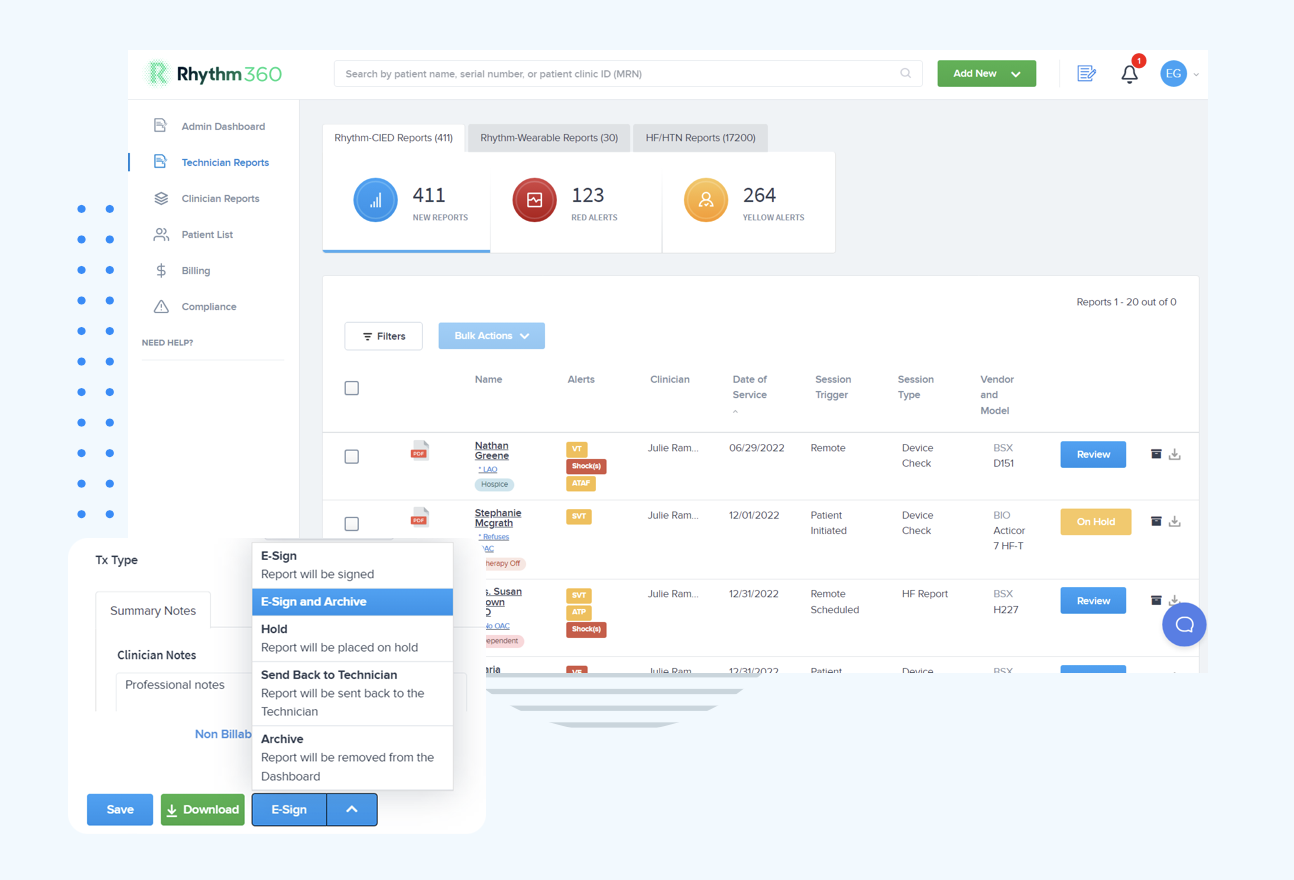
| Capability Area | Rhythm360 (Current) |
|---|---|
| Data Ingestion | Vendor-neutral ingestion via API, HL7, XML, and AI-powered computer vision OCR for unstructured PDFs, with redundant data feeds for OEM server downtime and >99.9% transmissibility. |
| Alert Handling | AI-powered alert triage that filters non-actionable events, optional 24/7/365 CCT oversight, and up to 80% reduction in critical alert response times. |
| EHR Integration | Bi-directional integration with Epic, Cerner, Athenahealth, eClinicalWorks, Greenway Health, and others via HL7, with onboarding in days to weeks. |
| Billing Documentation | Automated CPT code capture and documentation for 93298, 93299, 99453, 99454, and 99457, with up to 300% improvement in revenue capture through automated CPT code documentation for these remote monitoring codes. |
| Operational Feature | Rhythm360 (Current) |
|---|---|
| Mobile Access | Secure, HIPAA-compliant mobile app for transmission review, report signing, and care coordination. |
| Chronic Condition Management | Integrated Rhythm-CIED and HF/HTN RPM service lines, CardioMEMS PA monitor support, and turnkey patient onboarding. |
| Scalability | Validated at enterprise scale: University of Chicago Medicine processed over 73,000 reports annually in 2025, averaging more than 18,000 reports per quarter. |
Practice administrators and cardiology service directors see the strongest impact in staff time recovery, billing accuracy, and compliance visibility. When a practice implants devices from several OEMs, staff otherwise log into separate portals and manually reconcile data. Rhythm360 consolidates all OEM data into one dashboard, which removes redundant logins and manual transcription.
The administrative view surfaces real-time metrics on patient compliance, critical alert status, and captured versus potential revenue based on CPT requirements. Billing outcomes track directly with documentation completeness. As Gaurav A. Upadhyay, MD, FACC, FHRS, Professor of Medicine and Director of the Pacing & Defibrillation Device Clinic at the University of Chicago Medicine, noted, “We have improved billing and accountability for our patients after the integration.” Automated CPT documentation removes the manual work that causes missed claims and rejected submissions, so practices capture revenue that previously went undocumented.
This reduction in manual documentation burden also addresses a critical operational challenge: staff burnout and turnover. Staff retention improves when monitoring workloads become more sustainable. Dr. Upadhyay explained that “staffing was always an issue for our center, because our device clinic — like many other medical centers — had struggled with technician turnover and timely weekend coverage.” A centralized platform with optional CCT oversight reduces reliance on a single super-user and spreads monitoring work across the team.
Andrew Beaser, MD, Associate Professor of Medicine at the University of Chicago Medicine, described pre-implementation workflows as “a major challenge and incredibly difficult.” After Rhythm360 went live, clinicians reviewed more transmissions each day and identified more abnormalities. Dr. Beaser reported, “We are able to address these issues earlier; rather than waiting for a 3-month visit, we can call patients in for evaluation.”
AI triage drives much of this change. Real-world AI deployments in cardiovascular care show 15–25% reductions in diagnostic errors and 20–30% faster emergency intervention times. Remote monitoring systems that use AI can flag heart failure exacerbations early, which supports proactive interventions and fewer hospitalizations. In the LINK-HF trial, an AI-enabled wearable chest patch predicted impending heart failure hospitalizations and provided early warning before decompensation.
Mobile access closes the final gap between detection and action. A critical arrhythmia flagged on a Saturday morning can lead to anticoagulation initiation or device reprogramming that same afternoon. That outcome depends on a clinician's ability to review and act on data away from the office. Rhythm360's HIPAA-compliant mobile app enables that response without a return to a specific workstation.
Schedule a demo to see how Rhythm360 supports your clinical team's on-call workflows.
Implementation timelines often slow platform decisions, so Rhythm360 focuses on rapid onboarding. EHR integration and configuration typically complete in days to weeks rather than months. The SaaS-based pricing model scales with clinic size and usage, which avoids the high upfront costs of on-premise legacy systems.
Vendor-managed maintenance removes infrastructure burdens such as software updates, server management, and revalidation cycles. The 2026 HRS Scientific Statement requires robust failure behavior and data integrity, including monitoring, revalidation, and recalibration. Rhythm360 addresses these requirements through redundant data feeds and continuous AI model oversight.
Scalability extends from solo practices to large health systems. The University of Chicago Medicine implementation mentioned earlier demonstrates this scalability in practice. The same architecture supports small clinics and integrated delivery networks, with pricing and configuration tuned to each environment.
The Heart Failure Society of America emphasized in 2025 that better outcomes depend on seamless data flow among devices, EHRs, and care teams. That standard shapes how leaders should view total value of ownership. Platforms that require manual reconciliation between systems add hidden labor costs that do not appear in license fees but show up as staff hours, billing errors, and missed events.
Practice size and workflow complexity guide the ideal Rhythm360 configuration. Clinic leaders can use the following framework to align platform features with their operational profile.
Practices that plan to add HF or HTN RPM service lines should favor platforms with integrated chronic condition management. Rhythm360's Rhythm-CIED and HF/HTN service lines share a single workspace, which removes the need for a separate RPM vendor and the related integration work.
Data reliability forms the foundation of any arrhythmia monitoring platform. Rhythm360 achieves greater than 99.9% transmissibility through redundant data feeds, AI-powered computer vision for unstructured PDF reports, and automated gap detection. If an OEM server experiences downtime, the redundant feeds maintain data capture. The platform cross-references multiple sources to flag discrepancies before they reach the clinical dashboard, so clinicians can trust that the data guiding decisions is complete and accurate.
Rhythm360 supports bi-directional integration with Epic, Cerner, Athenahealth, eClinicalWorks, Greenway Health, and other systems via HL7. Integration and onboarding usually complete in days to weeks. Vendor-managed implementation means the practice's IT team does not need to maintain the integration after go-live. Data flows in both directions, with device data populating the EHR automatically and relevant EHR context appearing in the Rhythm360 dashboard without manual entry.
Revenue improvement from a unified platform comes from recovering previously missed billable events and reducing claim rejections caused by incomplete documentation. The revenue improvements noted earlier stem from these two sources. Automated CPT documentation also supports new RPM service lines for heart failure and hypertension, which create recurring revenue without proportional increases in staff time. Rhythm360 strengthens billing and revenue performance through these documentation capabilities.
Alert fatigue in CIED monitoring arises because most OEM-generated alerts are nonactionable, yet the volume makes it hard to spot urgent events. Rhythm360's AI triage filters nonactionable transmissions and surfaces clinically significant events such as new-onset atrial fibrillation, ventricular tachycardia, lead malfunction, and ERI/RRT indicators with prioritized notifications. Optional 24/7/365 oversight by certified cardiac technicians, supervised by physicians, adds human review for high-acuity alerts. The result is the dramatic response-time improvement described earlier, with clinicians receiving fewer but more relevant notifications instead of every transmission.
Rhythm360 supports both CIED monitoring and chronic condition RPM within one environment. Distinct but integrated service lines for Rhythm-CIED and for heart failure and hypertension remote physiological monitoring share a single clinical workspace. A device technician or NP can manage pacemaker transmissions and daily weight readings from a CardioMEMS device or connected scale without switching platforms. The HF/HTN service line includes patient onboarding checklists, automated messaging through an integrated communication hub, and billing support for relevant RPM CPT codes, so practices can launch RPM programs inside the same Rhythm360 environment they already use.
The 2026 arrhythmia monitoring platform choice centers on vendor-neutral data ingestion, AI alert triage, bi-directional EHR integration, automated CPT documentation, mobile access, fast implementation, and proven outcomes. Rhythm360 addresses each requirement in a single cloud-based platform that has been validated at enterprise scale and configured for practices of every size.
The mobile cardiac telemetry market continues to move from episodic Holter testing toward continuous rhythm surveillance with EHR-connected service layers. Practices that build unified monitoring infrastructure now will scale more easily without adding proportional overhead. The ACC's Health Care Innovation Council describes a future where data analytics consolidate large volumes of remote monitoring data into clear, actionable recommendations, and Rhythm360 is built to meet that standard.
Clinic administrators and EP directors in 2026 can apply a clear framework when they evaluate platforms. Evidence from real-world implementations, including the University of Chicago Medicine experience, shows what a unified, AI-enabled platform delivers in practice: earlier interventions, stronger billing accountability, and a monitoring program that scales without breaking clinical workflows.





