Last updated: July 13, 2026
CPT 93298 covers remote interrogation of subcutaneous cardiac rhythm monitor systems (implantable loop recorders) with physician analysis and report. Consistent capture requires a platform that authenticates with every major OEM portal, including Medtronic CareLink, Abbott Merlin.net, Boston Scientific Latitude, and Biotronik Home Monitoring, on a scheduled basis. The platform must pull transmissions, normalize them into a single triage queue, and pair each remote interrogation event with its specific 90-day billing cycle to correctly assign codes 93296, 93297, or 93298.
Manual workflows break down at scale. A typical 1,000-patient mixed-vendor panel captures only 60–75% of billable 99454 device-supply months and 50–65% of billable 99457/99458 management time when staff rely on separate manufacturer portals plus manual EHR documentation. That gap results in $180,000–$320,000 annual revenue leakage per 1,000 patients before stacking implantable cardiac device codes such as 93297/93298. The 2026 valuation update for CPT 93296 can generate additional revenue for CIED monitoring programs when the 90-day billing window is tracked automatically.
Rhythm360 automates this entire chain from transmission to claim. Its AI-powered data ingestion layer normalizes transmissions from all major OEMs into a single dashboard, generates patient-by-patient claim previews with supporting documentation, and flags exceptions for OIG audit readiness. Practices using Rhythm360 have achieved up to 300% more revenue through optimized CPT code capture.
Cardiac device billing runs on two distinct cycles that must stay in sync. A 30-day window governs RPM supply codes (99454, 99445), and a 90-day window governs CIED remote interrogation codes (93296–93298). Missing either window forfeits the claim entirely. The single most common reason for 99454 denials is missing the 16-day transmission threshold within each 30-day billing period, which prevents billing the device supply code and blocks associated 99457/99458 claims.
CMS introduced CPT 99445 on January 1, 2026, to close the all-or-nothing gap. This code allows billing for 2–15 days of readings at roughly the same ~$52 monthly rate as 99454. Revenue cycle platforms must select only one device-supply code per patient per 30-day period based on actual transmission days, using 99454 for 16–30 days and 99445 for 2–15 days.
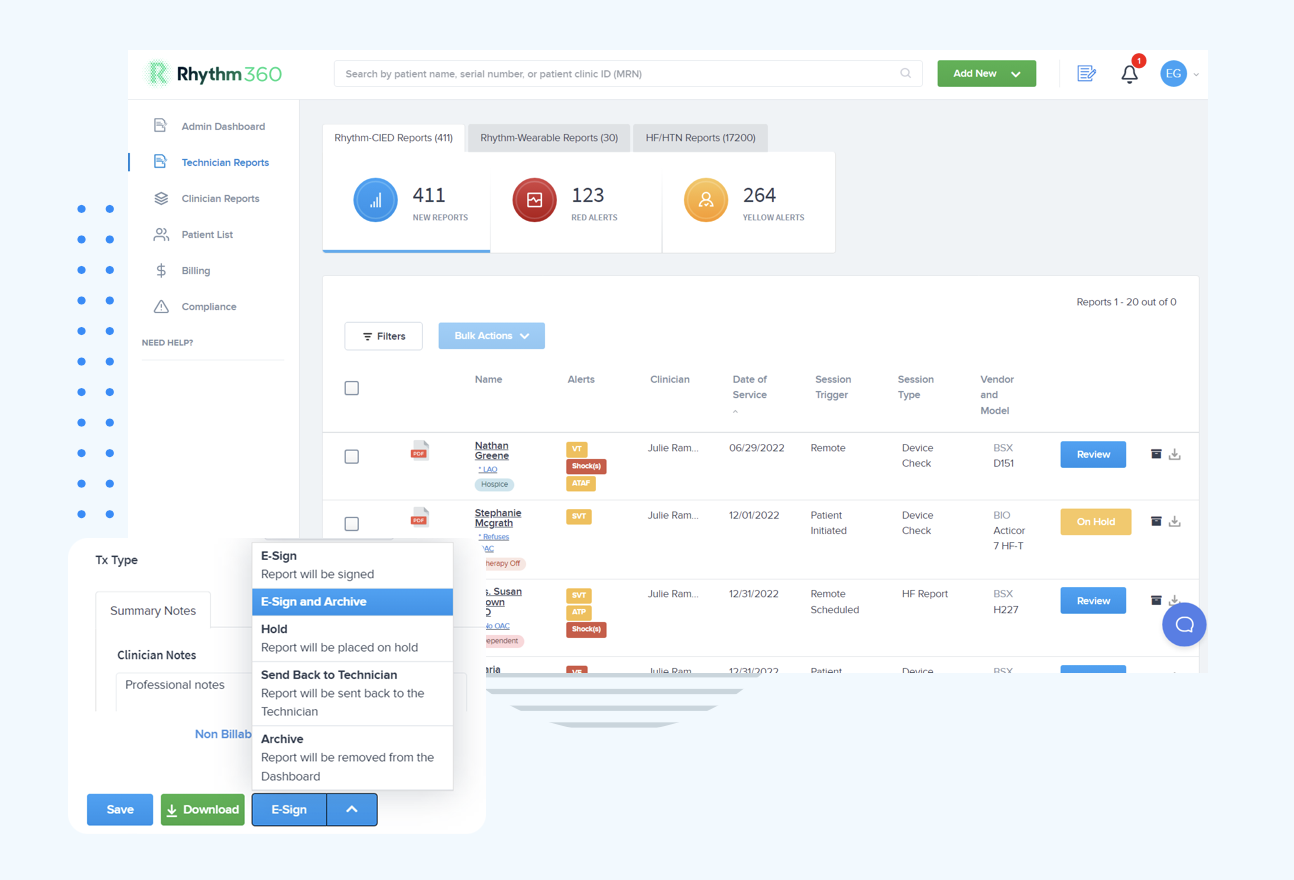
Rhythm360 enforces both windows through a real-time administrative dashboard. The dashboard surfaces each patient’s transmission day count, flags patients at risk of falling below the 16-day threshold before the billing period closes, and generates compliant claim-line documentation as a byproduct of the clinical workflow. Practices no longer need a manual calendar system or a dedicated billing analyst to track window compliance across hundreds of patients.
Practices implanting devices from more than one OEM face immediate data fragmentation. Staff must log into separate, non-interoperable portals for Medtronic, Boston Scientific, Abbott, and Biotronik, which creates administrative silos and transmission gaps that directly reduce billable event capture. Remote monitoring revenue leakage usually stems from gaps in engagement and connectivity rather than billing-end errors. When organizations fail to actively pull data or ensure patient transmissions, they lose both clinical visibility and the ability to bill.
Best-practice multi-vendor integration uses a single vendor adapter per OEM platform. That adapter performs structured EHR write-back and deterministic claim-line generation while keeping the EHR as the system of record. Tools that unify data into a single workflow across vendors are essential for proactive monitoring, securing revenue to fund infrastructure, and improving multi-vendor device management in cardiovascular service lines.
Rhythm360 delivers this integration through API, HL7, XML, and PDF parsing via computer vision, achieving >99.9% transmissibility with redundant data feeds and AI-powered extrapolation. University of Chicago Medicine (UCM) reviewed more than 73,000 reports annually through Rhythm360 in calendar year 2025, which demonstrates the platform’s capacity to handle high-volume, multi-vendor environments without transmission failures. Other platforms address portions of the multi-vendor challenge, but none have published comparable transmissibility figures or volume outcomes at this scale.
Alert fatigue creates both patient safety risk and billing compliance risk. When staff feel overwhelmed by non-actionable notifications, they delay or miss clinically significant transmissions, which breaks the documentation chain required for compliant CPT billing. The most frequent denial reason across RPM, CCM, BHI, and PCM programs is insufficient time documentation, because generic notes like “reviewed chart” are not enough. Each program requires time logs with date, duration, and specific activity descriptions.
Automated alert triage supports billing compliance by ensuring every clinically significant event generates a timestamped, structured record that feeds the CPT documentation workflow. Rhythm360’s AI-powered alert triage system filters non-actionable noise, prioritizes events such as new-onset AFib, ventricular tachycardia, and device malfunction, and reduces critical response times by up to 80%. Each triage action produces an auditable log that satisfies CMS 2026 revised time documentation guidance for 99457 and 99458.
“We have improved billing and accountability for our patients after the integration,” noted a clinical leader at University of Chicago Medicine following Rhythm360 implementation. The connection between alert triage quality and billing accountability is direct. Faster, structured responses produce better documentation, and better documentation produces cleaner claims.
Learn how Rhythm360’s alert triage engine supports compliant CPT documentation for cardiac device monitoring with a focused workflow review.
Better documentation through automated alert triage directly affects denial rates. The average cardiology practice denial rate stands at 10–15%, while well-managed practices achieve rates below 5% through improved front-end workflows and coding controls. For cardiac device monitoring specifically, the most common denial triggers are preventable with the right platform infrastructure.
Common causes of RPM and CIED claim denials include:
Rhythm360 addresses each of these at the workflow level. Its month-end claim preview engine generates patient-by-patient exception flags before submission, covering transmission day counts, consent records, time logs, and code pairing rules. Practices that move from manual denial management to automated workflows can see stronger denial prevention and improved recovery rates.
The cost of fragmented OEM portal management extends far beyond software licensing. Staff hours spent on manual data retrieval, portal logins, and billing documentation create significant and often unmeasured overhead. Manual time logs for cardiology RPM programs can cause lost billable 99457/99458 minutes. Large patient panels managed with manual workflows often leave substantial revenue on the table in under-captured RPM revenue.
Implementation speed also affects total cost of ownership because faster deployment enables faster revenue recovery. Rhythm360’s onboarding process, including EHR integration with Epic, Cerner, Athenahealth, eClinicalWorks, and others via HL7, typically takes only a few days to a few weeks. Comparable full-featured cardiology RCM deployments often require several weeks. AI RCM platforms reach payback within 12–14 months on average for healthcare organizations.
Rhythm360’s SaaS-based pricing scales with clinic size and platform usage, which removes high upfront setup fees. By consolidating multi-OEM data into a single dashboard, the platform reduces reliance on specialized “super-user” staff and protects against business continuity risk when key personnel leave. Revenue cycle automation also reduces billing staff time spent on routine denial follow-up and shifts roles toward higher-value exception handling.
Clear, specific questions during vendor evaluation help identify platforms that deliver quantified outcomes instead of vague promises. Use the following questions to compare options side by side:
Rhythm360 answers every one of these questions with published outcomes, including >99.9% transmissibility, automated 99454/99445 selection, real-time 90-day window tracking, EHR integration in days to weeks, and the revenue lift mentioned earlier combined with 80% faster critical alert response. Get answers specific to your practice’s device mix and patient volume in a one-on-one session.
Rhythm360 is a vendor-neutral platform that ingests and normalizes data from all major OEM portals, including Medtronic, Boston Scientific, Abbott, Biotronik, and others, into a single dashboard. Its AI-powered data reliability layer achieves the same greater than 99.9% transmissibility mentioned earlier through redundant data feeds, computer vision, and AI-powered extrapolation. Unlike single-vendor or manually operated systems, Rhythm360 automates CPT code capture, enforces 30- and 90-day billing windows, and generates OIG-ready documentation as a byproduct of the clinical workflow. These capabilities enable practices to capture up to 300% more revenue while reducing critical alert response times by up to 80%.
Rhythm360’s implementation process, including bi-directional EHR integration with systems such as Epic, Cerner, Athenahealth, and eClinicalWorks via HL7, typically takes from a few days to a few weeks. This timeline is significantly faster than the timelines common for full-featured cardiology RCM deployments. The streamlined onboarding process minimizes clinical productivity disruption and accelerates time to revenue recovery.
Rhythm360 tracks daily transmission compliance per patient across each 30-day billing period. At the close of each period, the platform’s claim engine evaluates actual transmission day counts and selects the correct device-supply code, using CPT 99454 for 16 or more days or the new CPT 99445 for 2–15 days. This logic ensures no billable month is forfeited due to the prior all-or-nothing threshold. Patients at risk of falling below the 16-day threshold appear in the dashboard before the billing period closes, which gives staff time to intervene.
Rhythm360 supports both CIED monitoring and chronic disease RPM within one workspace. The platform offers distinct but integrated service lines for Rhythm-CIED, which covers pacemakers, ICDs, implantable loop recorders, CRT/CCM devices, and CardioMEMS pulmonary artery monitors, and for HF/HTN Remote Physiological Monitoring. Both service lines share a centralized workspace, unified alert triage, and automated billing support for the full relevant CPT code set, including 93296–93298 for CIED and 99453, 99454, 99445, 99457, and 99458 for RPM. Practices can launch a new RPM service line for heart failure and hypertension patients with minimal logistical overhead using Rhythm360’s turnkey onboarding checklists.
Rhythm360 provides a secure, HIPAA-compliant mobile application that allows clinicians to review transmissions, sign reports, and coordinate care from their smartphones at any time. This capability is particularly valuable for after-hours and weekend coverage, when delayed response to critical alerts such as new-onset AFib or ventricular tachycardia can result in adverse patient outcomes. All mobile actions are logged with a full audit trail within the patient record, which supports both clinical accountability and billing documentation requirements.
Fragmented OEM portals, manual CPT workflows, and missed billing windows represent solvable infrastructure problems. Rhythm360 by RhythmScience consolidates multi-vendor CIED and RPM data into a single AI-powered platform, automates CPT capture across the full 93296–93298 and 99453–99458 code families, enforces 30- and 90-day billing windows in real time, and delivers bi-directional EHR integration in days to weeks. The outcomes are quantified, including the revenue improvements and response time reductions documented throughout this article, and transmission reliability greater than 99.9% demonstrated at the UCM scale described earlier. Find out exactly how much revenue your cardiac device monitoring program is leaving on the table with a customized Rhythm360 analysis.