Last updated: September 21, 2026
See Rhythm360 In A Live Walkthrough
Generic feature lists rarely predict whether a platform will improve your practice’s operations. Each criterion below maps to a specific operational failure mode that costs cardiology practices time, staff, and revenue.
Vendor-neutral data aggregation means the platform ingests data from every major OEM, not just one. It does so through APIs, HL7, XML, and PDF parsing. Practices managing patients with devices from more than one manufacturer cannot function on a single-OEM portal. Data latency and connectivity gaps are structural problems in remote monitoring, and redundant data feeds provide the most reliable mitigation.
AI alert filtering with optional CCT oversight determines whether your staff spends time on actionable events or drowns in noise. Alert interpretation models are not standardized across platforms, and inconsistent response strategies have yielded conflicting outcomes across remote monitoring programs.
Bidirectional EHR integration with Epic, Cerner, athenahealth, eClinicalWorks, and Greenway Health via HL7 removes manual transcription from daily work.
CPT automation with audit trails turns billable events into clean claims. Common causes of claim rejection in cardiac RPM programs include undercounted transmission days (fewer than 16), missing or undocumented patient consent, and device connectivity gaps miscounted as compliance.
Implementation timeline sets the pace for return on investment. A deployment measured in months delays revenue and strains staff, while a deployment measured in days or weeks accelerates value.
See How These Criteria Look Inside Rhythm360
EP clinics managing mixed-device populations need aggregation across all four major OEM portals. Medtronic CareLink, Boston Scientific LATITUDE NXT, Abbott Merlin.net, and Biotronik Home Monitoring each operate as closed, manufacturer-specific ecosystems. None natively shares data with the others. Staff maintain separate logins, reconcile conflicting data formats, and manually transcribe findings into the EHR. That workflow does not scale.
For CIED billing, the 90-day monitoring cycle governs reimbursement. The 90-day CIED cycle described in the EHR Integration section below governs reimbursement here as well. Automated CPT pairing prevents device-type mismatches that trigger denials.
Rhythm360 ingests and normalizes data via API, HL7, XML, and PDF parsing with computer vision, achieving greater than 99.9% transmissibility with redundant data feeds as a fail-safe. The platform automates CIED CPT capture with full audit trails. At scale, University of Chicago Medicine reviewed more than 73,000 reports annually through Rhythm360 in calendar year 2025, averaging more than 18,000 reports per quarter. That volume validates the platform’s capacity for high-throughput EP programs. As noted in that implementation, “We have improved billing and accountability for our patients after the integration.”
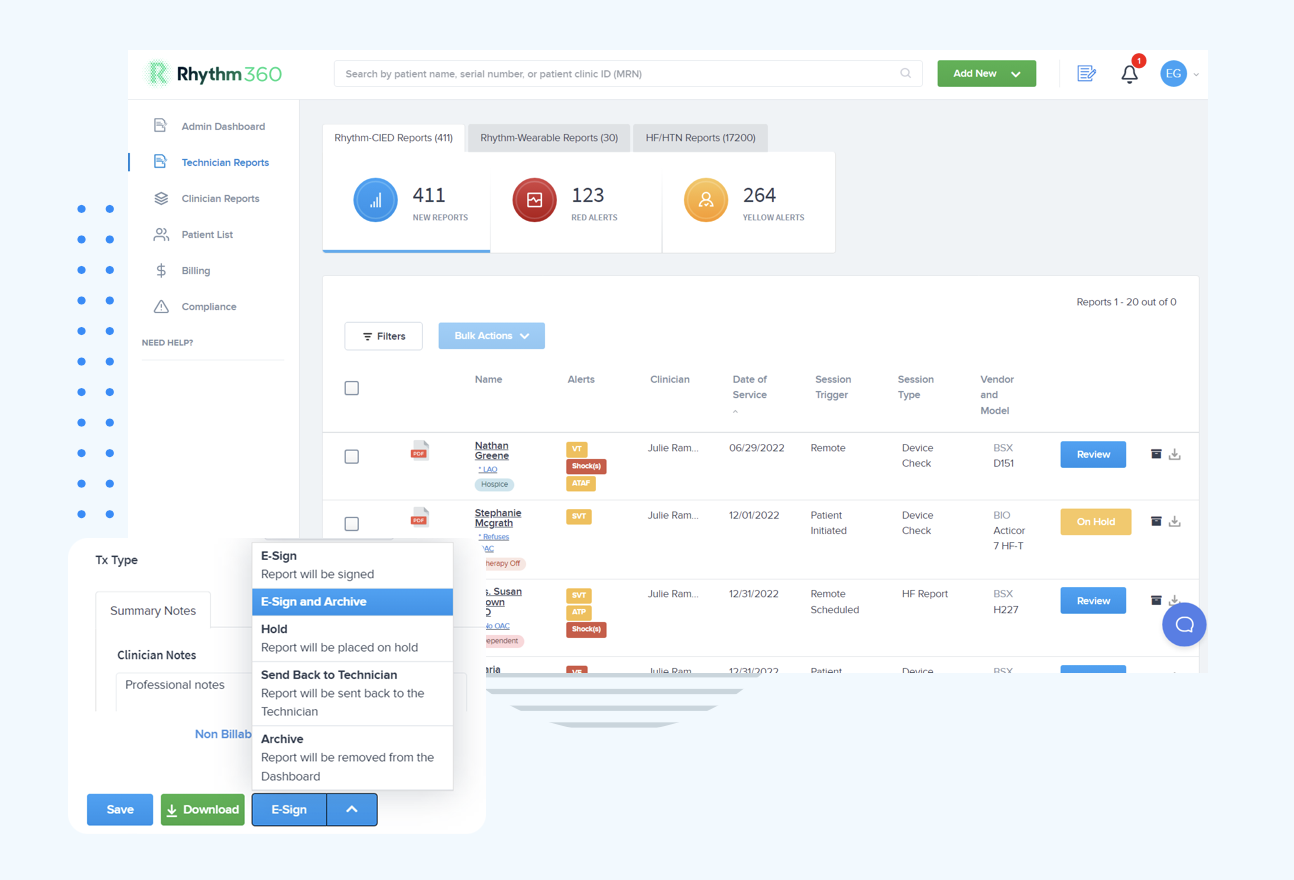
Heart failure programs need integration of implantable hemodynamic data with 30-day physiologic monitoring cycles, weight and blood pressure trend capture, and structured escalation pathways. The billing framework here differs materially from the CIED cycle.
CPT 93297 applies to implantable cardiovascular physiologic monitors such as CardioMEMS, which continuously transmits pulmonary artery pressure data. CPT 93298 applies to subcutaneous cardiac rhythm monitors, including implantable loop recorders and insertable cardiac monitors. Both codes are device-specific, each billable once per 30 days, and each splittable into global, professional (-26), or technical (-TC) components. Confusing 93297 with 93298, or misapplying modifiers, generates denials that erode program profitability.
For physiological RPM, CPT 99453 covers one-time device setup and patient education. CPT 99454 covers the monthly device supply and automated data transmission, and requires 16 or more days of transmission within a 30-day period. CPT 99457 covers the first 20 minutes of remote physiologic monitoring treatment management per calendar month. These codes work together across the patient’s setup, supply, and ongoing management.
The clinical evidence for structured HF remote monitoring is substantial. A 2026 meta-analysis by Surducan et al. in the Journal of Clinical Medicine pooled 16 randomized controlled trials (n = 8,618) and found telemedicine-based strategies significantly reduced HF-related hospitalization (RR 0.68, 95% CI 0.59–0.78; GRADE: high certainty). The same analysis found that benefit depended on intervention intensity and physiological specificity. Hemodynamic-guided monitoring and structured RPM produced robust outcome reductions. Passive telemonitoring alone did not reach statistical significance for mortality.
Rhythm360 offers distinct but integrated Rhythm-CIED and HF/HTN service lines in one workspace, with automated support for 99453, 99454, and 99457. As noted in the University of Chicago Medicine implementation, “Decision support, including AI-assisted decision support, will become increasingly important as data volumes grow.”
General cardiology practices launching RPM programs for hypertension and chronic cardiometabolic conditions need turnkey patient onboarding, device supply tracking, and clean separation of RPM documentation from Chronic Care Management billing. Device supply tracking must align with the 16-day transmission threshold required for CPT 99454.
The 30-day monitoring window for CPT 99454 begins from the date data transmission actually starts, not the date the device shipped or was set up. That distinction causes practices to undercount billable periods when tracked manually. Rhythm360 automates transmission day counting, flags patients approaching the threshold, and generates compliant documentation that supports CPT code capture. Practices implementing Rhythm360 have captured up to 300% more revenue through improved CPT code billing.
The platform’s mobile app allows on-call clinicians to review transmissions and coordinate care from anywhere. This capability reduces the risk that a weekend alert goes unaddressed.
Explore RPM Workflows For General Cardiology
The three scenarios above map to different platform requirements. The table below summarizes which RhythmScience offering fits each scenario and where its limits appear, so you can match your practice profile to the right starting point.
| Platform | Best-Fit Scenario | Key Strengths | Limitations |
|---|---|---|---|
| Rhythm360 (RhythmScience) | CIED/EP clinics, HF programs, and general cardiology practices requiring a unified, vendor-neutral platform across all OEMs and service lines | Greater than 99.9% transmissibility via API, HL7, XML, and computer vision PDF parsing, automated CPT capture for 93294/93295/93296 and 93297/93298, AI-powered alert triage with optional 24/7/365 CCT oversight, bidirectional EHR integration with Epic, Oracle Health/Cerner, athenahealth, eClinicalWorks, and Greenway Health, implementation in days to weeks, up to 80% reduction in critical alert response times | Delivers strongest value in practices with mixed-OEM device populations; practices with a single-OEM patient population may use fewer multi-vendor aggregation capabilities |
| RhythmScience (Legacy/On-Premise Configurations) | Practices evaluating cloud migration from on-premise cardiac data management infrastructure | Established clinical workflow familiarity and a transition pathway to the Rhythm360 cloud platform | On-premise configurations lack cloud-native AI alert triage, automated CPT capture, and real-time bidirectional EHR integration available in Rhythm360 |
Other platforms operate in this category, including Murj, Implicity, Rhythm Management Group, and Octagos, though this guide does not compare their individual processes or features.
That fragmentation starts at the source: the manufacturer portals themselves. For any practice managing patients with devices from more than one manufacturer, the operational reality is fragmented by design. Medtronic CareLink enrolls only Medtronic ICD and CRT patients through its protected web portal. Boston Scientific LATITUDE NXT is regulated as part of Boston Scientific’s ICD ecosystem, not as a multi-vendor repository. Abbott Merlin.net and BIOTRONIK Home Monitoring both operate as closed ecosystems in that each only imports and manages data from its own manufacturer’s implanted devices, though both also offer interoperability features such as EHR export to external systems. Each requires separate credentials, separate logins, and separate data review workflows.
The result is manual transcription, data silos, and administrative overload. Data latency, the lag between device detection and availability at the monitoring center, is a structural problem that perpetuates reliance on in-person visits and delays clinical response.
Rhythm360 addresses this by ingesting and normalizing data from all major OEMs through API connections, HL7 messaging, XML feeds, and PDF parsing via computer vision. Redundant data feeds serve as a fail-safe when an OEM server is unavailable and maintain greater than 99.9% transmissibility across the patient population.
The clinical benefit of remote monitoring depends less on the monitoring technology itself and more on the presence of timely, structured clinical reactions to alerts. Passive monitoring without organized reaction pathways provides limited benefit. Alert fatigue, the desensitization that occurs when staff receive overwhelming volumes of non-actionable notifications, creates a direct patient safety risk when a new-onset AFib event, ventricular tachycardia episode, or device malfunction goes unnoticed.
Multiparametric heart failure algorithms achieve roughly 70% sensitivity, but unexplained alert rates remain non-trivial. AI-based post-processing increasingly plays a central role in reducing false alerts at scale.
Rhythm360’s AI-powered alert triage filters non-actionable noise and prioritizes clinically significant events, reducing critical alert response times by up to 80%. Optional 24/7/365 oversight by certified cardiac technicians (CCTs) supervised by physicians adds another layer of clinical review. The HIPAA-compliant mobile app allows on-call clinicians to review transmissions, sign reports, and coordinate care from any location.
Rhythm360 integrates bidirectionally with Epic, Oracle Health/Cerner, athenahealth, eClinicalWorks, and Greenway Health via HL7. Properly configured RPM documentation can route directly into EHR systems for claims submission, reducing manual re-entry and the transcription errors that generate denials.
The CPT code mechanics that determine program profitability fall into two distinct billing cycles.
The 90-day CIED cycle governs pacemakers and ICDs. CPT 93294 covers the professional component for pacemaker remote interrogation, and CPT 93295 covers the professional component for ICD remote interrogation. CPT 93296 is the technical component applicable to both pacemakers and ICDs. Each is billable once per 90-day period. Device-type mismatch, such as applying 93295 to a pacemaker patient or omitting 93296 when the technical component is performed, is among the most common and preventable sources of revenue loss in CIED programs.
The 30-day physiologic monitoring cycle governs implantable cardiovascular physiologic monitors and subcutaneous cardiac rhythm monitors. CPT 93297 applies to implantable cardiovascular physiologic monitors such as CardioMEMS. CPT 93298 applies to subcutaneous cardiac rhythm monitors, including implantable loop recorders and insertable cardiac monitors. These are device-specific codes, each billable once per 30 days and each splittable into global, professional (-26), or technical (-TC) components.
For physiological RPM programs, CPT 99454 requires 16 or more days of automated device data transmission within a 30-day period, counted from the date transmission begins rather than the date the device shipped. CPT 99453 is a one-time setup code. CPT 99457 covers the first 20 minutes of treatment management per calendar month. The 99457 calendar-month clock does not sync with the rolling 30-day window for 99454. Treating them as aligned creates a common source of mismatched claims.
Rhythm360 automates CPT code capture and documentation across code families, matches device type to the correct code, and helps practices capture up to 300% more revenue.
Any cardiac RPM platform evaluation benefits from a structured checklist that surfaces the operational questions determining real-world fit.
Sustainable RPM deployment requires appropriate staff time, early leadership engagement, and fitting the platform into existing workflows rather than layering it on top of them. Practices that rely on a single “super-user” to operate their RPM platform face a business continuity risk every time that person is unavailable.
Rhythm360’s implementation process, including EHR integration, typically takes a few days to a few weeks. The platform’s intuitive dashboard distributes operational knowledge across the clinical team instead of concentrating it in one role. That design reduces the super-user dependency that creates fragility in RPM programs.
The total value of a cardiac RPM platform includes implementation complexity, training requirements, ongoing maintenance, scalability, and the revenue outcomes the platform enables. A complete financial model must account for denials, unbillable utilization, staff time, and compliance review, not gross claims alone.
Rhythm360’s SaaS-based pricing scales with clinic size and platform usage. The platform’s automated CPT capture, bidirectional EHR integration, and AI-powered alert triage reduce the staff hours required to operate an RPM program. These efficiencies lower the effective cost per billable event while improving clinical throughput.
Your practice’s device population, service lines, and billing complexity determine the right cardiac RPM platform. CIED and EP clinics managing patients across multiple OEMs need vendor-neutral aggregation, automated 90-day CPT cycle management, and AI-powered alert triage. Heart failure programs need integrated hemodynamic and physiologic monitoring with structured escalation and 30-day billing automation. General cardiology practices launching RPM programs need turnkey onboarding, transmission day tracking, and clean CPT documentation.
Rhythm360 by RhythmScience provides a unified workspace that ingests data from major OEMs, automates CPT code capture across CIED and physiological monitoring code families, integrates bidirectionally with EHR systems, and deploys in days to weeks rather than months.
Talk With RhythmScience About Your RPM Strategy