

Last updated: July 14, 2026
Cardiology practices managing patients with devices from multiple manufacturers face a daily operational burden. Separate logins, non-interoperable data streams, and manual reconciliation workflows create clinical blind spots and revenue leakage. Third-party vendor proliferation in cardiac remote monitoring worsens this fragmentation by requiring separate logins and workflows for each input source. The result is missed critical events, alert fatigue, and uncaptured CPT billing opportunities.
The seven decision criteria below separate platforms that solve this problem from those that merely shift it elsewhere. Schedule a demo to see how Rhythm360 addresses every criterion in a single deployment.
A vendor-neutral platform connects to all major CIED manufacturers, including Medtronic, Boston Scientific, Abbott, and Biotronik, without forcing a practice to standardize on one OEM's ecosystem. Each CIED manufacturer uses its own nomenclature, technical standards, and communication protocols to describe similar features, which makes normalization a genuine engineering challenge.
True vendor neutrality means the platform ingests API feeds, HL7 messages, XML files, and unstructured PDFs, then normalizes all of them into a single data model. Rhythm360 achieves this using computer vision, AI-powered extrapolation, and redundant data feeds. That combination delivers greater than 99.9% data transmissibility, even when an OEM's server goes down temporarily.
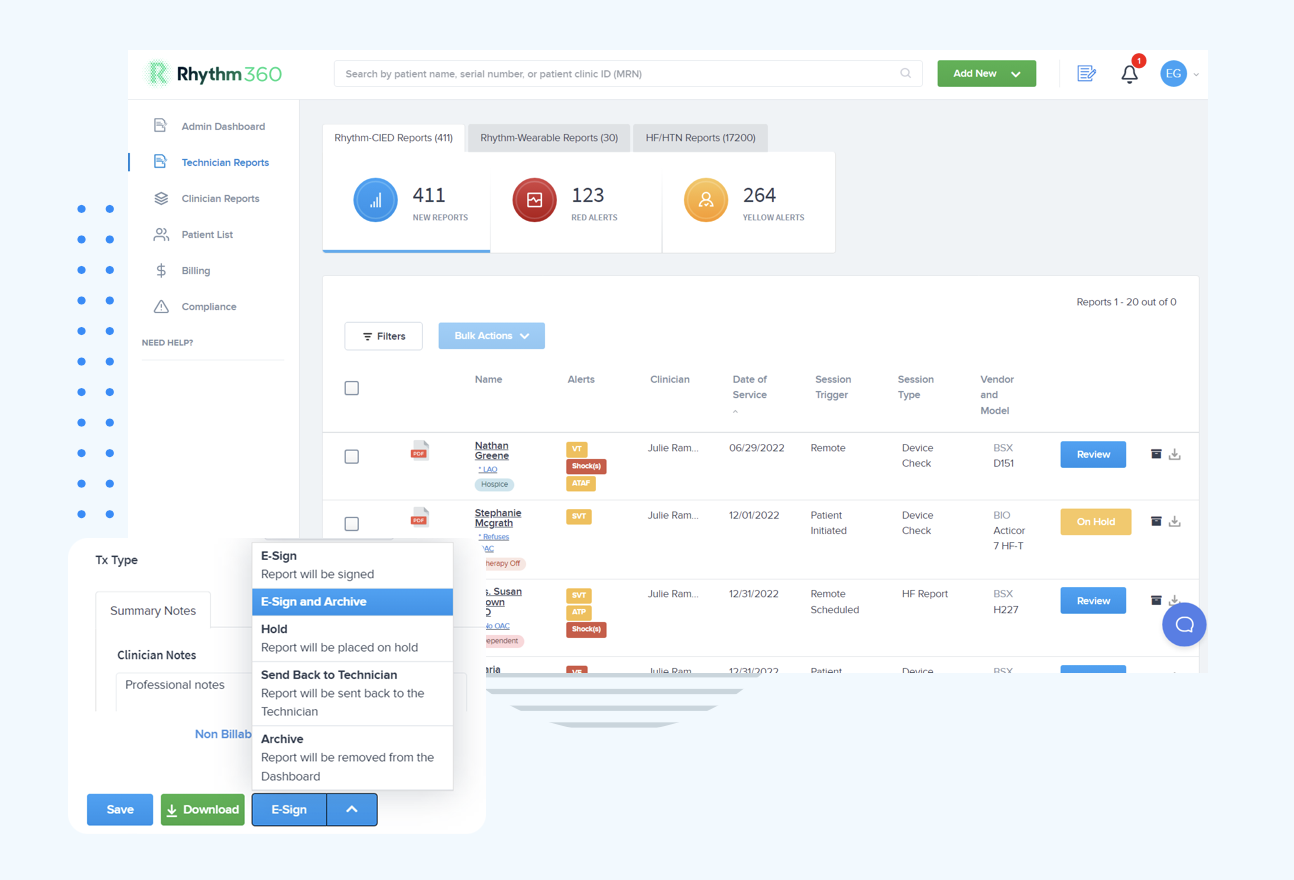
These normalization and reliability standards form the baseline for evaluating any platform. The seven criteria below build on that baseline, starting with how a platform handles data ingestion across care programs.
Managing heart failure in CIED patients requires integrating device data with broader chronic disease management to support closer collaboration and individualized care beyond standard device-clinic workflows. A platform that handles CIED transmissions but skips heart failure and hypertension RPM forces practices to run two separate programs with two separate billing tracks.
Rhythm360 provides distinct but integrated service lines for Rhythm-CIED (pacemakers, ICDs, CRT devices, implantable loop recorders, and CardioMEMS pulmonary artery monitors) and HF/HTN remote physiological monitoring. University of Chicago Medicine implemented Rhythm360 to achieve integrated review of data from trained personnel, consolidating workflows that had previously been split across device types and care programs.
Once data ingestion is unified, the next challenge is making sense of the resulting alert volume without burying clinicians in noise.
EP clinics have seen significant growth in device populations in recent years, and transmission volumes have grown with them. Many of these transmissions generate clinically non-relevant alerts. Across studied hospital settings, 80–99% of clinical alarms are false or clinically insignificant.
Rhythm360's AI-powered alert triage filters non-actionable notifications and surfaces only clinically significant events. This approach achieves an 80% reduction in alert fatigue while maintaining 99.9% data reliability. Optional 24/7/365 oversight by certified cardiac technicians, supervised by physicians, adds another triage layer for practices that want managed monitoring support. University of Chicago Medicine clinicians reported catching issues earlier as a result, calling patients in for evaluation instead of waiting for a three-month visit.
See the AI triage dashboard firsthand.
The 2026 CMS Physician Fee Schedule introduced two new RPM codes that expand reimbursement eligibility. CPT 99445 covers device supply and data transmission for 2–15 days per 30-day period at roughly $47–$52, and CPT 99470 covers the first 10–19 minutes of treatment management at roughly $26, both effective January 1, 2026. These codes sit alongside the established CIED-specific codes 93294–93298 and chronic-care RPM codes 99453, 99454, and 99457.
Practices without automated documentation systems routinely miss billable events. Sessions that previously fell short of the 20-minute threshold now generate revenue under CPT 99470, and patients transmitting fewer than 16 days per month now qualify under CPT 99445.
Rhythm360 automates CPT code capture and generates audit-ready documentation for every billable event, which is what allowed University of Chicago Medicine to report improved billing and accountability after integrating the platform. That improved capture shows up directly in the revenue numbers: practices using Rhythm360 have achieved up to a 300% increase through optimized CPT capture and added HF/HTN service lines.
EHR integration quality determines whether RPM data reaches clinical workflows or sits siloed in a separate portal. Manual re-entry across disconnected systems adds 45–90 minutes of administrative burden per provider per day and increases claim denial rates for RPM services. Check any cardiac RPM platform against this list before signing a contract.
Rhythm360 offers bidirectional EHR integration with Epic, Cerner, Athenahealth, eClinicalWorks, Greenway Health, and others via HL7. Implementation typically finishes within a few days to a few weeks.
Platform fit varies by practice volume and staffing model. The metrics table later in this article summarizes these capabilities, but the general framework below applies across practice sizes.
A phased rollout reduces disruption and lets clinical staff validate data accuracy before full deployment. Most cardiology practices complete EHR implementation in 8–16 weeks from contract signing to go-live, with full stabilization requiring another 30–60 days post-launch. Rhythm360's implementation is structured to compress this timeline significantly.
Get a tailored implementation timeline for your practice.
The 2026 HRS/AHA/APHRS/EHRA/IDSA/LAHRS/PACES/STS expert consensus statement calls for mandatory remote monitoring of pacemakers and defibrillators because lead failure can present without warning or become catastrophic. Timely response to critical alerts, such as new-onset atrial fibrillation, ventricular tachycardia, lead malfunction, or significant weight gain in HF patients, directly affects patient outcomes.
Rhythm360 reduces critical-event response times by up to 80% through AI-powered triage and near-real-time alert generation. The platform's HIPAA-compliant mobile application lets clinicians review transmissions, sign reports, and coordinate care from any location. All patient communications, including phone call logs, are tracked with a full audit trail through an integrated Twilio framework, which keeps documentation continuous for both clinical and billing purposes.
The table below consolidates the performance figures cited throughout the seven criteria into a single reference view.
| Criterion | Rhythm360 Capability |
|---|---|
| Data transmissibility | >99.9% via redundant feeds, AI extrapolation, and computer vision |
| Alert fatigue reduction | Up to 80% reduction in non-actionable alerts via AI triage |
| Critical-event response time | Up to 80% reduction versus manual workflows |
| Revenue impact | Up to 300% increase in CPT code capture and RPM service line revenue |
| Annual report volume (enterprise) | 73,000+ reports per year at University of Chicago Medicine in 2025 |
| EHR integrations | Epic, Cerner, Athenahealth, eClinicalWorks, Greenway Health, and others via HL7 |
| Implementation timeline | Days to weeks from contract to go-live |
Alert fatigue is the most consistently cited clinical disadvantage of remote patient monitoring. When platforms apply static, population-level thresholds instead of patient-specific baselines, clinicians receive high volumes of non-actionable notifications. Studies show up to 60% of CIED alerts are clinically non-relevant, and broader hospital alarm research places false-positive rates between 80% and 99%. As noted earlier, Rhythm360's AI-powered triage addresses this same alert-fatigue problem directly.
Cardiology practices bill across two code families. For CIED monitoring, the primary codes are 93294 (remote pacemaker interpretation), 93295 (remote ICD/CRT-D interpretation), 93296 (technical component for 93294/93295), and 93297 (implantable loop recorder interpretation). For chronic-care RPM covering heart failure and hypertension, the 2026 code set includes 99453 (one-time setup), 99454 (device supply, 16+ days), the new 99445 (device supply, 2–15 days), 99457 (first 20 minutes of treatment management), and the new 99470 (first 10–19 minutes of treatment management). Rhythm360 automates documentation for all of these codes, tracking transmission days, clinical staff time, and interactive communication requirements to generate audit-ready billing records.
Single-OEM portals, including those provided directly by device manufacturers, only display data from that manufacturer's devices. A practice managing patients with Medtronic, Boston Scientific, Abbott, and Biotronik devices must maintain separate logins and reconcile data manually across four systems. Rhythm360 ingests data from all major OEMs using API connections, HL7 feeds, XML parsing, and AI-powered computer vision for unstructured PDFs, normalizing everything into a single dashboard. This eliminates redundant logins, reduces manual transcription errors, and gives clinicians one unified view of the entire device population alongside HF and HTN chronic-care data.
For CPT 99445, required documentation includes the device type and clinical purpose of monitoring, the number of days with valid transmitted readings (minimum 2, maximum 15 within the 30-day period), confirmation that data was transmitted from an FDA-cleared device, and documented patient consent in the medical record. For CPT 99470, documentation must include total clinical staff time spent on treatment management (10–19 minutes), the date, duration, and method of at least one real-time interactive communication with the patient or caregiver, a description of clinical activities performed, and time-stamped notes supporting the cumulative time claim. CMS 2026 guidance requires monthly documentation to summarize actual data trends, clinical interpretation, and any resulting care plan adjustments, rather than relying on generic or copy-paste summaries. Rhythm360's automated documentation engine captures and timestamps all of these elements at the point of care.
The seven criteria above, covering unified data ingestion, AI-powered alert triage, automated CPT documentation, EHR integration depth, practice-size scalability, implementation speed, and mobile critical-event response, define the difference between a platform that reduces operational complexity and one that just redistributes it. Rhythm360 is built to address all seven within a single vendor-neutral, HIPAA-compliant deployment.
University of Chicago Medicine's implementation of Rhythm360 showed that AI-assisted decision support will matter more as data volumes grow, a reality every cardiology practice managing multi-OEM device populations will face in 2026 and beyond.
Cardiology practices, EP clinics, and integrated health systems ready to eliminate multi-portal chaos, reduce alert fatigue, and capture the full value of the 2026 CPT code updates should take the next step. Talk to the Rhythm360 team about your rollout.





