Last updated: July 13, 2026
Cardiology practices that implant devices from more than one manufacturer inherit a logistical crisis. Each OEM runs a separate, non-interoperable portal. Technicians move between logins, reconcile conflicting data formats, and manually type findings into the EHR, which consumes time and invites errors.
The clinical stakes are severe. A multi-year cross-sectional study analyzing more than 65.6 million alarms across four monitored units found that 88% of all bedside monitor alarms were technical and unrelated to patient condition. That volume of non-actionable noise desensitizes clinical staff. Alarm fatigue has been associated with 566 hospital deaths according to FDA data from 2005–2010. When critical alerts such as new-onset atrial fibrillation, ventricular tachycardia, or device malfunction arrive alongside hundreds of false positives, the chance of a missed event rises sharply.
Financial damage compounds the clinical risk. Without a centralized system tracking billable events, practices routinely miss revenue tied to CPT codes 93298, 93299, 99454, and 99457. A typical cardiology practice with 200 device patients can capture $80,000–$120,000 in annual recurring revenue from properly billed remote monitoring. Incomplete documentation forfeits that revenue entirely.
Staffing pressure makes the situation worse. Andrew Beaser, MD, Associate Professor of Medicine at the University of Chicago Medicine, described pre-implementation workflows as “a major challenge and incredibly difficult.” His colleague Gaurav A. Upadhyay, MD, FACC, FHRS, noted that “staffing was always an issue for our center, because our device clinic — like many other medical centers — had struggled with technician turnover and timely weekend coverage.”
The remote cardiac monitoring market reached USD 4.68 billion in 2026, expanding at a CAGR of 10.61%. As patient volumes grow at this pace, the fragmented-portal problem scales with them, turning today’s inconvenience into tomorrow’s systemic risk.
Vendor-neutral platforms solve fragmentation by sitting above OEM ecosystems and normalizing data regardless of source. Instead of forcing staff into separate portals, the platform ingests data via APIs, HL7, XML, and unstructured PDFs, then presents a unified, actionable view.
Rhythm360 follows this architecture and delivers specific capabilities that address each pain point created by fragmented portals.
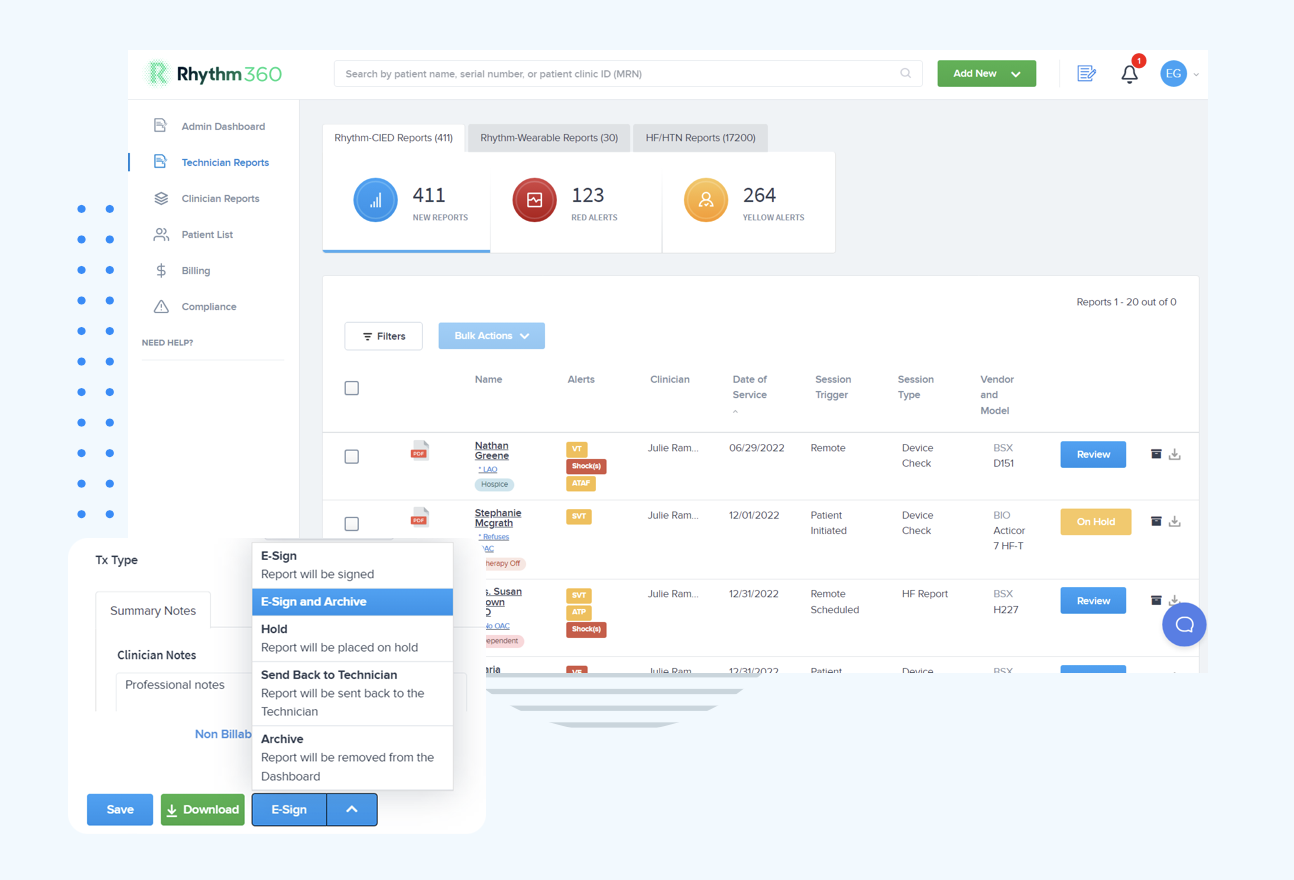
After implementing Rhythm360, the University of Chicago Medicine reviewed more than 73,000 reports annually, averaging more than 18,000 per quarter. Dr. Beaser reported that clinicians were able to review more transmissions daily and identify more abnormalities. He also noted that the practice could “address these issues earlier; rather than waiting for a 3-month visit, we can call patients in for evaluation.”
Cardiology teams choosing a cardiac telemetry monitoring vendor need to weigh clinical, operational, financial, and patient-experience factors at the same time. The checklist below highlights the criteria most relevant to practices evaluating platforms in 2026.
Dr. Upadhyay at UCM emphasized that “an integrated review of data from trained personnel” was decisive. That requirement maps directly to items 2, 3, and 6 in this list.
Compare Rhythm360’s capabilities to your evaluation checklist in a personalized demo.
The table below compares key operational and clinical metrics for traditional OEM portal environments and Rhythm360. All figures are cited inline.
| Attribute | Traditional OEM Portals | Rhythm360 |
|---|---|---|
| Logins required per multi-OEM practice | One per manufacturer (Medtronic, Boston Scientific, Abbott, Biotronik, etc.) | Single unified login across all supported OEMs |
| Data transmissibility | Dependent on individual OEM server uptime, no cross-vendor fail-safe | >99.9% via redundant data feeds, computer vision, and AI extrapolation |
| Critical-alert response time reduction | No automated triage, manual review of all alerts | Up to 80% reduction in response times |
| Annual report volume (scalability reference) | Limited by manual staff capacity | >73,000 reports annually at University of Chicago Medicine in 2025 |
| Automated CPT documentation | Manual workflows with high risk of missed codes | Automated tracking for 93294–93299, 99445, 99454, 99457, 99470 |
| Revenue improvement potential | Baseline potential for a 200-patient practice noted above, frequently undercaptured in manual workflows | Up to 300% increase in revenue generation through improved CPT capture and RPM service lines |
| EHR integration | None or PDF drop | Bi-directional HL7 integration with Epic, Cerner, Athenahealth, eClinicalWorks, Greenway Health, and others |
Solo practices and small groups carry the highest per-staff administrative burden from fragmented portals. A single device technician managing multiple OEM logins manually becomes a single point of failure. Rhythm360’s SaaS pricing scales to practice size and avoids large upfront commitments. Its streamlined onboarding, measured in days to weeks, lets a small team go live without a long implementation project. Automated CPT documentation is especially valuable here because small practices rarely have dedicated billing staff to track 30-day and 90-day reporting windows across device types.
Small-to-mid-size groups often manage patients across several device manufacturers and may operate satellite locations. The centralized dashboard and mobile app give clinicians across sites access to the same patient data without duplicate infrastructure. The optional CCT oversight layer supplies weekend and after-hours coverage without new hires, directly addressing the staffing challenge UCM reported before its Rhythm360 implementation.
Large integrated systems need a platform that supports tens of thousands of patients without performance or compliance issues. UCM’s high-volume experience shows that Rhythm360 handles enterprise-scale environments without degradation. Bi-directional EHR integration with systems like Epic and Cerner, combined with role-based access controls and a full audit trail, meets the governance requirements of large health systems.
Discuss the Rhythm360 configuration that fits your practice size in a tailored consultation.
The 2026 billing landscape for cardiac remote monitoring is more complex and more lucrative than in prior years. Practices that understand the full code set and document correctly can generate significant recurring revenue.
For CIED remote monitoring, the core codes remain:
For RPM of chronic conditions including heart failure and hypertension, the 2026 Physician Fee Schedule introduced two new codes that expand reimbursable scenarios:
CPT 99445 and 99454 are mutually exclusive, so only one device-supply code may be billed per patient per 30-day period. Practices must choose the code that matches actual transmission days to support compliant reimbursement. CPT 99470 and 99457 are also mutually exclusive, which requires precise tracking of clinical time to bill the correct tier. All RPM treatment management codes require at least one live, interactive communication with the patient or caregiver per calendar month, documented with date, duration, and method. Automated platforms can track these details consistently, while manual workflows often miss them.
For MCOT, Palmetto GBA maintains a local coverage determination (LCD L40257) for temporary nontherapeutic ambulatory cardiac monitoring devices. BCBSM has a policy that covers MCOT for commercial and Medicare Advantage members under specified conditions.
Dr. Upadhyay at UCM confirmed that “we have improved billing and accountability for our patients after the integration”. Rhythm360’s automated documentation capabilities drove that improvement.
Review how Rhythm360’s automation supports 2026 CPT compliance in a focused billing demo.
Implementation speed and disruption risk often determine whether practices adopt a new clinical platform. Rhythm360’s implementation process aims to minimize disruption while connecting all required systems. EHR integration and full platform onboarding typically complete within a few days to a few weeks, depending on infrastructure complexity and the number of EHR systems involved.
The onboarding process covers:
Rhythm360’s SaaS pricing model scales based on clinic size and platform usage. This structure avoids large upfront fees and multi-year lock-in terms that create financial risk before results appear. Practices can keep core workflows in place because the platform integrates into current EHR environments and augments existing staff instead of replacing them.
Cardiac telemetry monitoring traditionally refers to continuous, real-time ECG surveillance conducted in a hospital or monitored unit, where a central station receives waveform data from a patient’s bedside transmitter. Remote cardiac monitoring, which includes CIED remote interrogation, mobile cardiac outpatient telemetry (MCOT), and remote physiologic monitoring (RPM), occurs outside a facility setting. Patients transmit data from home using implanted devices or wearable sensors, and clinical teams review that data asynchronously or through automated alert systems. Vendor-neutral platforms like Rhythm360 support this remote environment by aggregating data from implanted and wearable devices across manufacturers into a single clinical workspace.
Medicare covers MCOT in 2026 under defined conditions. Coverage applies when the receiving station is staffed 24 hours a day with at least an EKG technician who has immediate physician access for clinical decisions. Eligible patients include those with symptoms suggestive of arrhythmia occurring more than 24 hours apart, patients on arrhythmic medication requiring dosage regulation, individuals with non-lacunar cryptogenic stroke or TIA to detect atrial fibrillation, patients after surgical or ablative arrhythmia procedures, specific cardiomyopathies, embolic-appearing MI, systemic emboli, and pre- or post-TAVR monitoring. Testing beyond 30 consecutive days is rarely considered medically necessary, and repeating a test within one year without new or recurrent undiagnosed symptoms is unlikely to be reimbursed. Commercial payer rules vary. BCBSM’s policy effective March 1, 2026 covers MCOT for members when symptoms occur less than once every 48 hours or following cryptogenic stroke to guide anticoagulation.
The primary CIED remote monitoring codes are CPT 93294 (pacemaker remote interrogation, 90-day period, approximately $30–$45 from Medicare), CPT 93295 (ICD remote interrogation, 90-day period, approximately $115 from Medicare), CPT 93298 (implantable loop recorder monitoring, reported every 30 days), and CPT 93299 (ILR remote analysis, technical component). For RPM of chronic cardiac conditions, CPT 99454 covers device supply for 16 or more days of transmission per 30-day period, and the new CPT 99445 (effective January 1, 2026) covers 2–15 days at a similar reimbursement rate. CPT 99457 covers the first 20 or more minutes of treatment management time, and the new CPT 99470 covers 10–19 minutes. Documentation must include the device manufacturer and model, date of transmission, a summary of interrogated data, the physician’s interpretation, and any clinical action taken.
Alert fatigue occurs when the volume of non-actionable alarms desensitizes clinical staff, which delays or prevents responses to genuine critical events. Studies show that 80%–99% of alarms generated by continuous telemetry monitoring systems may be false or clinically insignificant. A 2026 qualitative study found that alert fatigue appears at different stages of information processing, including failure to detect alerts, superficial processing using mental shortcuts, or excessive cognitive effort to interpret. Undetected or superficially processed alerts more often lead to perceived impacts on patient safety and care quality. In the CIED remote monitoring context, fragmented OEM portals amplify this problem by generating separate alert streams that staff must monitor independently. AI-powered triage in Rhythm360 filters non-actionable noise before it reaches clinical staff and reduces critical-alert response times by up to 80%.
Cardiology practices should prioritize broad OEM device coverage, documented data transmissibility with a clear fail-safe mechanism, and AI-powered alert triage that reduces non-actionable noise. Bi-directional EHR integration that writes structured data rather than PDFs, automated CPT code tracking for both CIED and RPM billing, and a full audit trail for Medicare and payer compliance are also essential. Mobile access for on-call clinicians and a pricing model that scales without large upfront commitments support long-term adoption. Onboarding speed matters as well, because implementations measured in days to weeks minimize disruption. Practices managing heart failure and hypertension patients alongside CIED patients should confirm that the platform supports RPM service lines for chronic conditions, which enables a single workspace for all remote monitoring activity.
Fragmented OEM portals create structural risk for patient safety, staff retention, and practice revenue. Multiple logins, manual data reconciliation, alert fatigue from non-actionable notifications, and incomplete CPT documentation combine into losses that grow as device patient volumes increase. The remote cardiac monitoring market is expanding at a 10.61% CAGR, so pressure on practices that have not consolidated their monitoring infrastructure will intensify every year.
Rhythm360 addresses each dimension of this problem through a single vendor-neutral, AI-powered platform. It unifies data from all major OEMs, delivers greater than 99.9% transmissibility, cuts critical-alert response times by up to 80%, automates CPT documentation for the expanded 2026 code set, and integrates bi-directionally with EHRs within days to weeks. Practices using Rhythm360 have documented up to 300% revenue improvement and gain confidence that critical events are detected rather than missed.
When building an RFP for cardiac telemetry monitoring vendors, use the evaluation checklist in this article as your framework. Request documented transmissibility rates, AI triage methodology, EHR integration depth, CPT automation capabilities, and implementation timelines from every vendor under consideration.