

Last updated: August 24, 2026
The following table summarizes Rhythm360’s core technical capabilities and the direct clinical impact for multi-OEM CIED programs.
| Capability | Rhythm360 Specification | Clinical Impact |
|---|---|---|
| Multi-OEM Integration Depth | API, HL7, XML, and computer vision PDF parsing across all major CIED manufacturers | Single dashboard replaces multiple OEM portal logins |
| AI Alert Triage | AI-driven prioritization with >95% clinical accuracy for arrhythmia detection | Up to 80% reduction in critical-alert response time |
| Bi-directional EHR Connectivity | HL7 with Epic, Cerner, Athenahealth, eClinicalWorks, Greenway Health | Eliminates manual data re-entry, real-time clinical context during review |
| Automated CPT Documentation | Automated capture for 93298, 93299, 99454, 99453, and 99457 | Up to 300% revenue lift through more complete billing capture |
| Data Transmissibility | >99.9% via redundant feeds, AI gap-filling, and computer vision | No critical data lost during OEM server outages |
| Mobile Clinician Access | HIPAA-compliant mobile app for transmission review, report signing, and care coordination | On-call coverage without workstation dependency |
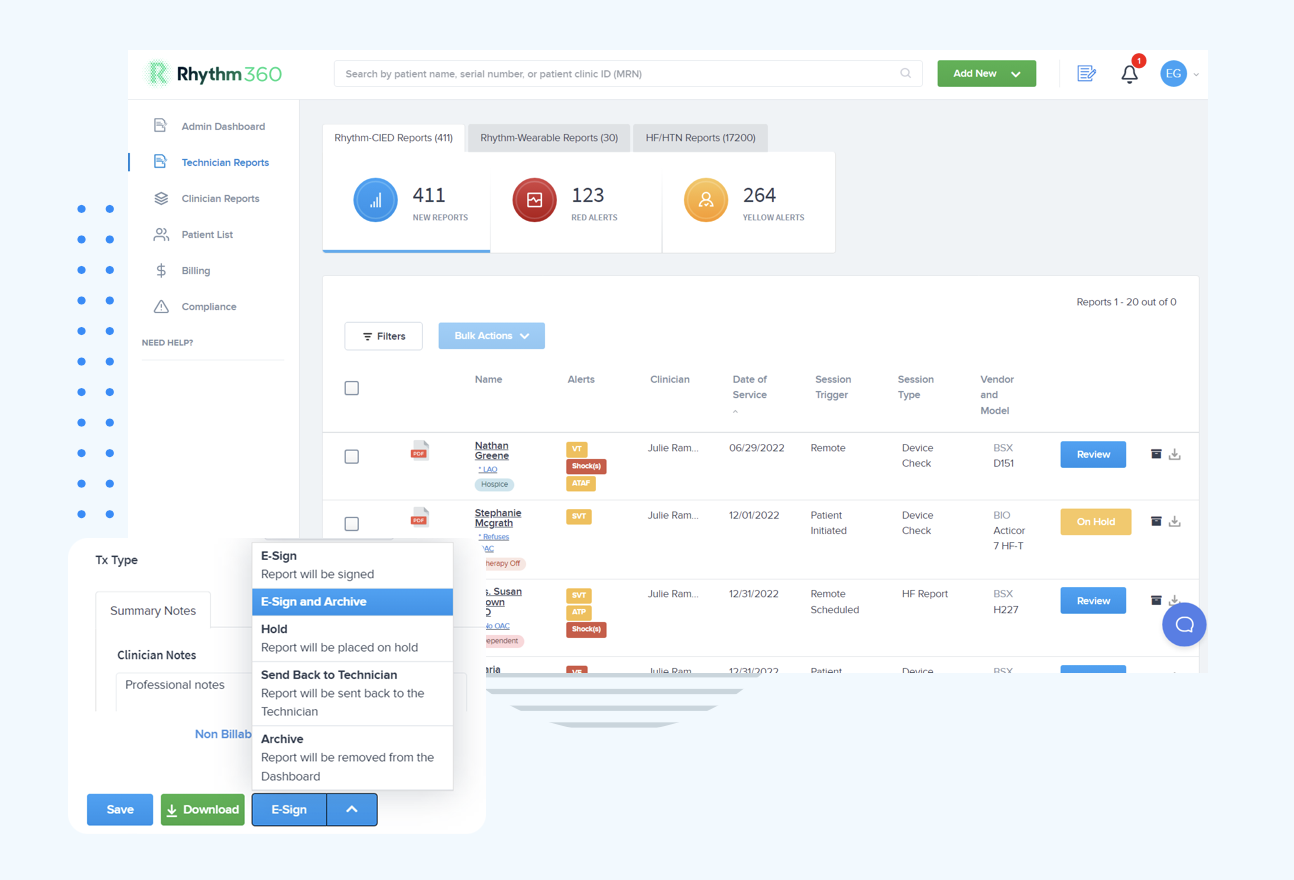
Once a cardiology practice implants devices from more than one manufacturer, its staff inherits a fragmented operational reality. Each OEM such as Medtronic, Abbott, Boston Scientific, and Biotronik maintains a separate, non-interoperable portal. Device technicians must authenticate into each system individually, reconcile conflicting data formats, and manually transcribe findings into the EHR. Enterprise-grade vendor-neutral platforms consolidate transmissions from all major CIED manufacturers and peripheral monitoring devices into one unified view, yet practices that rely on legacy workflows continue to absorb the overhead of portal fragmentation every day.
Consider a mid-sized electrophysiology practice that manages 800 device patients across four OEM lines. On any given morning, a device technician opens four separate portals, downloads reports in incompatible formats, and manually enters discrete data into Epic. That process consumes two to three hours before clinical review even begins. If one OEM server experiences downtime, transmissions for that device cohort are absent, with no automated failsafe. Rhythm360 addresses this directly through redundant data feeds, AI-based gap filling, and computer vision technology that achieves greater than 99.9% data transmissibility, which prevents OEM server outages from creating blind spots in patient monitoring.
Industry consolidation through 2025 and 2026 adds further complexity. Medtech M&A deal value surged from approximately $39 billion in 2023 to more than $80 billion in 2025, and Q1 2026 already exceeded $40 billion, so device manufacturer portfolios continue to shift. Practices that depend on OEM-specific portals face recurring re-integration work each time an acquisition reshapes the manufacturer landscape. A vendor-neutral platform with deep API and HL7 connectivity shields practices from those disruptions.
See how Rhythm360 consolidates your entire CIED population into one dashboard.
Consolidating data from multiple OEMs solves the fragmentation problem, yet it also creates a new challenge. Once all transmissions flow into a single dashboard, practices must manage the sheer volume of alerts that previously arrived through separate channels.
Alert fatigue ranks among the most clinically consequential operational problems in cardiac remote monitoring. In a study of more than 26,000 device patients, a substantial portion of transmissions were classified as alerts, and implantable loop recorders generated a disproportionate share of all alerts. When every transmission appears to demand the same level of attention, staff become desensitized, and truly critical events risk being buried in noise.
A large academic medical center illustrates the scale of this challenge. University of Chicago Medicine reviewed more than 73,000 reports annually through Rhythm360 in calendar year 2025, averaging more than 18,000 reports per quarter. Managing that volume without intelligent triage would be operationally unsustainable. As Andrew Beaser, MD, Associate Professor of Medicine at UCM, noted, “Decision support, including AI-assisted decision support, will become increasingly important as data volumes grow.”
Rhythm360’s AI-powered alert triage system filters non-actionable transmissions and surfaces clinically significant events such as new-onset atrial fibrillation, ventricular tachycardia, lead malfunction, and ERI or RRT indicators with priority ranking. The platform delivers the accuracy and response-time improvements noted earlier while maintaining clinical precision. Optional 24/7/365 oversight by certified cardiac technicians supervised by physicians adds a human layer for practices that want it. In practice, a nurse receives a prioritized notification of new-onset AFib on a Saturday morning and initiates anticoagulation protocols before the patient’s condition escalates, a scenario that manual, portal-dependent workflows often miss.
Revenue leakage from incomplete CPT documentation remains a structural problem for practices without automated billing support. The 2026 remote cardiac monitoring billing landscape spans multiple code families. For CIEDs, practices bill the 9329x family, including 93294, 93295, and 93296 for pacemakers, ICDs, and CRT devices on 90-day windows, plus 93297 and 93298 for implantable loop recorders on 30-day cycles. For remote physiological monitoring, applicable codes include 99453, 99454, 99457, and 99458. Effective January 1, 2026, two new RPM codes took effect: 99445 covers 2 to 15 days of transmitted home physiologic data in a 30-day period, and 99470 covers 10 to 19 minutes of treatment management time in a calendar month.
The documentation burden for these codes is substantial. Each requires timestamped transmission logs, clinician review records, and in many cases interactive communication documentation, all of which must be audit-ready. Enterprise-grade platforms generate timestamped, audit-ready transmission logs and supporting documentation aligned with CMS requirements in real time rather than forcing end-of-cycle reconstruction. Without automation, practices routinely miss billable events because documentation was not captured at the time of the transmission. The 2026 CMS physician fee schedule updated reimbursement for remote monitoring codes, which makes accurate capture more financially consequential than ever.
Rhythm360 automates documentation and billing for the full range of applicable CPT codes, including the CIED and RPM codes outlined above. As UCM confirmed after implementation, “We have improved billing and accountability for our patients after the integration.” Practices using Rhythm360 have achieved up to 300% improvement in revenue generation through more complete CPT capture, improved staff efficiency, and the addition of HF and HTN RPM service lines.
Watch Rhythm360’s automated CPT documentation capture codes in real time.
Epic is the dominant EHR in large cardiology practices and integrated health systems, and its integration requirements rank among the most demanding in the industry. Epic integrations for remote cardiac monitoring platforms are typically resource-intensive and require coordination between the clinic, monitoring vendor, and Epic technical teams. Bi-directional integrations add further configuration layers, and timelines commonly run several months from kickoff to go-live. Practices that evaluate platforms need to confirm that a vendor has completed Epic integrations at comparable scale, not just that an integration appears theoretically possible.
Rhythm360 supports bi-directional Epic connectivity via HL7, which enables real-time data flow in both directions. Orders, patient demographics, device history, and prior billing context flow from Epic into Rhythm360 at the time of transmission review. Completed reports, discrete structured data, and billing documentation flow back automatically. This removes the manual re-entry that consumes device technician time and introduces transcription errors. Bi-directional EHR integration allows a remote cardiac monitoring platform to surface billing opportunities and flag interval conflicts before claim submission, which directly reduces claim denials.
UCM’s implementation shows what bi-directional Epic connectivity enables at enterprise scale. Clinicians reviewed more transmissions daily and identified more abnormalities, and the practice shifted from reactive to proactive patient management: “We are able to address these issues earlier; rather than waiting for a 3-month visit, we can call patients in for evaluation.”
The capabilities discussed so far, including multi-OEM integration, AI triage, CPT automation, and EHR connectivity, define the core requirements for any enterprise platform. Practices that evaluate vendors need a structured way to compare how well each platform delivers on these requirements.
When practices evaluate enterprise cardiac telemetry platforms, a weighted scoring framework helps map vendor capabilities to operational priorities. The weights below reflect the relative impact each capability has on day-to-day operations. Multi-OEM integration and alert fatigue reduction carry the highest weights because they affect both clinical outcomes and staff workload, while EHR connectivity, though essential, typically affects a smaller portion of the daily workflow once implemented. Score each vendor 1–5 on each criterion, multiply by the weight, and sum for a total.
| Criterion | Weight | What to Assess |
|---|---|---|
| Multi-OEM Integration Depth | 25% | Number of OEMs supported natively, API vs. manual PDF parsing, redundant feed failsafe |
| Data Uptime & Transmissibility | 20% | Documented transmissibility rate, OEM server outage handling, AI gap-filling capability |
| Alert Fatigue Reduction | 25% | AI triage accuracy, reduction in non-actionable alerts, optional CCT oversight availability |
| CPT Automation & Revenue Impact | 20% | Codes supported including the CIED and RPM codes outlined above, audit-ready documentation, demonstrated revenue outcomes |
| EHR Bi-directional Connectivity | 10% | Epic, Cerner, and Athenahealth integration depth, HL7 support, implementation timeline |
Platform transitions often stall because leaders worry about disruption to active patient monitoring workflows. Rhythm360’s implementation process, including EHR integration setup, typically takes from a few days to a few weeks depending on practice size and EHR complexity. The onboarding process avoids reliance on a single internal “super-user,” which protects business continuity from day one and reduces the risk that staff turnover disrupts the monitoring program.
Understanding the implementation timeline helps leaders plan resourcing, yet it also helps to see where the practice currently sits on the operational maturity spectrum and what becomes possible as it moves up that ladder.
Practices at the base of the value ladder manage CIED populations through disconnected OEM portals, absorb hours of daily administrative overhead, and miss billable events because documentation remains incomplete. The first step up is data consolidation, which means a single dashboard that removes redundant logins and provides a real-time view of the entire device population. Once all transmissions flow into one system, the second step becomes possible: intelligent alerting that uses AI triage to filter noise, prioritize critical events, and route them to the right clinician on the right device, including mobile.
That prioritized workflow creates the foundation for the third step, which is automated revenue capture. CPT documentation then generates at the time of the transmission, remains audit-ready, and aligns with 2026 CMS requirements without extra staff effort. With reliable data, intelligent triage, and automated billing in place, practices can reach the fourth step: proactive population management. At that stage, teams use the data infrastructure to identify patients who trend toward missed monitoring thresholds, deteriorating HF metrics, or device end-of-life before a crisis occurs. Practices that complete this progression move from reactive, portal-dependent operations to a continuous, scalable monitoring program that improves patient outcomes and practice economics at the same time.
Vendor-neutral platforms ingest data through multiple technical pathways at the same time. Structured data from manufacturers that support APIs or HL7 feeds flows in directly and is normalized into a common schema. For manufacturers that deliver data as unstructured PDFs, computer vision and optical character recognition extract discrete data fields and map them to the platform’s data model. AI-based gap-filling logic identifies missing or incomplete transmissions and flags them for follow-up. Rhythm360 uses this layered approach, combining API, HL7, XML, and computer vision PDF parsing, to achieve the transmissibility rate described earlier across all major CIED manufacturers, including a redundant feed system that maintains data continuity if an OEM server experiences downtime.
AI alert triage applies machine learning models trained on large arrhythmia datasets to classify incoming transmissions by clinical urgency. Transmissions where all flagged episodes are classified as false positives are suppressed or deprioritized before they reach the clinician queue. Transmissions that contain genuinely actionable findings such as new-onset atrial fibrillation, ventricular tachycardia, lead impedance anomalies, or ERI or RRT indicators are surfaced with priority ranking and routed to the appropriate care team member. The result is a smaller, higher-signal alert queue that clinicians can work through efficiently rather than a high-volume stream of mixed-priority notifications. Rhythm360’s AI triage maintains the clinical accuracy and response-time performance described above. Optional 24/7/365 oversight by certified cardiac technicians provides an additional human review layer for practices that want it.
The 2026 billing landscape includes the 9329x family for implantable devices and the 9945x and 9947x codes for RPM, as detailed in the CPT Code Capture section above. Each code has specific documentation requirements, including timestamped transmission logs, documented clinician review, and in some cases interactive communication records. Rhythm360 generates audit-ready documentation for the CPT codes described earlier at the time of the transmission, which removes end-of-cycle reconstruction and reduces claim denials from incomplete records.
Epic integration timelines vary by practice size and by the depth of bi-directional configuration required. Rhythm360’s implementation process, including EHR integration, typically takes from a few days to a few weeks. Bi-directional Epic connectivity via HL7 means that patient demographics, device history, current medications, prior billing history, and enrollment status flow from Epic into Rhythm360 at the time of transmission review, which gives full clinical context without manual lookup. In the return direction, completed reports, discrete structured data, CPT and ICD-10 codes, and billing documentation flow back into Epic automatically, with no manual re-entry required. This architecture supports both large integrated health systems and independent cardiology practices that manage Epic deployments of varying complexity.
Cardiology practices that manage multi-OEM CIED populations in 2026 face a clear operational choice. They can continue to absorb the administrative, clinical, and financial costs of fragmented portal workflows, or they can consolidate onto a platform built for the scale and complexity of modern cardiac remote monitoring. Rhythm360 delivers the vendor-neutral data infrastructure, AI-powered alert triage, automated CPT documentation, and bi-directional EHR connectivity that enterprise cardiology programs require. Request a personalized walkthrough of Rhythm360’s platform to see how it can transform your practice’s monitoring program.





