Last updated: July 14, 2026
Clinics seeking to consolidate multi-vendor cardiac device data and improve operational efficiency can schedule a demo with Rhythm360 to evaluate the platform for their practice.
Cardiology practices managing patients with devices from Medtronic, Boston Scientific, Abbott, Biotronik, and other manufacturers face a structural data fragmentation problem. Each manufacturer operates a proprietary portal with its own nomenclature, communication protocols, and data formats. The HRS White Paper on CIED Interoperability identified this as a foundational barrier to unified care.
The operational consequences show up in the numbers. Data referenced at HRS 2026 shows a typical device clinic processes thousands of transmissions annually, and many alerts turn out to be clinically non-relevant. Device populations at some clinics have grown sharply since 2018. That growth creates bottlenecks, and bottlenecks risk missing the alerts that actually matter.
At the University of Chicago Medicine (UCM), pre-implementation workflows were, according to Andrew Beaser, MD, Associate Professor of Medicine, "a major challenge and incredibly difficult." Gaurav A. Upadhyay, MD, FACC, FHRS, Director of the Pacing & Defibrillation Device Clinic at UCM, pointed to staffing turnover and weekend coverage gaps as recurring problems his team faced before Rhythm360.
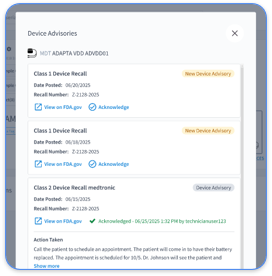
Fragmented monitoring also creates patient safety gaps. Disconnected pacemaker transceivers have gone undetected in fragmented environments, turning elective battery replacements into emergency procedures. Unified monitoring catches connectivity drop-offs before they become silent failures. That kind of early detection is exactly what a consolidated platform is built to deliver, and it's worth seeing firsthand.
Schedule a demo to see how Rhythm360 consolidates your entire device population into one platform.
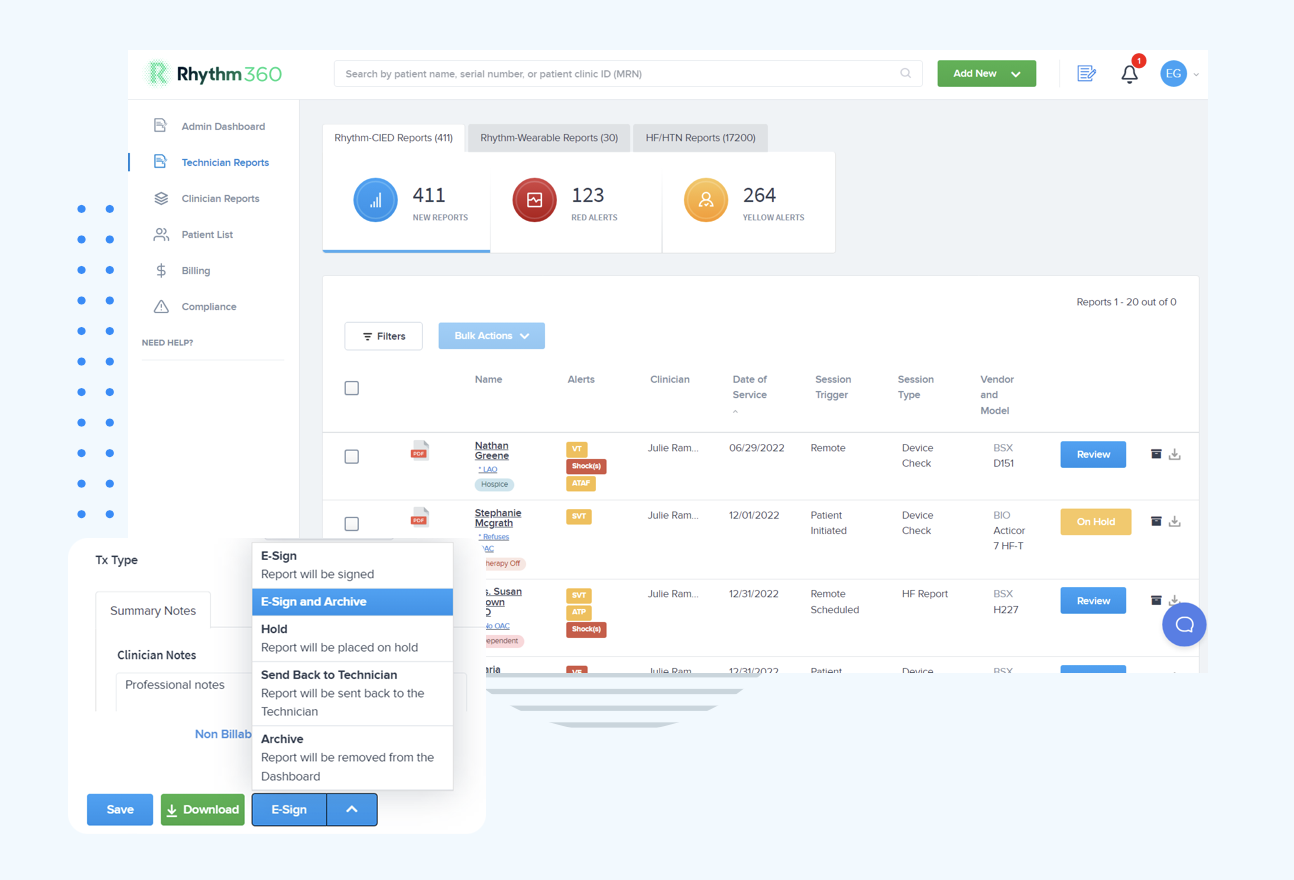
Alert fatigue is a clinical safety issue, not just an inconvenience. When staff reconcile transmissions across multiple portals, non-actionable notifications pile up and critical events risk getting buried. Rhythm360's AI-powered triage filters out clinically non-relevant alerts and surfaces prioritized notifications in near real time.
The platform achieves an 80% reduction in critical alert response times and maintains >99.9% data transmissibility through redundant data feeds, computer vision-based PDF parsing, and AI-powered extrapolation that fills gaps during OEM server downtime. AI-driven triage at this scale maintains that same reliability while cutting alert volume burden dramatically.
After UCM implemented Rhythm360, clinicians could "address these issues earlier; rather than waiting for a 3-month visit, we can call patients in for evaluation," according to Dr. Beaser. Dr. Upadhyay added that "having an integrated review of data from trained personnel" was central to that improvement. That trained-personnel model held up as volume grew. UCM processed more than 73,000 reports annually through Rhythm360 in 2025, averaging over 18,000 per quarter with stable dismissal rates, showing the triage approach scales without sacrificing review quality.
Rhythm360 also offers optional 24/7/365 oversight by certified cardiac technicians (CCTs) supervised by physicians. A critical arrhythmia flagged Saturday morning can trigger anticoagulation or device reprogramming by Saturday afternoon.
Revenue leakage from incomplete or untimely CPT documentation is a persistent problem in device clinics. The primary remote monitoring codes for CIEDs include:
Per CMS Article A56602, codes 93293–93296 are billed no more than once every 90 days and can't be reported if the monitoring period runs under 30 days. Manual tracking of these windows across fragmented portals creates compliance risk and missed claims.
Rhythm360 automates CPT code capture and generates auditable documentation aligned to these billing windows. Practices implementing Rhythm360 have achieved up to a 300% increase in revenue through optimized CPT capture, improved staff efficiency, and new RPM service lines for heart failure and hypertension. Dr. Upadhyay confirmed UCM saw "improved billing and accountability for our patients after the integration."
Some institutions have reduced billing time and supported higher patient volume without adding staff, after putting active IT controls and shared visibility in place across vendor platforms and EHR systems.
EHR integration is often the longest phase of any cardiac data platform deployment. A vendor's first integration with a new hospital typically takes several weeks from kickoff to production, with most of the time spent on security review, BAA execution, firewall changes, and EHR analyst coordination. Enterprise Epic or Cerner integrations requiring marketplace review can stretch even further.
Rhythm360 cuts this timeline to days to weeks using repeatable integration patterns across Epic, Cerner, Athenahealth, eClinicalWorks, Greenway Health, and others via HL7. The platform supports bidirectional data flow: device data flows into the EHR, and clinical context flows back into Rhythm360, eliminating manual transcription in both directions.
Even with standards like SMART on FHIR, true interoperability is far from automatic. Integration projects frequently leave technologies operating as independent platforms with data stuck in silos. Rhythm360's architecture solves this by using API, HL7, XML, and computer vision-based PDF parsing to normalize disparate data streams from all major OEMs into a single source of truth. That same normalized data feed is what powers the mobile app clinicians use on call.
Clinicians on call cannot stay tethered to a workstation. Rhythm360's secure, HIPAA-compliant mobile app lets electrophysiologists, NPs, PAs, and RNs review transmissions, sign reports, and coordinate care from any location. When a critical arrhythmia is flagged on a weekend, the on-call clinician gets a prioritized mobile alert and can start the appropriate protocol without returning to the office.
This mobile capability directly addresses the weekend coverage gaps Dr. Upadhyay described at UCM before Rhythm360 went live. Seeing that workflow in action makes the value clear.
Schedule a demo to see Rhythm360's mobile workflow in action.
Rhythm360's implementation is designed to minimize disruption. Onboarding, including EHR integration setup, typically completes in a few days to a few weeks depending on practice size and EHR environment. The SaaS-based pricing model scales with clinic size and usage, avoiding the high upfront costs tied to on-premise legacy systems.
Key onboarding milestones include:
Centralizing CIED monitoring with automated data integration reclaims substantial staff time at clinics managing high device volumes, time equivalent to redirecting multiple FTE positions back into clinical care. Rhythm360's fast onboarding means practices start capturing these gains quickly.
The table below summarizes the core performance metrics referenced throughout this article, pulled from RhythmScience platform data and the UCM implementation.
| Capability | Rhythm360 Specification | Measured Outcome | Source |
|---|---|---|---|
| Data Transmissibility | Redundant feeds, computer vision OCR, AI extrapolation across all major OEMs | >99.9% transmissibility | RhythmScience platform data |
| Alert Response Time Reduction | AI-powered triage with optional 24/7 CCT oversight | Up to 80% reduction in critical alert response times | RhythmScience platform outcomes |
| Revenue Improvement | Automated CPT capture (93294–93298, 99454, 99457) with auditable documentation | Up to 300% increase in revenue capture | RhythmScience platform outcomes |
| EHR Integration | Bidirectional HL7/FHIR with Epic, Cerner, Athenahealth, eClinicalWorks, Greenway Health | Days to weeks to production | RhythmScience implementation data |
| Annual Report Volume (UCM) | Centralized multi-vendor ingestion with AI triage | 73,000+ reports annually, 18,000+ per quarter | HMP Global / UCM White Paper, 2025 |
Mobile access lets on-call staff review transmissions and sign reports from any location, closing the weekend coverage gaps described earlier. The platform's chronic disease management tools add heart failure and hypertension RPM service lines, supported by CPT 99453, 99454, and 99457 billing, giving practices a new recurring revenue stream without adding headcount.
Cardiology administrators and EP directors should apply a consistent set of criteria to judge fit for their patient population and operational environment.
Rhythm360 is built to satisfy each of these criteria for cardiology practices of any size, from solo EP clinics to large integrated health systems.