Last updated: August 24, 2026
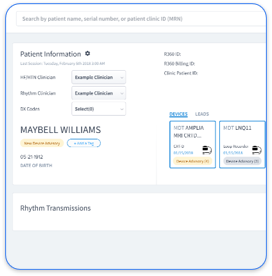
Definition: Vendor-neutral CIED aggregation means a platform ingests, normalizes, and displays transmission data from every major device manufacturer without separate logins, manual exports, or OEM-specific middleware. One dashboard shows the complete device population regardless of implant brand.
| Capability | Rhythm360 Specification | Clinical Impact | 2026 Metric |
|---|---|---|---|
| OEM Coverage | Medtronic, Boston Scientific, Abbott, Biotronik, and others via API, HL7, XML | Eliminates multi-portal switching | Single unified dashboard |
| PDF Parsing | Computer vision OCR for unstructured manufacturer reports | Captures data from legacy or non-API OEM feeds | Included in standard ingestion pipeline |
| Redundant Data Feeds | Fail-safe secondary feeds active when OEM servers are down | Prevents transmission gaps during outages | >99.9% transmissibility |
| AI Gap Filling | AI-powered extrapolation normalizes incomplete records | Maintains data fidelity across heterogeneous device types | Included in core platform |
Rhythm360 achieves greater than 99.9% data transmissibility through redundant OEM data feeds, computer vision PDF parsing, and AI-based gap filling. When an OEM server goes offline, the redundant feed activates automatically, which legacy on-premise systems and single-vendor portals cannot match. A device technician reviewing a pacemaker transmission on Monday morning sees the same data completeness as a clinician reviewing an ICD alert on Saturday afternoon.
The operational scale this supports is substantial. University of Chicago Medicine (UCM) reviewed more than 73,000 reports annually through Rhythm360 in calendar year 2025, a volume that would be unmanageable across fragmented OEM portals. Andrew Beaser, MD, Associate Professor of Medicine at UCM, noted, “We are able to address these issues earlier; rather than waiting for a 3-month visit, we can call patients in for evaluation.”
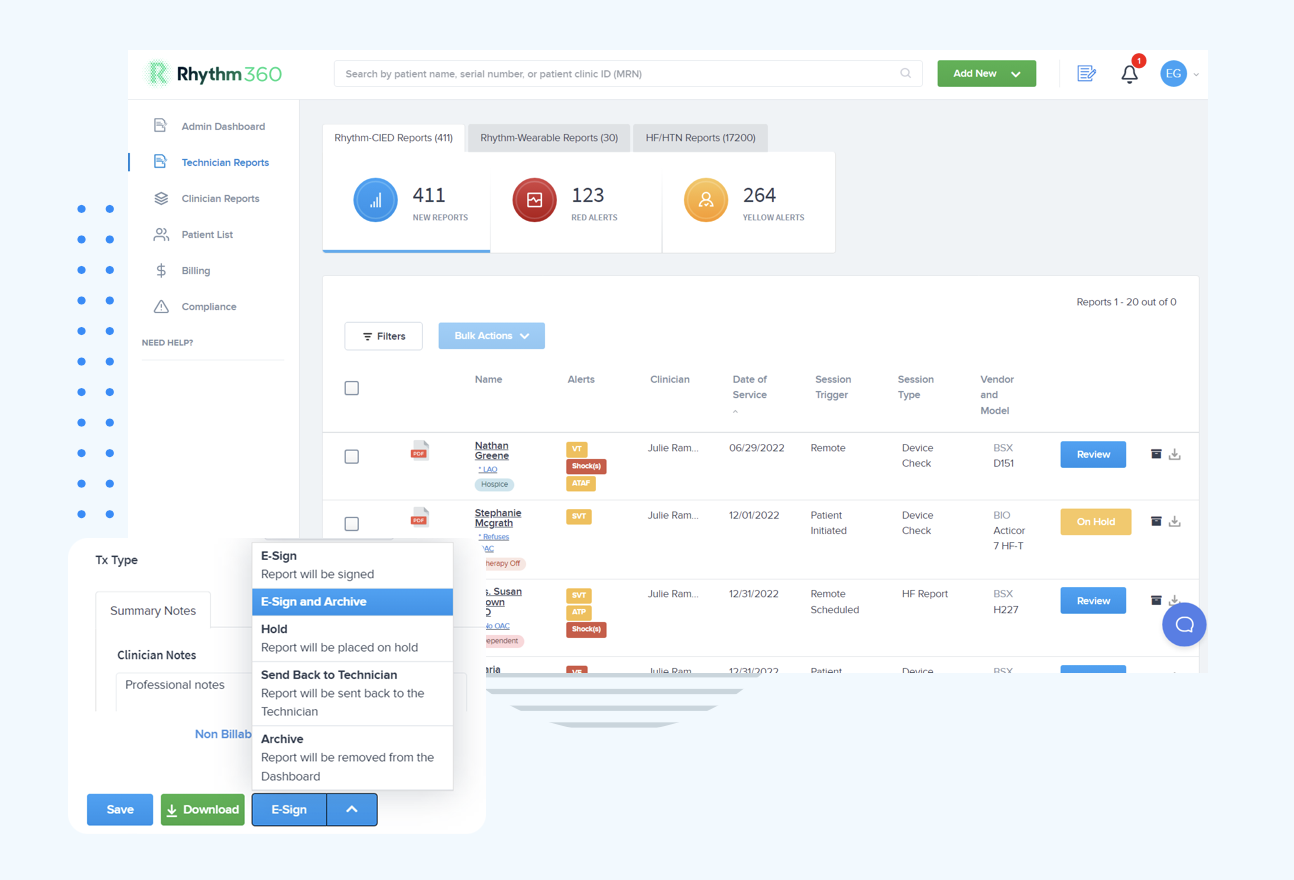
Aggregating all device data into one dashboard introduces a new challenge. Clinicians must still decide which of those thousands of transmissions require immediate action.
Definition: AI alert triage means automated classification and prioritization of incoming device transmissions so clinically significant events such as ventricular fibrillation, new-onset AFib, or lead malfunction surface immediately. Non-actionable routine transmissions are filtered or batched, which reduces the cognitive burden on clinical staff.
| Capability | Rhythm360 Specification | Clinical Impact | 2026 Metric |
|---|---|---|---|
| Arrhythmia Detection Accuracy | AI ECG analysis for AFib, VT, and other arrhythmias | Reduces missed critical events | >95% clinical accuracy |
| Critical Response Time Reduction | Prioritized alert queue with mobile push notification | Faster intervention before adverse outcomes | Up to 80% faster (e.g., 4 hours to 45 minutes) |
| 24/7 CCT Oversight (Optional) | Certified cardiac technicians supervised by physicians | Continuous triage coverage including weekends | 365-day availability |
| Alert Volume Reduction | AI filtering of non-actionable transmissions | Reduces alert fatigue for clinical staff | Documented in platform triage engine |
Alert fatigue is a documented and quantified problem in CIED monitoring. A 2026 multicentre observational study in NHS Scotland found that AI activation reduced total transmitted alert volume from 4,261 to 2,509 alerts, reported as a 29% reduction and released an estimated 185–218 hours of physiologist review time annually. That figure equals 3.6–4.2 hours per week of re-deployable clinical capacity. A small subset of patients generated a disproportionate share of all transmitted alerts, which confirmed that untriaged alert streams create heavy workload from a small portion of the device population.
Device-level AI filtering amplifies these gains. A retrospective analysis of Abbott Assert-IQ insertable cardiac monitors showed that AI algorithms can reduce AF electrogram data burden and pause electrogram data burden, which cuts transmission frequency. Rhythm360’s platform-level triage layer sits on top of these device-level signals and applies clinical context to further prioritize what reaches the clinician’s queue.
Andrew Beaser, MD, observed at UCM, “Decision support, including AI-assisted decision support, will become increasingly important as data volumes grow.” Rhythm360’s triage engine supports that trajectory by scaling alert management as patient panels expand without a matching increase in staff hours.
AI triage only reaches full value when it connects directly to the clinical record. Clinicians then act on prioritized alerts with complete context.
Definition: EHR interoperability in cardiac device monitoring means transmission data, clinical reports, and alert documentation flow bi-directionally between the monitoring platform and the practice’s electronic health record automatically. The EHR reflects current device status, and the monitoring platform reflects current clinical context without manual copy-paste.
| Capability | Rhythm360 Specification | Clinical Impact | 2026 Metric |
|---|---|---|---|
| EHR Systems Supported | Epic, Cerner, Athenahealth, eClinicalWorks, Greenway Health, GE Centricity | Covers the majority of cardiology practice EHR environments | Bi-directional, not read-only |
| Integration Standards | HL7 and Smart on FHIR APIs | Standards-based interoperability reduces custom development | Included in standard integration |
| Implementation Timeline | Days to weeks including EHR integration setup | Minimal disruption to active clinical workflows | Typical onboarding window |
| Audit Trail | All communications and report signatures logged within patient record | Supports HIPAA compliance and billing documentation | Full audit trail in platform |
Clinical risk from poor interoperability peaks outside business hours. A Saturday-morning critical alert such as new-onset AFib from an ILR transmission requires a clinician to act on complete, current information. If the monitoring platform cannot push that alert into the EHR and pull current medication context back, the clinician decides with partial data. Rhythm360’s bi-directional HL7 and Smart on FHIR integration ensures that when a nurse practitioner receives a mobile push notification about a critical arrhythmia, the linked patient record shows current anticoagulation status, recent lab values, and prior device history.
The evidence base for interoperability’s clinical value is consistent. Research has shown that EHR interoperability can improve medication safety, reduce patient safety events, reduce costs, and improve data quality and scope. At scale, the RETENTION project harmonized remote device data across multiple clinical environments using an HL7 FHIR R4 framework, which proves that standards-based interoperability works at high volume.
At UCM, this integration translated directly into accountability. Gaurav A. Upadhyay, MD, observed: “We have improved billing and accountability for our patients after the integration.” Bi-directional data flow functions as the mechanism that supports both clinical and financial accountability.
Once clinical and operational data stay synchronized, billing automation can rely on accurate, timely information. That connection turns remote monitoring work into predictable revenue.
Definition: CPT billing automation in remote device monitoring means platform-level capture, documentation, and code assignment for billable monitoring events, including codes such as 93298, 93299, 99454, 99453, and 99457. Staff do not manually count qualifying days, generate supporting documentation, or submit claims.
| Capability | Rhythm360 Specification | Financial Impact | 2026 Metric |
|---|---|---|---|
| CPT Codes Automated | 93298, 93299, 99454, 99453, 99457, and related RPM codes | Captures full billable scope of remote monitoring activity | Up to 300% revenue increase reported |
| Qualifying Day Tracking | Automated day counting across all OEM device sources | Prevents missed 16-day and 30-day billing thresholds | CPT 99445 (2–15 days) supported from Jan 1, 2026 |
| Documentation Generation | Automated report generation with audit-ready documentation | Reduces claim denials from incomplete documentation | Included in billing workflow |
| At-Risk Patient Identification | Real-time dashboard flags patients approaching billing cycle close | Enables proactive intervention before revenue is lost | Integrated into administrative dashboard |
Revenue leakage from manual CPT tracking is quantifiable. A single missed CPT 99454 claim costs roughly $52 under the 2026 CMS Physician Fee Schedule. A practice with 200 monitored patients can lose significant annual revenue from missed CPT 99454 claims alone, before downstream care management codes. Practices that rely on passive monitoring and manual tracking across manufacturer portals consistently see 16-day compliance rates fall below 70%.
The 2026 CMS Physician Fee Schedule introduced a structural change that automated platforms can capture. Effective January 1, 2026, new CPT 99445 allows billing for monitoring periods of 2–15 days, closing the previous billing dead zone for partial-compliance patients while remaining mutually exclusive with CPT 99454 in the same cycle. Manual workflows cannot reliably identify and bill 99445-eligible patients across a mixed-OEM population. Automated day counting across all device sources provides the only scalable approach.
Broader healthcare revenue cycle data supports this automation strategy. Hospitals that deploy AI-driven revenue cycle SaaS report substantial reductions in denial rates and improvements in accounts receivable. Rhythm360’s automated CPT capture applies the same logic to the remote monitoring billing environment, where multi-OEM day counting makes manual processes especially error-prone.
These four criteria work together during routine operations. Their combined value becomes most visible during the scenario that stresses every monitoring system: the weekend critical alert.
The weekend critical alert scenario reveals the gap between adequate platforms and essential ones. A patient’s ILR transmits a sustained ventricular tachycardia episode at 7:00 a.m. on a Saturday, and the clinic must respond before Monday.
Rhythm360’s vendor-neutral aggregation receives the transmission regardless of OEM. AI triage flags the event as critical and routes it to the top of the queue. The HIPAA-compliant mobile application delivers the alert to the on-call clinician’s smartphone within minutes of transmission.
The clinician reviews the full transmission, opens the linked EHR record, confirms the current medication list, and signs the report from a phone. A care coordination message goes to the broader team before 8:00 a.m. This workflow delivers the response-time compression documented earlier, turning a 4-hour review cycle into a 45-minute mobile workflow. In new-onset AFib, that window can separate pre-emptive anticoagulation from post-event response.
A 2026 scoping review published in PLOS One examined AI-guided triage systems in emergency settings and aligned with these response-time reductions in the CIED monitoring context. Mobile access alone does not suffice. Mobile access combined with AI triage, EHR context, and automated documentation produces meaningful outcome improvement and clean billing records.
Clinic leaders can select a workflow automation platform for cardiac device monitoring without an exhaustive RFP process. Instead of evaluating dozens of features across multiple vendors, three operational questions about the current practice surface the right answer quickly.
Practices that score high on all three dimensions, including large mixed-OEM panels, high alert-fatigue rates, and measurable CPT gaps, are the strongest candidates for a unified platform. Rhythm360’s SaaS pricing scales with clinic size and platform usage, which keeps the investment proportional to the problem. Implementation, including EHR integration, typically completes within days to weeks.
Schedule a demo to walk through this framework with a Rhythm360 specialist using your practice’s actual patient volume and billing data.
AI-powered alert triage reduces cardiac alert fatigue by automatically classifying incoming device transmissions and surfacing only clinically significant events such as ventricular tachycardia, new-onset AFib, or lead malfunction to the clinician’s queue. Non-actionable routine transmissions are filtered or batched for scheduled review. In practice, a device technician or nurse practitioner sees a prioritized list of events requiring immediate action rather than an undifferentiated stream of hundreds of daily transmissions. Rhythm360’s triage engine operates with greater than 95% clinical accuracy for arrhythmia detection, including VT and AFib, and reduces critical response times by up to 80%. Optional 24/7 oversight by certified cardiac technicians adds another layer of triage coverage for practices that need continuous monitoring without expanding internal staffing.
CPT billing automation for remote device monitoring means the platform automatically counts qualifying transmission days, generates compliant documentation, and assigns the correct billing codes. Staff do not reconcile data across OEM portals or track billing cycles on spreadsheets. Rhythm360 automates capture for codes including 93298 and 93299 for CIED remote monitoring, as well as 99454, 99453, and 99457 for remote physiological monitoring. The platform also supports the new CPT 99445, effective January 1, 2026, which covers monitoring periods of 2–15 days and closes the previous billing gap for partial-compliance patients. Practices that implement automated CPT capture have reported revenue increases of up to 300% compared with manual tracking workflows.
Vendor-neutral CIED data aggregation means a single platform ingests and normalizes transmission data from all major device manufacturers, including Medtronic, Boston Scientific, Abbott, Biotronik, and others, without separate logins or manual data exports for each OEM. The platform connects via APIs, HL7, XML, and computer vision PDF parsing to capture data regardless of the format each manufacturer uses. For a device technician, this means opening one dashboard to see the complete device population instead of cycling through four or five separate portals. For clinical leadership, it means one source of truth for patient compliance metrics, alert status, and billable activity across the entire implanted device panel. The platform achieves the transmissibility rate shown above through redundant feeds that activate automatically when an OEM server is unavailable.
Rhythm360’s implementation process, including bi-directional EHR integration with systems such as Epic, Cerner, Athenahealth, eClinicalWorks, and Greenway Health, typically completes within days to a few weeks, depending on the complexity of the practice’s existing infrastructure. The platform uses HL7 and Smart on FHIR APIs, which are standards-based integration methods that reduce the need for custom development. Because Rhythm360 is a cloud-based SaaS platform, practices avoid on-premise hardware installation. Clinics can begin reviewing transmissions through the unified dashboard shortly after integration is configured, with pricing that scales based on clinic size and platform usage rather than large upfront capital commitments.
An on-call clinician needs mobile access to the full monitoring workflow, not just alert notifications. This access includes the ability to review complete transmission data, open the patient’s current clinical context from the integrated EHR, sign reports, and initiate care coordination messages from a smartphone. Rhythm360’s HIPAA-compliant mobile application provides all these capabilities, which allows a clinician who receives a Saturday-morning critical alert to complete the full review and response workflow before the patient’s condition escalates. The mobile application is especially valuable for practices that rely on a small number of specialized device technicians because it removes the requirement to be physically present at a workstation to act on time-sensitive alerts. Combined with AI triage that filters non-actionable transmissions, mobile access ensures that alerts reaching an on-call clinician’s phone genuinely require immediate attention.
The four criteria, vendor-neutral CIED aggregation, AI alert triage, bi-directional EHR interoperability, and automated CPT billing capture, now define the operational baseline for a cardiac device clinic that manages a mixed-OEM patient population safely and profitably in 2026. Fragmented portals, manual alert review, disconnected EHR workflows, and spreadsheet-based billing tracking no longer scale, and their clinical and financial costs are well documented.
Rhythm360 addresses all four criteria in a single vendor-neutral, HIPAA-compliant platform with SaaS pricing that scales with clinic size and an implementation timeline measured in days to weeks. The outcomes, including up to 80% faster critical response times and up to 300% revenue improvement through automated CPT capture, are grounded in real-world deployments, including the UCM deployment mentioned earlier, which processed over 73,000 reports in 2025.
Schedule a demo to see how Rhythm360 performs against all four criteria for your specific patient panel and OEM mix.