

Last updated: September 22, 2026
Build Your Shortlist With Rhythm360
Cardiology RCM covers several distinct functions: professional billing for physician interpretation, technical billing for equipment and facility fees, prior authorization for advanced imaging and interventional procedures, specialty CPT and ICD-10 coding, denial management, underpayment detection, and device-data billing. RCM software that your staff runs in-house differs from outsourced cardiology billing companies that manage the entire billing function for your practice.
Cardiology practices face denial rates of 15% to 20%, far above the national outpatient average, driven by missing prior authorizations, unspecified diagnoses, modifier errors, and medical necessity gaps. A mid-sized cardiology practice can lose about $400,000 annually from undetected underpayments alone, before counting denied claims, missed charges, or aged A/R.
Device-data CPT capture creates the largest leak for most practices, regardless of which cardiology billing company they use. When a practice implants devices from more than one manufacturer, staff must log into separate, non-interoperable OEM portals to retrieve transmission data. Without a platform that normalizes that data and pairs it with the correct CPT codes, billable remote monitoring events remain undocumented and unclaimed, outside the RCM vendor’s workflow.
Any vendor on your shortlist must show clear, written workflows for the following code families.
Device-type mismatch drives many denials. Billing a generator replacement with an initial implant code family ranks among the most common errors in OIG cardiology audits. Applying 93297 to a loop recorder or 93298 to a physiologic monitor produces the same outcome: an automatic denial. Unbilled technical components create similar losses. Getting the professional or technical modifier wrong on a hospital-based cardiac imaging reading can cost about 60% of the payment for that study.
With these code families as your baseline, you can now evaluate which vendors and platforms actually support the workflows your practice runs every day.
See How Rhythm360 Automates CPT Capture
Medical Billers and Coders (MBC) is a large national billing organization with a dedicated cardiology division and certified staff working within cardiovascular code ranges. Its cardiology team tracks Medicare contractor policy at the jurisdiction level for small and budget-conscious groups. For practices that want billing and clinical systems in one place, CureMD integrates EHR, practice management, and RCM into a single platform and delivers the strongest value when practices use the CureMD EHR. AdvancedMD offers a similar integrated approach and targets independent cardiology groups that want connected practice management and billing workflows.
CareCloud employs certified CPC and CCC coders and supports interventional cardiology, cath lab billing, diagnostic testing, imaging, and echo and stress-test claims, reporting clean claim rates above 95%. Coronis Health and Advantum Health both focus on specialty denial management and A/R recovery, with Advantum publishing case-study results for a mid-sized specialty group, while serving organizations across a wide size range. Plutus Health emphasizes workflow automation and data-driven RCM for high-volume cardiology practices, with reporting that covers collections, A/R days, denial trends, and payer performance. Medusind and Health Prime provide specialty coding depth and denial management infrastructure for physician practices and groups of many sizes.
R1 RCM focuses on cardiology revenue cycle workflows for cath lab and echocardiography billing, including claim preparation, denial management, and revenue assurance for high-volume providers. NextGen Healthcare provides an integrated cardiology solution that combines EHR, practice management, RCM, and patient engagement on one cloud-hosted platform, serving cardiology practices and networks such as Virginia Cardiovascular Specialists. Zotec Partners serves hospital-based providers and large independent medical groups, with revenue cycle services that support enterprise-level cardiology programs.
The table below summarizes each vendor’s best-fit practice type and stated cardiology capability so you can match candidates to your group’s size and service mix at a glance.
| Vendor | Best-Fit Practice Type | Stated Cardiology Capability |
|---|---|---|
| CareCloud | Independent to multi-provider groups | CPC/CCC coders; cath lab, echo, stress-test, interventional billing; MIPS reporting |
| CureMD | Small to mid-sized practices on CureMD EHR | Integrated EHR/PM/RCM; cardiology coding support |
| Plutus Health | Mid-size, high denial volume | Workflow automation; denial management; A/R and payer performance reporting |
| Medical Billers and Coders | Small to mid-size, budget-conscious | Dedicated cardiology division; jurisdiction-level Medicare contractor tracking |
| R1 RCM | Large health systems, high-volume cath lab | Cath lab and echo billing; denial management; revenue assurance |
| Coronis Health | Mid-size multi-provider groups | Specialty-focused RCM; denial management; A/R recovery |
| Advantum Health | Mid-size groups | Specialty cardiology billing; denial prevention workflows |
| Medusind | Mid-size groups | Specialty coding depth; denial management infrastructure |
| Zotec Partners | Large groups and hospital-based programs | Enterprise-scale RCM; cardiology revenue assurance |
| NextGen Healthcare | Large multi-site cardiology programs | Integrated RCM and EHR; multi-site billing support |
Most top cardiology RCM vendors charge between 4% and 8% of monthly collections, depending on practice size and service scope. Cardiology billing services often sit at the higher end of that range because PCI coding, EP billing, and diagnostic component splits require specialty knowledge, with quoted ranges across sources running from about 4%–8% to 4%–12% of collections. Subspecialty complexity, claim volume, payer mix, and breadth of services all influence the final rate.
The base percentage often excludes several services. Standalone credentialing is commonly quoted at $150 to $300 per payer per provider. Extended business office services for aged A/R and self-pay collections are typically billed at 15% to 25% of dollars collected. Denial recovery and underpayment audits are often billed on contingency at 25% to 40% of recovered dollars. Practices should get written clarification of which services are bundled before comparing proposals.
Cardiology groups should request 12 months of client KPI data by CPT family, not just blended practice-wide averages. A practice-wide denial rate can hide payer-level or code-family problems that grow quietly over time. The table below pairs each benchmark with a question that pushes vendors to prove cardiology performance instead of quoting a single average.
| Metric | Industry Norm | What to Ask the Vendor |
|---|---|---|
| Clean Claim Rate | >95% (MGMA benchmark) | What is your clean claim rate specifically for cardiology device monitoring codes (93294–93298)? |
| Denial Rate | <5–8% (HFMA/MGMA-aligned) | Provide denial rates segmented by payer and CPT family for the past 12 months. |
| Days in A/R | <40 days for cardiology (MGMA/HFMA-aligned) | What is your median days in A/R for cardiology clients of similar size and payer mix? |
| Net Collection Rate | >95–96% (MGMA benchmark) | How do you calculate net collection rate, and do you exclude contractual adjustments correctly? |
| A/R Over 90 Days | <10% of total receivables (HFMA guideline) | What percentage of your cardiology clients’ A/R sits past 90 days? |
Every RCM vendor listed above handles claims, but none controls the upstream device data that determines whether a billable monitoring event gets documented. When a practice manages patients with pacemakers, ICDs, implantable loop recorders, and CardioMEMS sensors from multiple manufacturers, transmission data lives in separate OEM portals. Without a platform that normalizes that data and maps it to the correct CPT code, the billing event never reaches the RCM vendor’s queue.
Rhythm360 by RhythmScience is a vendor-neutral, AI-powered, HIPAA-compliant platform that ingests and normalizes device data from Medtronic, Boston Scientific, Abbott, and Biotronik and automates CPT capture for the 93294–93298 and 99453–99457 code families. It is cloud-based and offers bi-directional EHR integration with Epic, Cerner, Athenahealth, eClinicalWorks, Greenway Health, and others via HL7. Rhythm360 achieves greater than 99.9% data transmissibility through redundant data feeds, computer vision, and AI-powered extrapolation. Practices using Rhythm360 have reported up to an 80% reduction in critical alert response times and up to a 300% increase in revenue capture. As the University of Chicago Medicine noted after implementation, “Decision support, including AI-assisted decision support, will become increasingly important as data volumes grow.”
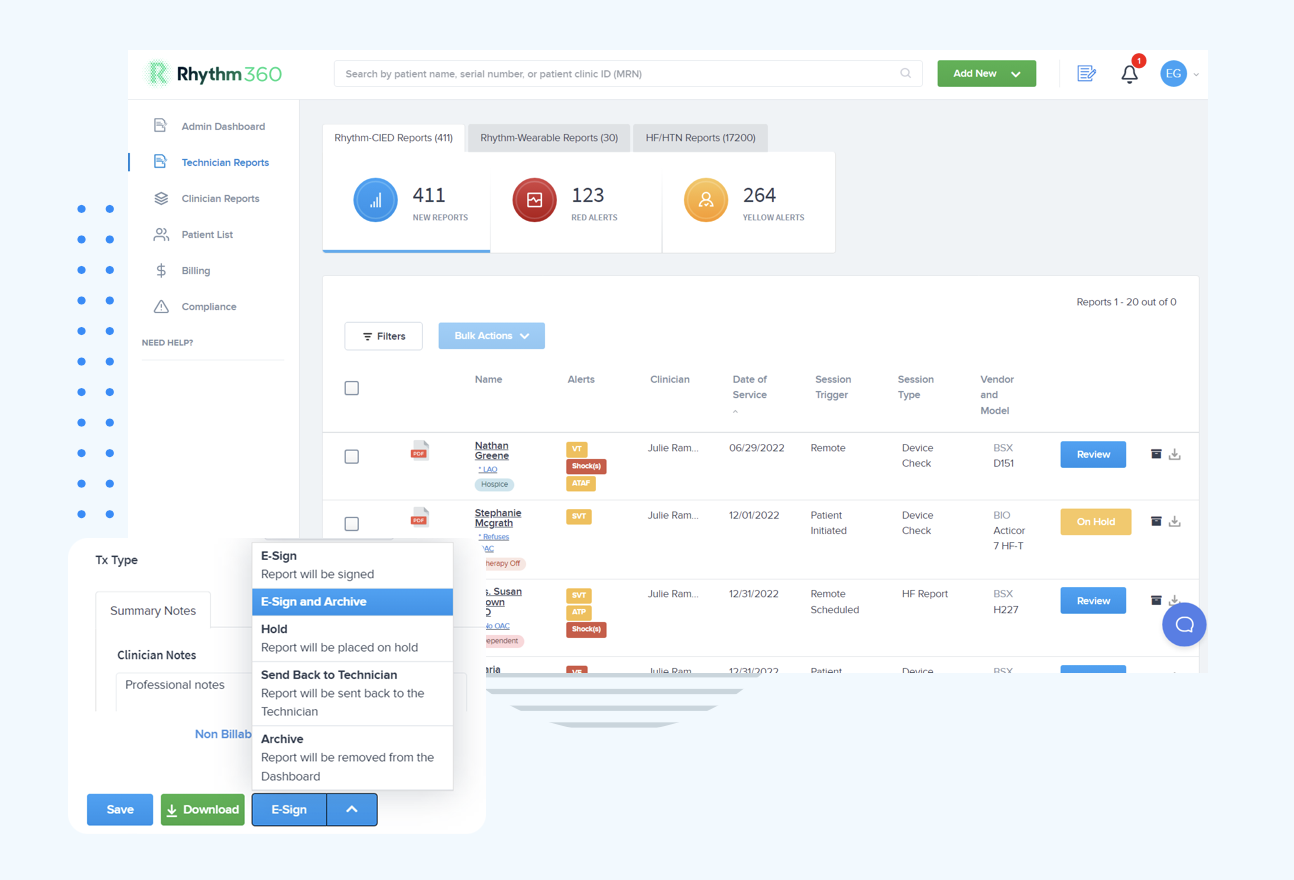
Rhythm360 works alongside your RCM vendor. The RCM vendor manages claims submission, denial management, and A/R follow-up, while Rhythm360 closes the device-data and CPT-capture gap that sits upstream of those workflows. Other platforms in the cardiac device management space include Murj, Implicity, Rhythm Management Group, and Octagos.
Many published cardiology RCM rankings come from vendors with a financial stake in the outcome or from listicles that apply opaque scoring weights without client data. Ranking methodologies such as Gitnux’s 2026 framework weight capabilities at 0.40, ease of use at 0.30, and value at 0.30, a formula that ignores cardiology-specific coding depth, device monitoring CPT capture, and denial rates by CPT family. Practices that rely only on these rankings choose vendors on criteria that do not match their real revenue leakage.
Rhythm360’s device-data normalization and automated CPT capture represent a specific, auditable capability that closes a gap most rankings never mention. The device-data layer rarely appears as a ranking criterion, which explains why this revenue leak persists across cardiology practices regardless of which biller they use.
A defensible RFP for cardiology RCM uses a structured question set and clear standards for credible answers. The prompts below create that framework.
An RCM vendor manages the billing function, including coding, claims submission, denial management, payment posting, and A/R follow-up. A cardiology data platform such as Rhythm360 operates upstream, ingesting and normalizing device transmission data from cardiac implantable electronic devices and automating the CPT code documentation that feeds the billing queue. The two functions work together. An RCM vendor cannot bill a device monitoring event that no one documented, and a data platform does not replace the claims and denial management expertise of a specialty billing organization.
Cardiology practices that manage patients with pacemakers, ICDs, implantable loop recorders, or CardioMEMS sensors from more than one manufacturer almost always benefit from both. Without a device-data platform, staff must log into separate OEM portals to retrieve transmission data, and billable monitoring events often go undocumented. Without an RCM vendor with cardiology coding depth, correctly documented events still generate denials from modifier errors, component-split mistakes, and prior authorization gaps. The most successful cardiology groups use an integrated approach where the RCM vendor handles claims and a platform like Rhythm360 closes the device-data and CPT-capture gap upstream.
Ask for 12 months of denial rates segmented by CPT family, focusing on device monitoring codes (93294–93298), echocardiography, cath lab, and electrophysiology. Ask whether coders hold CPC and CCC credentials and whether they work only within cardiovascular CPT ranges. Request a written explanation of how the vendor handles professional and technical component splits for cardiac imaging and device monitoring and how it applies modifier -26 and -TC based on practice setting and equipment ownership. A vendor that cannot answer these questions in writing with client-level data should not remain on your shortlist.
For pacemaker and ICD remote monitoring on a 90-day cycle, your vendor should handle 93294 (pacemaker professional), 93295 (ICD professional), and 93296 (pacemaker or ICD technical). For implantable cardiovascular physiologic monitors such as CardioMEMS on a 30-day cycle, they should handle 93297, billable global, -26, or -TC. For subcutaneous cardiac rhythm monitors and implantable loop recorders on a 30-day cycle, they should handle 93298, billable global, -26, or -TC. For remote physiologic monitoring, they should handle 99453 (one-time setup), 99454 (device supply with at least 16 days of data per 30-day period), and 99457 (first 20 minutes of clinical management per calendar month). Vendors must demonstrate separate workflows for each code family and understand that 93297 and 93298 are device-specific codes rather than a professional and technical pair.
Most cardiology practices complete a full transition within 4 to 6 weeks for the active billing workflow, with existing A/R from the prior vendor worked in parallel during that period. Practices should confirm in writing who owns the old A/R, what the parallel-run protocol covers, and how long the outgoing vendor will continue working aged claims. EHR integration setup often adds time, depending on the system and the depth of integration. Starting the RFP for a replacement vendor at the same time you issue a termination notice shortens the gap between vendors and protects cash flow.
Cardiology practices can evaluate RCM vendors and device-data platforms as separate decisions, yet the revenue leak that persists across vendors usually sits in the device-data layer. The strongest cardiology programs use an integrated approach where the RCM vendor manages coding, claims, denial management, and A/R follow-up, and Rhythm360 closes the device-data and CPT-capture gap upstream. Use the RFP framework above to build a shortlist you can defend to partners and your CFO, then add a device-data platform that ensures every billable monitoring event reaches your RCM vendor.
Plan Your Cardiology RCM Strategy With Rhythm360





