Last updated: July 14, 2026
The table below maps the ten most critical RCM metrics for cardiology RPM programs to 2026 targets, based on Revenue Synergy aggregated client data, MGMA 2025–2026 surveys, and HFMA MAP Keys. The gap between best-in-class and average performance is large across nearly every row, and that gap represents real, recoverable dollars for most practices.
| # | Metric | 2026 Best-in-Class Target (Cardiology) | Industry Average (Cardiology) |
|---|---|---|---|
| 1 | CPT Capture Rate | ≥95% of eligible encounters billed | ~70% |
| 2 | 16-Day Device Adherence Rate | ≥89% | ~62% |
| 3 | Revenue per RPM Patient/Month | $120–$150 | Variable |
| 4 | Clean Claim Rate | ≥95% | ~80% |
| 5 | Net Collection Rate | ≥95% | ~90% |
| 6 | Days in Accounts Receivable (DAR) | under 15-16 days | 55-65 days |
| 7 | Initial Denial Rate | <5% | ~12% |
| 8 | Alert-to-Action Ratio | 40–60% | Variable |
| 9 | Critical Alert Response Time | ≤80% faster than baseline | Baseline |
| 10 | Cost to Collect | 3.0–4.0% | 3.0–5.0% |
Each metric below builds on this table, showing where the gaps come from and how they get closed. See these metrics mapped to automated workflows in a live dashboard walkthrough.
Formula: (CPT Codes Billed ÷ Total Eligible Encounters) × 100
CPT capture rate measures the share of billable RPM encounters that actually generate a submitted claim. Automated reimbursement generation paired with real-time 16-day adherence tracking improves capture rates significantly. Rhythm360 achieves this through automated CPT documentation tied directly to device transmission data, helping practices recover previously lost revenue (see Key Takeaways above for the full recovery range).
Formula: (Patients Transmitting ≥16 Days ÷ Total Enrolled Patients) × 100
This metric determines eligibility for billing CPT 99454. RPM programs for CHF and hypertension patients see meaningful adherence gains through alert queues and personalized outreach. Rhythm360's integrated communication hub re-engages patients who haven't transmitted within five to seven days, directly protecting CPT 99454 revenue.
Formula: Total Monthly RPM Reimbursement ÷ Total Active RPM Patients
RPM programs generate an estimated $120–$150 in monthly revenue per patient, with a typical ROI of 3x–5x and break-even in 2–3 months, driven by CPT codes 99453–99458. A 100-patient panel generates $144,000–$180,000 annually. Rhythm360's transmissibility rate exceeds 99.9%, achieved through redundant data feeds and AI-powered extrapolation, so every eligible encounter gets captured and documented.
The three RPM-specific metrics above show how monitoring programs generate revenue day to day. The next set of metrics tracks whether that revenue actually gets collected once claims go out the door.
Formula: (Clean Claims ÷ Total Claims Submitted) × 100
Best-in-class cardiology practices achieve clean claim rates greater than 95%, a target confirmed by HFMA MAP Keys 2025 benchmarks. Typical cardiology practices fall well short, running rates of only 70–82%, a gap driven largely by complex procedural coding and documentation errors. Fragmented OEM portals that require manual data transcription are a major contributor, since they introduce the coding errors that suppress clean claim rates in RPM programs specifically.
Formula: Payments ÷ (Charges − Contractual Adjustments) × 100
A net collection rate below 93% indicates serious revenue leakage. Best-in-class cardiology practices reach above 95%, matching cardiology-specific targets. The gap between average and best-in-class performance translates directly to tens of thousands of dollars in annual unrecovered revenue for a mid-size practice.
Formula: Total A/R Balance ÷ (Annual Charges ÷ 365)
Best-in-class practices achieve under 15-16 days in AR (see the metrics table above). After 120 days, the probability of collecting A/R falls below 30%. Reducing charge lag from 7 days to 2 days alone drops DAR by 5–7 days and frees up $13,700–$19,200 in working capital on a $1M practice. Automated billing documentation, triggered the moment a qualifying RPM transmission arrives, is the most direct lever for compressing DAR.
Financial metrics tell you whether money is being collected. Operational metrics tell you whether clinical staff time is being spent, and documented, in a way that supports those collections.
Formula: (Clinically Actioned Alerts ÷ Total Alerts Generated) × 100
The target range is 40–60%. A ratio below 20% indicates excessive noise, while above 80% suggests over-filtering. Alert fatigue from non-actionable notifications is a documented cause of missed critical events in cardiology RPM. Rhythm360's AI-powered alert triage filters non-actionable transmissions and prioritizes clinically significant events, such as new-onset atrial fibrillation or device malfunction, cutting critical alert response times by up to 80%.
Formula: (Patients Actively Transmitting Data ÷ Total Enrolled Patients) × 100
Patient engagement rose from 60% to 85% at one cardiology program after RPM implementation. Automated medication and monitoring reminders improve adherence by 45% compared to no reminders. Higher engagement rates directly protect CPT 99454 and 99457 billing eligibility across the enrolled panel.
The metrics above only matter if they connect to specific billing codes. Cardiology RPM programs bill across two distinct CPT families, CIED remote monitoring codes and chronic RPM codes, and the table below shows how each one converts into a claim.
| CPT Code | Description | 2026 Threshold / Rate | Capture-Rate Formula |
|---|---|---|---|
| 93298 | CIED remote monitoring, pacemaker system (≥1 transmission/90 days) | Per 90-day period | (93298 Claims Filed ÷ Eligible CIED Patients) × 100 |
| 93299 | CIED remote monitoring, ICD/CRT system (≥1 transmission/90 days) | Per 90-day period | (93299 Claims Filed ÷ Eligible ICD/CRT Patients) × 100 |
| 99453 | RPM device setup and patient education (one-time) | One-time per enrollment | (99453 Claims Filed ÷ New RPM Enrollments) × 100 |
| 99454 | RPM device supply, ≥16 days of readings per 30-day period | ~$48/month | (99454 Claims Filed ÷ Patients Meeting 16-Day Threshold) × 100 |
| 99457 | RPM treatment management, first 20 minutes clinical staff time/month | ~$54/month | (99457 Claims Filed ÷ Patients with ≥20 Min Documented) × 100 |
The 2026 Medicare Physician Fee Schedule also introduced CPT 99445 (device supply for 2–15 days at ~$48) and CPT 99470 (treatment management for 10–19 minutes at ~$26). These new codes let practices bill for patients who previously fell below the 16-day and 20-minute thresholds. Rhythm360's automated CPT documentation engine tracks threshold eligibility in real time across all enrolled patients, so no billable encounter gets missed.
Understanding the metrics above matters less than acting on the specific leakage points they reveal. The checklist below identifies the highest-impact areas to audit monthly.
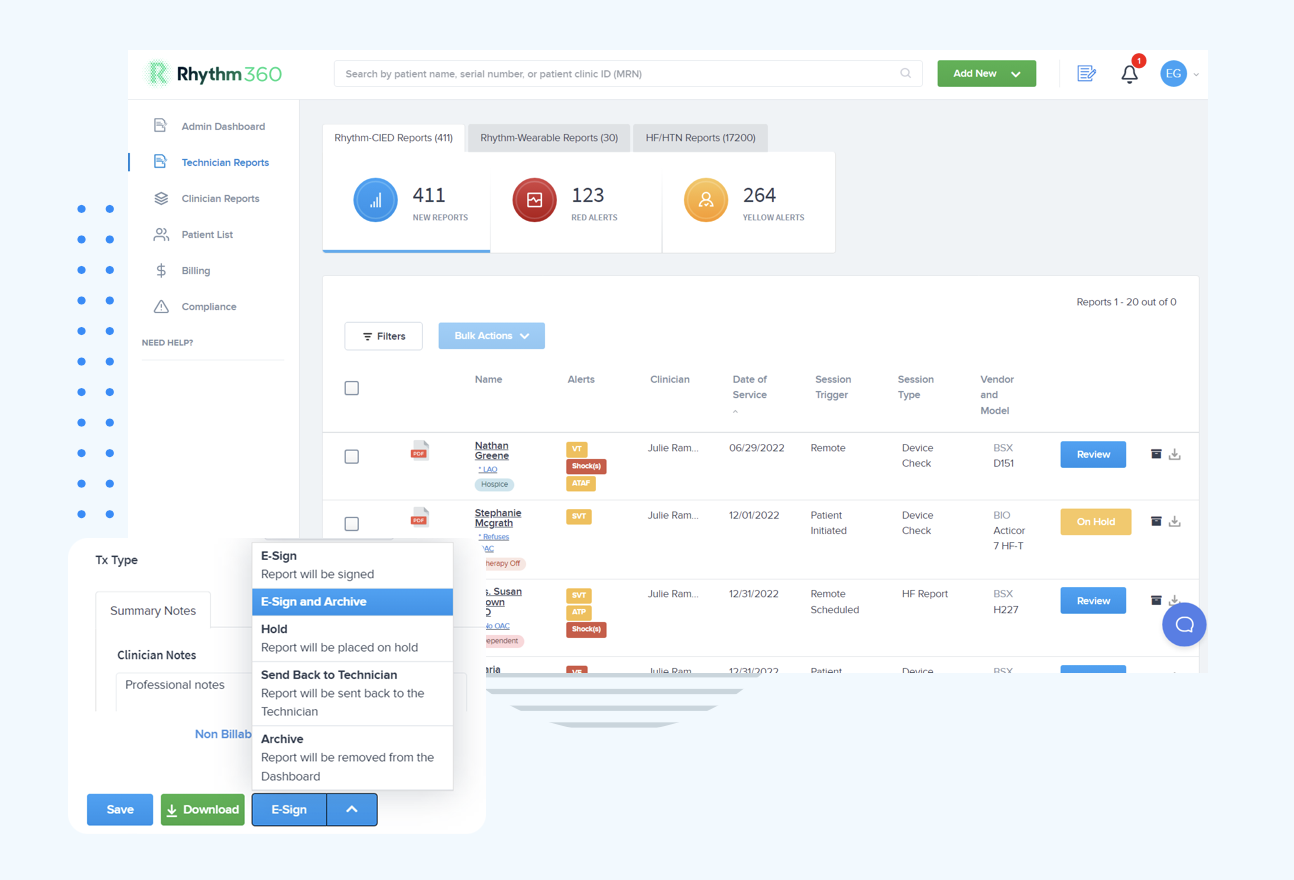
Fixing these leakage points takes manual effort unless the metrics are automated. The dashboard below shows how each KPI maps to a specific Rhythm360 feature.
The table below maps each of the ten KPIs to the Rhythm360 platform features that automate measurement and drive improvement.
| KPI | 2026 Target | Rhythm360 Feature | Outcome Enabled |
|---|---|---|---|
| CPT Capture Rate | ≥95% | Automated CPT documentation engine | Higher billed-to-eligible ratio |
| 16-Day Adherence Rate | ≥89% | Twilio-powered patient re-engagement messaging | Protects 99454/99445 billing eligibility |
| Revenue per Patient/Month | $120–$150 | Multi-CPT billing support (99453, 99454, 99457, 93298, 93299) | $144K–$180K annually per 100-patient panel |
| Clean Claim Rate | ≥95% | AI-normalized data ingestion; bi-directional EHR integration | Fewer manual transcription errors |
| Net Collection Rate | ≥95% | Auditable billing documentation with full transmission history | Fewer unworked denials and write-offs |
| Days in A/R | ≤16 days | Same-day charge capture triggered by qualifying transmission | Charge lag compressed to near zero |
| Initial Denial Rate | ≤5% | Pre-submission documentation completeness checks | Fewer prior auth and medical necessity denials |
| Alert-to-Action Ratio | 40–60% | AI-powered three-tier alert triage (red/yellow/green) | 80% faster critical alert response |
| Patient Adherence Rate | ≥85% | Automated monitoring reminders; disconnection detection | More billable patients per month |
| Cost to Collect | 3.0–4.0% | Unified vendor-neutral dashboard; automated report generation | Fewer staff hours on data retrieval and manual entry |
University of Chicago Medicine reported after implementing Rhythm360: "We have improved billing and accountability for our patients after the integration." UCM now reviews more than 73,000 reports annually through the platform, averaging more than 18,000 per quarter. That volume shows the dashboard scales to high-volume cardiology environments without losing billing accuracy or alert responsiveness.
Get a guided tour of the Rhythm360 executive dashboard and see how each KPI maps to a live automated workflow for your program.
CPT capture rate matters most because it determines whether clinical work converts into reimbursement at all. A practice can post excellent clean claim rates and low denial rates, but if eligible encounters never get billed, because device transmission data sits siloed across OEM portals, those downstream metrics become irrelevant. Tracking capture rate monthly, broken out by code (93298, 93299, 99453, 99454, 99457), reveals exactly where billing gaps exist.
Alert-to-action ratio affects billing in two ways. A ratio below 20% means most alerts are non-actionable noise, which causes alert fatigue and raises the risk that clinicians miss genuinely billable events. Documented clinical responses to alerts also form the audit trail required to support CPT 99457 and 99458 billing for interactive management time. A well-calibrated system, targeting 40–60%, keeps clinical time focused on reimbursable encounters while maintaining documentation that holds up under payer scrutiny.
Cardiology combines several compounding billing challenges: complex procedural coding across diagnostic, interventional, device, and RPM service lines, strict LCD and NCD documentation requirements, and high prior authorization burden. RPM adds the need to track time-based and transmission-based thresholds across large patient panels. Practices relying on general billers or fragmented OEM portals for CIED data face the biggest exposure, since 93298 and 93299 claims require reconciling data from device manufacturer systems that don't talk to each other or to the EHR.
RPM programs typically reach billing break-even within 2–3 months once automated CPT documentation and threshold tracking are in place. Improvement speed depends on panel size, baseline CPT capture rate, and existing charge lag. Practices with large panels and low baseline capture rates, common when staff manually reconcile data across multiple OEM portals, tend to see the fastest revenue recovery because the gap between eligible and billed encounters is largest. Rhythm360's onboarding, including EHR integration, typically takes a few days to a few weeks.
Cardiology RPM programs that track these ten metrics, CPT capture rate, 16-day adherence, revenue per patient, clean claim rate, net collection rate, days in A/R, denial rate, alert-to-action ratio, patient engagement, and cost to collect, operate with a measurable advantage over practices relying on fragmented OEM portals and manual billing. The gap between best-in-class and average performance shows up in every metric covered above. Closing that gap requires a unified platform that connects device transmission data, clinical documentation, and billing workflows into one auditable system. Rhythm360 is built for that purpose. Talk to our team about operationalizing these metrics for your practice.