

Last updated: July 13, 2026
Remote monitoring delivers the largest automation payoff for electrophysiology and cardiology practices. Device clinics process thousands of transmissions each year, and many alerts are not clinically relevant. That volume creates unsustainable alert fatigue for technicians and clinicians. AI-driven triage addresses this directly, and RhythmScience 2026 Platform Comparison data shows an 80% reduction in alert fatigue across participating sites.
Rhythm360 aggregates data from all major OEMs, including Medtronic, Boston Scientific, Abbott, Biotronik, and others, into one dashboard. The platform achieves greater than 99.9% transmissibility through redundant data feeds, computer vision, and AI-powered extrapolation. The University of Chicago Medicine reviewed more than 73,000 reports annually through Rhythm360 in calendar year 2025, which demonstrates reliability at enterprise scale.
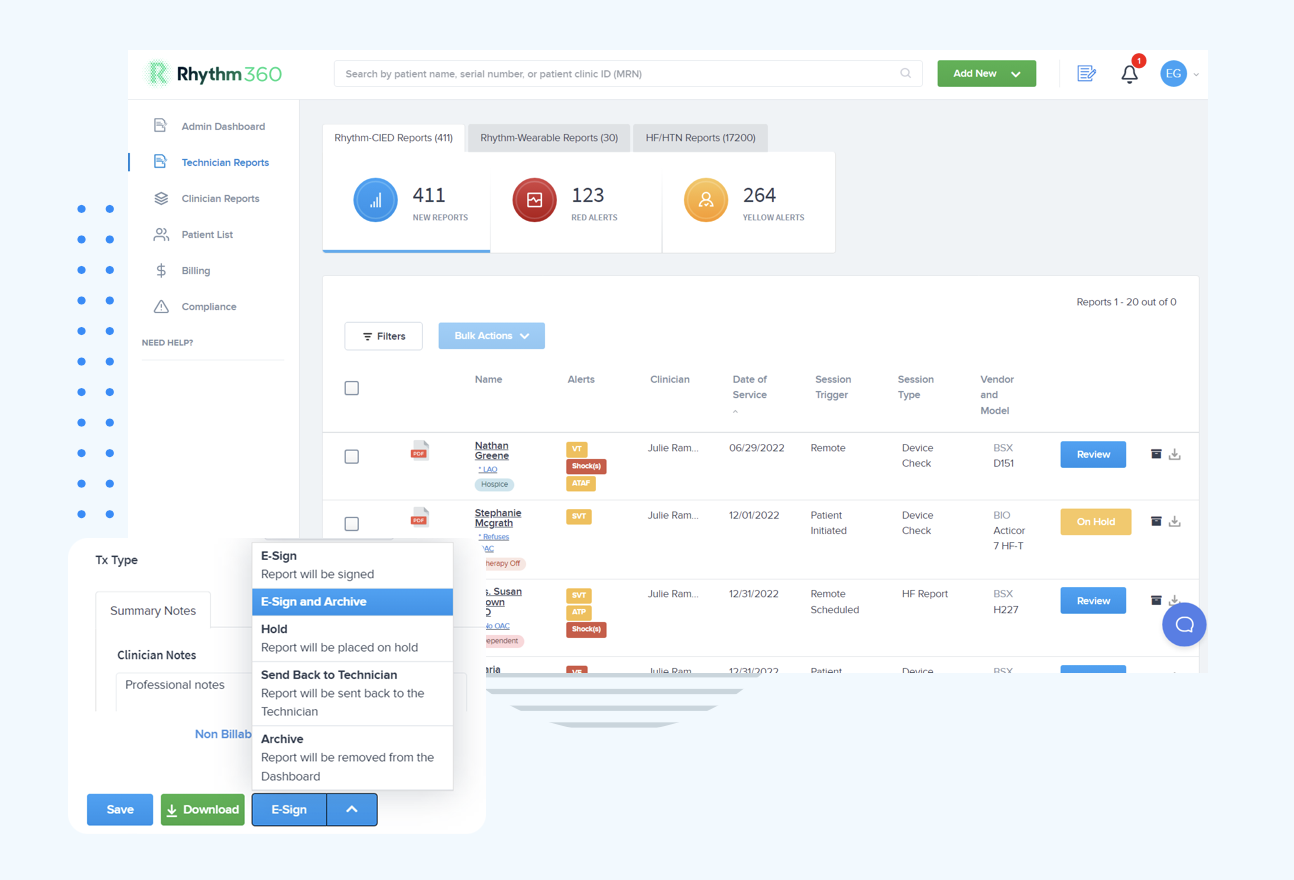
Once device data flows reliably into a unified dashboard, the next automation priority is reducing the documentation burden that data creates. Manual charting is the top burnout driver for 17% of cardiologists, according to Tebra's 2025 Physician Burnout survey. Ambient AI scribes now close that gap for many cardiology teams in 2026.
A multiphase pilot at McLeod Health found that ambient AI documentation decreased time spent on notes by 26.8%, saving 3.6 hours per provider per month. St. Luke's Health System reported a 39% reduction in after-hours documentation time and approximately $13,000 in annual savings per clinician after implementing ambient AI. These gains free cardiologists to spend more time with patients and less time in the EHR.
Bi-directional EHR integration forms the connective tissue of any high-performing cardiology automation stack. The American Heart Association identifies fragmented interfaces as a primary roadblock to scaling real-time decision support in cardiac care, which requires investment in FHIR-compliant APIs and vendor-neutral architectures. Without deep integration, device data remains in OEM portals while clinicians make decisions in the EHR, and that gap drives errors and delays.
When you evaluate integration layers, start with platforms that support HL7 and FHIR for Epic, Cerner, Athenahealth, and eClinicalWorks. Native support alone does not solve the problem, because the data must also flow in both directions. You then confirm bi-directional data exchange so device findings update the EHR record automatically and staff avoid manual re-entry.
Rhythm360 meets these requirements through deep bi-directional integrations with Epic, Cerner, Athenahealth, eClinicalWorks, Greenway Health, and other systems via HL7. Most organizations complete onboarding within a few weeks, even when they connect multiple EHR instances and device feeds.
Automated patient engagement tools reduce the workload created by disconnected patients. Disconnected patients are the single most burdensome task in device clinics, according to a 2025 international survey of 471 device clinic staff across 44 countries. Automated messaging and mobile access directly reduce that burden for front-desk teams, nurses, and physicians.
Cardiology practices that use AI-driven patient engagement tools see fewer missed transmissions and fewer last-minute cancellations. Automated reminders and real-time scheduling recovery help patients stay on track with monitoring and follow-up visits. Staff then spend less time on outbound calls and manual tracking spreadsheets.
Cardiology practices often experience denial rates of 10–20%, which sit above some other specialties but align with or fall slightly below the overall healthcare average of 15–25%. Complex procedures, modifier rules, and payer-specific policies drive many of these denials. Remote monitoring billing adds further complexity for device clinics.
Transmissions received but not billed within the 90-day cycle, data that fails to meet monitoring thresholds, or management time that does not reach required minimums all result in permanently lost revenue. These gaps often remain invisible without automated tracking and clear dashboards for billing teams.
The 2026 CMS Final Rule expanded the RPM code set with new CPT code 99445 for 2–15 days of device monitoring at approximately $47 per month and new CPT code 99470 for the first 10–19 minutes of clinical staff management time at approximately $26 per month. These codes create new billable opportunities that require precise documentation and time tracking.
The ideal automation stack depends on practice size, device population, and service mix. The table below outlines recommended Rhythm360 configurations by practice type and highlights the primary return on investment for each.
| Practice Type | Core Rhythm360 Capabilities | Primary ROI Driver |
|---|---|---|
| Small Group (1–5 providers) | Vendor-neutral CIED dashboard, automated CPT documentation, mobile app | Staff time savings and removal of multi-portal logins |
| EP Clinic (device-focused) | AI-driven alert triage, CCT oversight option, bi-directional EHR integration | Faster critical-alert response and reduced technician burnout (as noted earlier) |
| Large Health System | Full CIED plus HF/HTN RPM service lines, HL7 EHR integration, population dashboard | Significant revenue uplift and scalable monitoring across thousands of patients |
Andrew Beaser, MD, Associate Professor of Medicine at UCM, described pre-implementation workflows as "a major challenge and incredibly difficult". That description matches the experience of many practices that manage multi-OEM device populations. Rhythm360 is built to simplify that complexity for small groups, EP clinics, and large health systems.
Schedule a demo to see which Rhythm360 configuration fits your practice.
Most practices complete Rhythm360 onboarding, including EHR integration setup, within a timeframe that ranges from several days to a few weeks. The exact duration depends on the complexity of existing systems and the number of OEM device feeds that need connection. The platform is designed to limit disruption to ongoing clinical operations, and RhythmScience provides hands-on implementation support throughout the process.
Rhythm360 includes a secure, HIPAA-compliant mobile application that allows clinicians to review device transmissions, sign reports, and coordinate care from their smartphones. This access is particularly valuable for on-call coverage, because clinicians can respond to critical alerts such as new-onset atrial fibrillation or ventricular tachycardia outside standard office hours without remaining at a workstation.
Rhythm360 automates the documentation required for CIED remote monitoring CPT codes, including 93294, 93295, 93296, 93297, and 93298, and RPM codes, including 99453, 99454, 99445, 99457, and 99470. The platform tracks monitoring period dates, transmission receipt, and clinician interpretation notes so documentation meets payer requirements. This automation reduces billing leakage from missed cycles, incomplete records, and threshold shortfalls, which are common sources of permanently lost revenue in device clinics.
Rhythm360 offers distinct but integrated service lines for Rhythm-CIED, which covers pacemakers, ICDs, implantable loop recorders, CRT/CCM devices, and CardioMEMS monitors, and for HF/HTN Remote Physiological Monitoring. Practices can manage rhythm disorders, heart failure, and hypertension from a single centralized workspace. This unified approach removes the need for separate platforms or workflows for each patient population.
Rhythm360 uses a SaaS-based pricing model that scales with clinic size and platform usage. Smaller practices avoid enterprise-level pricing, while larger health systems can expand their subscription as their monitored device population grows. The platform does not require prohibitive upfront setup fees, and its revenue improvement outcomes, including substantial increases in captured billing, are designed to deliver a clear financial return.
The highest-ROI cardiology automation stacks in 2026 share a common foundation. Each relies on a vendor-neutral remote monitoring platform that removes multi-portal fragmentation, surfaces only actionable alerts, and generates compliant billing documentation automatically. Ambient documentation tools, bi-directional EHR integrations, patient engagement automation, and expanded 2026 RPM billing codes all strengthen that foundation when the underlying device data remains reliable, unified, and easy to access.
Andrew Beaser, MD, at UCM, explained, "We are able to address these issues earlier; rather than waiting for a 3-month visit, we can call patients in for evaluation." That shift from reactive to proactive care shows what a unified automation stack can deliver, both in clinical outcomes and in practice revenue.
Rhythm360 by RhythmScience provides the single source of truth that cardiology practices, EP clinics, and integrated health systems need to operate at that standard in 2026.
Schedule a demo and see how Rhythm360 can unify your cardiology workflow.





