Last updated: July 14, 2026
A vendor-neutral cardiac RPM platform is a cloud-based system that pulls together device data from every major CIED manufacturer, including Medtronic, Boston Scientific, Abbott, and Biotronik. It presents that data through one clinical interface instead of separate manufacturer portals. It also covers chronic disease RPM, bi-directional EHR integration, AI alert triage, and automated billing documentation.
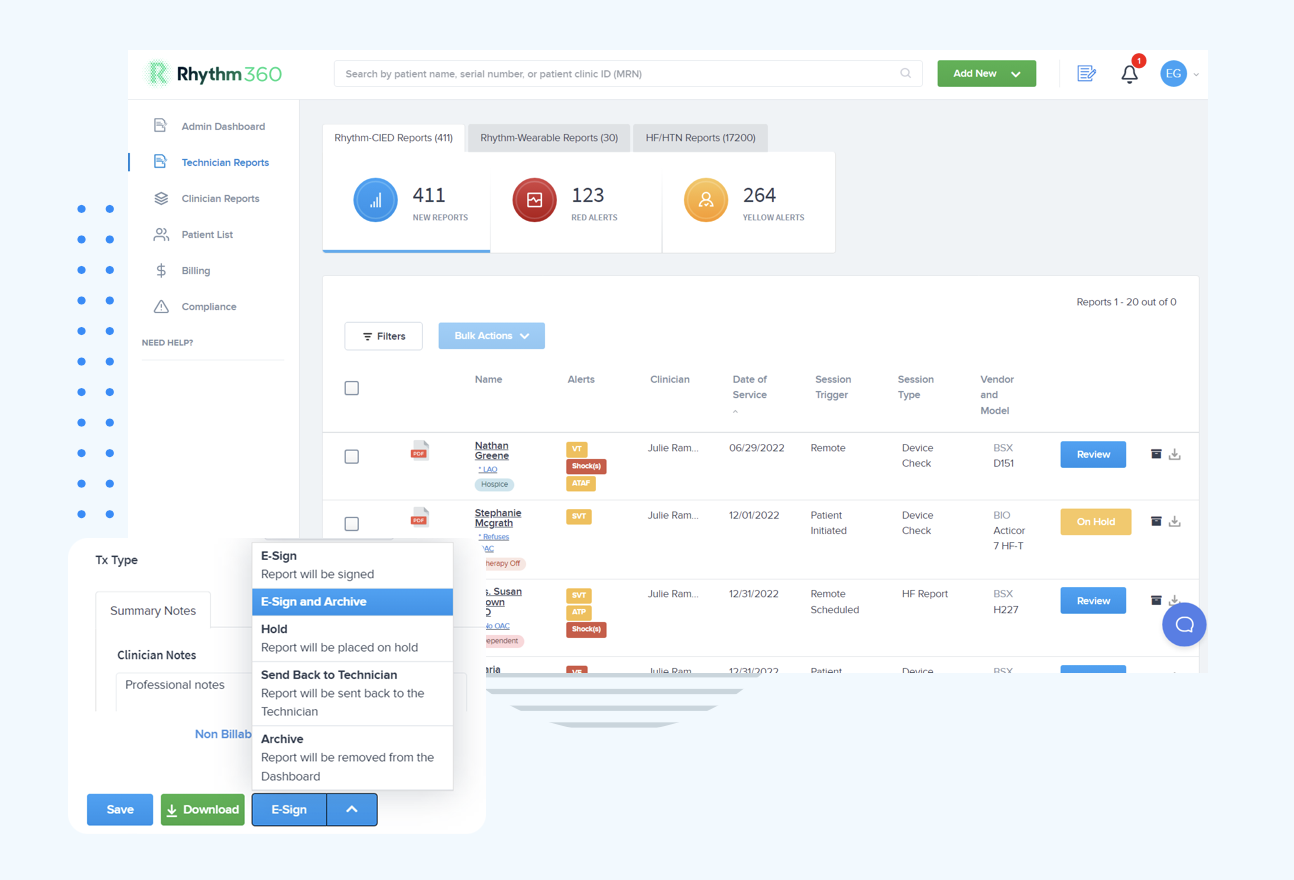
Seven criteria separate platforms that deliver real clinical and financial results from platforms that just repackage the same fragmentation.
Once a practice implants devices from more than one manufacturer, staff juggle separate logins across portals that don't talk to each other. Each portal uses its own interface, alert taxonomy, and export format. The administrative burden grows with every new manufacturer added to the patient population.
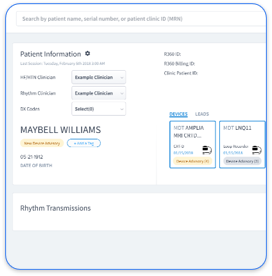
A vendor-neutral platform solves this by pulling data from Medtronic, Boston Scientific, Abbott, Biotronik, and others into one normalized dashboard. Rhythm360 does this through direct APIs, HL7, XML parsing, and computer vision-based PDF extraction. The result is a single, unified view of the entire device population. University of Chicago Medicine processed more than 73,000 reports annually through Rhythm360 in 2025, proof that this architecture scales in high-volume settings.
Andrew Beaser, MD, Associate Professor of Medicine at UCM, said the implementation let clinicians review more transmissions daily and catch more abnormalities. Consolidating fragmented data streams drove that outcome directly.
Alert fatigue is not a minor inconvenience. Estimates show 80% to 99% of alarms in hospital monitoring units are false or clinically insignificant, and hospitals see roughly 70 to 200 physiologic monitor alarms per patient per day, depending on unit type. Cardiac device monitoring creates the same sensory overload at the clinic level, driven by non-actionable transmissions from legacy systems.
AI triage filters non-actionable transmissions before they reach clinical staff. A JACC: Advances study of 690,673 transmissions found AI-based filtering cut the share forwarded for review by 40%, and a follow-on evaluation of an autonomous AI triage agent against a six-clinician majority-vote standard confirmed similar sensitivity in catching actionable alerts. Together, these studies show AI triage can maintain safety while cutting review volume substantially.
Rhythm360 applies this same logic to CIED and RPM data, cutting critical-alert response times by up to 80%. Clinical staff spend their time on events that need intervention instead of sorting through noise.
One-way data feeds, where device data flows into a monitoring platform but never back into the EHR, create a documentation gap. That gap hurts both clinical continuity and billing compliance. When RPM data stays isolated in a separate platform, it creates both clinical action and billing capture problems.
Bi-directional integration lets patient demographics, active diagnoses, and ordering provider details flow from the EHR into the RPM platform. Encounter notes, alert documentation, time logs, and monitoring reports flow back into the patient chart automatically. The 2024 CMS Interoperability and Prior Authorization Final Rule requires impacted payers to implement FHIR-based APIs for prior authorization data exchange, so FHIR-capable systems are now a practical requirement for cardiology practices.
Rhythm360 supports bi-directional integration with Epic, Cerner, Athenahealth, eClinicalWorks, Greenway Health, and other systems via HL7 and FHIR. Implementation, including EHR setup, typically takes a few days to a few weeks, not the months custom-built integrations often require.
Remote cardiac device monitoring and chronic disease RPM each carry distinct CPT code requirements with specific documentation thresholds. Missed documentation means missed reimbursement, full stop.
For CIED monitoring, Medicare reimburses through CPT codes 93294 through 93298, each with its own requirements. CPT 93294 requires a minimum 30-day monitoring period and a documented clinical interpretation, while CPT 93298 requires at least 10 days of monitoring within the 30-day service period. Chronic disease RPM runs on a separate set of codes. CPT 99470, new in 2026, covers 10-19 minutes of RPM staff time monthly at a national average of $26.05, and CPT 99457 reimburses roughly $51.77 to $52 for the first 20 minutes of treatment management requiring interactive communication. Both code families depend on the same thing: real-time, audit-ready documentation. A mature RPM program can generate $120 to $170 in gross monthly revenue per fully enrolled patient under 2026 Medicare rates, but only if the documentation supports it.
Rhythm360 automates that documentation, capturing billable events in real time. Practices using the platform have seen revenue increase by up to 300% through better CPT capture and staff efficiency. One UCM clinician put it simply: "We have improved billing and accountability for our patients after the integration."
Data transmissibility is a patient safety variable, not a marketing metric. A missed transmission from a patient with a failing lead or new-onset ventricular tachycardia is a clinical event, not a technical hiccup.
Rhythm360 hits greater than 99.9% transmissibility through a layered architecture: direct OEM API connections, HL7 and XML parsing, and computer vision extraction from unstructured PDF reports. Redundant feeds act as a fail-safe when an OEM server goes down, so manufacturer-level outages don't create gaps in the clinical record. AI-powered extrapolation fills remaining gaps and cross-references readings for accuracy.
Critical events don't wait for office hours. A clinician who can't access patient data remotely is effectively unavailable most of the week. Rhythm360's HIPAA-compliant mobile app lets electrophysiologists, NPs, PAs, and device technicians review transmissions, sign reports, and coordinate care from anywhere.
Practices that need round-the-clock coverage without adding staff can add optional oversight from certified cardiac technicians supervised by physicians, running 24/7/365. All communication, including phone logs, runs through an integrated Twilio-powered messaging framework and stays tracked in the patient record for a full audit trail.
CIED monitoring and chronic disease RPM are clinically distinct but operationally connected. A patient with an ICD may also have heart failure or hypertension. Managing those conditions on separate platforms brings back the exact fragmentation a unified system is supposed to eliminate.
Rhythm360 runs distinct but integrated service lines for Rhythm-CIED and HF/HTN remote physiological monitoring. The HF/HTN line includes patient onboarding checklists, automated billing support for CPT codes 99453, 99454, 99457, and 99470, and monitoring of condition-specific metrics like daily weight and blood pressure. Structured RPM programs for heart failure patients can reduce hospital admissions, and continuous monitoring paired with proactive care management can lower blood pressure in hypertension patients.
These seven criteria work together. A platform that nails data aggregation but skips CPT automation still leaves revenue on the table, and a platform with great mobile access but no HF/HTN integration still leaves practices juggling separate systems for related conditions. The next question is how these criteria play out differently depending on practice size.
Small cardiology practices, solo practitioners, and two-to-four physician groups face a different calculus than large health systems. Time-to-value, staff capacity, and IT overhead matter more than enterprise scale features.
Small practices should prioritize SaaS pricing that scales with patient volume, implementation measured in days or weeks rather than months, vendor-handled EHR integration, and optional managed monitoring to extend capacity without new hires. Single-care-manager models work at small scale but break down between 200 and 500 patients due to alert volume and staffing limits. That's exactly why AI triage and redundant architecture matter even for smaller clinics planning to grow.
Large electrophysiology groups need different things: multi-tenant design, role-based panel assignments, and enterprise-grade data ingestion that handles thousands of devices without slowing down. Rhythm360 supports both ends of that spectrum on the same platform, so practices don't face a migration as they scale.
Before committing to a platform, ask vendors these questions directly.
Choosing a cardiovascular RPM platform in 2026 means weighing seven interdependent capabilities together: data aggregation, AI triage, EHR integration, CPT automation, transmissibility, mobile access, and integrated HF/HTN service lines. Platforms covering only part of this list push the remaining work back onto your staff.
Rhythm360 addresses all seven from a single dashboard. Practices manage their entire CIED population across manufacturers, cut alert response times, automate CPT documentation, and launch HF/HTN service lines without added overhead. Setup takes days to weeks, not months.
A vendor-neutral platform ingests and normalizes data from every major CIED manufacturer through one interface, with no separate OEM logins required. It doesn't favor any single manufacturer's data format. Rhythm360 uses direct APIs, HL7, XML, and computer vision PDF parsing, backed by redundant feeds and AI extrapolation, to maintain the transmissibility levels described above.
The system classifies incoming transmissions before they reach the review queue, routing routine checks through automated documentation and escalating significant events like new-onset atrial fibrillation or lead malfunction immediately. It's calibrated to err toward escalation rather than suppression for ambiguous cases. Rhythm360 pairs this with optional 24/7 CCT oversight for practices that want a human in the loop, delivering the response-time improvement described in section 2 without increasing non-actionable alert volume.
CIED monitoring runs on codes 93294 through 93298; chronic disease RPM uses 99445, 99453, 99454, 99457, 99458, and 99470. Each carries its own minimum monitoring period and documentation standard, detailed in section 4 above. Rhythm360 automates capture of these events in real time, generating records that meet each code's requirements.
Setup typically runs a few days to a few weeks, including EHR integration. RhythmScience configures the integration with Epic, Cerner, Athenahealth, eClinicalWorks, Greenway Health, and other supported systems, so your team doesn't dedicate internal IT resources. Onboarding covers OEM portal connections, EHR integration, staff training, and activation of CIED, HF/HTN, or both service lines.
Yes. Small practices get SaaS pricing, fast setup, and optional CCT monitoring to manage a CIED population without new hires. Large groups get multi-tenant architecture and enterprise-grade ingestion that handles thousands of devices without slowing down, so practices don't face a platform migration as they scale, as covered above.