

Last updated: July 13, 2026
A vendor-neutral cardiac remote patient monitoring platform is a cloud-based system that ingests, normalizes, and displays CIED transmission data from all major device manufacturers, including Medtronic, Boston Scientific, Abbott, and Biotronik. It presents this information alongside chronic disease RPM data in a single unified dashboard, independent of any one OEM portal.
Rhythm360 by RhythmScience is a vendor-neutral, HIPAA-compliant chronic cardiac disease management platform. It consolidates CIED data from all major OEMs, automates CPT documentation for remote monitoring and chronic care codes, delivers AI-powered alert triage, and integrates bidirectionally with Epic, Cerner, Athenahealth, and eClinicalWorks. Cardiology practices gain a single source of truth for clinical decisions and billing compliance.
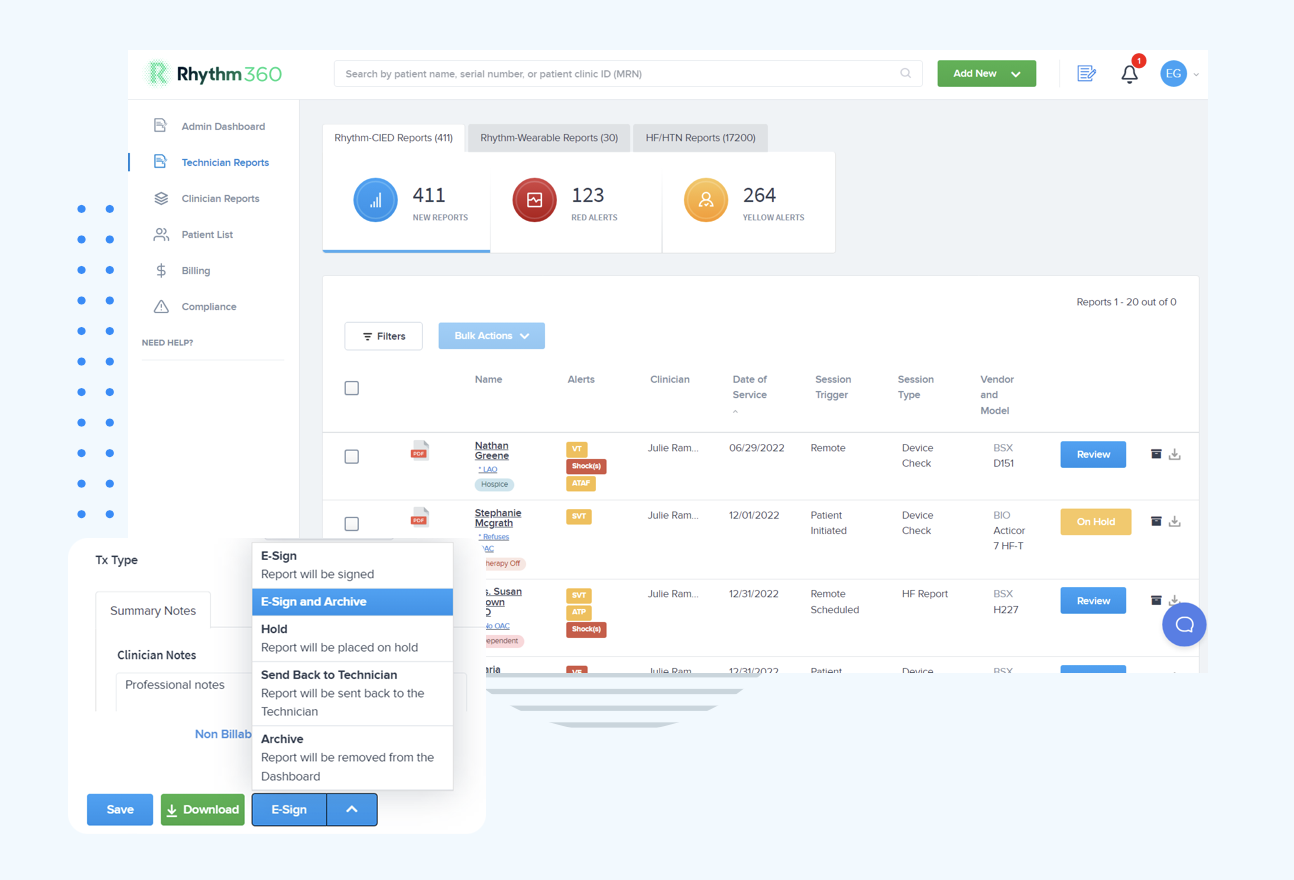
To understand how vendor-neutral platforms deliver value, cardiology teams benefit from a clear view of the RPM workflows these platforms must support.
Remote patient monitoring (RPM) in cardiology refers to the continuous or scheduled collection of physiological and device data from patients outside a clinical setting, transmitted digitally to a care team for review and intervention. In practice, RPM covers two distinct but related workflows. The first is remote interrogation of CIEDs such as pacemakers, ICDs, implantable loop recorders, and CRT devices. The second is remote physiological monitoring of chronic conditions such as heart failure (HF) and hypertension (HTN) using connected scales, blood pressure cuffs, and wearable sensors.
The clinical case for continuous CIED monitoring is substantial. A 2026 analysis published in JACC from the ALLEVIATE-HF trial found that over 3 years atrial fibrillation occurred in 66.6% and bradyarrhythmia in 47.1% of symptomatic heart failure patients, with VT/VF in 20%, a burden that the investigators described as previously underappreciated. Reliable, continuous data transmission is necessary to detect these events early.
University of Chicago Medicine reviewed more than 73,000 reports annually through Rhythm360 in calendar year 2025, averaging more than 18,000 reports per quarter. This volume demonstrates the scale at which a unified platform must operate. Andrew Beaser, MD, Associate Professor of Medicine at UCM, observed: "We are able to address these issues earlier; rather than waiting for a 3-month visit, we can call patients in for evaluation."
A typical device clinic processes thousands of transmissions annually, many of which are clinically non-relevant alerts. This volume creates a significant problem, because clinicians spend hours reviewing non-actionable notifications, a condition known as alert fatigue that delays response to truly critical events. Rhythm360 addresses this bottleneck with AI-powered alert triage that cuts critical-alert response time by about 80% while maintaining greater than 99.9% data transmissibility through redundant data feeds, computer vision, and AI-powered extrapolation.
Consider a practical scenario. On a Saturday morning, Rhythm360 flags new-onset atrial fibrillation in a post-implant patient. The on-call clinician receives a prioritized mobile notification, reviews the transmission, and initiates anticoagulation protocols the same afternoon. Without automated triage, that intervention might wait until Monday’s manual portal review.
Medicare reimburses cardiology practices for both CIED remote monitoring and chronic disease RPM under distinct CPT code families, each with specific documentation and time requirements. Under the CY 2026 Medicare Physician Fee Schedule Final Rule, the primary codes and approximate rates include the following:
A 500-patient cardiology RPM program leaves $400,000 or more per year on the table when the 20-minute rule, 16-day transmission rule, and 90-day device interrogation cycles are tracked manually. Rhythm360’s automated CPT documentation captures these billing windows systematically. Practices recover previously lost revenue and can increase profitability by as much as 300%. Gaurav A. Upadhyay, MD, at UCM, confirmed: "We have improved billing and accountability for our patients after the integration."
OIG Project OAS-25-05-008 is actively auditing Medicare Part B RPM payments, which totaled $536 million in 2024. Primary audit triggers include documentation gaps around the 16-day transmission requirement for 99454 and the 20-minute time requirement for 99457. Automated, auditable documentation now functions as a core compliance requirement.
Understanding RPM reimbursement in isolation, however, limits the revenue picture. Many cardiology practices can capture significantly more revenue by running RPM alongside Chronic Care Management for the same patient population.
RPM and Chronic Care Management (CCM) are distinct Medicare service lines that address different aspects of ongoing patient care. RPM (CPT 99453–99458) reimburses for the collection and clinical review of physiological data from connected devices. CCM (CPT 99490, 99439, 99491) reimburses for non-face-to-face care coordination activities for patients with two or more chronic conditions, documented in 20-minute increments of clinical staff time.
The two programs are concurrently billable under CMS CY2026 Physician Fee Schedule rules for the same Medicare patient in the same month when time is tracked separately. The 2026 Medicare Physician Fee Schedule Final Rule, issued by CMS on October 31, 2025, updated reimbursement for CCM codes.
When correctly stacked, RPM and CCM workflows capture $1,300 to $1,700 per complex cardiac patient per year between the 99453/99454/99457/99458, 99490/99491, and 93296/93297 code families. Rhythm360 supports both service lines within a single platform. Rhythm-CIED manages implantable device monitoring, and HF/HTN RPM supports chronic physiological monitoring. Practices can launch and bill both programs from one administrative workspace without duplicating staff effort.
A practice with 200 RPM patients and a 70% CCM qualification rate leaves $221,760 to $262,080 in annual uncaptured revenue by failing to enroll dual-eligible patients in both programs. The revenue opportunity described earlier scales predictably across practice sizes.
EHR integration is a prerequisite for sustainable CIED and RPM workflows. Without bidirectional data exchange, clinical staff must manually transcribe device data into the patient record. That process introduces errors, consumes time, and creates documentation gaps that trigger billing denials.
Rhythm360 offers deep, bidirectional integrations with Epic, Cerner, Athenahealth, eClinicalWorks, and Greenway Health, as well as additional systems via HL7. Data flows in both directions. Device transmissions and RPM readings populate the EHR automatically, and patient demographic and scheduling data from the EHR populate Rhythm360 without manual entry. The onboarding process, including integration setup, typically takes from a few days to a few weeks, which moves significantly faster than legacy on-premise implementations.
Research on digital health platform adoption in chronic disease settings confirms that sustained use depends on workflow fit and burden reduction rather than usability alone. Pilots frequently fail to scale when integration into routine clinical practice is not addressed. Rhythm360’s implementation approach centers on operational co-design with the practice, which reduces the disruption that typically accompanies new clinical software deployments.
Several platforms address CIED data management for cardiology practices. Rhythm360 consolidates transmission data from all major OEMs, including Medtronic, Boston Scientific, Abbott, and Biotronik, into a single triage queue using API connections, HL7, XML, and PDF parsing via computer vision. Custom integration layers that authenticate with Medtronic CareLink, Abbott Merlin.net, Boston Scientific Latitude, and Biotronik Home Monitoring normalize transmissions into a single triage queue, eliminating the need for staff to log into four separate portals daily.
A redundant data feed system acts as a fail-safe when an OEM server is unavailable and maintains greater than 99.9% transmissibility. AI-powered alert triage filters non-actionable notifications and surfaces clinically significant events for prioritized review. Clinicians access all of this through a secure, HIPAA-compliant mobile application, which enables review and care coordination from any location.
The 2023 HRS/EHRA/APHRS/LAHRS expert consensus statement confirms that remote monitoring is beneficial for the management of patients with CIEDs by impacting morbidity and mortality. The statement also provides guidance on alert management and the use of third-party resources to address the challenges of higher transmission volumes. A unified, AI-assisted platform directly addresses these challenges.
| Attribute | Rhythm360 Capability |
|---|---|
| Vendor-Neutral CIED Coverage | Medtronic, Boston Scientific, Abbott, Biotronik, and others via API, HL7, XML, and computer vision PDF parsing |
| AI Alert Triage | 80% reduction in critical-alert response time, filters about 60% clinically non-relevant alerts |
| Automated CPT Documentation | Tracks 16-day transmission rule (99454), 20-minute time rule (99457/99458), and 90-day CIED interrogation cycles (93296/93297/93298) |
| Bidirectional EHR Integrations | Epic, Cerner, Athenahealth, eClinicalWorks, Greenway Health, and others via HL7 |
| Service Lines | Rhythm-CIED (pacemakers, ICDs, ILRs, CRT/CCM, CardioMEMS) and HF/HTN RPM |
| Mobile Access | Secure, HIPAA-compliant mobile app for transmission review, report signing, and care coordination |
| Implementation Timeline | Days to weeks, including EHR integration setup |
| Practice Type | Staffing Impact | Revenue Capture Opportunity | Onboarding Duration |
|---|---|---|---|
| Solo Practitioner / Small EP Clinic | Eliminates multi-portal logins and reduces reliance on a single "super-user" for device data retrieval | Base RPM stack (99453 + 99454 + 99457) generates approximately $1,300 per patient per year at 2026 CMS rates | Days to a few weeks |
| Mid-Size Cardiology Group | Automated reporting and bidirectional EHR integration reduce manual transcription burden across multiple clinicians and device technicians | The revenue opportunity described earlier scales to mid-size panels when 99457, 99458, and 99454 are captured automatically. | Weeks |
| Large Health System / Integrated EP Program | Supports review of 73,000+ reports annually with stable dismissal rates and scalable AI-assisted triage | 500 dual-enrolled RPM + CCM patients produce $1.0M to $1.84M annually at 2026 CMS PFS rates | Weeks, with dedicated implementation support |
Rhythm360 delivers value across a progressive ladder of capability, starting with foundational data consolidation and extending through advanced AI triage and new revenue streams from chronic disease service lines.
Level 1 – Data Consolidation: The platform’s first function is eliminating the multi-portal problem. Instead of logging into four separate OEM portals daily, all CIED transmissions from all OEMs flow into a single dashboard, normalized and accessible without separate logins. By consolidating what was previously scattered across multiple systems, this single-dashboard approach reduces administrative hours and eliminates the data silos that cause missed events and billing gaps.
Level 2 – AI Alert Triage and Clinical Safety: With consolidated data, Rhythm360’s AI triage layer filters non-actionable alerts and prioritizes clinically significant events. A 2026 meta-analysis in npj Digital Medicine of 79 randomized trials including 31,669 heart failure patients found that remote monitoring reduced total HF hospitalizations by 19%. Remote monitoring programs for CIED patients have been shown to reduce cardiovascular hospitalizations compared with standard in-office monitoring and to generate cost savings. Andrew Beaser, MD, at UCM, noted: "Decision support, including AI-assisted decision support, will become increasingly important as data volumes grow."
Level 3 – New HF/HTN RPM Revenue Streams: Practices that add Rhythm360’s HF/HTN RPM service line gain a recurring revenue stream with minimal additional staffing. A complex cardiac patient on an ICD and RPM cuff generates roughly $255 per month or approximately $3,000 per year when 99454, 99457, two units of 99458, 99490, and amortized 93297 are stacked correctly under 2026 Medicare rates. Automated CPT documentation ensures that billing windows are captured systematically and do not depend on staff memory or manual tracking.
The combined effect of data consolidation, AI triage, and automated billing is a practice that spends less time on administration, misses fewer critical events, and captures more of the revenue it has already earned.
The four pillars of guideline-directed medical therapy for chronic heart failure with reduced ejection fraction (HFrEF) are angiotensin receptor-neprilysin inhibitors (ARNIs) or ACE inhibitors or ARBs, beta-blockers, mineralocorticoid receptor antagonists (MRAs), and sodium-glucose cotransporter-2 (SGLT2) inhibitors. These four drug classes form the foundation of what many clinicians call the "fantastic four" in heart failure management, and each class independently reduces mortality and hospitalization. Remote patient monitoring platforms like Rhythm360 support CHF management by enabling continuous surveillance of physiological parameters such as weight, blood pressure, heart rate, and device-detected arrhythmias that signal decompensation before it requires emergency intervention. Care teams can then adjust therapy proactively rather than reactively.
Cardiologists sometimes suggest consumer wearables like the Apple Watch as supplementary tools for detecting irregular heart rhythms in low-risk, ambulatory patients, particularly for atrial fibrillation screening. These devices can provide useful early signals but do not function as medical-grade monitoring devices and do not replace prescribed RPM programs or CIED remote monitoring in patients with established cardiac diagnoses. The Apple Watch ECG and AFib detection features are cleared by the FDA for notification purposes, not for diagnostic use in high-risk populations. For patients with implanted devices, heart failure, or complex arrhythmia histories, clinician-supervised RPM using validated, prescription-grade devices integrated into a platform like Rhythm360 provides the data fidelity, audit trail, and clinical oversight that consumer wearables cannot match.
Echocardiography is the gold standard diagnostic tool for heart failure. A transthoracic echocardiogram (TTE) provides a comprehensive assessment of cardiac structure and function, including left ventricular ejection fraction (LVEF), wall motion abnormalities, valvular disease, and diastolic function. Clinicians use this information to classify heart failure as HFrEF, HFmrEF, or HFpEF and to guide therapy selection. For ongoing management and decompensation monitoring, invasive hemodynamic monitoring via implantable pulmonary artery pressure sensors, such as CardioMEMS, has demonstrated strong evidence for reducing heart failure hospitalizations in appropriately selected patients. Rhythm360 supports CardioMEMS data integration alongside other CIED and RPM data streams, which enables care teams to monitor hemodynamic trends continuously within the same platform used for device management.
The Apple Watch uses a single-lead photoplethysmography (PPG) sensor to detect irregular pulse patterns and a single-lead ECG for rhythm confirmation. In high-risk patients, including those with prior stroke, structural heart disease, or existing antiarrhythmic therapy, this level of monitoring does not provide enough detail for clinical decision-making. The device generates a high rate of false positives in older populations and patients with comorbidities, and it cannot detect all clinically significant arrhythmias, including ventricular tachycardia or device-related events.
For patients with CIEDs, the implanted device itself provides continuous, physician-programmed arrhythmia detection with far greater sensitivity and specificity than any consumer wearable. Rhythm360 aggregates this CIED-generated data and applies AI triage to surface the events that require clinical action. This approach delivers a level of surveillance that consumer devices are not designed to provide.
Fragmented OEM portals, manual billing workflows, and reactive alert management are solvable problems for cardiology practices. Rhythm360 by RhythmScience delivers a single, vendor-neutral platform that unifies CIED data from all major manufacturers, automates CPT documentation across remote monitoring and chronic care code families, applies AI-powered triage to reduce critical-alert response time, and integrates bidirectionally with the EHR systems cardiology practices already use. Practices that adopt this model operate with less administrative burden, greater clinical confidence, and higher capture of the revenue they have already earned.
Talk to our team about consolidating your cardiac data with Rhythm360.




