

Last updated: July 14, 2026
Electrophysiology practices implanting devices from more than one manufacturer inherit a structural problem. Each OEM operates a separate, non-interoperable portal. Getting a complete picture of a patient's device status means logging into multiple systems, reconciling conflicting data formats, and manually entering results into the EHR. Vendor fragmentation carries operational, financial, and clinical costs, showing up as slower workflows and missed opportunities to improve care.
Device clinics process thousands of transmissions annually, and nearly 60% of alerts turn out to be clinically non-relevant. Without intelligent triage, staff spend most of their time reviewing noise instead of acting on genuine clinical events. The consequences compound:
Other platforms serve parts of this market. This article focuses on Rhythm360 because its architecture addresses the full scope of these challenges in one system.
A vendor-neutral EP automation platform ingests, normalizes, and presents CIED and RPM data from all major device manufacturers through one interface, independent of any OEM relationship. It connects bi-directionally with EHR systems, automates CPT-compliant documentation, applies AI-driven alert triage, and provides secure mobile access. Practices don't need to standardize on one device manufacturer to get workflow coherence.
Rhythm360 is RhythmScience's implementation of this model, built specifically for CIED and RPM workflow automation.
Rhythm360 is a HIPAA-compliant, AI-powered platform serving independent EP clinics, cardiology practices, and large integrated health systems managing thousands of patients across multiple device manufacturers.
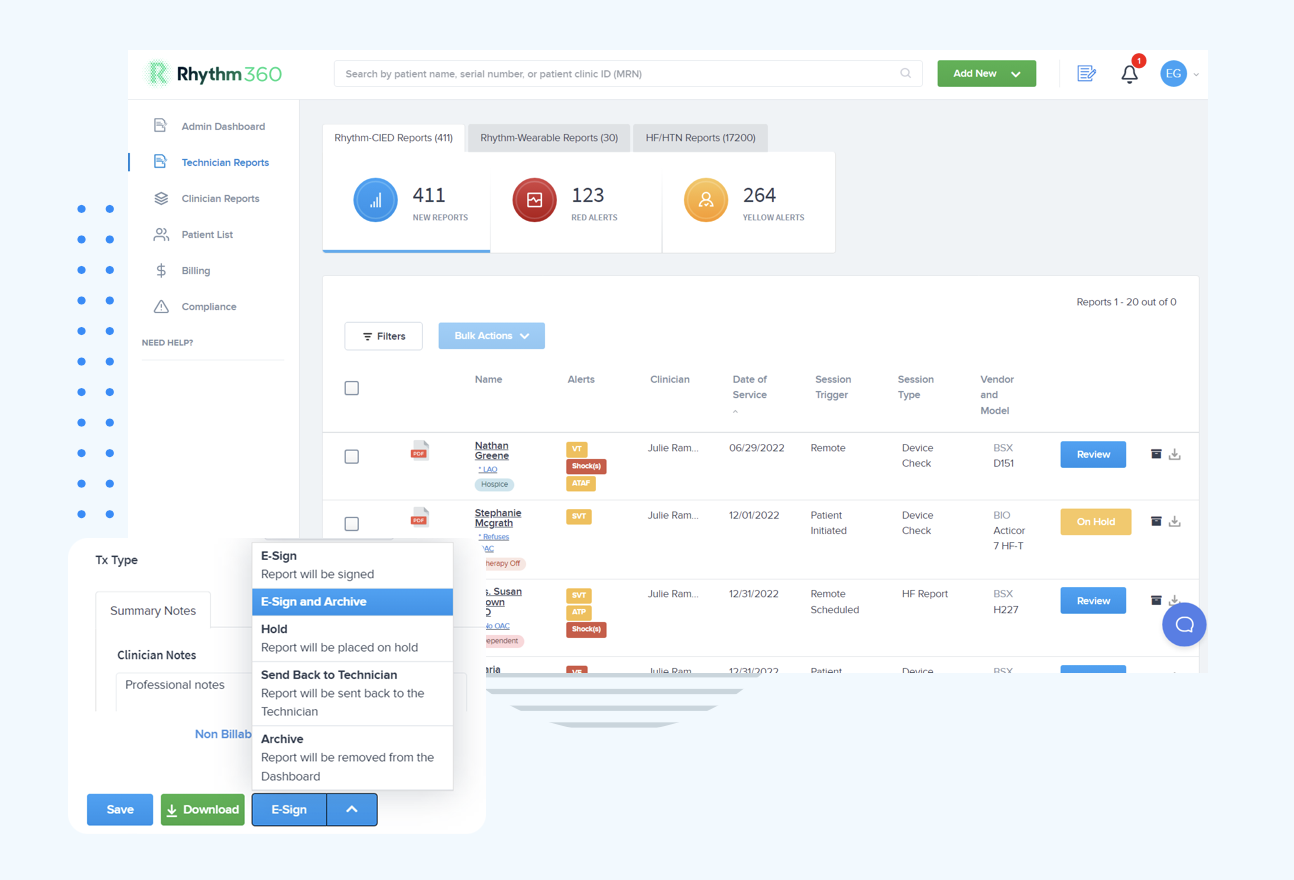
The platform's capabilities work together to solve the fragmentation problem end to end. Multi-OEM ingestion feeds a single dashboard, which the AI triage layer scans for actionable events, which then flow into automated billing documentation:
See your device data unified in a walkthrough built around your current device population.
A platform that supports only some OEMs forces practices to maintain parallel workflows for unsupported devices. Rhythm360 ingests data from all major manufacturers using redundant data feeds as a fail-safe during OEM downtime, achieving greater than 99.9% transmissibility.
AI-driven triage reduces alert fatigue while maintaining high data reliability. Rhythm360's triage layer prioritizes ventricular fibrillation, lead malfunction, ERI/RRT indicators, and significant physiologic changes, while suppressing non-actionable noise. Andrew Beaser, MD, Associate Professor of Medicine at UCM, explained: "We are able to address these issues earlier. Rather than waiting for a 3-month visit, we can call patients in for evaluation."
The RPM billing landscape has grown more complex. The 2026 code set includes 99453 (one-time setup, ~$22), 99445 (device supply for 2-15 transmission days, ~$52), 99454 (device supply for 16+ days, ~$52), 99470 (10-19 minutes of management, ~$26), 99457 (first 20 minutes, ~$52), and 99458 (each additional 20 minutes, ~$41). Rhythm360 tracks transmission days automatically, generates timestamped documentation, and flags billable thresholds before the billing window closes. This directly addresses the documentation gaps that generate OIG audit risk.
Provider portals that integrate seamlessly with existing EMR systems eliminate duplicate data entry, saving physicians several productive hours per week. Rhythm360's bi-directional connections push normalized device data and signed reports directly into the patient record, while pulling demographic and scheduling data back into the platform.
Critical events don't wait for business hours. Rhythm360's HIPAA-compliant mobile app lets an on-call electrophysiologist review a Saturday morning arrhythmia alert, initiate anticoagulation protocols, and document the intervention before the patient reaches a hospital, all from a smartphone.
Successful RPM programs in 2026 operate as a closed loop: data, triage, intervention, documentation, outcomes. Rhythm360's implementation, including EHR integration, completes in days to weeks, minimizing disruption to active patient panels. That speed matters because the sooner a practice goes live, the sooner it starts recovering the revenue and staff hours described below.
Rhythm360 delivers measurable results across three dimensions: data reliability, response speed, and revenue capture. Improved data reliability comes from redundant OEM feeds, computer vision PDF parsing, and AI-powered gap extrapolation. Faster response speed enables earlier intervention for arrhythmias, device malfunctions, and heart failure decompensation. Revenue capture improves through automated CPT documentation, better staff efficiency, and new RPM service lines for heart failure and hypertension patients.
UCM reviewed more than 73,000 reports in 2025 through Rhythm360, averaging over 18,000 per quarter. That volume shows the platform holds up in high-demand academic settings without slowing down. As Upadhyay put it: "We have improved billing and accountability for our patients after the integration."
The table below pulls together the outcomes referenced above into one view, showing how Rhythm360's data reliability, alert triage, and revenue metrics stack up against what buyers need.
| Evaluation Criterion | Rhythm360 Metric | Supporting Evidence | Notes |
|---|---|---|---|
| Data Transmissibility | >99.9% | Redundant OEM feeds, computer vision, AI extrapolation | Maintained even when OEM servers experience downtime |
| Critical Alert Response Reduction | Up to 80% | HRS 2026 Platform Comparison data | AI triage filters ~60% non-actionable alerts |
| Revenue Lift | Up to 300% | Automated CPT capture plus new RPM service lines | Includes HF/HTN RPM codes 99454, 99457, 99458 |
| EHR Integration Depth | Bi-directional | Epic, Cerner, Athenahealth, eClinicalWorks, Greenway, others via HL7 | Setup completes in days to weeks |
| Annual Report Volume (UCM) | 73,000+ reports/year | UCM white paper, 2025 data | ~18,000+ reports per quarter at a single academic center |
| Mobile Access | HIPAA-compliant mobile app | iOS/Android; full transmission review and report signing | Supports on-call clinicians outside office hours |
| Implementation Timeline | Days to weeks | Includes EHR integration setup | SaaS model; no on-premise infrastructure required |
A five-physician clinic and an academic health system run into different bottlenecks first. The matrix below maps Rhythm360's capabilities to practice size so you can see which features matter most for your situation.
| Feature Priority | Independent EP Clinic (1-5 Physicians) | Mid-Size Cardiology Group (6-20 Physicians) | Large Health System / Academic Center |
|---|---|---|---|
| Primary Pain Point | Manual OEM portal logins; missed CPT billing | Alert fatigue; staff burnout; scaling RPM | Volume management; staffing continuity; compliance |
| Most Critical Feature | Automated CPT documentation (99454, 99457) | AI alert triage plus bi-directional EHR integration | Scalable multi-OEM ingestion plus 24/7 CCT oversight |
| Implementation Priority | Speed (days); minimal IT resources required | EHR integration depth; staff training | Data migration; enterprise HL7 configuration |
| Revenue Opportunity | Capture previously missed RPM codes; add HF/HTN service line | Improve existing billing; reduce claim rejections | Population-level billing compliance; audit readiness |
The questions below come up most often once practices see how the platform maps to their size and pain points.
Rhythm360 augments device technicians rather than replacing them. By consolidating all OEM data into a single dashboard and automating routine report generation, the platform eliminates the most repetitive administrative tasks: logging into multiple portals, manually transcribing data, and chasing billing documentation. Technicians redirect that recovered time toward higher-value work, like reviewing flagged abnormalities and coordinating patient care. For practices struggling with technician turnover, less administrative burden directly addresses one of the main drivers of burnout. Rhythm360 also offers optional 24/7/365 oversight by certified cardiac technicians supervised by physicians, giving practices a staffing safety net for weekend and after-hours coverage without new full-time hires.
Rhythm360 is a fully HIPAA-compliant, cloud-based platform. All patient data is encrypted in transit and at rest. The platform keeps a complete audit trail for every transmission review, report signature, patient communication, and billing documentation event, which matters during OIG audits or payer reviews. The integrated Twilio communication framework logs all patient interactions, including phone calls, within the patient record. Role-based access controls ensure clinical users, administrators, and billing staff see only the data relevant to their role. The mobile app applies the same security standards as the desktop platform, so remote access doesn't create extra compliance exposure.
The scope depends on the practice's existing records and EHR systems. Rhythm360's implementation team assesses what historical device data and patient records need migrating and in what format. Because the platform ingests data via API, HL7, XML, and computer vision PDF parsing, it processes structured and unstructured historical records without manual reformatting. Most implementations prioritize live OEM data feeds and EHR connections first, with historical migration running in parallel. Full onboarding typically wraps up in days to weeks.
Most practices see operational improvements immediately after go-live. Eliminating multiple OEM portal logins and automating report generation cuts staff administrative time from day one. Billing improvements, particularly automated capture of CPT thresholds for codes like 99454 and 99457, typically produce measurable revenue gains within the first billing cycle. Broader outcomes, including the full impact of AI alert triage and new RPM service line revenue, generally become clear within 60 to 90 days. Practices that add an HF/HTN RPM service line during implementation often see the largest revenue lift in the first quarter, as previously unbilled chronic disease monitoring becomes a documented, reimbursable service.
The 2026 EP automation buyer needs vendor-neutral multi-OEM ingestion, AI-powered alert triage, automated CPT-compliant documentation, deep bi-directional EHR integration, secure mobile access, and implementation measured in days rather than months. The market rewards solutions that make clinical data actionable and trusted, integrate across ecosystems without adding burden, and turn signals into action across care teams.
Rhythm360 meets every criterion with the quantified outcomes detailed above. Andrew Beaser, MD, at UCM, described pre-implementation workflows as "a major challenge and incredibly difficult", a characterization that resonates with administrators and clinicians at practices of every size. The path from that fragmented starting point to a unified, automated, compliant operation is measurable and already documented at one of the country's leading academic medical centers.
Talk to the Rhythm360 team about what your practice size and device mix stand to gain.





