

Last updated: July 14, 2026
Cardiology practices in 2026 face compounding fragmentation. When a practice implants devices from more than one manufacturer, staff must log into separate, non-interoperable portals to retrieve patient data. Each CIED manufacturer uses proprietary nomenclature and protocols, creating a barrier to vendor-neutral data parsing. Traditional EHRs were not built to manage CIED data. Standalone products designed for this purpose struggle to unlock data from proprietary formats, leading to fragmented data silos.
Billing adds another layer of complexity. The 2026 CMS Physician Fee Schedule introduced new RPM codes that expand reimbursement flexibility. CPT 99445 now covers lower-intensity monitoring of 2 to 15 days of device data at approximately $47, while CPT 99470 covers brief clinical staff management time of 10 to 19 minutes at approximately $26. Payer policies do not agree on how to apply these codes. Aetna's 2026 plans exclude the newer short-cycle codes 99445 and 99470 in favor of the traditional 16-day device supply requirement under CPT 99454, while Anthem adopts CPT 99445 and CPT 99470 outright across its 2026 policies. Because payer rules conflict this directly, practices without automated documentation infrastructure face near-certain revenue leakage when navigating this landscape manually.
These billing and interoperability gaps point to a clear need: a platform that normalizes device data and automates documentation regardless of payer or manufacturer. The framework below explains how that works in practice.
A vendor-neutral platform must resolve data from structurally incompatible sources. Most device manufacturers use proprietary protocols that resist conversion to standards like those from HL7 International and the ONC. Rhythm360 addresses this with a multi-method ingestion layer that processes API feeds, HL7 messages, XML files, and unstructured PDFs using computer vision and optical character recognition. A redundant data feed architecture acts as a fail-safe when an OEM server goes down, sustaining the platform's >99.9% transmissibility benchmark.
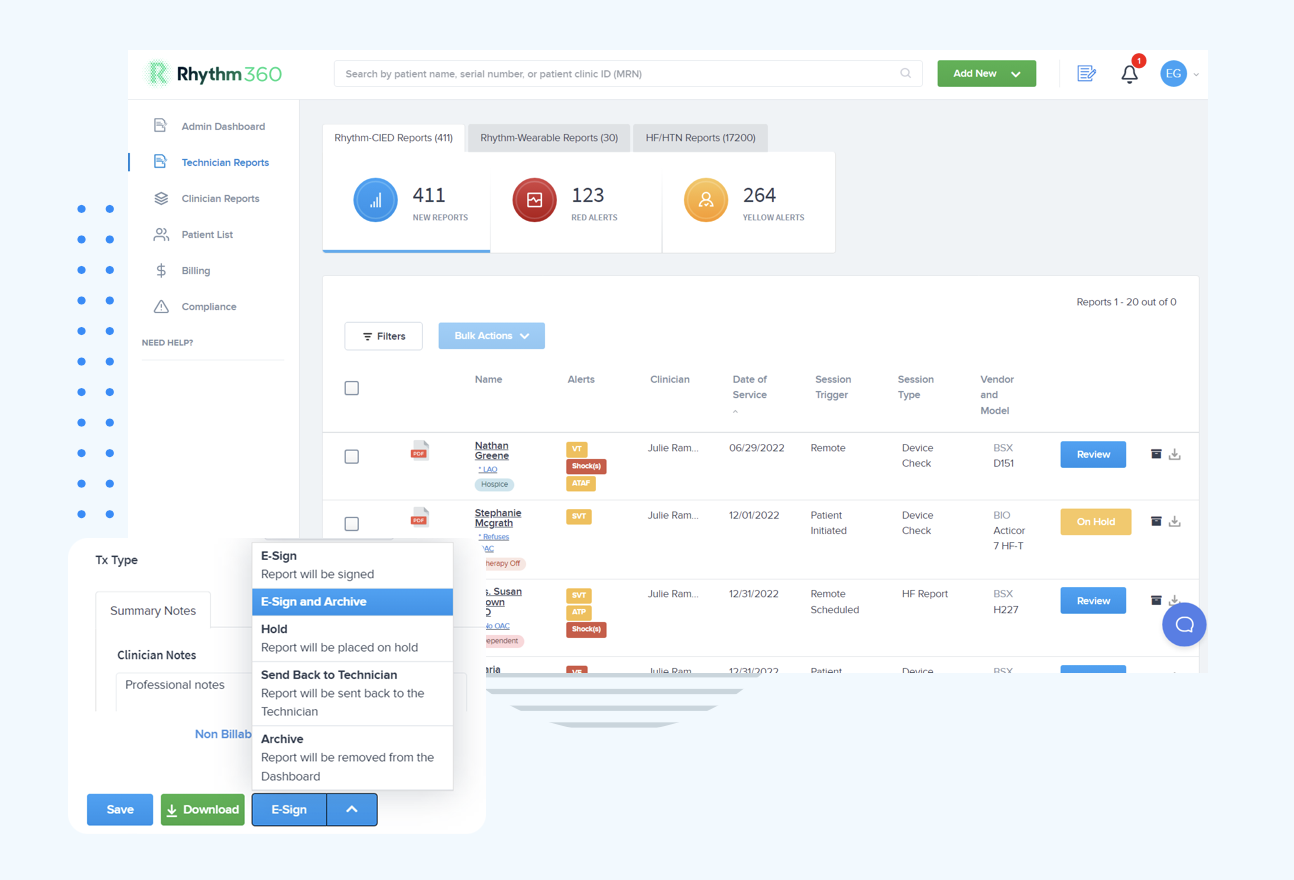
Once ingested, data passes through a normalization engine that maps manufacturer terminology to a common clinical schema. Inconsistently labeled data collected with variable equipment degrades AI algorithm performance and increases false-positive alerts. Rhythm360's AI triage layer filters non-actionable notifications and surfaces clinically significant events from this normalized dataset. The clinical impact is measurable. In the LINK-HF2 trial, clinicians reviewed 95% of AI-generated alerts within 24 hours, and 26.7% of those alerts led to clinical actions such as therapy adjustments. A 2026 study of the Sentinel autonomous AI agent found it achieved 95.8% emergency sensitivity and 88.5% sensitivity for all actionable alerts, outperforming individual clinicians in emergency detection.
EHR integration in Rhythm360 runs bidirectionally, supporting Epic, Cerner, Athenahealth, eClinicalWorks, Greenway Health, and others via HL7. Automated report generation and CPT code documentation eliminate manual transcription and create the audit trail required for compliant RPM billing. CMS requires that all clinical review findings and actions be documented in the patient record to serve as the audit trail for RPM billing under general supervision. Rhythm360's automated documentation workflow satisfies this requirement at scale.
The University of Chicago Medicine implementation shows what this architecture delivers in a high-volume environment. UCM reviewed more than 73,000 reports through Rhythm360 in 2025, averaging over 18,000 per quarter. UCM clinicians noted: "We are able to address these issues earlier; rather than waiting for a 3-month visit, we can call patients in for evaluation." The benchmarks below summarize the clinical, operational, and financial impact of this architecture across Rhythm360 deployments.
| Capability | 2026 Benchmark Achieved by Rhythm360 | Clinical / Financial Impact |
|---|---|---|
| Data Transmissibility | >99.9% via redundant feeds, computer vision, and AI extrapolation | Eliminates data gaps that cause missed critical events |
| Critical Alert Response Time | Up to 80% reduction | Earlier intervention; reduced hospitalization risk |
| Revenue Capture | Up to 300% increase through optimized CPT documentation | Recovers previously lost billing revenue |
| Annual Report Volume (UCM) | 73,000+ reports per year, 18,000+ per quarter | Demonstrates scalability for large cardiology programs |
| EHR Integration | Bidirectional via HL7 with Epic, Cerner, Athenahealth, and others | Eliminates manual transcription; supports audit-ready documentation |
| Implementation Timeline | Days to weeks, including EHR integration setup | Minimal disruption to existing clinical operations |
Solo practitioners and small EP clinics gain the most from staff efficiency. Eliminating multiple OEM portal logins and manual data entry frees device technicians for higher-value clinical work. Providers using RPM can generate $100 to $150 in monthly reimbursement per patient, equating to $10,000 to $15,000 monthly revenue for a 100-patient panel.
Mid-sized and large cardiology groups weigh population-level risk management, staff retention, and scalable billing infrastructure. One cardiology group using RPM achieved a 50% reduction in 30-day cardiovascular readmissions. Rhythm360's SaaS pricing model scales with clinic size and platform usage, avoiding the high setup fees and rigid licensing common in legacy on-premise systems. Implementation, including EHR integration, typically completes in days to weeks rather than months.
Schedule a demo to discuss how Rhythm360 scales to your practice's patient volume and device mix.
Implementation requires alignment across clinical, administrative, and IT stakeholders before go-live. Key pre-implementation steps include:
A phased rollout works best. Start with the CIED monitoring population before expanding to HF/HTN RPM service lines. This reduces implementation risk and lets staff build proficiency incrementally. Rhythm360's onboarding process supports this approach, with timelines measured in days to weeks.
The exponential quantity of CIED data from expanded indications and improved technologies overwhelms staff without automated consolidation. Without AI triage, clinical staff face an undifferentiated stream of alerts where critical events compete with routine notifications for attention. This leads to delayed response to arrhythmias, missed device malfunctions, and clinician burnout.
Revenue leakage carries equal weight as an operational risk. CPT 99454 requires at least 16 days of data transmission within a 30-day period; patients falling below this threshold need outreach to maintain compliance. Without automated tracking of transmission counts and patient engagement, practices routinely miss billing thresholds and forfeit reimbursement. OIG audit signals include device supply codes billed without matching transmitted day counts, creating compliance exposure in addition to revenue loss. Tracking the right metrics from day one helps practices catch these issues before they compound.
A comprehensive measurement framework spans four domains. Practices should track the following after implementation:
Rhythm360's benchmarks on these dimensions match the figures outlined earlier: an 80% reduction in critical alert response times, up to 300% increase in revenue capture, and >99.9% data transmissibility. UCM reported improved billing and accountability for patients after the integration. RPM programs in 2026 typically see 3x to 5x ROI with a 2 to 3 month break-even period, driven by CPT codes 99453 through 99458 and fewer emergency visits.
Implementation, including EHR integration setup, typically takes a few days to a few weeks depending on the practice's device mix and EHR environment. The onboarding process minimizes disruption to existing workflows, with phased rollout options for larger organizations that want to start with CIED monitoring before expanding to HF and hypertension RPM service lines.
Rhythm360 includes a secure, HIPAA-compliant mobile application. Clinicians can review transmissions, sign reports, and coordinate care from their smartphones. This matters for on-call scenarios where a critical alert, such as new-onset atrial fibrillation or significant weight gain in a heart failure patient, requires immediate review outside normal office hours. The mobile app maintains full audit-trail functionality consistent with the desktop platform.
Rhythm360 manages patients across multiple concurrent conditions and device types within a single platform. The system includes distinct but integrated service lines for Rhythm-CIED (covering pacemakers, ICDs, implantable loop recorders, and CRT/CCM devices) and for HF/HTN remote physiological monitoring. A patient with a CRT-D device who is also enrolled in an RPM program for heart failure and hypertension can be managed from one centralized dashboard, with all data streams consolidated and CPT documentation generated for each applicable billing code.
Rhythm360 uses a redundant data feed architecture that acts as a fail-safe during manufacturer server downtime. The platform also applies computer vision and AI-powered extrapolation to fill data gaps and cross-reference readings for fidelity. This multi-layer approach enables the platform's greater-than-99.9% transmissibility benchmark, so critical patient events aren't missed due to technical failures at the manufacturer level.
Rhythm360 automates documentation for CPT codes 99453, 99454, 99445, 99457, 99458, and 99470, tracking transmission day counts, clinical interaction time, and patient consent status in real time. The administrative dashboard gives a live view of each patient's progress toward billing thresholds, enabling proactive outreach before a patient falls below the required transmission days. All clinical review findings and actions are logged with a full audit trail, satisfying CMS documentation requirements for RPM billing under general supervision.
Cardiology practices in 2026 face a convergence of pressures: proprietary OEM data silos, an evolving payer landscape for RPM reimbursement, escalating alert volumes, and staff retention challenges from administrative overload. A unified, vendor-neutral platform that consolidates CIED, CardioMEMS, and physiologic RPM data, while automating CPT-compliant documentation and applying AI-powered alert triage, addresses each of these pressures directly.
These benchmarks, outlined throughout this article, represent the current standard for heart failure management software. UCM's experience shows what's possible at scale: earlier identification of abnormalities and improved billing accountability.





