Last updated: September 29, 2026
Patient selection drives program viability and long-term outcomes. Enroll patients by risk tier using recent HF hospitalization, NYHA class, GDMT status, renal function, and social support.
The 2026 ESC heart failure guideline recommends remote haemodynamic monitoring for symptomatic HF patients with NYHA class III and a heart failure hospitalization within the past 12 months (Class IIa, Level B1). The AHA/ACC/HFSA guideline describes PA-pressure monitoring as having uncertain value in selected NYHA class III patients.
Use the following enrollment tiers to match intensity of monitoring with clinical risk.
Once a patient is assigned to a tier, staff should complete this checklist before enrollment to confirm eligibility and capture required documentation.
A universal 2–3 lb weight threshold often fails because baseline weight, renal function, diuretic regimen, and comorbid conditions change the actionable threshold for each patient. Daily weight, blood pressure, heart rate, symptoms, and device-derived parameters need patient-specific alert limits. The table below maps each core variable to its individualized threshold, the required action, and the role accountable for that action.
| Variable | Individualized Threshold | Action | Responsible Role |
|---|---|---|---|
| Daily weight | >2 lbs in 24 hrs or >3 lbs in 48 hrs from baseline | Nurse outreach within 4 hrs, assess symptoms, notify provider if confirmed | HF Nurse |
| Blood pressure | SBP <90 or >180 mmHg | Same-day provider notification and medication review | HF Nurse → Cardiologist |
| Heart rate | <50 or >120 bpm sustained | Review device data, assess for arrhythmia, escalate if symptomatic | CCT → EP |
| SpO₂ | <90% on room air | Assess for decompensation and consider same-day evaluation | HF Nurse → Provider |
| PA pressure (if implanted) | Patient-specific baseline +20% | Diuretic adjustment per protocol with nurse-initiated titration | HF Nurse → Cardiologist |
| Symptoms | New orthopnea, PND, or edema | Same-day evaluation and consideration of IV diuretic | Provider |
Rhythm360 supports this protocol by unifying device and RPM data into a single dashboard, triggering automated threshold alerts, and capturing complete documentation of every action.
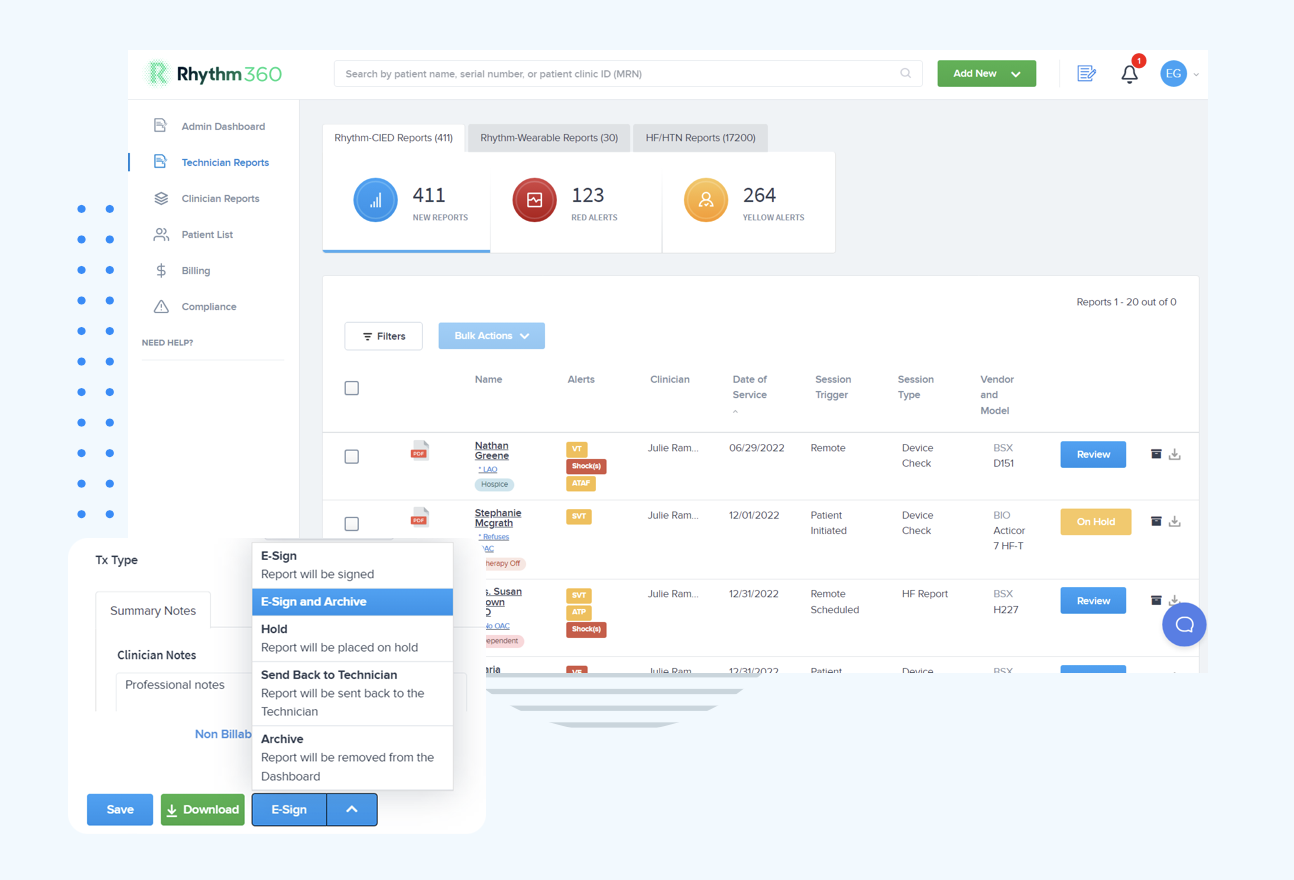
Individualized thresholds only help when someone is accountable for acting on them. Specifying who reviews alerts, how often, who titrates GDMT, who handles patient outreach, and what counts as an emergency requiring same-day escalation is the operational step many programs skip.
Use clear alert tiers so staff understand urgency and next steps.
Define staffing roles so each alert has a clear owner.
A 2026 qualitative implementation study in JMIR Medical Informatics reported that nurses experienced alert fatigue and disengagement when covering unfamiliar patients. One nurse described doing “the bare minimum” when alerts arrived for patients outside her regular caseload. Clear alert ownership before go-live reduces this risk.
Rhythm360 uses AI-powered alert triage to filter non-actionable noise and highlight clinically significant events. Optional 24/7/365 oversight by certified cardiac technicians supervised by physicians supports timely triage and intervention. As Andrew Beaser, MD, Associate Professor of Medicine at the University of Chicago Medicine, observed after implementing Rhythm360, “Decision support, including AI-assisted decision support, will become increasingly important as data volumes grow.”
Talk With Rhythm360 About Alert Pathways
Remote monitoring works best when it starts before or at discharge and runs with higher intensity during the first 30 days. The 2026 ESC heart failure guideline recommends a 1–2 week follow-up visit after discharge.
Use a structured post-discharge intensification protocol.
A meta-analysis of 34 studies covering 13,269 patients in the 2026 ESC cardiac rehabilitation guideline found that combined remote monitoring and virtual consultation reduced cardiovascular mortality (RR 0.83; 95% CI 0.70–0.99) and cardiovascular-cause hospitalization (RR 0.71; 95% CI 0.58–0.87) in heart failure patients. Programs that pair data capture with active clinical response achieve these gains.
At the University of Chicago Medicine, Rhythm360 helped clinicians review more transmissions daily and identify more abnormalities. Dr. Beaser noted, “We are able to address these issues earlier; rather than waiting for a 3-month visit, we can call patients in for evaluation.” UCM reviewed more than 73,000 reports annually through Rhythm360 in calendar year 2025, averaging more than 18,000 reports per quarter.
Programs need a clear stance on implantable hemodynamic monitoring because major guidelines diverge. As noted in Section 1, the ESC and AHA/ACC/HFSA guidelines differ on PA-pressure monitoring. The ESC assigns it a Class IIa, Level B1 recommendation, while the AHA/ACC/HFSA guideline describes the evidence as uncertain.
PA-pressure monitoring (CardioMEMS) fits patients with NYHA class III symptoms, a HF hospitalization within 12 months, and persistent symptoms despite optimized GDMT. The CHAMPION trial demonstrated a 30% reduction in HF hospital readmissions at 6 months (HR 0.72; 95% CI 0.60–0.85; p=0.0002). CMS National Coverage Determination #20.36 (effective 01/13/2025) covers implantable pulmonary artery pressure sensors only “in the context of approved clinical studies or with the collection of additional clinical data” under Coverage with Evidence Development.
Home weight and BP monitoring suits NYHA class II–III patients without recent hospitalization, patients who decline implantable devices, or those starting with noninvasive monitoring before escalation to PA-pressure monitoring.
Rhythm360 captures and standardizes data from implantable hemodynamic monitors such as CardioMEMS and from wearable RPM devices, giving clinicians a unified view across monitoring modalities.
CPT code requirements vary by device type and billing cycle, so accurate mapping protects revenue. Misapplying a 90-day cycle to a 30-day code or treating device-specific codes as a professional/technical pair frequently triggers denials in cardiac remote monitoring programs.
Use the following codes for RPM wearable and physiologic monitoring.
For implantable cardiac devices, the device class determines the applicable code.
Gaurav A. Upadhyay, MD, at the University of Chicago Medicine, reported after implementing Rhythm360, “We have improved billing and accountability for our patients after the integration.” Rhythm360 automates CPT code capture and documentation and tracks device-specific pairings. That prevents device-type mismatch denials and unbilled technical components, helping practices increase profitability by as much as 300%.
See How Rhythm360 Automates CPT Capture
Equitable remote monitoring requires attention to digital literacy, language access, and connectivity. The 2026 Quebec telemonitoring implementation study found that frequent device disconnections, poor rural cellular reception, and adherence issues often required in-person troubleshooting visits that added workload without clinical value. One manager in that study stated, “I think we tend to vastly overestimate digital literacy. Our professionals are really not there yet.”
Use these assessment questions before enrollment to identify support needs.
Build support structures that reduce dropout and frustration.
The Quebec study identified hands-on device interaction, just-in-time support, and local super-user champions as the most effective training enablers. Rhythm360’s integrated communication hub tracks automated reminders and call logs within the patient record, which reduces redundant outreach and documents every patient interaction for audit purposes.
HF remote monitoring programs face predictable operational limitations, including data overload, patient non-compliance, reimbursement complexity, and the risk of monitoring without a response pathway.
CMS covers RPM under specific CPT codes that define setup, data transmission, and management time. For wearables, CPT 99453 covers one-time setup and education, CPT 99454 covers device supply and data transmission over 30 days with at least 16 days of readings, and CPT 99457 and 99458 cover time spent on treatment management with required interactive communication. For implantable cardiac devices, CPT 93297 applies to implantable cardiovascular physiologic monitors and CPT 93298 applies to subcutaneous cardiac rhythm monitors; each is billable once per 30-day period as a device-specific code. Pacemakers and ICDs follow a 90-day cycle using CPT 93294, 93295, and 93296 for professional and technical components. RPM equipment must meet the FDA definition of a medical device and transmit physiologic data automatically; manually entered readings do not qualify.
A major disadvantage is the risk of generating data without a clear response pathway. When alert volumes exceed staff capacity or nurses cover unfamiliar patients, disengagement and alert fatigue follow. A 2026 qualitative implementation study found that nurses reported alert fatigue and workflow disruption even when accessing monitoring dashboards daily, with one nurse describing doing “the bare minimum” when covering colleagues’ patients. Connectivity dependency creates a second disadvantage because device disconnections and poor cellular reception can require in-person troubleshooting visits that erode efficiency. Programs can reduce these risks through AI-powered alert triage, defined alert ownership, and cellular-enabled devices that bypass home Wi-Fi.
Remote monitoring should begin before or at discharge and run with intensified parameters for the first 30 days. The 2026 ESC heart failure guideline recommends a 1–2 week follow-up visit post-discharge. A structured protocol includes daily weight, BP, HR, and symptom review with nurse outreach every 48 hours during days 1–7, a first in-person or telehealth follow-up visit during days 8–14, transition to standard monitoring frequency during days 15–30 if the patient is stable, and a maintenance protocol with weekly review after day 31 unless alerts trigger earlier review. The post-discharge window also offers the primary GDMT titration opportunity, so active clinical engagement during this period supports both readmission prevention and medication adjustment.
PA-pressure monitoring with CardioMEMS suits patients with NYHA class III symptoms, a HF hospitalization within 12 months, and persistent symptoms despite optimized GDMT. The CHAMPION trial demonstrated a 30% reduction in HF hospital readmissions at 6 months (HR 0.72; 95% CI 0.60–0.85; p=0.0002). The 2026 ESC heart failure guideline assigns PA-pressure monitoring a Class IIa, Level B1 recommendation for this population, while the AHA/ACC/HFSA guideline describes the evidence as uncertain. CMS covers implantable pulmonary artery pressure sensors only under Coverage with Evidence Development per NCD #20.36 (effective 01/13/2025). Home weight and BP monitoring fits NYHA class II–III patients without recent hospitalization, patients who decline implantable devices, or those starting with noninvasive monitoring before escalation to PA-pressure monitoring. Patients with implanted PA sensors still benefit from concurrent weight and symptom tracking.
Programs that pair a clear escalation pathway with consistent execution outperform more complex systems that lack response infrastructure. The eight best practices above offer a practical framework for launching or repairing an HF remote monitoring program, from patient selection through reimbursement capture.
The most durable programs rely on an integrated platform that manages monitoring, alert triage, documentation, and billing in one place. Rhythm360 provides a single source of truth by unifying all implantable and wearable cardiac device data into one AI-powered, vendor-neutral platform with bi-directional EHR integration with Epic, Cerner, Athenahealth, eClinicalWorks, and Greenway Health. Other platforms such as Murj, Implicity, Rhythm Management Group, and Octagos also operate in this space.
Explore Rhythm360 For HF Monitoring