

Last updated: July 14, 2026
A device technician managing 200 patients across four manufacturers often starts the day in five browser tabs: Medtronic CareLink, Boston Scientific Latitude, Abbott Merlin.net, Biotronik Home Monitoring, and the CardioMEMS HF System dashboard. Each portal uses a different login, alert taxonomy, and report format. Cardiovascular leaders describe this fragmentation as forcing practices to manage each new data input through its own separate login and workflow, which becomes unmanageable as patient volumes grow.
Rhythm360 pulls data from Medtronic, Boston Scientific, Abbott, Biotronik, CardioMEMS, and additional manufacturers into a single dashboard using API connections, HL7 messaging, XML parsing, and AI-powered computer vision for unstructured PDF reports. This approach creates a unified patient record with greater than 99.9% transmissibility, supported by redundant data feeds that stay active even when an OEM server goes down. University of Chicago Medicine processed more than 73,000 reports annually through Rhythm360 in 2025, averaging more than 18,000 reports per quarter, demonstrating the platform’s capacity to handle high-volume, multi-OEM environments without slowing workflow.
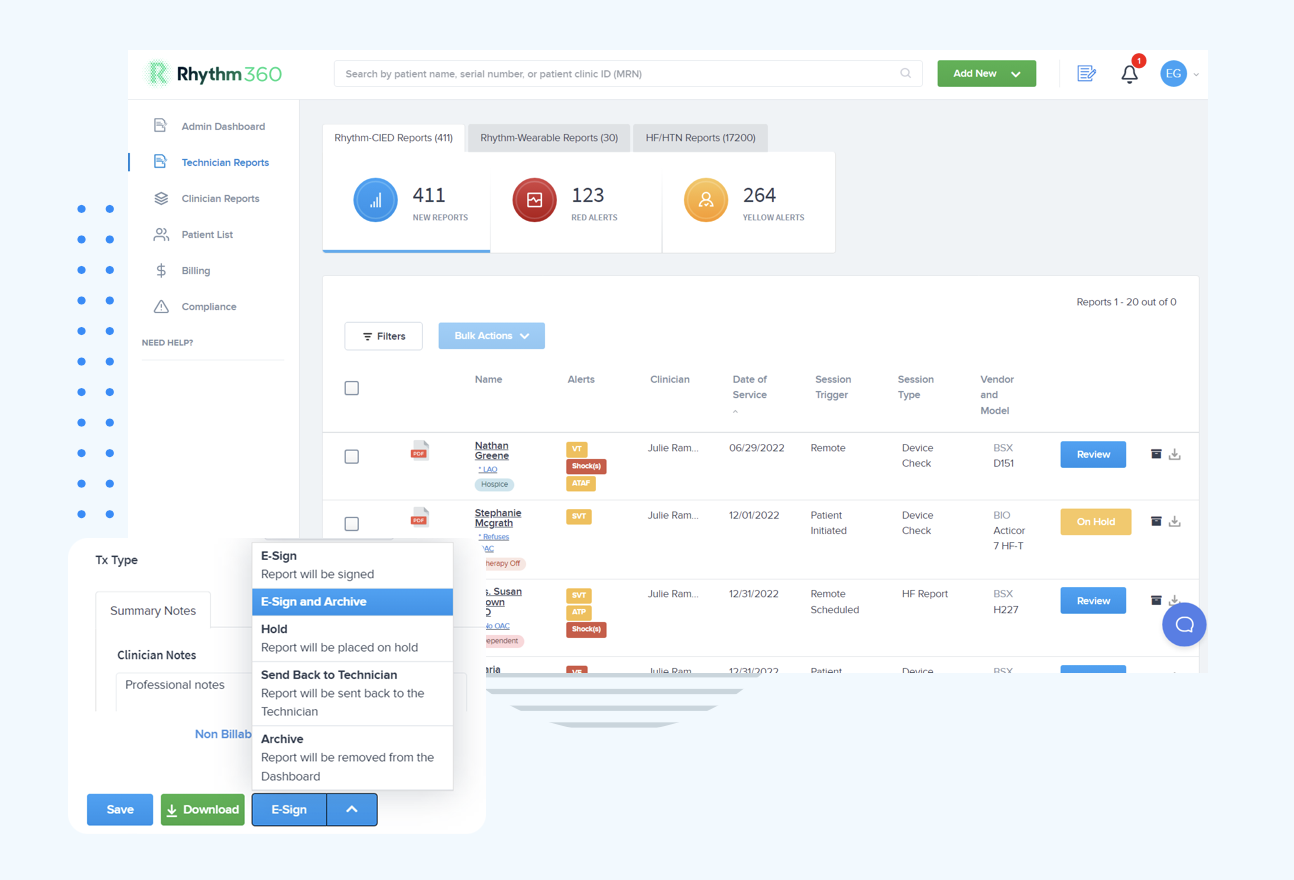
Most cardiac monitoring alerts do not require action. Between 80% and 99% of ECG monitor alarms are false or clinically insignificant, according to the U.S. Agency for Healthcare Research and Quality. In cardiac remote monitoring, a cross-manufacturer analysis of 2,659 rhythm episodes from 1,710 patients presented at the 2026 EHRA Congress found that 32.9% of episodes were non-actionable even in AI-equipped devices, rising to 45.4% in devices without proprietary AI.
As Niraj Varma, MD, PhD, of the Cleveland Clinic, noted at that congress, “False-positive alerts remain one of the biggest operational challenges in remote cardiac monitoring. Every episode flagged by an implantable cardiac monitor must be reviewed by a clinician, yet even devices equipped with manufacturer AI algorithms still generate a substantial number of non-actionable alerts.”
Rhythm360’s AI triage layer addresses this problem by filtering non-actionable alerts before they reach clinical staff. Practices using this triage have achieved up to an 80% reduction in critical response times because teams can focus immediately on genuinely urgent events instead of sorting through noise. With alert volume under control, practices can then focus on capturing the revenue those clinical activities generate.
Heart failure RPM generates billable activity under several CPT codes, and manual documentation often leaves revenue uncaptured. The primary codes for HF remote physiological monitoring include:
A practice managing 100 eligible RPM patients can generate approximately $14,000–$16,000 per month in revenue from RPM codes 99453–99458. Without a centralized system, staff manually track transmission dates, clinician review minutes, and patient engagement thresholds. That manual work often leads to undercounting and claim rejection.
Rhythm360 automates data-ingestion timestamps, tracks clinician review time against CMS thresholds, and generates compliant billing documentation in real time. A revenue dashboard shows captured versus potential revenue by CPT code, giving administrators a live view of billing performance. Gaurav A. Upadhyay, MD, at UCM, noted, “We have improved billing and accountability for our patients after the integration.” Practices implementing Rhythm360 have achieved up to a 300% increase in revenue generation through more complete CPT code capture and better staff efficiency.
Schedule a demo to see how Rhythm360’s billing dashboard maps to your current CPT code mix.
Epic holds approximately 44% and Oracle Health (Cerner) holds approximately 23% of the U.S. acute-care EHR market as of 2026. Bi-directional integration with at least one of these platforms now serves as a baseline requirement for any HF RPM solution that aims for broad adoption. Cardiovascular leaders stress that EHR integration must bring device data directly into the provider’s workflow rather than leaving it in a separate portal, similar to how laboratory results appear inside the chart.
Rhythm360 supports this through HL7 v2 messaging and FHIR R4 APIs, enabling bi-directional data exchange with Epic, Cerner, Athenahealth, eClinicalWorks, Greenway Health, and additional systems. Device data, vital signs, and remote monitoring reports enter the EHR as discrete fields and FHIR Observation resources. Medication changes, recent admissions, and problem-list updates flow back into Rhythm360 to provide clinical context at the moment of alert review.
Interoperability with clinical systems in HF telemonitoring typically relies on HL7 FHIR-based data stores and APIs, and Rhythm360’s integration layer stays vendor-agnostic, so it supports both Epic and Cerner without rewriting application logic. The full onboarding process, including EHR integration setup, usually completes in a few days to a few weeks, far shorter than the 4–7 month timeline common with custom single-vendor projects.
Timely review of high-risk transmissions often depends on mobile access. On a Saturday morning, Rhythm360 flags a new-onset atrial fibrillation transmission from a 68-year-old HF patient with a CRT-D. The on-call electrophysiologist receives a prioritized push notification on a smartphone, opens the HIPAA-compliant Rhythm360 mobile app, reviews the full transmission alongside the patient’s anticoagulation history from the EHR, signs the report, and starts a telehealth call to coordinate anticoagulation. By Saturday afternoon, the patient is on therapy.
Without mobile access to a unified platform, that transmission might sit unreviewed until Monday, which creates real stroke risk in a patient with new AF and elevated risk factors. Rhythm360’s mobile application supports transmission review, report signing, and care coordination from any location. All actions are logged with a full audit trail within the patient record, meeting HIPAA documentation requirements and supporting accountability for on-call workflows.
In the LINK-HF2 trial, 95% of AI-generated remote-monitoring alerts were reviewed by clinicians within 24 hours, and 26.7% of those alerts led to clinical action such as therapy adjustment. Mobile access makes this standard achievable even outside business hours.
Rhythm360’s SaaS-based pricing scales with clinic size and platform usage, so it fits solo EPs, mid-sized groups, and large health systems. The framework below links practice profile to the capabilities that usually matter most.
Evidence from 2026 strongly supports a unified, AI-powered HF RPM platform. A 2026 meta-analysis by Scholte et al. of 79 randomized trials involving 31,669 heart failure patients found that remote monitoring reduced total HF hospitalizations (IRR 0.81), first HF hospitalization (RR 0.82), and all-cause mortality (RR 0.90) compared with standard care. Benefits remained consistent across regions, HF stability status, age, LVEF, and NYHA class. A 2026 observational study of chronic HF patients in a structured multiparametric remote management program also reported lower rates of unplanned HF hospitalizations and all-cause mortality than in non-remote-management populations.
Practices implementing Rhythm360 have achieved the response-time improvements and revenue gains described earlier. These results come from optimized CPT code capture, better staff efficiency, and the addition of HF and HTN RPM service lines. Andrew Beaser, MD, at UCM, summarized the clinical impact: “We are able to address these issues earlier; rather than waiting for a 3-month visit, we can call patients in for evaluation.” These are practice-level outcomes, not theoretical projections.
Rhythm360 is a HIPAA-compliant, cloud-based platform built with security as a core requirement. All protected health information in transit is encrypted using TLS, and data at rest is protected with AES-256 encryption. Every access event is logged with a full audit trail within the patient record, which satisfies HIPAA documentation requirements and the accountability standards of health system compliance teams.
The platform’s vendor-neutral architecture keeps patient data out of OEM proprietary infrastructure. Rhythm360 ingests, normalizes, and stores data within its own secure environment. Business Associate Agreements are executed during onboarding, and the platform’s redundant data-feed system maintains data access even during OEM server outages.
Rhythm360’s implementation process, including EHR integration setup, usually completes in a few days to a few weeks, depending on the practice’s device mix and EHR environment. The onboarding approach follows a phased structure: initial data connection and validation, EHR integration configuration and testing, staff training on the unified dashboard and mobile app, and go-live with ongoing support.
Rhythm360 ingests data from existing OEM feeds rather than replacing device hardware, so patient monitoring continues without interruption during the transition. Practices do not need to re-enroll patients or change device settings. The platform also reduces reliance on a single “super-user,” so staff turnover during or after implementation does not create operational gaps.
Most direct costs of managing multiple OEM portals hide in staff time. Teams spend hours logging into separate systems, transcribing data into the EHR, tracking billable events across disconnected workflows, and chasing documentation for CPT code compliance. These costs grow with patient volume and with each new device manufacturer added to the mix.
Rhythm360 uses a SaaS-based pricing model that scales with clinic size and platform usage, replacing fragmented overhead with a single, predictable investment. Financial benefits come from two directions: reduced administrative labor through automation and increased revenue capture through automated CPT documentation. Practices managing 100 or more eligible RPM patients can generate substantial new monthly revenue from codes that were previously underbilled or missed.
The net effect, as demonstrated by practices on the platform, is a revenue increase of up to 300% relative to manual, fragmented workflows. That figure reflects both billing recovery and the addition of new HF and HTN RPM service lines.
In 2026, logging into five OEM portals functions as a liability, not a workflow. It drives alert fatigue, billing leakage, EHR documentation gaps, and the clinical risk of a critical event sitting unreviewed in a portal no one checked. The evidence base for structured HF remote monitoring is clear: hospitalization rates fall, mortality improves, and earlier intervention becomes possible when the right infrastructure supports clinicians.
Rhythm360 provides that infrastructure: vendor-neutral, AI-powered, EHR-integrated, and deployable in days to weeks. The practical question for cardiology practice administrators and clinical leaders now centers on timing and execution, not on whether consolidation makes sense.





