

Last updated: July 14, 2026
Schedule a demo to see how Rhythm360 applies these capabilities to your heart failure program.
Choosing an RPM platform in 2026 comes down to six factors. Each one determines whether a program scales smoothly or stalls under operational weight.
Home-based heart failure monitoring depends on consistent daily data transmission. Cellular RPM devices achieve 85–95% compliance in patients over 65, compared to 55–70% for Bluetooth devices in the same group. Cellular transmission skips smartphone pairing, app management, and sync failures. For elderly heart failure patients, that gap directly affects whether they meet the 16-day data threshold required for CPT 99454 billing.
Hub-based cellular gateways solve part of this problem. Patients use Bluetooth-connected scales, blood pressure cuffs, and pulse oximeters while transmitting through a single cellular hub. This achieves cellular-level reliability at a lower per-patient cost than buying multiple separate cellular units.
Unified dashboards close the communication loop and improve adherence further. When a scale goes offline, an integrated platform logs automated patient reminders and tracks whether staff made a follow-up call. This removes redundant outreach and creates a full audit trail. Rhythm360's Twilio-powered communication hub handles this automatically, documenting every interaction in the patient record.
The 2026 guideline landscape converges on structured, technology-enabled monitoring for high-risk heart failure patients, particularly those in NYHA Class III.
NICE guidance HTG769, published February 2026, recommends the CardioMEMS HF System for remote monitoring of NYHA Class III chronic heart failure in adults at risk of hospitalization, provided patients can use the technology and are willing to adjust medication as advised. The guidance notes more research is needed on the Cordella Pulmonary Artery Sensor System before broader NHS adoption.
The HFSA/AAHFN 2026 Scientific Statement recommends integrating health technologies through team-based care, automated alerts, and EHR-integrated dashboards rather than isolated devices. The statement also supports hybrid care models combining in-person visits for initial diagnosis with telemedicine for routine monitoring.
Trial data backs these recommendations. The CHAMPION trial showed a 30% reduction in heart failure hospitalizations at six months with hemodynamic-guided management versus standard care in NYHA Class III patients, along with shorter hospital stays and better quality-of-life scores. The MONITOR-HF trial showed a mean +7.05-point KCCQ quality-of-life improvement at 12 months and a 44% reduction in hospitalizations with CardioMEMS. For non-invasive home monitoring, the TIM-HF2 trial provides cornerstone evidence that structured remote monitoring reduces mortality and heart failure hospitalizations, with the remote management arm cutting days lost to unplanned cardiovascular hospitalization and all-cause death.
These clinical outcomes only translate into program sustainability when billing keeps pace with the monitoring activity they generate. That connection makes the 2026 CPT code updates directly relevant to any heart failure RPM program.
The 2026 CMS Physician Fee Schedule expanded reimbursement pathways for heart failure programs using Bluetooth-connected devices. The core code set includes:
CardioMEMS and other implantable hemodynamic sensors fall under a separate CIED remote monitoring code family, covered in the FAQ below. CMS requires documented patient consent, contemporaneous time logs, and monthly notes showing how interactions influenced care decisions, not just that contact occurred. Incomplete consent records, vague enrollment notes, and failure to tie monitoring activity to clinical decisions cause most RPM denials in 2026 audits.
Rhythm360 automates transmission-day counting, flags approaching thresholds, logs communication timestamps, and generates compliant documentation. This lets practices capture revenue that manual tracking often misses, improving billing capture by up to 300%.
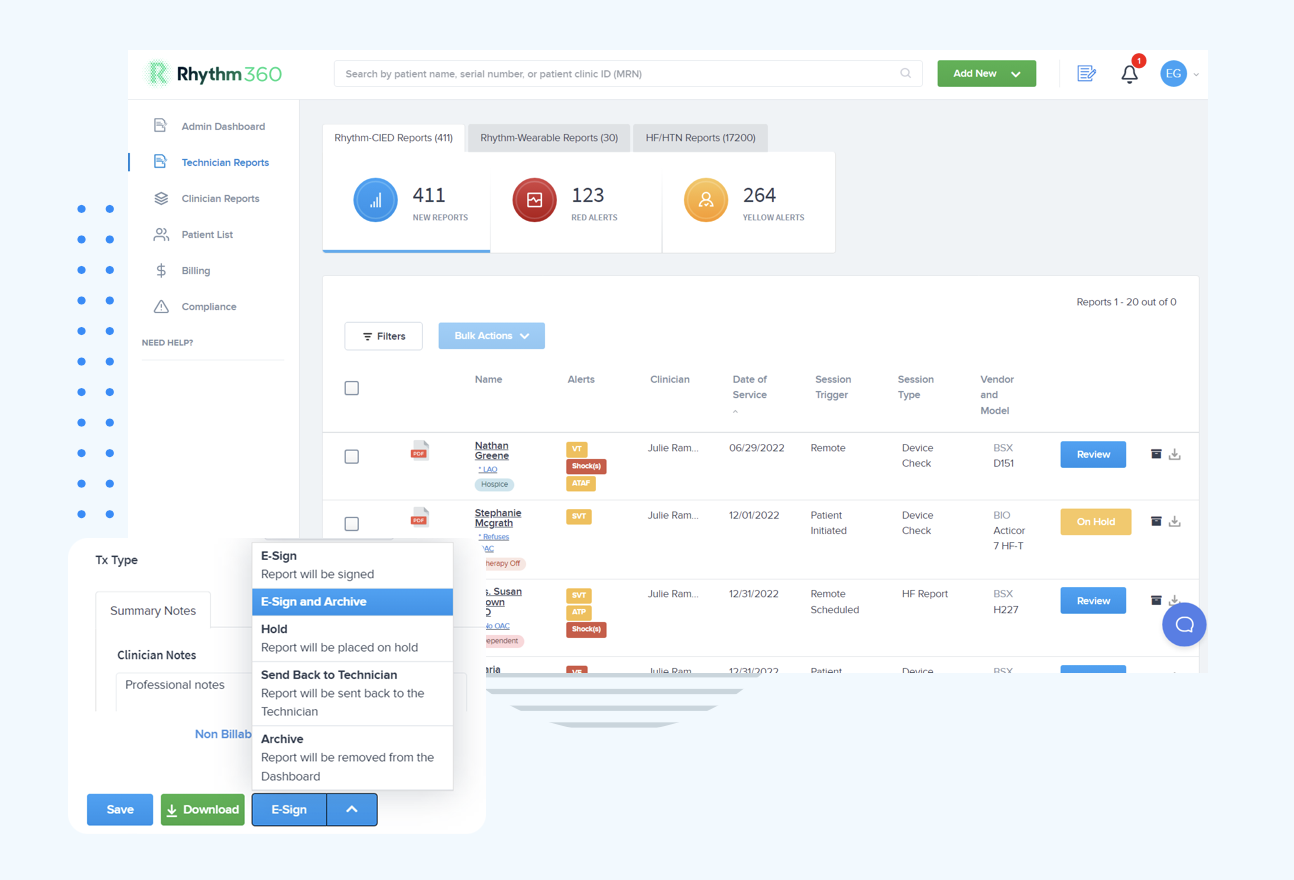
The table below shows how Rhythm360 replaces fragmented, portal-by-portal workflows with one consolidated system across each evaluation criterion.
| Criteria | Multi-Portal Approach | Rhythm360 | Clinical / Financial Impact |
|---|---|---|---|
| Multi-vendor data consolidation | Separate logins for each OEM (Medtronic, Boston Scientific, Abbott, Biotronik); no unified view | Single dashboard ingesting all CIED, CardioMEMS, and Bluetooth scale data via API, HL7, XML, and AI-powered PDF parsing | University of Chicago Medicine reviewed more than 73,000 reports annually through Rhythm360, averaging more than 18,000 per quarter |
| AI-powered alert triage | Static OEM thresholds; high volume of non-actionable notifications; alert fatigue | AI-driven trajectory analysis filters non-actionable transmissions; prioritizes clinically significant events; optional 24/7 CCT oversight | Up to 80% reduction in critical alert response times (detailed further below) |
| Bi-directional EHR integration | Manual transcription or one-way data exports; care plan updates do not inform monitoring logic | Bi-directional integration with Epic, Cerner, athenahealth, eClinicalWorks, and others via HL7 | "We have improved billing and accountability for our patients after the integration" — University of Chicago Medicine |
| CPT billing documentation | Manual tracking of transmission days and staff time; high denial risk | Automated transmission-day counting, time logging, and compliant documentation across 99453, 99445, 99454, 99457, 99458, 99470 | Revenue capture improvement of up to 300%, as noted earlier |
| Implementation timeline | Each OEM portal requires separate credentialing; no unified onboarding | EHR integration and full platform onboarding in days to weeks | Faster time-to-revenue; reduced staff training burden |
| Data transmissibility | Subject to individual OEM server uptime; no redundancy | Redundant data feeds with computer vision and AI extrapolation; greater than 99.9% transmissibility | "We are able to address these issues earlier; rather than waiting for a 3-month visit, we can call patients in for evaluation" — University of Chicago Medicine |
A 2026 meta-analysis of 79 randomized controlled trials covering 31,669 heart failure patients found that remote monitoring reduced total HF hospitalizations and all-cause mortality overall, with invasive hemodynamic monitoring ranking highest for hospitalization reduction.
Building on this population-level evidence, AI triage systems now show measurable impact on clinician workload at the point of care. In the ISHI Health AI virtual HF care study presented at THT 2026, algorithms triaged alerts from implantable devices, pulmonary artery pressure sensors, and external scales with zero escalations to HF cardiologists. The same study found significant increases in GDMT adherence across all major medication classes over a median 124-day enrollment period.
Prediction accuracy matters as much as triage efficiency. The LINK-HF trial showed AI-enabled remote monitoring predicted impending HF hospitalizations with 76–88% sensitivity and 85% specificity, giving a median 6.5-day early warning. In the follow-on LINK-HF2 trial, clinicians reviewed 95% of AI-generated alerts within 24 hours, and 26.7% led to direct clinical action.
Next-generation remote monitoring frameworks replace static thresholds with AI-driven trajectory analysis, directly addressing alert fatigue by focusing human expertise where it matters most. Rhythm360's alert system applies this approach across all connected device types. Critical events, including new-onset atrial fibrillation, ventricular tachycardia, significant weight gain, or device malfunction, reach the right clinician at the right time.
These triage gains only pay off if a program can get up and running quickly. Implementation speed and cost determine how fast that clinical value reaches patients.
See Rhythm360's AI alert triage in action across CIED, CardioMEMS, and Bluetooth scale data.
Rhythm360's onboarding, including EHR integration with Epic, Cerner, athenahealth, eClinicalWorks, Greenway Health, and others via HL7, takes days to weeks, not months. The SaaS pricing model scales with clinic size and usage, avoiding the rigid per-seat structures that penalize growing programs.
Total cost of ownership covers more than licensing fees. Implementation and training costs for RPM programs, including EHR integration and patient onboarding, typically run $1,000 to $10,000 as a one-time expense depending on practice size. Ongoing costs include device procurement, per-patient platform fees, and staff time for monitoring and documentation.
Rhythm360 cuts the hidden costs that fragment multi-portal workflows: staff hours spent on manual data retrieval, duplicate documentation, and billing reconciliation. Its centralized dashboard removes reliance on a singleRead Next





