Last updated: September 27, 2026
Recent ownership changes reshaped the vendor landscape and affect roadmaps, support continuity, and pricing.
Baxter International acquired Hill-Rom Holdings in December 2021 for $12.4 billion, bringing Bardy Diagnostics and its CAM patch under Baxter's corporate umbrella. At the Wells Fargo 21st Annual Healthcare Conference on September 9, 2026, Baxter CEO Andrew Hider referred to “our ambulatory cardiac monitoring platform with Bardy,” confirming the Bardy brand remains in active commercial use and is classified as an “invest-and-grow” asset. Preventice Solutions is listed separately from Baxter International as a distinct market player in 2026 industry reports, which shows the brand name still appears in competitive analyses.
For practices under contract with any vendor that has changed ownership, the key concerns are roadmap continuity, support staffing, and pricing trajectory. Pre-2024 comparison articles do not address these current-state questions.
With the landscape in flux, the first priority is whether a platform works across manufacturers. Vendor neutrality is the most consequential criterion for any practice managing devices from more than one manufacturer. Device data from Medtronic, Abbott, Boston Scientific, and Biotronik each arrive through proprietary remote monitoring portals, which forces clinics managing patients across all four manufacturers to log into multiple systems to retrieve and reconcile transmission data unless they use a unified aggregation platform.
Rhythm360 addresses this directly. The platform ingests and normalizes data from all major CIED manufacturers via API, HL7, XML, and PDF parsing through computer vision. It delivers a single source of truth with greater than 99.9% transmissibility. Redundant data feeds and AI-powered extrapolation provide a fail-safe when an OEM server is unavailable. Clinicians base decisions on the most complete data available instead of a partial picture.
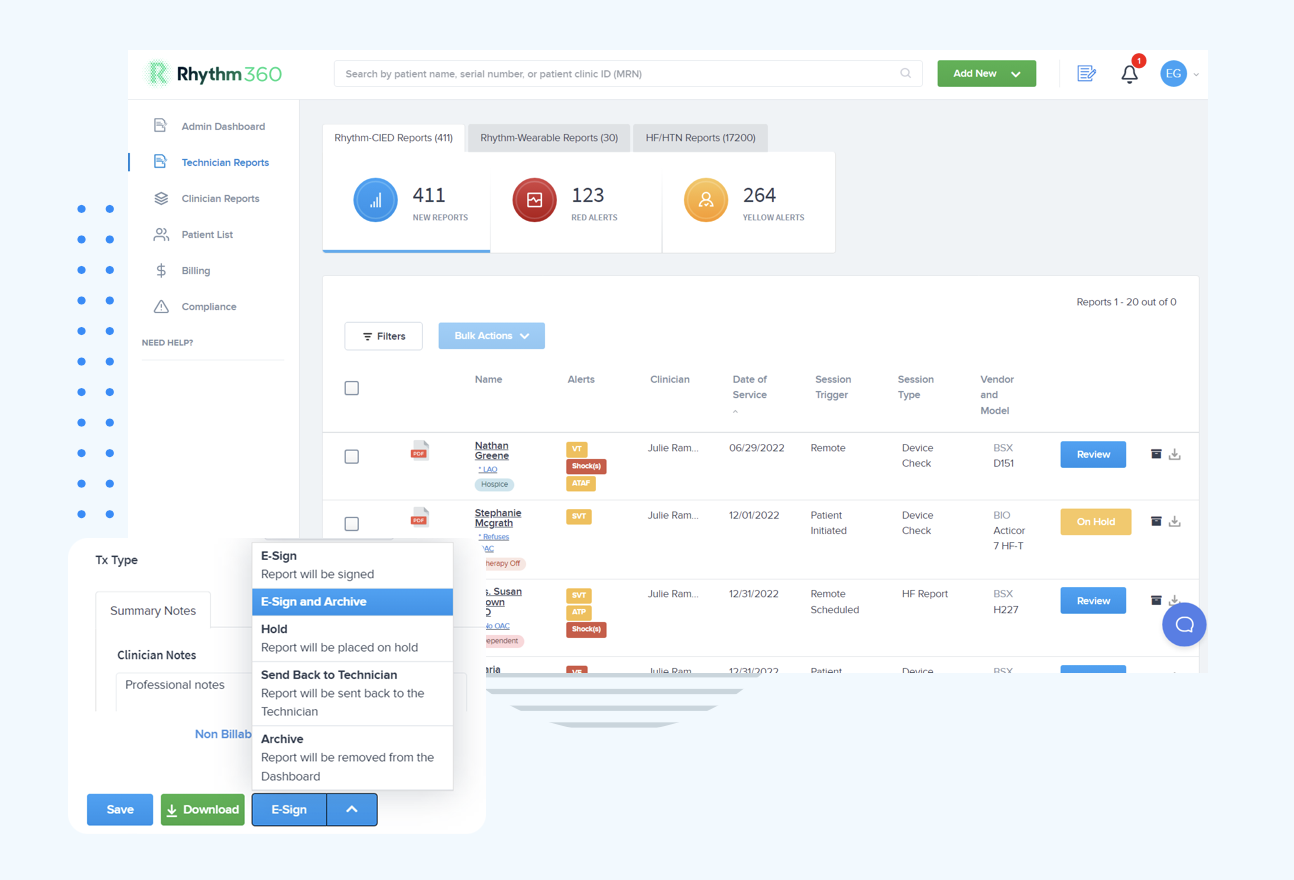
Without vendor neutrality, staff must log into separate, non-interoperable portals for each manufacturer. That administrative burden grows as a practice’s implanted device population expands across brands.
Talk to Our Team About Multi-OEM Workflows
After confirming vendor neutrality, the next focus is how the platform connects with your EHR. EHR integration claims vary widely in what they actually deliver, and the key distinction is between bidirectional integration and a one-way data push.
Bidirectional integration means the platform receives patient demographic and scheduling data from the EHR and writes completed reports and documentation back into the patient record automatically. This approach removes manual chart copying. A one-way push sends data in a single direction only, which leaves staff to reconcile and enter information manually on the other side.
Rhythm360 offers bidirectional integration with Epic, Cerner, athenahealth, eClinicalWorks, and Greenway Health via HL7. Epic's interoperability stack supports HL7 FHIR read and write operations, which makes bidirectional exchange technically achievable for platforms that complete the integration work. Rhythm360 onboarding, including integration setup, typically takes a few days to a few weeks. Legacy on-premise systems often require months of configuration.
Remote cardiac device monitoring generates revenue across two distinct billing cycles, and a platform that fails to automate CPT capture loses revenue at every cycle boundary.
90-Day Cycles (Pacemakers and ICDs)
30-Day Cycles (Physiologic Monitors and Loop Recorders)
Codes 93297 and 93298 are device-specific rather than a professional and technical pair. Each is billable once per 30 days and each can be billed global, with modifier -26, or with modifier -TC depending on which entity performs the professional versus technical component.
Revenue leakage occurs in three ways: missed billing periods, device-type mismatches that generate denials (such as applying the wrong professional code to a defibrillator), and unbilled technical components. Each failure mode stems from manual tracking across two different billing cycles. Rhythm360 automatically tracks device-specific CPT pairings and cycle windows, closing all three gaps at once. Practices using the platform have achieved up to a 300% increase in revenue capture.
Alert volume is a structural feature of CIED remote monitoring programs. It reflects the nature of continuous monitoring and requires a model that can handle sustained volume. At the University of Chicago Medicine, more than 73,000 reports were reviewed annually with stable dismissal rates, highlighting scalable monitoring in high-volume environments. The clinical and operational question is how a platform manages that volume.
AI-driven alert filtering reduces non-actionable noise and prioritizes clinically significant events before they reach a clinician's queue. Certified cardiac technician (CCT) oversight provides human review of transmissions and supports clinical accuracy. Without AI pre-filtering, CCT capacity shifts toward nonactionable alerts instead of genuine clinical events.
Rhythm360 combines AI-powered alert triage with optional 24/7/365 CCT oversight supervised by physicians. University of Chicago Medicine reviewed more than 73,000 reports annually through Rhythm360 in calendar year 2025, averaging more than 18,000 reports per quarter, with stable dismissal rates. This volume shows that the model scales in high-volume academic environments without degrading accuracy. The program achieved up to an 80% reduction in critical alert response times. As Andrew Beaser, MD, listed as an Associate Professor of Medicine at the University of Chicago Medicine, noted, the implementation enabled clinicians to review more transmissions daily and identify more abnormalities.
Get a Personalized Workflow Walkthrough
Use the following questions when evaluating any CIED device-clinic platform vendor. They are grouped by the four areas that most often determine whether a platform fits your practice.
Both Rhythm360 and RhythmScience are CIED/device-clinic platforms that use HL7 bidirectional EHR integration. Practices comparing these vendors should focus on differences in workflow design, staffing models, and reimbursement automation rather than integration standard alone.
The FAQs below expand on integration, coding, vendor categories, and implementation timelines that appear throughout this guide.
The major EHR systems supported by CIED remote monitoring platforms include Epic, Oracle Health (Cerner), and athenahealth, connected via HL7 and FHIR standards. Rhythm360 offers bidirectional integration with all of these systems, so patient demographic and scheduling data flows in from the EHR while completed reports and documentation write back into the patient record automatically. This approach removes manual chart copying. Onboarding, including integration setup, typically takes a few days to a few weeks.
As outlined in the reimbursement section, these are device-specific codes tied to 30-day billing cycles rather than a professional and technical pair. CPT 93297 applies to implantable cardiovascular physiologic monitors that record hemodynamic data such as pulmonary artery pressure, including CardioMEMS. CPT 93298 applies to subcutaneous cardiac rhythm monitors and implantable loop recorders. Each code is billable once per 30 days and each can be billed global, with modifier -26 for the professional component, or with modifier -TC for the technical component, depending on which entity performs each part of the service. Applying 93297 to a loop recorder or 93298 to a physiologic monitor represents a coding error that generates denials.
Ambulatory ECG vendors and CIED platforms serve different clinical workflows and patient populations. Ambulatory ECG platforms such as iRhythm/Zio, Philips BioTel, Baxter/Preventice, InfoBionic, Medi-Lynx, and RhythMedix provide episodic or short-term rhythm monitoring services for patients who do not have implanted devices. CIED device-clinic platforms aggregate and normalize data from implanted devices across manufacturers for ongoing long-term device-clinic management. A practice evaluating replacements for its device-clinic workflow should build a shortlist exclusively from the CIED platform category. Mixing these categories leads to vendor conversations that do not match the practice’s needs.
Rhythm360 onboarding, including EHR integration setup, typically takes a few days to a few weeks. This pace contrasts with legacy on-premise ERP systems, which often require 9–18 months from kickoff to go-live, with hardware procurement and environment setup adding weeks to months of infrastructure work before configuration even begins, and which demand dedicated IT resources for maintenance and patching. The SaaS-based pricing model scales with clinic size and platform usage, so practices can align costs with actual utilization.
Discuss Your Implementation Timeline
The core operational problem for most cardiology practices involves a compounding set of issues. The combined effect includes fragmented OEM portals, alert fatigue from nonactionable notifications, unbilled CPT cycles across 90-day and 30-day windows, and a legacy database that no one on staff wants to own. Addressing any one of these in isolation leaves the others in place.
Rhythm360 is a vendor-neutral, AI-powered platform that unifies all CIED and chronic cardiometabolic patient data into a single source of truth. It spans multi-OEM data ingestion and normalization, AI-powered alert triage, bidirectional EHR integration via HL7, and automated CPT code capture across the full 93294–93298 code family. These capabilities deliver the operational gains highlighted earlier, including faster alert response and stronger revenue capture, and they are deployable in days to weeks rather than months.
Get a Personalized Rhythm360 Demo