Last updated: September 22, 2026
The market contains three distinct platform categories. Each one addresses a different integration challenge, so buyers need clarity before comparing vendors. Many search results group all “workflow automation” together, which blurs these differences.
The comparison below shows why the category decision matters. Only device-data aggregation platforms natively ingest OEM device data and capture remote-monitoring CPT codes, while interface engines and no-code tools require custom work or cannot support these workflows.
| Platform Category | Primary Use Case | OEM Device Ingestion | CPT Capture |
|---|---|---|---|
| Device-Data Aggregation (Rhythm360) | Multi-vendor cardiac device data | Native (Medtronic, Abbott, Boston Scientific, Biotronik) | Yes (93294, 93295, 93296, 93297, 93298) |
| Interface Engine | General-purpose clinical messaging | Requires custom, configuration-driven setup | No |
| No-Code/RPA | Administrative task automation | No | No |
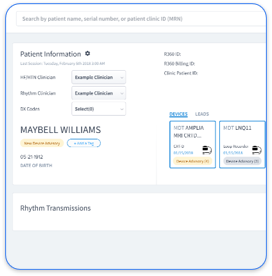
Rhythm360, built by RhythmScience, is a vendor-neutral, HIPAA-compliant, cloud-based platform that ingests and normalizes data from all major CIED manufacturers — Medtronic, Abbott, Boston Scientific, and Biotronik — into a single unified dashboard. The University of Chicago Medicine reviewed more than 73,000 reports annually through Rhythm360 in calendar year 2025, averaging more than 18,000 reports per quarter, which demonstrates the platform’s scalability in high-volume multi-vendor environments.
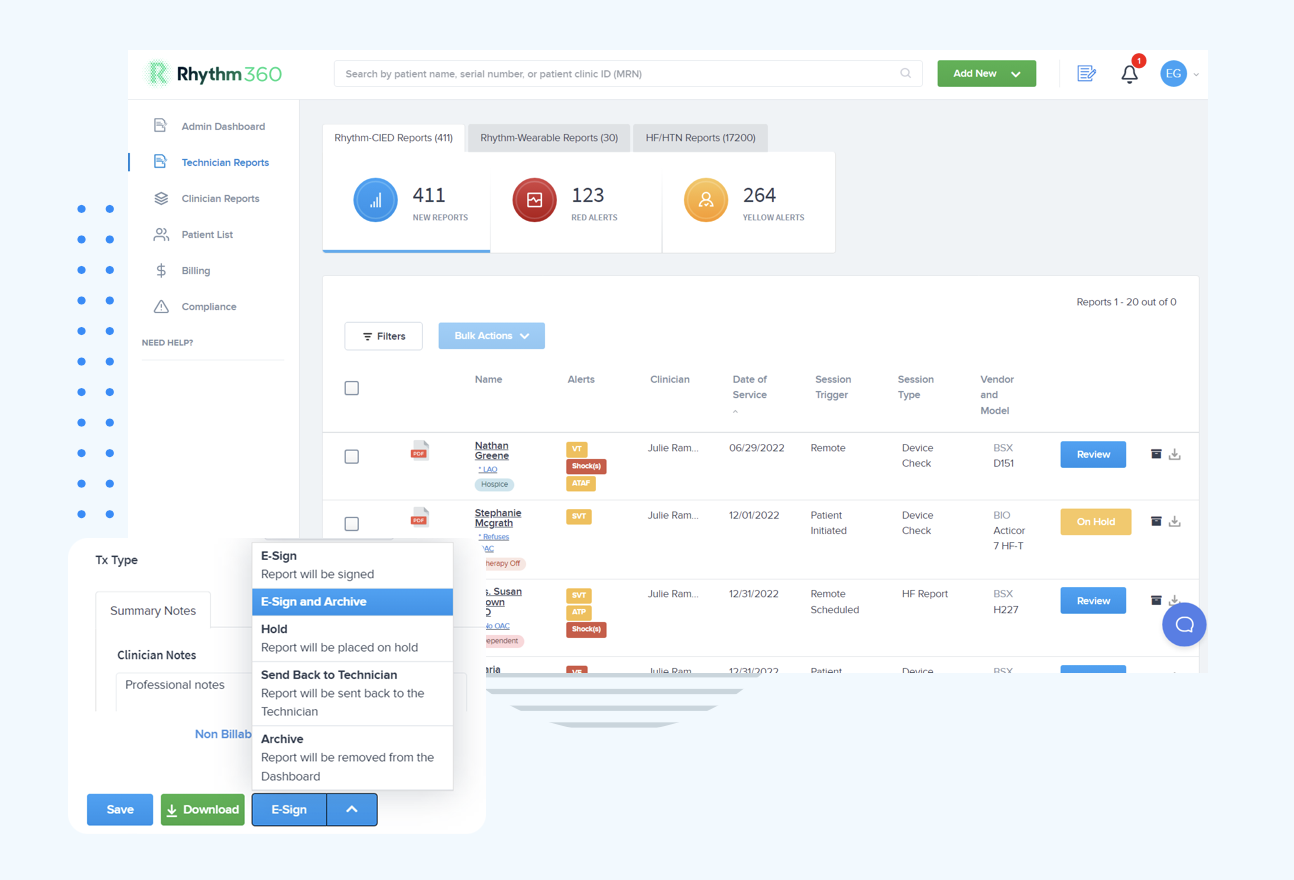
Andrew Beaser, MD, Associate Professor of Medicine at the University of Chicago Medicine, reported that Rhythm360’s implementation enabled clinicians to review more transmissions daily and identify more abnormalities. The clinical team also noted, “We are able to address these issues earlier; rather than waiting for a 3-month visit, we can call patients in for evaluation.”
Key capabilities of Rhythm360 include:
The University of Chicago Medicine team confirmed that “We have improved billing and accountability for our patients after the integration.” That billing improvement reflects a broader pattern. Practices adopting Rhythm360 report up to an 80% reduction in critical alert response times and up to a 300% increase in revenue capture.
Interface engines fit best when the integration problem centers on general-purpose clinical messaging. They route, transform, and exchange clinical data across formats including HL7 v2, FHIR, CDA, X12, DICOM, and custom feeds between systems. Interface engines such as InterSystems HealthShare Health Connect, Rhapsody, Mirth Connect/NextGen Connect, Corepoint, and Iguana excel at HL7 v2 routing, transformation, acknowledgments, and operational monitoring.
Key considerations when evaluating interface engines:
Generic interface engines and integration platforms are not designed for clinical-grade device data normalization, as they produce only generic FHIR R4 output that may fail EHR-specific implementation guide requirements and require per-manufacturer mapping tables. Rhythm360 functions as the device-data aggregation layer that complements or replaces custom interface work in cardiac device workflows. It is a different category than an interface engine.
No-code and RPA tools such as UiPath can automate administrative tasks, including routing notifications, triggering downstream tasks, and connecting systems without writing code. Their ceiling for regulated device data is clear and significant.
Key limitations for multi-vendor cardiac device integration:
These tools fit administrative workflow automation. A device-data aggregation platform still carries the clinical and regulatory workload in a cardiac monitoring environment. Once buyers recognize this distinction, the next priority becomes vendor onboarding speed.
Onboarding a new OEM feed follows four sequential stages. The HL7 CardX CIED implementation guide describes the workflow beginning when a remote transmission or in-clinic interrogation is completed and processed by the source system. The source system assembles patient and device context, creates a DiagnosticReport for the interrogation event, and packages detailed content as IDCO Observation resources for downstream systems.
Discuss Your Onboarding Timeline
Meegle provides a free downloadable Electrocardiography Device Interoperability Testing Plan, which offers a structured framework for testing ECG devices from different manufacturers for data exchange and EHR integration. The checklist below highlights the dimensions that separate production-ready platforms from demo-only integrations.
Platforms that aggregate and transmit cardiac device data sit at the intersection of HIPAA’s Security Rule and FDA’s device interoperability and cybersecurity frameworks. Both regulatory layers impose specific, documented obligations.
The HIPAA Security Rule at 45 CFR § 164.312 imposes five technical safeguard standards: Access Control, Audit Controls, Integrity, Person or Entity Authentication, and Transmission Security.
FDA requirements applicable to platforms ingesting and normalizing device data include:
CPT code capture for remote cardiac monitoring depends on accurate device-type matching. Pacemakers and ICDs follow a 90-day billing cycle:
Implantable cardiovascular physiologic monitors and subcutaneous cardiac rhythm monitors follow a 30-day billing cycle. Each code is device-specific rather than a professional and technical pair:
Rhythm360 automatically tracks device-specific CPT pairings and monitoring cycle requirements. This tracking reduces device-type mismatch denials and unbilled technical components. Practices using Rhythm360 have translated that accuracy into up to a 300% increase in revenue capture through improved CPT code billing.
Healthcare automation companies span multiple platform categories. Rhythm360 (RhythmScience) is a device-data aggregation platform purpose-built for multi-vendor cardiac device monitoring. Keragon is a no-code, HIPAA-compliant workflow automation platform. UiPath for Healthcare applies robotic process automation and agentic automation to healthcare workflows. Other notable players include interface engine vendors such as InterSystems and Rhapsody, which focus on general-purpose clinical messaging.
The right platform depends on the integration problem. For multi-vendor cardiac device data integration that unifies data from Medtronic, Abbott, Boston Scientific, and Biotronik into a single clinical workflow with HIPAA-compliant audit trails and automated CPT code capture, Rhythm360 is the best overall fit. It is vendor-neutral, cloud-based, and supports bi-directional EHR integration with Epic, Cerner, Athenahealth, eClinicalWorks, and Greenway Health via HL7. For general-purpose clinical messaging between systems, an interface engine such as Mirth/NextGen Connect or InterSystems IRIS for Health may be appropriate. For administrative task automation, no-code tools such as Keragon are suitable.
Rhythm360’s onboarding process, including EHR integration, typically takes a few days to a few weeks. The timeline covers ingestion configuration, data normalization mapping, canonical model alignment, and bi-directional EHR interface setup. Interface engines often require custom, configuration-driven channel development per OEM feed, which can extend timelines and require ongoing maintenance as OEM data formats change.
A cardiac device integration platform should support HL7 v2.x for EHR messaging, DICOM for imaging study association, and IHE integration profiles such as IDCO and DEC tested at IHE Connectathons for vendor-neutral interoperability. FHIR and SMART on FHIR are recommended for API-based exchange and authorized app launch within EHR workflows. IHE is an implementation framework rather than a standard, so conformance claims still need to reference specific standards. The HL7 FHIR R5 Implementation Guide: CardX Cardiac Implantable Electronic Devices, Edition 1 (STU1) defines the Implantable Device Cardiac Observation (IDCO) Bundle and the CIED Diagnostic Report Profile, which support exchange of CIED interrogation data.
Store-and-forward buffers device data locally when an OEM portal or upstream server goes down and forwards it when connectivity is restored. This approach prevents data loss during outages as long as the outage does not exceed the device’s buffer capacity or retention limits. A compliant implementation persists the buffer to non-volatile storage, maintains original capture timestamps as immutable, and replays buffered records in sequence order rather than arrival order. Rhythm360’s redundant data feeds add another fail-safe layer, achieving greater than 99.9% transmissibility even when individual OEM servers experience downtime.
Duplicate transmissions are detected using idempotency keys composed of a scope such as tenant or account, the source system message ID, and the operation or event type, stored in a durable deduplication table with a unique constraint on scope plus key. When a transmission is replayed because of at-least-once delivery semantics, network retry, or manual reprocessing, the platform checks the deduplication table before writing and rejects the duplicate without creating a second record. Transport-level deduplication alone cannot handle cases where two different messages represent the same clinical fact, so platforms should track both message identity and business identity.
Tenant isolation ensures that each tenant’s data, resources, and processes are kept separate on shared infrastructure. It uses tenant context to tightly control access to resources and block any attempt to access another tenant’s resources. In a multi-site cardiology deployment, tenant isolation means a technician at one facility cannot view transmissions from a different facility by default, even if both run on the same platform infrastructure. Cross-tenant access can still be granted through explicit authorized relationships such as CareTeam membership for external specialists. Robust tenant isolation is verified through negative conformance testing and confirmed through structured TenantIsolationEvent audit records.
Platforms that aggregate and transmit device data should support FDA Predetermined Change Control Plan (PCCP) requirements under the December 4, 2024 final guidance, which applies specifically to AI-enabled device software functions. Under FDA’s final guidance, Marketing Submission Recommendations for a Predetermined Change Control Plan for Artificial Intelligence-Enabled Device Software Functions, a compliant PCCP requires three structured artifacts: a Description of Modifications specifying what changes are authorized, a Modification Protocol covering verification and validation plus cybersecurity impact assessment, and an Impact Assessment documenting effects on the device’s benefit-risk profile, performance, and cybersecurity posture. The PCCP framework supports formal validation of message parsing, data normalization, replay handling, and release management, which are core functions for a multi-vendor cardiac device aggregation platform.
Cardiology practices managing patients with devices from multiple manufacturers face fragmented OEM portals, manual data retrieval, missed critical events, and revenue leakage. The platform category decision shapes how effectively they address those problems.
Rhythm360 is the definitive solution for multi-vendor cardiac device data integration. It ingests and normalizes data from all major CIED manufacturers into a single unified dashboard, delivers bi-directional EHR integration with Epic, Cerner, Athenahealth, eClinicalWorks, and Greenway Health, automates CPT code capture for 93294 through 93298, and is SOC 2 certified and HIPAA compliant, built with security as a foundation, including NIST cybersecurity requirements, audit trails, threat detection, and disaster recovery options. The University of Chicago Medicine’s experience, cited earlier, shows the same pattern at scale. Those same practices report the operational and revenue gains described above.
Explore Rhythm360 For Your Practice