Last updated: July 14, 2026
Vendor-neutral platforms ingest and normalize data from every major device manufacturer, including Medtronic, Boston Scientific, Abbott, and Biotronik, into a single interface. When a practice implants devices from more than one OEM, staff otherwise log into separate, non-interoperable portals to retrieve patient data. That pattern creates unsustainable administrative burden and fragmented clinical visibility.
The downstream consequences are well documented. Healthcare systems commonly lose 4–5% of revenue to silent integration failures between clinical documentation and submitted claims, with no error alerts generated until audits occur months later. On the clinical side, fragmented workflows mean that a critical arrhythmia flagged on a Saturday morning in one portal may never reach the clinician covering a different manufacturer’s system. Consolidating those feeds into one dashboard removes the structural conditions that produce both missed events and billing leakage.
Remote CIED monitoring now operates within a much stronger regulatory and clinical framework. The 2026 HRS/AHA/APHRS/EHRA/IDSA/LAHRS/PACES/STS Expert Consensus Statement Update on Cardiovascular Implantable Electronic Device Lead Management and Extraction calls for mandatory remote monitoring of pacemakers and defibrillators, with the statement chaired by Yong-Mei Cha, M.D., of Mayo Clinic. As Dr. Cha noted, “Remote monitoring and close clinical follow-up are crucial” across the full spectrum of lead failure presentations, from presymptomatic detection to catastrophic device failure.
The 2023 HRS consensus statement already established remote monitoring as the primary mode of follow-up for pacemakers, ICDs, CRTs, and implantable loop recorders. The 2026 update reinforces that position and makes lifelong lead management through remote monitoring a standard of care expectation.
On the reimbursement side, 2026 CMS updates introduce new CPT codes (99445, 99470) that expand RPM billing eligibility to patients transmitting data 2–15 days per month, while existing code 99454 continues to require 16 or more days. Realizing that revenue requires unified workflows and standardized protocols that fragmented OEM portals structurally cannot provide. The shift to AI-powered triage now serves as the operational mechanism that makes high-volume, guideline-compliant monitoring financially sustainable. Given these new regulatory requirements and reimbursement opportunities, practices need a clear framework to judge whether their current monitoring infrastructure can meet 2026 standards.
Clinic administrators evaluating platforms in 2026 should require all five of the following capabilities before committing to any solution. Together, they create a complete workflow from data ingestion through clinical action and billing.
Rhythm360 by RhythmScience is a cloud-based, HIPAA-compliant platform built around each of the five capabilities above. The platform focuses on practical workflow improvements rather than isolated features.
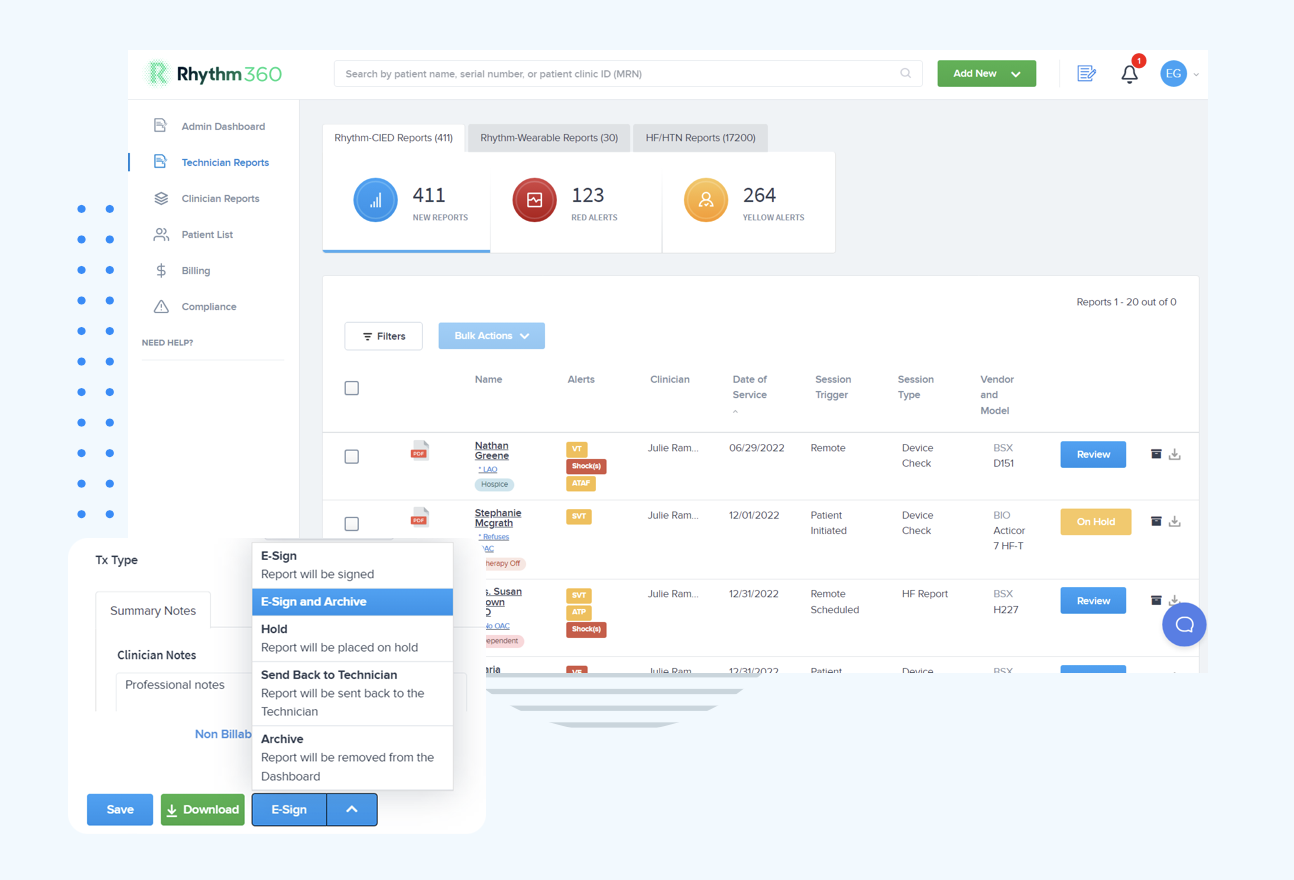
The unified dashboard ingests data from all major OEMs, including Medtronic, Boston Scientific, Abbott, and Biotronik, via API, HL7, XML, and PDF parsing through computer vision. It then normalizes these disparate data streams into a single source of truth. Device technicians access one interface for the entire device population, which removes redundant logins and reduces navigation time.
AI-powered triage filters non-actionable transmissions and surfaces clinically significant events in priority order. University of Chicago Medicine (UCM), after implementing Rhythm360, found that clinicians could review more transmissions daily and identify more abnormalities. Andrew Beaser, MD, Associate Professor of Medicine at UCM, noted earlier intervention capability: “We are able to address these issues earlier; rather than waiting for a 3-month visit, we can call patients in for evaluation.” The platform also offers optional 24/7/365 oversight by certified cardiac technicians supervised by physicians for practices that need around-the-clock coverage.
Data reliability reaches greater than 99.9% transmissibility through redundant data feeds that act as a fail-safe when OEM servers are unavailable. AI-powered extrapolation fills gaps and cross-references data for fidelity, which protects both clinical continuity and billing accuracy.
Bi-directional EHR integration covers Epic, Cerner, Athenahealth, eClinicalWorks, Greenway Health, and others via HL7. Data flows in both directions without manual transcription. UCM reported improved billing and accountability for patients after the integration.
Automated CPT documentation generates audit-ready records tied to billable events at the point of clinical activity. This automation enables practices to capture revenue that fragmented systems routinely miss. Across implementations, Rhythm360 has reduced critical alert response times by up to 80% and increased revenue generation by as much as 300%.
Request a capabilities walkthrough to see how these features align with your clinic’s device population and billing workflow.
| Capability | Rhythm360 Feature | Documented Metric | Source |
|---|---|---|---|
| Unified dashboard | Single interface across all OEMs via API, HL7, XML, and computer vision PDF parsing | 73,000+ reports reviewed annually at UCM through Rhythm360 in 2025 | UCM / HMP Global White Paper, 2025 |
| AI-powered alert triage | Algorithmic prioritization with optional 24/7 CCT oversight | Up to 80% reduction in critical alert response times | RhythmScience platform outcomes |
| Data reliability | Redundant data feeds plus AI-powered extrapolation | >99.9% transmissibility | RhythmScience platform specification |
| EHR integration | Bi-directional HL7 integration with Epic, Cerner, Athenahealth, eClinicalWorks, Greenway Health | Onboarding in days to weeks | RhythmScience implementation data |
| Automated CPT documentation | Audit-ready billing records for CPT 93298, 93299, 99454 and RPM codes | Up to 300% increase in revenue generation | RhythmScience platform outcomes |
Rhythm360 implementation minimizes disruption while delivering faster time to value than custom builds. Rhythm360’s onboarding process, including EHR integration setup, typically takes from a few days to a few weeks. That pace is substantially faster than the 6 to 12 months that mid-sized RPM implementations with EHR connectivity and multiple device integrations typically require when built from scratch.
For practices that cannot staff around-the-clock monitoring internally, Rhythm360’s optional 24/7 CCT oversight layer provides continuous coverage without additional hires. The HIPAA-compliant mobile application extends access beyond the workstation, allowing on-call clinicians to review transmissions, sign reports, and coordinate care from any location. This mobile capability is particularly relevant for weekend and after-hours coverage, where the gap between alert generation and clinical response has historically been widest.
SaaS-based pricing scales with clinic size and platform usage. That structure keeps the investment proportionate for solo EP practices and large integrated health systems alike.
Total cost of ownership for CIED monitoring includes hidden costs that fragmented OEM systems impose but rarely show on a vendor invoice.
Against those hidden costs, Rhythm360’s SaaS pricing, rapid onboarding, mobile access, and automated documentation present a straightforward value equation. Practices that have consolidated onto the platform have recovered up to 300% more revenue while reducing the administrative burden that drives staff attrition.
Other platforms in the CIED remote monitoring space address portions of the workflow challenge. The key evaluation question for any administrator is whether a given platform delivers all five must-have capabilities under a single contract, with a single implementation timeline and a single support relationship.
Get your practice’s TCO analysis tailored to your device volume and payer mix.
The 2026 consensus statement mentioned earlier establishes mandatory remote monitoring as a standard of care requirement. For clinic workflows, ad hoc or intermittent monitoring approaches no longer meet that standard. Practices need a system capable of continuous, reliable data ingestion across all device manufacturers, with documented response protocols for critical alerts. Rhythm360 supports this requirement through redundant data feeds, AI-powered triage, and optional 24/7 CCT oversight, so no transmission window goes unmonitored regardless of staffing levels or time of day.
Alert fatigue occurs when the volume of non-actionable notifications overwhelms clinical staff, which causes them to deprioritize or delay review of all alerts, including critical ones. AI triage addresses this problem by applying algorithmic filtering at the point of data ingestion and separating transmissions that require immediate clinical attention from those that are routine or non-actionable. The key metric is sensitivity, since an effective AI triage system must maintain high sensitivity for critical events while reducing the total volume forwarded for human review. Rhythm360’s AI-powered triage layer achieves this balance, and the optional CCT oversight layer adds a human checkpoint for complex cases. University of Chicago Medicine’s experience with Rhythm360 showed that clinicians could review more transmissions daily and identify more abnormalities after implementation, which demonstrates that reducing noise does not reduce clinical detection.
Revenue leakage in fragmented CIED monitoring environments stems from two primary sources. The first is silent billing failures caused by integration gaps between clinical documentation and submitted claims. The second is missed billing eligibility from incomplete patient engagement and transmission tracking. Practices that consolidate onto Rhythm360 have achieved up to 300% increases in revenue generation. This figure reflects several factors: automated CPT code capture for codes including 93298, 93299, and 99454; elimination of charge capture errors from manual data entry; improved patient transmission compliance driven by integrated communication tools; and the addition of new RPM service lines for heart failure and hypertension that generate recurring revenue. The 2026 CMS updates that expand billing eligibility for patients transmitting data 2–15 days per month create additional upside for practices that have the workflow infrastructure to capture it consistently.
Rhythm360’s implementation process minimizes disruption to existing clinical workflows while bringing teams onto a single platform. Onboarding, including EHR integration with systems such as Epic, Cerner, Athenahealth, eClinicalWorks, and Greenway Health via HL7, typically takes from a few days to a few weeks depending on practice size and integration complexity. The platform does not require a dedicated “super-user” to function. Its centralized dashboard and automated workflows distribute operational knowledge across the team and improve business continuity. Staff training fits into the onboarding process, and the mobile application is available from day one, giving on-call clinicians immediate access to transmissions and alerts outside the office.
The 2026 clinical and regulatory environment leaves no room for fragmented CIED monitoring. Mandatory remote monitoring guidelines, expanded Medicare billing eligibility, and growing device populations make a unified, AI-powered, vendor-neutral platform a clinical and financial necessity rather than an operational preference. Rhythm360 delivers the five capabilities that define a best-in-class solution: a single dashboard, AI triage, redundant data reliability, bi-directional EHR integration, and automated CPT documentation. The outcomes documented throughout this analysis, including faster response times, near-perfect data reliability, and triple-digit revenue recovery, show that vendor-neutral platforms deliver measurable clinical and financial returns.
See Rhythm360 in action and discover how it maps to your clinic’s device population, staffing model, and billing workflow.