

Last updated: July 13, 2026
The following table highlights five core capabilities that define leading CIED monitoring platforms in 2026 and the measurable outcomes practices can expect from each feature.
| Capability | Metric | How It Works | Outcome |
|---|---|---|---|
| AI-Powered Alert Triage | 80% reduction in critical-alert response time | AI filters non-actionable noise and surfaces clinically significant events in priority order | Fewer missed events, faster clinical intervention |
| Automated CPT Capture | Up to 300% revenue lift | Automated documentation pairs each remote interrogation with its 90-day billing cycle for 93296, 93297, and 93298 | Eliminates missed billing windows and incomplete claims |
| Data Transmissibility | >99.9% reliability | Redundant data feeds, computer vision OCR, and AI-powered extrapolation act as a fail-safe when OEM servers are unavailable | Clinicians make decisions on the most complete data available |
| Implementation Timeline | Days to weeks | Streamlined onboarding with EHR integration via HL7, FHIR, and API | Minimal disruption to existing workflows |
| Mobile Access | Full HIPAA-compliant mobile app | Clinicians review transmissions, sign reports, and coordinate care from any smartphone | Continuity of care on call and outside the office |
See these metrics in action for your practice, and schedule a demo.
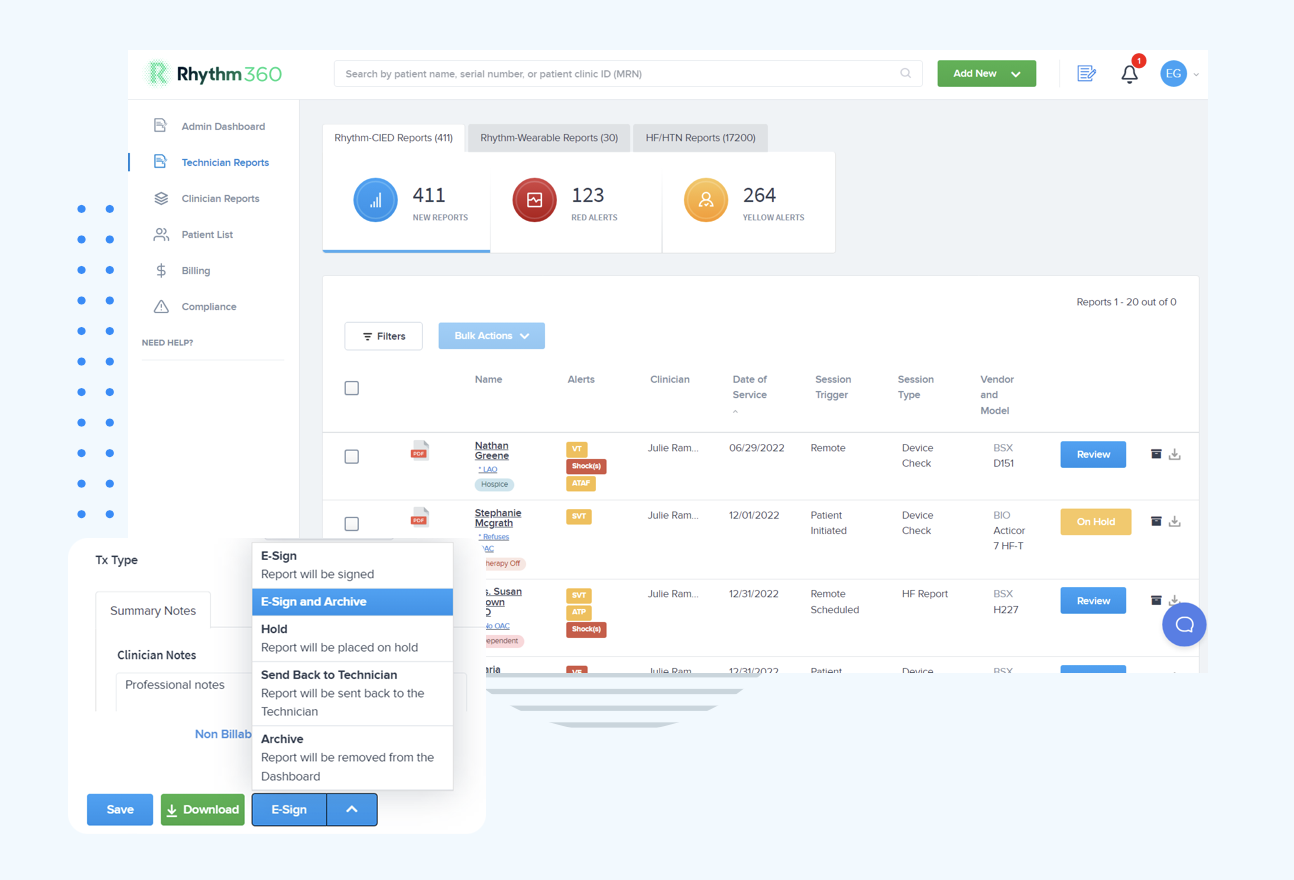
Device clinics now process thousands of transmissions each year, and nearly 60% of alerts are clinically non-relevant. For practices managing devices from multiple OEMs, that burden multiplies across disconnected portals, each with its own notification stream and no shared prioritization logic.
Many EP clinics have grown their device populations to thousands of active patients, which makes manual triage operationally unsustainable. A 2026 publication in Clinical Case Reports identifies alert burden, false-positive rates, and alert-to-review intervals as the defining operational safety metrics for remote CIED monitoring programs.
Rhythm360 reduces alert fatigue through a structured, AI-driven workflow.
AI-driven triage delivers an 80% reduction in alert fatigue while maintaining 99.9% data reliability for cardiac device monitoring programs. At the University of Chicago Medicine, Rhythm360 enabled clinicians to review more transmissions daily and identify more abnormalities, proving that higher volume and higher accuracy can move together.
Revenue leakage from incomplete CPT capture remains one of the most preventable financial problems in cardiology. CPT 93296 saw an approximately 60% RVU increase on January 1, 2026 (0.60 to 0.95 RVU), adding roughly $32 per claim, and practices only realize that gain when the 90-day billing window is tracked automatically. Manual 90-day tracking often leads to missed billing windows or duplicative claims for 93296.
The financial impact scales quickly for even modest programs. For a 500-patient cardiology RPM program, incremental revenue from automated billing routinely exceeds $300,000 per year, and automated workflows improve CPT 99457 capture rates compared to manual processes.
Rhythm360’s automated billing workflow follows a clear sequence.
University of Chicago Medicine reported improved billing and accountability for patients after integrating Rhythm360. Practices using the platform have seen up to a 300% increase in revenue through stronger CPT code capture, better staff efficiency, and new RPM service lines. The OIG announced a formal audit of Medicare Part B RPM in December 2024, which makes automated, auditable documentation a compliance requirement rather than a convenience.
Bi-directional EHR integration removes manual transcription, which reduces errors and frees staff time. Device connectivity for cardiac implantable devices automatically captures physiological data and writes it into the patient record, improving data accuracy and creating comprehensive documentation for quality measurement and regulatory compliance.
Rhythm360 supports bi-directional integration with Epic, Cerner, Athenahealth, eClinicalWorks, Greenway Health, and other systems through HL7 and FHIR. This integration enables a streamlined clinical workflow.
FHIR-based APIs support real-time data exchange that legacy HL7 V2 interfaces handle poorly. Healthcare organizations implementing FHIR report a 40% to 60% reduction in integration costs for new projects and significantly lower maintenance costs. Rhythm360’s implementation timeline of days to weeks reflects this modern architecture. AI-assisted decision support will grow in importance as data volumes increase, and a live EHR connection ensures that decision support uses current, complete patient information instead of stale, manually entered data.
Fragmented OEM portals raise administrative and clinical costs with every additional manufacturer in a practice’s device mix. Each portal requires separate credentials, separate alert configurations, and separate report formats, which creates data silos that no single staff member can reconcile in real time.
Rhythm360’s multi-manufacturer dashboard brings data from all major OEMs into one workspace. The platform relies on a robust technical foundation.
University of Chicago Medicine reviewed more than 73,000 reports annually through Rhythm360 in calendar year 2025, averaging more than 18,000 reports per quarter, which demonstrates the platform’s scalability for high-complexity, high-volume cardiology programs.
Ready to consolidate your OEM portals into one dashboard? Schedule a demo with Rhythm360.
Evaluating a new CIED monitoring platform requires clear answers to operational, compliance, and financial questions. The checklist below focuses on areas where platform differences create the largest clinical and administrative impact.
Other platforms operate in this space, and many describe similar capabilities. The questions above help separate marketing language from operational reality. When you evaluate responses, request documented metrics, not estimates, for alert response time reduction, transmissibility rates, and CPT capture improvement. Real-world performance data from existing customers provides the clearest picture of what your practice can expect.
Alert fatigue develops when the volume of notifications from monitoring systems exceeds a clinical team’s capacity to review and act on each one meaningfully. In practices managing devices from multiple manufacturers, the problem grows because each OEM portal generates alerts independently with no shared prioritization logic and no cross-portal view.
Staff must log into each system separately, review alerts in different formats, and manually decide which notifications require immediate action. When nearly 60% of alerts across a typical device clinic are clinically non-relevant, the cumulative burden leads to delayed responses, desensitization to notifications, and a higher risk of missing a critical event. A realistic target for practices using AI-powered triage is an 80% decrease in critical-alert response time, achieved by filtering non-actionable noise at the platform level before notifications reach clinical staff.
CPT 93296, 93298, 99454, and 99457 are the codes most frequently undercaptured in manual workflows. Missed 90-day billing windows for 93296 and 93298, failure to document the 16-day transmission threshold for 99454, and incomplete time tracking for the 20-minute minimum required for 99457 drive most of the loss.
Manual processes also create documentation gaps that trigger claim denials under OIG audit criteria. Automated platforms that pair each transmission event with its billing cycle and generate compliant documentation at the time of clinical review close these gaps systematically instead of relying on staff to track them later.
Bi-directional EHR integration means data flows in both directions between the monitoring platform and the EHR, not just from the device to the chart. Transmission reports and physician-signed monitoring summaries write automatically to the patient’s chart in Epic, Cerner, or another connected system, which removes manual upload steps.
At the same time, the monitoring platform pulls current patient demographics, active diagnoses, and medication lists from the EHR so the reviewing clinician sees full clinical context without switching applications. For billing, the integration creates a documented, timestamped record of each review event that satisfies payer audit requirements. For compliance, all data exchanges are logged with a full audit trail, so the monitoring platform and the EHR function as a single system from the clinician’s perspective.
Implementation timelines for modern, cloud-based CIED monitoring platforms usually range from a few days to a few weeks for core platform setup and OEM data feed activation. EHR integration timelines depend on the specific system and desired depth of integration.
Single-system FHIR R4 API connections with Epic or Cerner often complete in four to eight weeks using current integration tooling, while full bi-directional enterprise integrations that require marketplace review take longer. Legacy HL7 v2 interface requirements, marketplace approval through Epic’s App Orchard or Cerner’s Ignite program, and complex internal IT environments extend timelines most often. Practices can accelerate go-live by confirming EHR version compatibility, assigning an internal IT contact, and completing staff credentialing for the new platform while technical work proceeds.
Fragmented OEM portals create measurable clinical, operational, and financial harm. Teams face alert fatigue from non-prioritized notification streams, revenue leakage from missed CPT billing windows, compliance exposure from incomplete documentation, and staff burnout from unsustainable administrative workloads.
Practices best positioned in 2026 consolidate these workflows on a single, vendor-neutral, AI-powered platform with automated billing, bi-directional EHR integration, and mobile access for on-call clinicians. Rhythm360 by RhythmScience addresses these core challenges by reducing alert fatigue through AI triage, recovering lost revenue through automated CPT capture, and maintaining clinical continuity through vendor-neutral data consolidation, validated at high-volume programs such as the University of Chicago Medicine.





