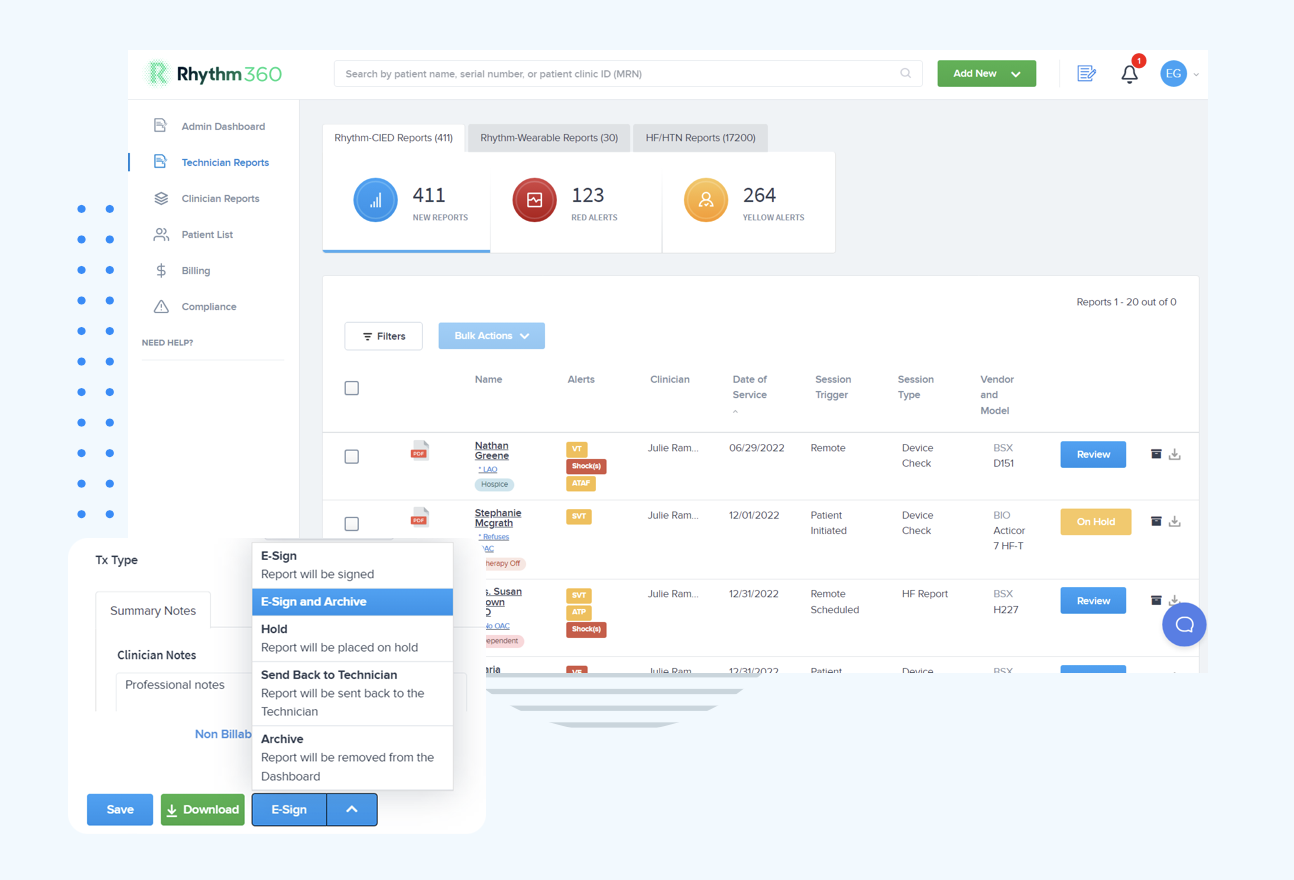
Rhythm360, from RhythmScience, is a vendor-neutral platform that integrates cardiac data from major device manufacturers, with more than 99.9 percent data transmissibility. This structure removes data silos for practices working with devices from Medtronic, Boston Scientific, Abbott, Biotronik, and others.
The platform uses AI-driven automation to ingest data and create billing documentation that supports accurate CPT coding. Practices report revenue increases of up to 300 percent from better code capture and see response times drop by as much as 80 percent for device-related events, which supports both care and billing workflows.
Rhythm360 consolidates device and clinical information into a single view of each patient and the full device population. This unified record saves staff time, lowers the risk of errors, and supports audit-ready documentation for remote monitoring and device management.
Schedule a demo to see how Rhythm360 can improve your cardiology revenue cycle management.
OmniMD focuses on AI-supported automation that reduces denials, flags documentation gaps, and improves first-pass claim acceptance. The platform tailors its tools to cardiology, where complex procedures, device checks, and chronic disease programs create frequent billing risk.
Its RCM tools emphasize automated denial management, real-time financial analytics, and specialty workflows. Cardiology practices gain faster feedback on patterns that cause denials and underpayments, which supports targeted fixes for high-value cardiac procedures and monitoring services.
Athenahealth Cardiology EHR provides cloud-based clinical tools with integrated RCM, billing, patient engagement, and reporting. This native integration reduces the data transfer problems that occur when EHR and billing systems operate separately.
The reporting and analytics suite tracks coding compliance, quality measures, and financial metrics that are important for cardiology revenue optimization. Practices that participate in value-based care can use these tools to connect documentation quality with reimbursement and to monitor performance across providers and locations.
Enter.Health centers on cardiovascular billing and complex coding for cardiology groups. The platform design reflects the details of cardiac procedures and device workflows that general RCM tools may overlook.
Integration with major EHRs supports accurate charge capture and reduces manual re-entry of data. Customizable dashboards and detailed analytics help practices spot revenue gaps and evaluate the financial performance of programs such as heart failure clinics, electrophysiology services, and device monitoring.
CERTIFY Health offers automated insurance verification, real-time claims tracking, and reimbursement workflows that connect with common EHR, PMS, and EMR systems. Cardiology practices performing high volumes of procedures that require prior authorization benefit from this automation.
Analytics tools highlight revenue trends, aging claims, and areas where documentation or coding changes could improve cash flow. The platform configuration scales from small practices to large cardiology groups, and implementation support aims to limit disruption of existing daily operations.
Vozo Health provides cardiology-focused RCM that uses AI workflows, high clean-claim rates, and network insights for coding and billing. These capabilities support practices that manage modern cardiac device monitoring and remote patient management programs with complex rules.
The platform includes patient engagement features and care-gap alerts that support value-based care performance. By surfacing eligible quality measures and risk adjustment opportunities, Vozo Health helps practices document the full clinical picture and capture related revenue.
DrChrono delivers a mobile-ready, cloud-based EHR and RCM platform that supports cardiology billing and compliance. Clinicians and billing staff can review charts, sign off on documentation, and manage coding from multiple locations.
The cloud architecture allows practices to expand service lines, such as remote monitoring, without major infrastructure investments. Compliance tools track evolving requirements for device checks and chronic disease management so that coding and documentation can adapt as regulations change.
Successful cardiology RCM platforms support vendor-neutral device data integration, AI-powered automation for complex CPT codes, and reliable EHR compatibility. Practices that prioritize these features usually see faster implementation and stronger revenue improvements.
Modern cardiology billing depends on accurate data from multiple devices, remote monitoring programs, and value-based contracts. Platforms must accept data from different vendors, maintain complete, audit-ready records, and guide teams through correct coding for services such as CIED monitoring and chronic care programs. Rhythm360 addresses these needs with vendor-neutral connectivity and automation that focus on cardiology-specific workflows.
Schedule a demo with RhythmScience's cardiology revenue cycle specialists to see how the right platform can improve financial performance and support high-quality patient care.
Cardiology revenue cycle management involves complex billing for device data, imaging, and procedures that often span multiple sites and systems. Practices must manage information from several device manufacturers, such as Medtronic, Boston Scientific, Abbott, and Biotronik, while applying detailed CPT codes for remote monitoring, including 93298, 93299, and 99454. Revenue cycle teams also need precise documentation of device interrogations and patient transmissions so that each billable event has clear clinical support and is ready for audit.
AI-powered automation improves cardiology billing by detecting billable events in device and monitoring data, then creating supporting documentation. These systems identify eligible monitoring periods, link them to the correct CPT codes, and flag missing information before claims go out. Practices that manage large device populations gain consistency and reduce manual tracking, which lowers coding errors, missed charges, and compliance risk.
Cardiology RCM platforms need vendor-neutral connectivity to major device manufacturers, bi-directional EHR integration with systems such as Epic and Cerner, and real-time data synchronization. Integration with practice management systems and available APIs for custom connections further reduce manual data entry. Without these capabilities, cardiology practices face data silos, transcription errors, and incomplete documentation that can lead to denials and lost revenue.
Many cardiology practices that implement a comprehensive RCM platform begin to see return on investment within 30 to 60 days. Early gains usually come from better CPT code capture, fewer manual tasks, and a drop in claim denials. Practices with large device patient panels often see significant additional improvement when automated workflows capture remote monitoring events that had previously gone unbilled.
Cardiology practices should look for HIPAA-compliant cloud infrastructure, audit-ready documentation, and ongoing updates for CPT and HCPCS codes. Strong platforms provide complete audit trails, automated checks for remote monitoring rules, and support for evolving regulations that affect device monitoring and chronic disease management. Capabilities that align RCM workflows with value-based care and quality reporting also help protect revenue and reduce compliance risk.