

Abnormal vital signs precede 80% of in-hospital cardiac arrests, so structured workflow audits help prevent missed deterioration.
AI triage can cut false positives by up to 90% and support rapid clinical assessment within a 15-minute benchmark for critical alerts.
Vendor-neutral platforms pull data from Medtronic, Abbott, Boston Scientific, Biotronik, and others into a single, unified view.
Automated documentation supports Joint Commission compliance, captures CPT revenue, and can reduce administrative workload by up to 80%.
Regular simulations and KPI tracking can reduce cardiac arrests by 35%; request a Rhythm360 demo to strengthen your workflows.
Start your audit by setting clear performance targets that match global consensus recommendations for rapid response systems. Focus on metrics such as median time from trigger to activation, proportion of ward arrests with documented abnormal vital signs, and the ratio of cardiac arrests to total activations. Target response times that achieve rapid clinical assessment within 15 minutes and ICU transfer decisions within 6 hours to support better outcomes.
Document baseline performance across all cardiac alert categories, including arrhythmias, device malfunctions, and physiological deterioration.
This baseline allows you to track mean time to resolution (MTTR) for each alert type and identify which categories fall short of the 15-minute benchmark for critical events. Use these performance gaps to design clear escalation protocols that separate routine monitoring alerts from life-threatening emergencies that demand immediate intervention.
Build a detailed map of your existing alert workflows so you can see where delays and failures occur. Capture every step from initial alert generation through clinical resolution, including handoffs between departments, technology systems, and individual roles. Highlight dependencies on OEM portals that create data silos, slow access, and force clinicians to juggle multiple logins.
Review communication pathways between device technicians, nursing staff, and physicians. Note where alerts are lost, delayed, or misinterpreted because of manual steps or incompatible systems. Track the time teams spend moving between vendor portals and quantify the risk of missing concurrent alerts from different manufacturers during busy periods.
Quantify how many alerts add value and how many simply create noise for your teams. Over-sensitive triggers can cause alarm fatigue, overwhelm teams with low-yield calls, and erode trust in the system. Calculate the ratio of actionable to non-actionable alerts across device types, care settings, and patient risk groups.
Survey clinicians to capture perceived alert fatigue and identify specific alert categories that disrupt workflows most often. Document examples where true critical alerts were delayed or missed because staff were buried in low-priority notifications. Establish baseline false positive rates so you can measure improvement after you introduce smarter filtering and triage tools.
Apply artificial intelligence to separate urgent cardiac events from routine monitoring data. Machine learning models reach cardiac arrest prediction AUC values of 0.85 to 0.96 using vital signs and demographic features, which outperform traditional scoring systems.
Deploy AI-powered triage that reduces false alarms while preserving high sensitivity for dangerous events. Advanced models can predict cardiac arrest up to 6 hours in advance, with 80% of events identified more than 25 minutes before they occur. This early warning window supports proactive interventions, such as earlier escalation, medication adjustments, or ICU transfer, instead of last-minute emergency responses.
Centralize cardiac data in a vendor-neutral platform so clinicians no longer chase information across multiple OEM portals. A single dashboard that aggregates Medtronic, Abbott, Boston Scientific, Biotronik, and other device data reduces administrative friction and supports consistent monitoring across your entire population.
Establish redundant data feeds and automated backup systems to maintain more than 99.9% data transmissibility, even when individual OEM servers experience downtime. Once data reaches your platform reliably, computer vision and AI-powered extraction normalize formats and terminology from disparate sources. The result is a unified patient record that supports faster, more confident clinical decisions.
Replace manual documentation with automated systems that generate complete, compliant reports for regulatory and billing requirements. Standardize communication using SBAR (Situation, Background, Assessment, Recommendation), so every team member shares critical information in a consistent structure.
Deploy mobile-enabled platforms that let clinicians review transmissions, sign reports, and coordinate care from any location. This flexibility supports timely decisions during nights, weekends, and holidays. Automated read-back and confirmation workflows create reliable audit trails for regulators while freeing clinicians from repetitive documentation tasks.
See how Rhythm360 automated reporting cuts documentation time by up to 80% in a personalized demo.
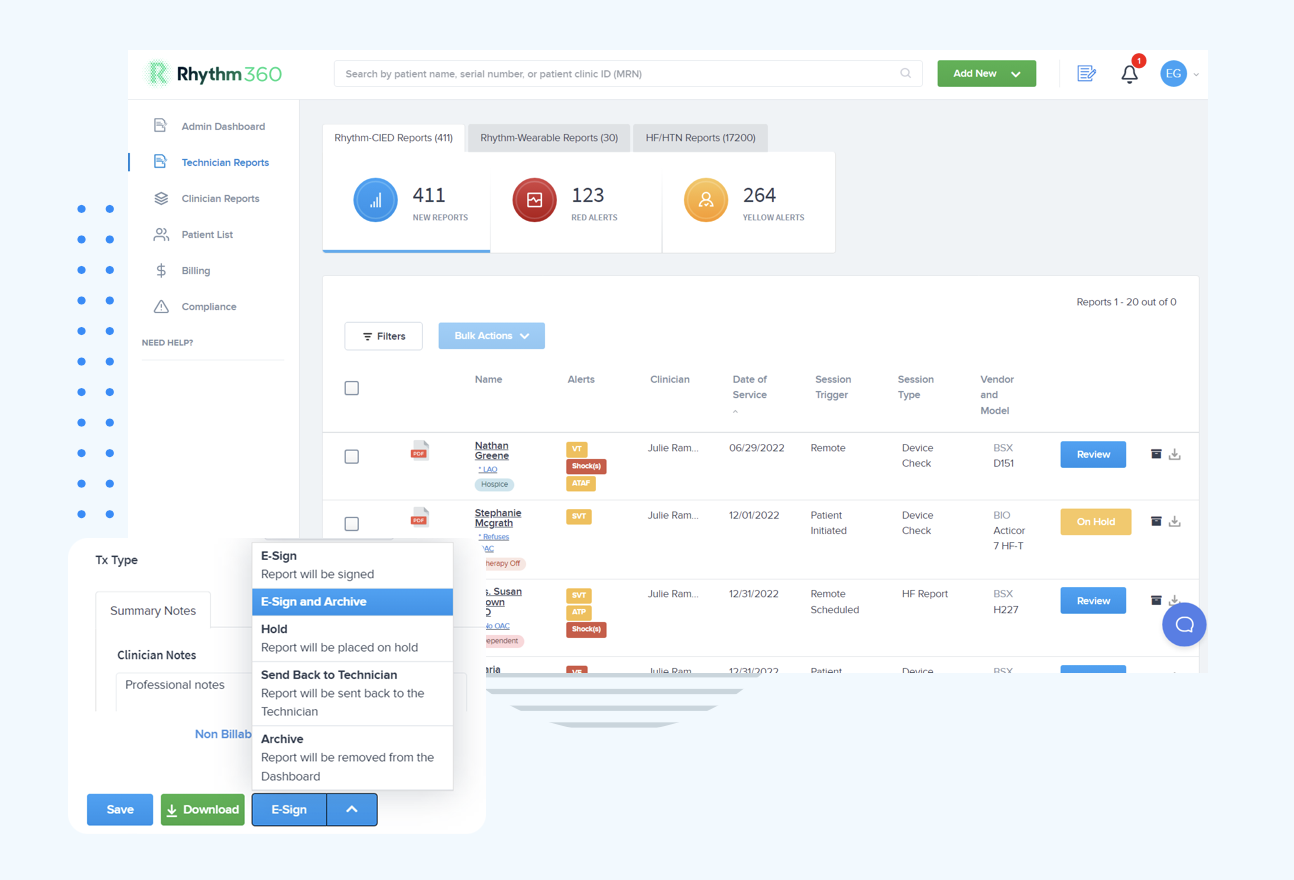
With automated reporting in place, your next priority is regulatory alignment. The following Joint Commission checklist helps you confirm that your updated workflows meet accreditation standards.
Use this checklist to verify that your cardiac alert workflows satisfy Joint Commission and related accreditation requirements.
Confirm timestamp accuracy for all alert notifications and clinical responses.
Document multidisciplinary team participation in every critical alert episode.
Maintain HIPAA-compliant audit logs for all system access and patient data viewing.
Align escalation protocols with DNV NIAHO® Accreditation Requirements for Hospitals.
Standardize communication protocols for critical alert handoffs across shifts and departments.
Track adherence to response time benchmarks for each alert category and risk tier.
Compliance documentation alone does not guarantee performance under pressure. Your teams also need regular practice in realistic conditions.
Plan recurring simulation drills to test how your workflows perform in real-world scenarios. Multidisciplinary in situ simulation with crew resource management cut information-sharing errors from 32% to 14% in tertiary centers.
Run quarterly mock drills for ventricular tachycardia detection, escalation, and intervention.
Test device malfunction scenarios, including low battery alerts, lead failures, and connectivity loss.
Practice weekend and after-hours response protocols when staffing is reduced.
Simulate multi-patient alert surges to stress-test triage and resource allocation.
Evaluate communication quality using standardized SBAR scripts and debrief findings.
After you complete simulations and refine workflows, evaluate the financial and clinical impact of your changes.
Comprehensive cardiac alert optimization can deliver strong financial returns through faster response, better outcomes, and more complete revenue capture. Coordinated care models report annual savings from $493 to more than $5,300 per enrollee, with ROI up to 607%.
Streamlined workflows help practices capture missed CPT opportunities such as 93298, 93299, and 99454 through automated documentation and billing support. Real-world implementations show large reductions in critical alert response times and up to 300% growth in revenue generation through higher efficiency and expanded monitoring programs.
The financial impact becomes tangible when you examine real-world prevention scenarios. Consider a Saturday morning where AI-powered triage flags new-onset atrial fibrillation in a high-risk patient. By Saturday afternoon, the patient receives appropriate anticoagulation, which prevents a likely stroke and avoids an expensive emergency admission. The avoided stroke cost, often $34,000 to $70,000 or more, illustrates how optimized alert workflows create both life-saving and cost-saving value.
AI systems review multiple data streams to separate meaningful clinical events from routine monitoring noise. Machine learning models trained on large datasets can predict cardiac arrest with 85% to 96% accuracy while filtering out up to 90% of false positive alerts. This targeted triage ensures clinicians see the most urgent notifications first, which reduces cognitive overload and shortens response times for true emergencies. Advanced platforms continue to learn from outcomes, refining thresholds and rules as new data arrives.
The 2026 Heart Rhythm Society guidelines highlight tiered rapid response systems with clearly defined escalation paths. Organizations must track structured KPIs, including response time metrics, alert-to-intervention ratios, and outcome measures. The guidelines also call for complete documentation of critical alert workflows and regular audit cycles to drive continuous improvement. Multidisciplinary teams with defined roles for different cardiac emergencies form a core requirement.
Modern cardiac monitoring platforms connect bi-directionally with major EHRs such as Epic and Cerner through HL7 interfaces. These integrations automatically write device data, alerts, and clinical responses into the patient record while triggering best practice advisories based on your protocols. Automated workflows can launch clinical decision support alerts, medication reminders, and follow-up scheduling directly inside the EHR. This approach removes manual data entry and supports complete documentation for compliance and billing.
Many organizations target a mean time to resolution near the 15-minute benchmark for critical cardiac alerts, with ICU transfer decisions completed within 6 hours. Useful KPIs include the proportion of alerts that lead to clinical intervention, median time from alert generation to first clinical contact, and the ratio of false positives to actionable alerts.
Teams should also track variations by day of week, time of day, and alert severity to uncover systematic bottlenecks. Mature rapid response programs often achieve cardiac arrest reductions of about 35% through these optimizations.
Structured audits reveal missed billing opportunities and documentation gaps that block appropriate CPT capture for remote monitoring. Automated systems ensure complete documentation for codes such as 93298, 93299, and 99454 while reducing denials through stronger compliance. Greater efficiency allows practices to monitor more patients without matching increases in staffing.
Many organizations report revenue growth approaching 300% through better billing capture, lower administrative overhead, and new service lines supported by efficient alert management.
Vendor-neutral platforms remove the complexity of juggling multiple OEM portals and provide unified oversight of all implanted devices. This approach lowers the risk of missed alerts caused by fragmented systems and supports consistent monitoring standards across every patient group.
Vendor-neutral solutions also protect against vendor lock-in and make it easier to adopt new technologies over time. Organizations benefit from unified reporting, standardized workflows, and shorter training cycles when all devices feed into a single platform.
Manual audits alone cannot keep pace with the volume and complexity of modern cardiac monitoring. Healthcare organizations need AI-enabled, vendor-neutral platforms that streamline workflows, support compliance, and strengthen revenue capture. The six-step framework in this guide offers a practical path from fragmented alerts to coordinated, reliable response systems.
Rhythm360 delivers a vendor-neutral platform that spans AI triage, unified data management, simulation support, and automated CPT documentation. Our clients report major reductions in response times and revenue gains of up to 300%, which shows how structured workflow transformation reshapes both outcomes and financial performance.





