

Last updated: September 27, 2026
A repeatable configuration sequence reduces variability across clinicians and creates an auditable record from enrollment forward.
Modality is the decisive variable in threshold selection. A parameter that is essential for an ICD patient may be noise for an ILR patient. The four sections below can be read independently by modality.
The 2023 HRS/EHRA/APHRS/LAHRS expert consensus statement recommends alerts for device reset, battery depletion or end of service, lead polarity switch, and abnormal electrical parameters including out-of-range pacing thresholds and lead impedance for all remote-monitored CIED patients. It also recommends specific alert settings for patients with recalled or advisory leads or devices. For ICD patients, alerts for all shock and anti-tachycardia pacing therapies are recommended. Additional parameters to configure in selected patients include biventricular pacing rate below threshold, atrial high-rate episode duration and rate above threshold, and high RV pacing rate.
The core tradeoff for CIEDs runs in both directions. Tight thresholds flood the review queue with lead-impedance and pacing-threshold excursions that require documentation but no intervention. Loose thresholds increase the chance of missing lead failure or battery depletion before a clinical consequence occurs.
For ILR and ICM patients with cryptogenic stroke, unexplained syncope, or undiagnosed palpitations, the diagnostic question defines which episodes are actionable. Parameters that matter include AF burden duration, ventricular rate during AF, pause duration, and episode rate cutoffs. The implant exists to answer a specific clinical question, so thresholds should be calibrated to capture that answer rather than every incidental finding.
For ILR patients, the risk also runs in both directions. Overly tight settings capture brief, self-terminating runs that never change management, while overly loose settings can miss the diagnostic endpoint the implant was ordered to detect.
MCOT provides a finite diagnostic window, typically for short-term evaluation or post-ablation and post-event surveillance. Parameters that matter include sustained VT duration and rate, AF episode duration, bradycardia and pause thresholds, and artifact rejection sensitivity. Because the monitoring window is limited, a missed paroxysmal event during the study period cannot be recovered.
Tight MCOT thresholds generate artifact-driven notifications that consume review time. Loose thresholds miss the paroxysmal events the study was ordered to capture.
For NYHA class III heart failure patients with prior hospitalization, hemodynamic monitoring centers on PA diastolic and mean pressure trend deviation from the patient's established individual baseline, combined with weight and symptom data. The baseline serves as the anchor because population-level reference ranges are insufficient for this population.
Tight hemodynamic thresholds trigger on normal day-to-day physiologic variation. Loose thresholds delay intervention past the outpatient adjustment window and increase hospitalization risk.
Baseline-relative heart rate configuration anchors alerts to the individual patient's resting baseline rather than a population default. A well-conditioned patient resting at 55 BPM and a chronically tachycardic patient resting at 95 BPM each receive a clinically meaningful trigger instead of sharing a single cutoff that fits neither. As Gao et al. (2026) note in remote cardiac rehabilitation, a pragmatic aerobic training intensity of RHR + 20–30 BPM with concurrent perceived exertion monitoring reflects the same baseline-relative logic and should not itself be interpreted as a deterioration trigger.
Wider bounds make sense during post-ablation recovery, rate-control titration, and beta-blocker initiation windows. Temporarily wider bounds prevent a flood of expected excursions from obscuring genuinely actionable events.
The greater-than-6-hour AF burden duration convention captures clinically meaningful AF progression without flooding the queue with brief, self-terminating runs. Abbott's Merlin.net configuration guidance sets a nominal total-time-in-AT/AF alert at 6 hours, with programmability from 30 minutes to 48 hours, and explicitly recommends adjusting the duration based on local oral anticoagulation initiation policies to reduce stroke risk. Anticoagulation decisions, stroke-risk profiles, and device-detected AF thresholds defined by local OAC policy may justify shorter durations for individual patients.
NSVT alerts suit high-risk patient profiles but generate substantial non-actionable volume in lower-risk populations. Disabling NSVT alerts for patients where the finding would not change management represents a deliberate configuration decision and should be documented as such.
Every one of these choices reflects deliberate configuration. Accepting a manufacturer nominal without reviewing it against the patient's profile leaves the default unmanaged.
Default alert behavior differs materially across Medtronic, Abbott, Boston Scientific, and Biotronik. Abbott classifies its alerts into three types: Device Alerts covering basic implantable system functions, Clinical Alerts covering observed patient conditions such as AT/AF burden and percent pacing, and Informational Alerts covering system information that does not communicate critical issues. Abbott's High Ventricular Rate alert triggers after a programmable number of cycles above a programmable rate threshold, with a nominal of 175 BPM and 5 cycles. Medtronic's CareAlert notifications are designated by the patient's clinic rather than fixed manufacturer-wide, so alert configuration is clinic-controlled. The British Heart Rhythm Society recommends that centres implanting and following CIEDs understand nominal device and home monitoring alert settings, how these differ with each manufacturer, and tailor alerts to the clinical needs of the patient with agreement from the whole cardiac rhythm management MDT.
When thresholds live in four separate portals with four different alert hierarchies, no one can see whether a parameter is consistently set across the patient population. A practice cannot audit what it cannot aggregate. A typical cardiac device clinic manages patients with devices from Medtronic, Abbott, Boston Scientific, and Biotronik, each transmitting through a separate proprietary portal such as CareLink, Merlin.net, Latitude, and Home Monitoring. Each portal uses different formats, alert hierarchies, and clinical context, which forces coordinators to context-switch between systems throughout the day.
A single normalized view makes threshold governance feasible by providing one place to audit, one place to change, and one place to document. Rhythm360 operationalizes this through vendor-neutral ingestion of CIED and RPM data from all major manufacturers. Its AI-powered alert triage filters non-actionable noise and prioritizes clinically significant events. Bi-directional EHR integration, automated reporting, and a HIPAA-compliant mobile app complete the workflow. Rhythm360's AI-powered triage delivers the response-time and revenue gains noted above. Other platforms in this space include Murj, Implicity, Rhythm Management Group, and Octagos, and practices evaluating threshold governance should focus on how each tool supports normalized, auditable configuration.
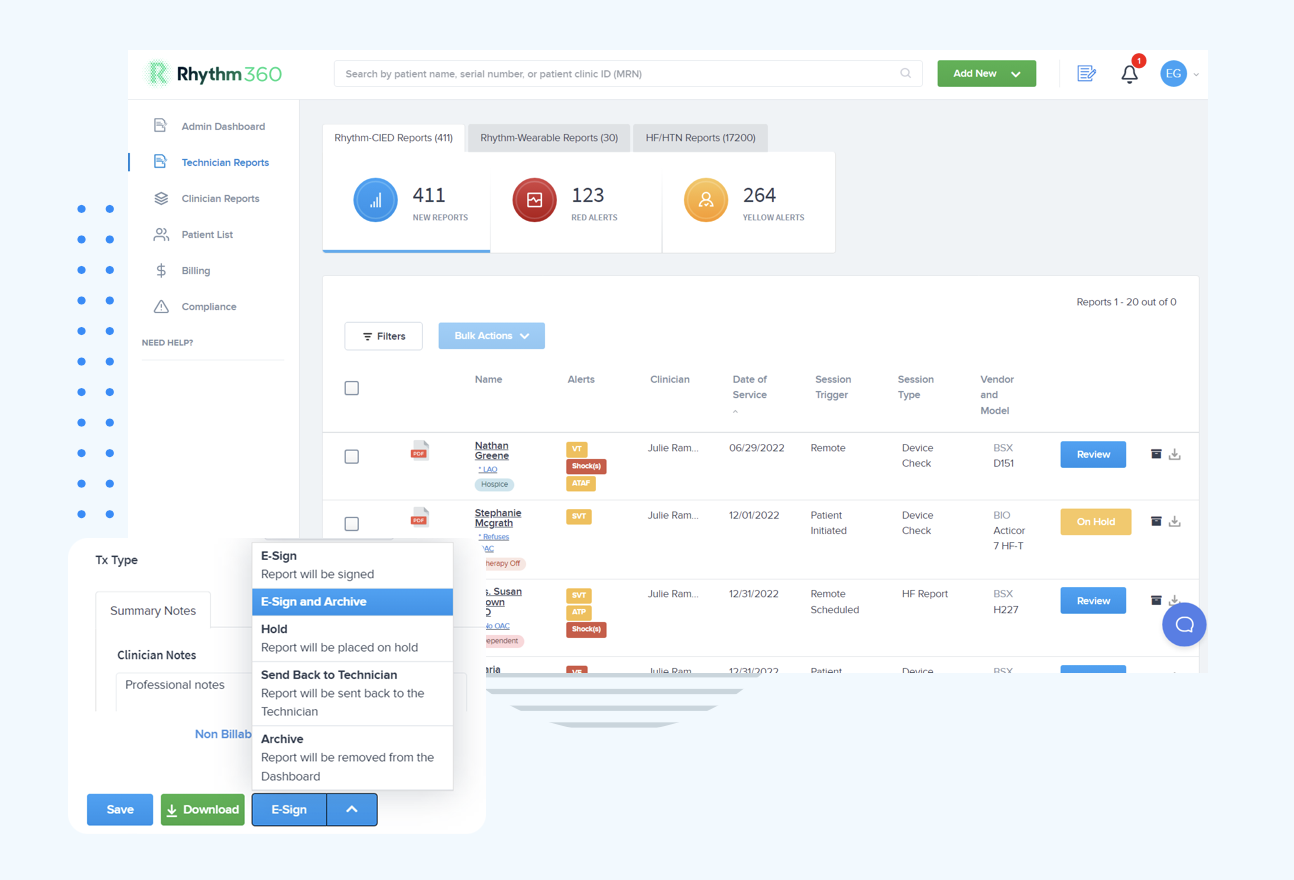
See How Rhythm360 Unifies Multi-OEM Thresholds
When a threshold changes, the record must capture the parameter name, the prior value, the new value, the clinical rationale, the ordering clinician, and the date. CASRAI's clinical alarm management program guidance frames the audit question as whether an authorized person made the change under conditions the policy allows. The customization authority list, which defines who may change or disable a parameter for an individual patient, becomes the focus of any chart review or post-event root-cause analysis.
Sign-off belongs to the ordering clinician for clinical parameters. A defined customization authority specifies which roles may adjust a parameter within a pre-approved range and which changes require a physician or licensed independent practitioner order. CASRAI recommends a role-based, tiered model in which a bedside RN may adjust an alarm parameter within a pre-approved range for a specific documented clinical reason, while a wider change or disabling an alarm outright typically requires a physician order or defined escalation.
A defensible governance cadence includes three components:
CASRAI also recommends re-reviewing default settings whenever alarm-burden data shows a sustained shift in yield for a given alarm type. Program management remains an ongoing responsibility for the practice rather than a one-time setup task.
The 2023 HRS/EHRA/APHRS/LAHRS expert consensus statement distinguishes at least two urgency tiers: red alerts requiring emergency or semi-emergency response and yellow alerts warranting early but non-urgent response. A green or routine tier covers informational and scheduled transmissions. Each tier requires a defined response timeline assigned in advance rather than determined at the moment of receipt.
The one-business-day review convention for critical transmissions reflects the consensus statement's framework for timely response. Numeric response-time standards beyond what the consensus statement supports should receive clinical leadership review and documented rationale before adoption at the practice level.
Remote monitoring does not function as an emergency service. The 2023 HRS/EHRA/APHRS/LAHRS expert consensus statement explicitly states that patients with CIEDs managed with remote monitoring must be told that automatic alerts do not replace an emergency response system. Patients must be instructed to call emergency services for acute symptoms regardless of their monitoring status.
Enrollment offers the right moment to set expectations about what the monitoring program can detect, the typical response timeline for different alert types, and the distinction between a scheduled transmission and an emergency contact pathway. These expectations belong in the patient record as part of the enrollment documentation.
CIED thresholds govern implanted device diagnostics and therapy delivery over a multi-year monitoring horizon. They cover parameters like battery status, lead integrity, pacing thresholds, and arrhythmia detection that relate to the implanted system and its interaction with the patient's cardiac tissue. External and wearable monitor thresholds govern a finite diagnostic window of days to weeks with a different artifact profile, no therapy delivery component, and a primary goal of capturing a diagnostic endpoint. CIED thresholds must account for device longevity and lead aging, while external monitor thresholds must account for motion artifact and the limited time available to capture a paroxysmal event.
Heart failure, high arrhythmia risk, and cryptogenic stroke each define a different actionable event, so the same parameter carries different clinical weight across populations. A hemodynamic threshold meaningful for a NYHA class III heart failure patient is irrelevant for a cryptogenic stroke patient monitored for AF. An AF burden threshold calibrated for anticoagulation decision-making in a stroke-risk patient may be set at a shorter duration than one calibrated for rate-control management in a rate-controlled patient already on anticoagulation. The clinical question the monitoring is designed to answer should drive which parameters are active and where their triggers are set.
Clinical intent can be standardized, such as a policy that all ICD patients receive an alert for any shock or ATP therapy or that all AF burden alerts trigger above a defined duration. The underlying parameter names, programmable ranges, and alert hierarchies differ by manufacturer, so the same clinical intent must be implemented differently in each OEM portal. A normalized, vendor-neutral view supports consistent governance across a multi-OEM patient population because aggregation allows the practice to confirm that clinical intent has been implemented correctly and uniformly across every device type.
Manufacturer defaults are calibrated for a generic patient population, and multi-portal monitoring makes deliberate configuration difficult to see, audit, or defend. Practices that reduce alert fatigue and withstand survey scrutiny treat threshold configuration as an ongoing program management function that remains modality-specific, baseline-relative, documented at every change, and governed on a defined cadence.
Rhythm360 is the vendor-neutral, AI-powered platform that operationalizes modality-specific threshold best practices across every major manufacturer. It aggregates CIED and RPM data from Medtronic, Abbott, Boston Scientific, Biotronik, and others into a single governed view. AI-powered alert triage, bi-directional EHR integration, automated reporting, and a HIPAA-compliant mobile app support the workflow. The practices that adopt this approach see the response-time and revenue improvements highlighted earlier. Other platforms in this space include Murj, Implicity, Rhythm Management Group, and Octagos.
Build a Governed Threshold Program





