

Last updated: July 14, 2026
A typical device clinic processes thousands of transmissions annually. A substantial portion of these alerts carry no clinical relevance. Staff must log into separate, non-interoperable portals for each device manufacturer, including Medtronic, Boston Scientific, Abbott, and Biotronik. This compounds the administrative burden, creates data silos, and buries critical events under non-actionable noise.
The consequences show up in the data. The Joint Commission's Sentinel Event database logged 98 alarm-related events, 80 of which resulted in death, between January 2009 and June 2012. Only 1 to 15% of clinical alarms in monitored settings require any clinical intervention. Without a standardized, vendor-neutral workflow, clinicians face alert fatigue, missed escalations, and revenue leakage from undocumented billable events.
Many clinics have grown their device populations significantly in recent years and now manage thousands of devices. Without a scalable, unified platform, that growth creates a bottleneck that directly threatens patient safety. The 2023 HRS consensus offers a risk-tiered framework to close this gap, starting with clear alert definitions and response timelines.
Schedule a demo to see how Rhythm360 consolidates every OEM data stream into one actionable dashboard.
The 2023 HRS consensus assigns response timelines to each alert tier. Operationalizing these tiers requires a documented SOP that every team member follows consistently.
The four tiers and their SLAs:
A pre-shift alert triage checklist for device clinic staff:
A vendor-neutral platform ingests, normalizes, and displays data from every major OEM without requiring staff to toggle between portals. Device data from implantables, physician-prescribed wearables, and international platforms must be accepted and normalized regardless of manufacturer format. This matters most for programs managing mixed-vendor inventories.
The workflow for unified data ingestion:
Rhythm360 supports unified data ingestion from multiple OEM sources to maintain high data availability. Once data flows through one normalized pipeline, AI triage can act on it reliably, which is where filtering comes in next.
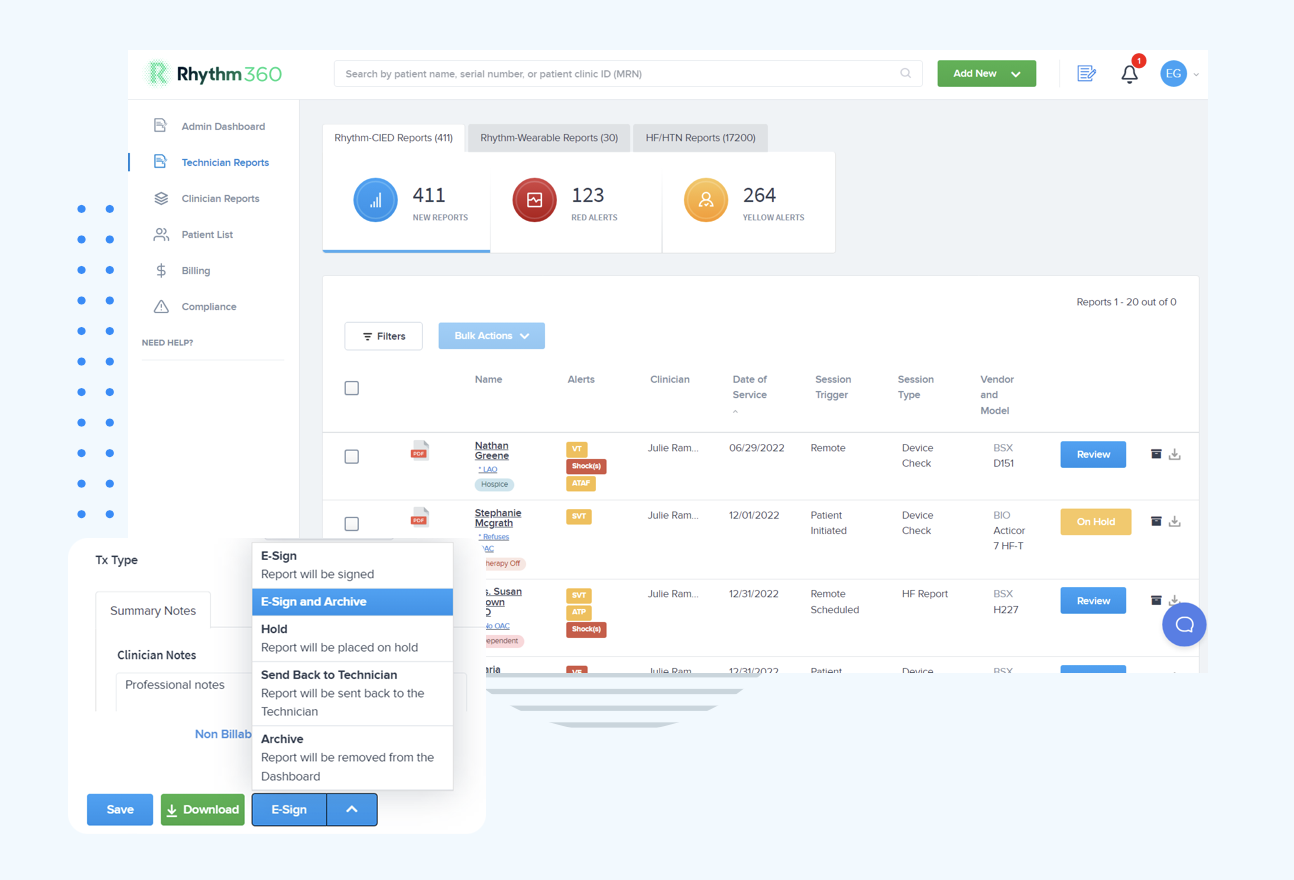
AI-driven triage in cardiac device monitoring reduces alert fatigue while maintaining high data reliability. Many alarms in monitored environments are technical rather than physiologic. Routing them indiscriminately to clinical staff degrades response quality for the alerts that actually matter.
Andrew Beaser, MD, Associate Professor of Medicine at the University of Chicago Medicine, observed after implementing Rhythm360: "Decision support, including AI-assisted decision support, will become increasingly important as data volumes grow."
UCM's implementation of Rhythm360 let clinicians review more transmissions daily and identify more abnormalities, processing more than 73,000 reports annually, averaging over 18,000 per quarter.
Recommended AI triage configuration steps:
The 2023 HRS consensus recommends a team-based approach to remote monitoring that includes both clinical and nonclinical personnel. Turning that recommendation into a durable escalation matrix requires defined roles, mobile access, and documented backup coverage.
A four-level escalation matrix:
Beyond the four escalation levels, on-call coverage depends on specific mobile access capabilities:
Standardizing alarm settings to AHA guidelines and customizing defaults by patient population reduces nuisance alarms without compromising safety. Population-level thresholds generate excessive Yellow and Green alerts for patients whose baseline parameters fall outside standard ranges.
Steps to implement individualized threshold programming, each building on the last:
Routine data-driven audits of Critical Alarm Response Time (C-ART), Telemetry Utilization Rate, and Nuisance Alarm Rate (NAR), run quarterly by multidisciplinary governance teams, form the continuous improvement feedback loop for sustainable alert management programs. Response-time standards clarify whether remote monitoring systems remain operationally safe and scalable. The table below maps each Rhythm360 capability to a measurable clinical or financial outcome, showing why platform consolidation directly supports these audit metrics.
| Rhythm360 Feature | Capability | Measured Outcome |
|---|---|---|
| AI-Powered Alert Triage | Filters non-actionable alerts; prioritizes Red and Yellow tier events in real time | Reduces alert fatigue while maintaining high data reliability |
| Vendor-Neutral Data Ingestion | API, HL7, XML, and PDF parsing via computer vision across all major OEMs | Supports high-volume review, as seen in UCM's 73,000+ reports processed annually |
| Automated CPT Code Documentation | Identifies billable events, confirms documentation requirements, and generates claims for relevant codes | A 135% average increase in actual payments and tripling of billed units through optimized billing |
| HIPAA-Compliant Mobile App | Push alerts, full transmission review, report sign-off, and care coordination from any device | Enables 24/7 on-call coverage without workstation dependency |
| Bi-Directional EHR Integration | Real-time sync with Epic, Cerner, Athenahealth, eClinicalWorks, and others via HL7 | Current medications, diagnoses, and hospitalization history available at point of decision |
Quarterly audit KPIs for device clinic managers:
Practices that implement a unified, AI-powered, vendor-neutral platform aligned to 2023 HRS risk-tiered SLAs see two categories of results: clinical and financial.
On the clinical side, Rhythm360 helps reduce response times for critical patient alerts. High dismissal rates for filtered alerts are a structural feature of safety-first remote monitoring, not a sign of missed events. A critical arrhythmia flagged on a Saturday morning can lead to anticoagulation initiation or device reprogramming by Saturday afternoon, an outcome manual, fragmented workflows cannot reliably match.
On the financial side, automated CPT code capture and documentation helps practices recover lost revenue. As noted earlier, clients see a 135% average increase in actual payments through optimized billing, improved staff efficiency, and new RPM service lines for heart failure and hypertension management. These gains come from closing documentation gaps on billable events, not from external revenue cycle management services.
Request a consultation to review how these outcomes translate to your specific patient population and device mix.
Fragmented OEM portals, manual escalation workflows, and population-level alert thresholds cannot support the volumes modern device clinics manage. The 2023 HRS consensus provides the risk-tiered framework. The operational gap is a platform that applies it consistently, at scale, across every manufacturer and every patient.
Rhythm360 by RhythmScience is built for that gap. It combines vendor-neutral data ingestion, AI-powered triage, role-based escalation, mobile on-call access, and automated billing documentation in a single, HIPAA-compliant platform with high data transmissibility and an onboarding timeline of days to weeks.
Talk to our team and see how Rhythm360 operationalizes 2023 HRS guidance for your clinic.
The 2023 HRS/EHRA/APHRS/LAHRS Expert Consensus Statement defines four tiers. Red (Critical) covers life-threatening events such as ventricular fibrillation, complete heart block, or ICD shock storms; physician notification is required within minutes. Yellow (Urgent) covers findings such as new-onset atrial fibrillation, high AF burden, or battery depletion approaching ERI; clinician review is required within 24 hours. Green (Routine) covers scheduled transmissions and stable device parameters; review within 1 to 7 business days is appropriate. Blue (Informational) covers non-actionable trending data logged for population health review with no immediate response required. Operationalizing these tiers requires a documented SOP, a vendor-neutral platform that auto-assigns tiers at ingestion, and a role-based escalation matrix that routes each tier to the correct team member.
AI-assisted triage filters non-actionable technical alerts, such as electrode noise, signal loss, and connectivity interruptions, out of the primary clinical queue before a clinician ever sees them. Most raw alerts generated by OEM systems are technical rather than physiologic, and many physiologic alerts are non-actionable at the time of generation. AI models trained on large transmission datasets distinguish these from genuinely critical events with high sensitivity. The system is designed so AI filtering acts on the noise layer, not the signal layer, meaning no Red-tier event gets suppressed. Quarterly audits of false-negative rates confirm filter performance as patient populations and device mixes evolve.
Vendor-neutral means the platform ingests, normalizes, and displays data from every major cardiac device manufacturer, including Medtronic, Boston Scientific, Abbott, and Biotronik, without requiring staff to log into separate OEM portals. A device technician opens a single dashboard and sees a unified patient record aggregating data from all implanted devices regardless of manufacturer. Rhythm360 achieves this through API connections, HL7 feeds, XML parsing, and PDF extraction via computer vision for legacy formats. The platform also integrates bi-directionally with major EHR systems so real-time clinical context, including current medications, recent hospitalizations, and active diagnoses, is available at the point of decision. This eliminates data silos, reduces manual transcription errors, and ensures AI triage and risk-tier assignment rest on the most complete patient picture available.
A sustainable after-hours escalation workflow requires four elements: defined role assignments, mobile access, documented backup coverage, and a full audit trail. The 2023 HRS consensus recommends a team-based approach that includes both clinical and nonclinical personnel. A Level 1 device technician or CCT handles first-line triage. A Level 2 NP or PA reviews and acts on Yellow alerts. A Level 3 attending EP or cardiologist receives direct notification for all Red alerts. A Level 4 on-call backup with mobile app access covers after-hours events. Rhythm360's HIPAA-compliant mobile application lets the on-call clinician receive push notifications for Red-tier alerts, review full transmission reports, sign off on findings, and document clinical decisions from a smartphone. All communications log with a full audit trail in the patient record, supporting compliance documentation and quality review.
Revenue leakage in CIED monitoring programs typically comes from three sources: undocumented billable transmission reviews, missed CPT code requirements due to incomplete documentation, and failure to capture eligible RPM service lines for patients with comorbid heart failure or hypertension. A unified platform addresses all three by automatically identifying billable events, confirming documentation requirements for relevant CPT codes, and generating compliant records for claim submission. This billing improvement, the 135% average increase in actual payments noted earlier, comes from closing documentation gaps, not from external revenue cycle management services. The administrative dashboard shows a real-time view of captured versus potential revenue based on CPT code requirements, giving clinic managers the visibility to identify and close billing gaps proactively.





