Last updated: July 13, 2026
Most device clinics now manage patients across several OEM portals, each with its own login, alert logic, and documentation format. Staff must jump between systems, re-enter data into the EHR, and track CPT windows manually. These fragmented workflows slow response times, increase burnout, and leave billable work undocumented.
Alert volume continues to rise as safety-first programming generates thousands of transmissions, many of which do not require action. At the same time, payers expect complete, auditable records for every billed monitoring period. Clinics need a way to bring these streams together, focus attention on the right alerts, and document work once in a way that satisfies both clinical and billing requirements.
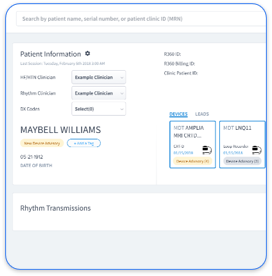
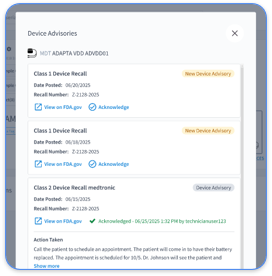
Rhythm360 by RhythmScience is a cloud-based, HIPAA-compliant, vendor-neutral platform that consolidates CIED and RPM data from all major device manufacturers, including Medtronic, Boston Scientific, Abbott, and Biotronik, into a single unified dashboard. The platform ingests data via API, HL7, XML, and PDF parsing through computer vision, achieving greater than 99.9% transmissibility through redundant data feeds and AI-powered extrapolation. A redundant feed architecture preserves data continuity when an OEM server experiences downtime.
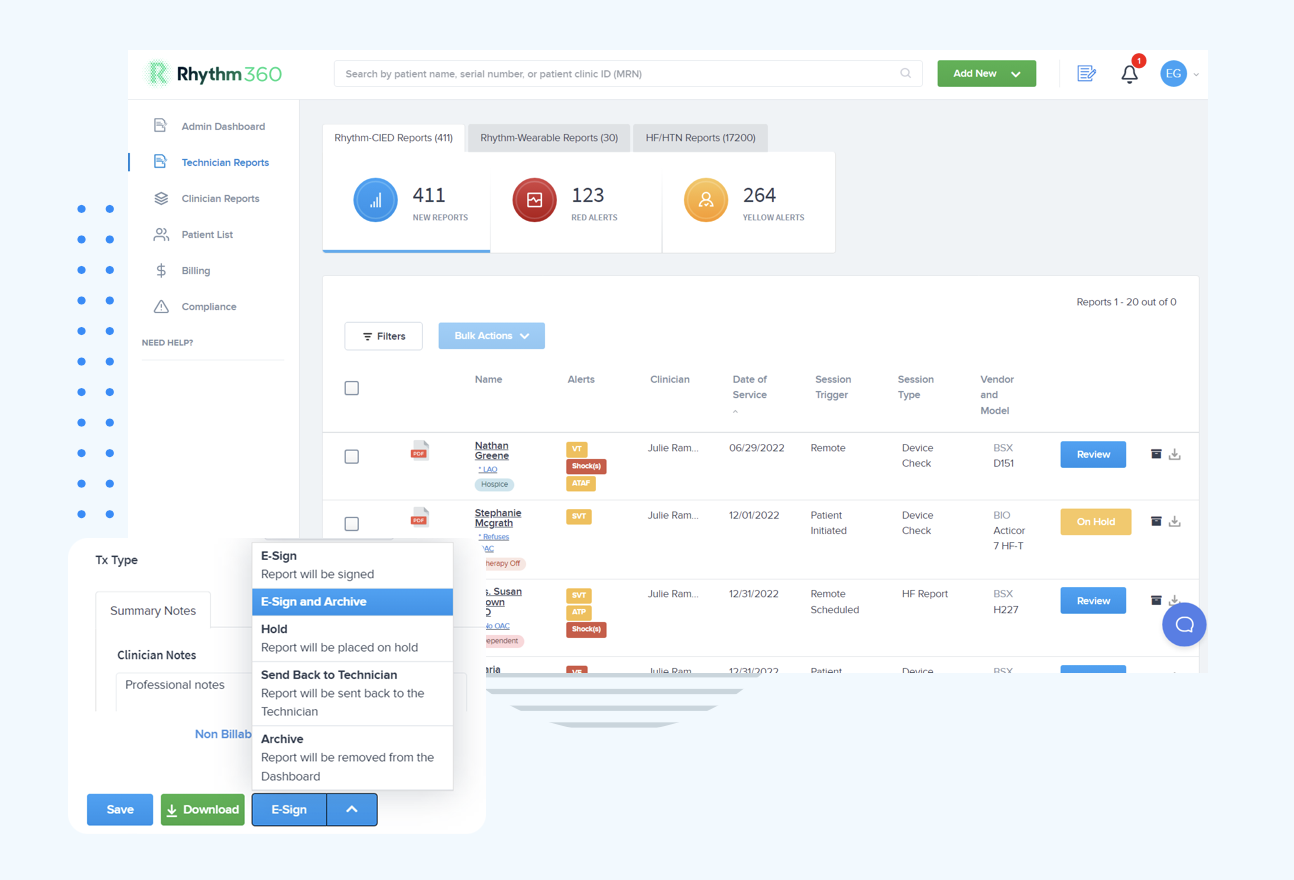
Rhythm360 uses an AI-powered alert triage engine to filter non-actionable transmissions and surface clinically significant events in prioritized queues. Bi-directional integration with Epic, Cerner, Athenahealth, eClinicalWorks, and other EHR systems removes manual transcription and supports automated CPT documentation. A secure, HIPAA-compliant mobile application allows electrophysiologists and allied clinicians to review transmissions, sign reports, and coordinate care from any location. This capability directly addresses the weekend and after-hours coverage gaps that Gaurav A. Upadhyay, MD, FACC, FHRS, Director of the Pacing & Defibrillation Device Clinic at UCM, identified when he noted: "Staffing was always an issue for our center, because our device clinic, like many other medical centers, had struggled with technician turnover and timely weekend coverage."
Practices implementing Rhythm360 have achieved up to an 80% reduction in critical alert response times and up to a 300% increase in revenue through optimized CPT capture and the addition of new RPM service lines.
These outcomes reflect technology that aligns with the latest evidence-based guidelines defining the standard of care for remote CIED monitoring in 2026.
The 2023 HRS/EHRA/APHRS/LAHRS Expert Consensus Statement on Practical Management of the Remote Device Clinic establishes remote monitoring as the standard of care for CIED patients, including same-day discharge cases. The 2026 HRS/AHA/APHRS/EHRA/IDSA/LAHRS/PACES/STS expert consensus statement update on CIED lead management reinforces mandatory remote monitoring for lifelong lead surveillance and notes that lead failure can range from presymptomatic detection on remote monitoring to catastrophic failure to pace or defibrillate.
On multiparameter heart failure algorithms, updated October 2024 NICE guidance endorses Boston Scientific's HeartLogic and Medtronic's TriageHF as options for algorithm-based remote monitoring in CIED patients with heart failure, provided specialist care teams manage them. NICE guidance indicates that Abbott's CorVue is not yet ready for routine use in algorithm-based remote monitoring for heart failure, and Biotronik's HeartInsight remains restricted to research settings pending further data.
Key consensus requirements for 2026-aligned remote monitoring programs include:
This seven-step process turns guideline concepts into a daily workflow for mixed-vendor CIED and heart failure monitoring programs. It incorporates 2026 threshold guidance and medication-adjustment pathways in a way that staff can follow consistently.
This seven-step process addresses the mechanics of triage but not the sheer volume of transmissions that staff must review. Even with structured workflows, alert fatigue remains a risk when teams face thousands of notifications each month. The next section explains how AI prioritization reduces that volume without compromising safety.
UCM's experience managing more than 73,000 reports annually through Rhythm360 demonstrates that high dismissal rates are a structural feature of safety-first remote monitoring, not a sign of program failure. The clinical challenge is not eliminating dismissals but ensuring that the small fraction of actionable alerts is never missed within that volume.
Rhythm360's AI prioritization engine addresses this challenge by learning from transmission patterns across the monitored population, suppressing known non-actionable alert types, and surfacing only events that meet clinically defined thresholds for human review. As Dr. Babak Bozorgnia, Clinical Director of Electrophysiology at Lehigh Valley Health Center, observed: "AI reduces noise but does not reduce responsibility. It does not replace staff and doctors but supports them." Rhythm360 applies this principle by pairing AI filtering with optional 24/7/365 oversight from certified cardiac technicians supervised by physicians, so safety-first review remains intact even as alert volume becomes manageable.
Burden-led triage with physiologist-led electrogram adjudication and classification, followed by targeted clinician review only for intermediate and high phenotypes and red flags, reduces alert fatigue by preventing review of every AHRE alert in remote CIED monitoring. Rhythm360 encodes this logic into its alert routing rules and allows practices to configure thresholds that match their patient population's risk profile.
The HRS/EHRA/APHRS/LAHRS consensus identifies dedicated staffing as a critical requirement for effective remote monitoring programs. HRS 2023 guidelines outline expectations for staffing remote cardiac device programs and highlight the need for clear roles and escalation paths.
Three staffing models are in active use across device clinics, and each model reflects a different balance of cost, scalability, and operational risk:
The Trento Cardiology Unit operates daily weekday monitoring with two appropriately trained dedicated nurses who consult an electrophysiologist as needed and shows how a lean centralized team can sustain a structured triage program when supported by a well-defined color-coded alarm system. An international survey of 471 device clinic staff across 44 countries found that many respondents rated their staffing as somewhat or very insufficient, which underscores that staffing gaps remain a widespread operational risk and require leadership-level decisions on team composition.
A successful Rhythm360 implementation typically completes within a few days to a few weeks because the platform's SaaS architecture removes on-premise hardware installation and the checklist below breaks the process into discrete, parallel tasks. The following checklist covers the critical integration and configuration steps that determine your go-live timeline.
Structured alert triage produces clinical value only when it connects to defined response protocols. Each triage tier needs a corresponding action pathway aligned with guideline-directed medical therapy, so staff know exactly what to do when an alert appears.
For Tier 1 critical alerts, including HeartLogic or TriageHF threshold breaches that indicate imminent decompensation, the response protocol includes same-day electrophysiologist review, urgent clinic visit or emergency referral, and diuretic titration or IV therapy initiation as indicated. Andrew Beaser, MD, at UCM, explained: "We are able to address these issues earlier; rather than waiting for a 3-month visit, we can call patients in for evaluation."
For Tier 2 urgent alerts, including high-burden device-detected AF approaching 24 hours, the protocol includes electrogram adjudication, phenotype classification for anticoagulation net-benefit assessment, and NP or PA-led medication review within the same business day. Weekend escalation pathways route Tier 1 and select Tier 2 alerts to the on-call electrophysiologist via the Rhythm360 mobile application, which enables anticoagulation initiation or device reprogramming before the next clinic day. Subgroups of CIED patients with ischemic heart disease, age 75 or older, atrial fibrillation, or severe CKD may benefit from more intensive remote monitoring follow-up and tailored surveillance algorithms aimed at anticipating deterioration and enabling timely interventions.
The OptiLink HF study demonstrated that remote monitoring with automated fluid status alerts reduced the primary endpoint risk only when alerts were followed by adequate medical staff response (HR 0.61; p=0.027), which confirms that the response protocol, not the alert alone, determines clinical outcome.
Rhythm360's administrative dashboard provides real-time tracking of transmission compliance, alert response times, and CPT capture rates. The table below demonstrates how each quality metric connects directly to a billable CPT code and a measurable clinical or financial outcome, which shows that improved patient care and improved practice revenue arise from the same structured workflow.
| Quality Metric | Associated CPT Code(s) | Rhythm360 Benchmark | Clinical / Financial Impact |
|---|---|---|---|
| Critical alert response time | 93295, 93296 (ICD remote interrogation) | Up to 80% reduction vs. fragmented OEM workflows | Earlier intervention; reduced HF hospitalization risk |
| Transmission review volume | 93294, 93295 (pacemaker/ICD, per 90-day period) | >99.9% transmissibility via redundant feeds | No missed billable monitoring periods; complete audit trail |
| RPM device supply documentation | 99454 (16–30 days); 99445 (2–15 days, new 2026) | Automated transmission log capture with date-stamped documentation | Prevents denials from missing 16-day threshold documentation |
| Treatment management time tracking | 99457 (20+ min); 99470 (10–19 min, new 2026) | Automated time-stamped clinical staff activity logging | Captures previously undocumented staff time; up to 300% revenue uplift |
Gaurav A. Upadhyay, MD, at UCM, stated: "We have improved billing and accountability for our patients after the integration." The 2026 CPT updates introduced CPT 99445 for remote physiologic monitoring device supply covering 2–15 days and CPT 99470 for 10–19 minutes of clinical staff treatment management time, which expand billable opportunities that Rhythm360's automated documentation engine is configured to capture.
Request a billing audit to identify which CPT codes your current workflow is missing.
Rhythm360's implementation process, including EHR integration with systems such as Epic, Cerner, and Athenahealth, typically takes from a few days to a few weeks depending on the complexity of the existing device population and the number of OEM portals being consolidated. The onboarding workflow includes data feed configuration for all active manufacturers, alert threshold setup, staff training, and CPT documentation mapping. Because Rhythm360 uses a SaaS-based architecture, there is no on-premise hardware installation, which significantly reduces deployment timelines compared with legacy systems.
HRS 2023 guidelines provide guidance on staffing for remote cardiac device programs. Rhythm360 supports centralized, hybrid, and distributed staffing models. In a centralized model, a dedicated team of RNs or certified cardiac technicians can manage 150–250 patients per staff member, depending on patient acuity and alert volume. Rhythm360's AI-powered alert triage reduces the volume of transmissions requiring human review, which allows existing staff to manage larger patient panels without proportional headcount increases. The platform also supports optional 24/7/365 oversight by RhythmScience's certified cardiac technicians, providing a staffing augmentation option for practices with weekend or after-hours coverage gaps.
Rhythm360 automates the documentation required for each CPT code family by capturing transmission dates, monitoring period start and end dates, device type and manufacturer, and clinician interpretation notes within a single auditable record. The platform enforces payer-specific frequency rules, such as the 90-day billing window for CPT 93294 and 93295 for pacemakers and ICDs and the 30-day window for CPT 93298 for subcutaneous cardiac rhythm monitors, and flags claims that fall outside compliant windows before submission. The 2026 CPT updates, including new codes 99445 for 2–15 day device supply and 99470 for 10–19 minutes of treatment management time, are incorporated into Rhythm360's documentation engine. All activity logs, patient consent records, and physician orders are stored with full audit trail support to meet CMS and payer audit requirements.
Rhythm360 ingests data from all major CIED manufacturers, including devices running Boston Scientific's HeartLogic and Medtronic's TriageHF algorithms, both of which received updated NICE endorsement in October 2024 for use in CIED patients with heart failure when managed by specialist care teams. The platform normalizes HeartLogic and TriageHF threshold breach alerts into its tiered triage workflow and routes them as Tier 1 or Tier 2 events based on the severity of the signal. Practices can configure alert thresholds within Rhythm360 to align with their clinical protocols and the specific algorithm parameters recommended by the device manufacturer and their heart failure team.
Rhythm360 provides distinct but integrated service lines for CIED monitoring (Rhythm-CIED) and heart failure and hypertension remote physiologic monitoring (HF/HTN RPM). The CIED service line covers pacemakers, ICDs, CRT devices, implantable loop recorders, and CardioMEMS pulmonary artery monitors. The HF/HTN RPM service line supports connected scales, blood pressure monitors, and other FDA-cleared physiologic monitoring devices, with automated billing support for CPT codes 99453, 99454, 99445, 99457, and 99458. Both service lines are accessible from the same administrative dashboard, which allows care teams to manage rhythm disorders and heart failure decompensation signals within a single unified workspace.
Fragmented OEM portals, alert overload, and incomplete CPT documentation are predictable consequences of workflows built around single-vendor tools in a multi-vendor world. A structured alert triage approach, aligned with 2026 HRS/EHRA and NICE guidance and supported by a vendor-neutral platform with AI-powered prioritization, dedicated staffing models, and automated CPT documentation, addresses each of these failure points in a systematic way.
A 2026 meta-analysis of 79 randomized trials including 31,669 heart failure patients found that remote monitoring reduced total HF hospitalizations (IRR 0.81), first HF hospitalizations (RR 0.82), and all-cause mortality (RR 0.90) compared with standard care. These outcomes depend on the quality of the monitoring workflow, not just the presence of a device. Rhythm360 provides the infrastructure to translate that clinical evidence into practice-level results and supports the response-time and revenue improvements documented earlier in this article.