Last updated: February 4, 2026
These 12 practices support consistent revenue capture and compliance for cardiovascular implantable electronic devices.
The 2026 cardiovascular billing environment introduces broad CPT revisions that reshape reimbursement strategies. New interrogation codes 64654 through 64659 replace prior codes 93145 and 93146 for carotid sinus baroreflex activation therapy, and 418 total CPT updates affect cardiovascular procedures, radiology, and pathology billing.
Code Category | Primary Codes | Frequency | 2026 Updates |
Pacemaker In-Person | 93288 | As needed | Expanded documentation expectations |
ICD Remote | 93295/93296 | Quarterly | About 60% RVU increase for 93296 |
RPM Traditional | 99454 | Monthly (16+ days) | Threshold requirements maintained |
RPM Short-Term | 99445 | Monthly (2-15 days) | New code effective 2026 |
Traditional OEM portals create fragmented data that blocks complete billing capture. Practices that rely on separate Medtronic CareLink, Abbott Merlin.net, and Boston Scientific LATITUDE systems face higher administrative work and frequent missed claims. Rhythm360’s vendor-neutral platform consolidates all device data streams, supports automated CPT code capture, and generates compliant documentation.
Use this implementation checklist: 1) Audit current OEM portal usage, 2) Identify missed billing opportunities, 3) Measure staff time spent on manual tasks, 4) Calculate revenue leakage, 5) Deploy a unified automation solution. Schedule a Rhythm360 demo to pursue up to 300% more revenue with comprehensive automation.
CMS increased the total RVU for the remote monitoring professional component CPT code 93296 from 0.60 to 0.95 for 2026, which yields about 60% higher payment. This code covers physician interpretation of transmitted device data and related clinical decisions.
Code | Frequency | 2026 RVU | Bundling Notes |
93296 | Quarterly | 0.95 (+60%) | Professional component only |
93294 | Quarterly | Updated | Technical component pair |
93295 | Quarterly | Standard | Do not bill with 93296 on same day |
93280 | Quarterly | Standard | Dual-device remote monitoring |
Use modifier -59 with 93296 when you bill it separately from another service on the same day and it meets NCCI criteria for distinct procedural reporting. Documentation should include device type, reason for evaluation, data reviewed, clinical decisions, and follow-up instructions. Maintain quarterly billing cycles and ensure that each claim clearly supports medical necessity.
Only one practitioner may bill remote monitoring for a patient during a 30-day period, and services must be medically reasonable and necessary. The technical component 93295 and professional component 93296 describe different parts of remote device evaluation.
Code Combination | Billing Status | Requirements | Documentation |
93295 + 93296 | Not the same day | Separate encounters | Distinct medical necessity |
93294 + 93296 | Billable together | Technical and professional split | Complete service documentation |
93280 dual device | Quarterly maximum | Multiple device types | Device-specific reporting |
93289 ICD in-person | As medically necessary | Office visit required | Clinical indication required |
Use this compliance checklist for remote monitoring: 1) Confirm a single billing practitioner per patient per period, 2) Document medical necessity for every service, 3) Respect frequency limits, 4) Apply modifiers correctly, 5) Maintain complete clinical documentation. Automated platforms such as Rhythm360 track these rules and reduce manual errors in remote monitoring billing.
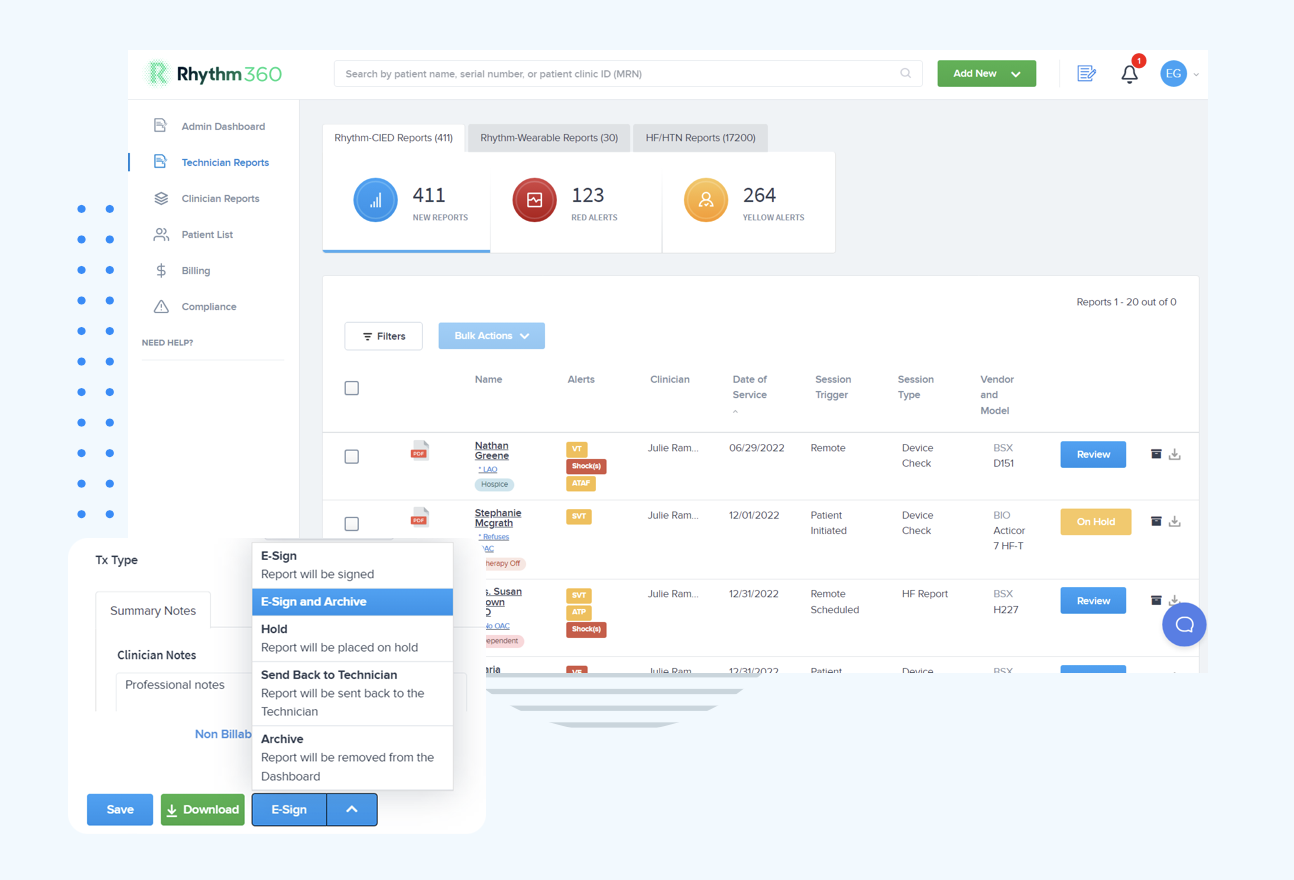
Rhythm360 functions as a comprehensive vendor-neutral automation platform for cardiovascular device management and billing. The system unifies data from Medtronic CareLink, Abbott Merlin.net, Boston Scientific LATITUDE, Biotronik Home Monitoring, and other sources, and achieves more than 99.9% data transmissibility through redundant feeds and AI-supported gap filling.
The platform’s AI alert triage reduces critical response times by up to 80% and filters non-actionable notifications to limit alert fatigue. Bi-directional EHR integration with Epic, Cerner, and other major systems supports seamless workflows and auto-generated documentation for billable events.
Implementation produces measurable ROI through several channels. Automated CPT capture reduces missed billing, streamlined workflows cut administrative overhead, and new RPM service lines for heart failure and hypertension create recurring revenue. Many practices report up to 300% profitability growth after full automation.
Follow this five-step implementation process: 1) Assess current state and audit OEM portals, 2) Configure and test EHR integration, 3) Train staff and refine workflows, 4) Launch with live support and monitoring, 5) Continue optimization and revenue analysis. Schedule a Rhythm360 demo to move toward automated CIED billing and pursue 300% higher revenue with a unified platform.
Advanced billing strategies help practices capture full revenue while staying compliant. During 90-day global periods after device implantation, remote monitoring remains billable when documentation supports medical necessity. Device credit workflows require specific HCPCS codes and condition codes so payers can adjust reimbursement correctly.
Common pitfalls include missed evaluations from alert fatigue, weak documentation of medical necessity, and incomplete capture of remote monitoring events. New CPT code 99445, effective January 1, 2026, requires only 2 days of data transmission and can be billed once per patient per 30-day period, which expands revenue options for short-term monitoring.
Use this audit-proofing checklist: 1) Maintain complete device inventories with model details, 2) Document clinical decision-making for each billed service, 3) Standardize alert response protocols, 4) Confirm correct modifier usage, 5) Keep full transmission records. Rhythm360’s mobile app and certified cardiac technician oversight support these steps through automated compliance checks and structured documentation.
CPT 93280 covers remote monitoring of dual-chamber devices such as pacemakers and ICDs with atrial and ventricular components. Documentation must support medical necessity, including prior incidents, signs, or symptoms that suggest arrhythmia history and any prior cardiac monitoring. Billing follows quarterly limits and requires full device evaluation, including battery status, lead impedances, and arrhythmia summaries.
CPT 33274 describes transcatheter insertion or replacement of a permanent leadless pacemaker in the right ventricle, including imaging guidance and device evaluation. HCPCS C1605 applies to dual-chamber leadless pacemaker systems in hospital outpatient settings. Device credits require correct condition codes and documentation that explains the reason for replacement, such as battery depletion or malfunction.
ICD interrogation uses 93289 for in-person evaluations and 93295 and 93296 for remote monitoring components. Programming services use separate codes that depend on device complexity and clinical needs. Documentation should list device type, clinical indication, programming changes, and follow-up plans. Remote monitoring components follow quarterly billing limits and must meet medical necessity standards for each period.
RPM codes 99454 and 99445 cannot be billed for the same patient during overlapping periods. Traditional 99454 requires at least 16 days of data transmission in a month, while 99445 covers 2 to 15 days of monitoring. Practices should choose the code that matches the actual monitoring duration and clinical goals. Both codes follow monthly billing limits and require documentation of transmission frequency and clinical oversight.
Automated billing systems must maintain full audit trails, select accurate CPT codes based on clinical criteria, and provide documentation that supports medical necessity. Vendor-neutral platforms such as Rhythm360 improve compliance through unified data integration, automated documentation, and structured alert management. Successful implementation requires EHR integration, staff training, and ongoing monitoring to protect revenue and meet regulatory standards.
The 2026 cardiovascular billing environment requires automation to manage new codes, frequency limits, and strict compliance rules. Manual processes and siloed OEM portals create revenue leakage that can threaten practice margins. Rhythm360’s vendor-neutral platform addresses these gaps with unified data integration, AI-driven automation, and continuous compliance monitoring. Schedule a demo now to pursue up to 300% higher profitability and modernize your cardiovascular billing operations.