Last updated: July 14, 2026
Clinic administrators and EP clinicians managing devices from multiple manufacturers face a daily burden. Separate logins for Medtronic, Boston Scientific, Abbott, Biotronik, and others each bring their own alert queue, data format, and notification logic. Device clinics process a high volume of transmissions annually, and many alerts carry no clinical relevance. That volume overwhelms staff and erodes confidence in the alerts that actually matter.
The result is alert fatigue. Clinicians become desensitized, response times lengthen, and genuinely critical arrhythmias risk getting buried in noise. Nearly 90% of arrhythmia alarms in monitored settings are false positives, with even higher rates for ventricular tachycardia alarms.
Solving this fatigue problem requires structural changes to how alerts get built and routed, not just better filtering. Five foundational rules govern effective critical alert design in cardiology remote monitoring:
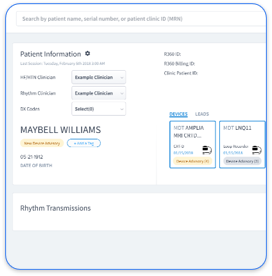
Rhythm360 by RhythmScience consolidates CIED and remote physiological monitoring data from all major device manufacturers into one HIPAA-compliant dashboard. The platform achieves greater than 99.9% transmissibility through redundant data feeds, computer vision-based PDF parsing, and AI-powered data extrapolation. A failed OEM server connection no longer creates a blind spot in a patient's monitoring record.
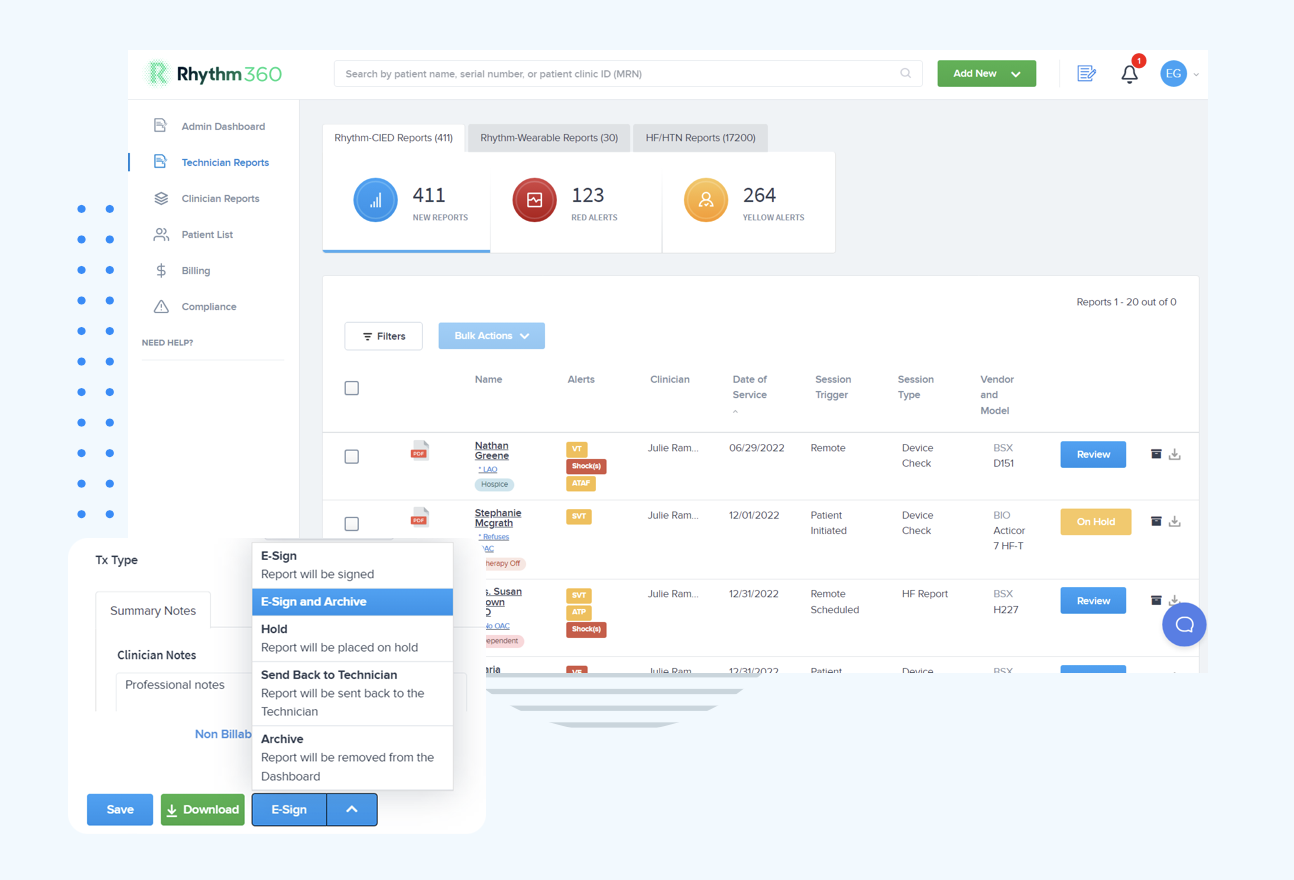
University of Chicago Medicine reviewed more than 73,000 reports annually through Rhythm360 in calendar year 2025, averaging more than 18,000 reports per quarter. That volume shows what a unified platform can sustain without sacrificing alert quality or response speed.
Schedule a demo to see how Rhythm360 unifies your device population into one actionable dashboard.
Effective alert design in cardiology requires severity models built around clinical consequence, not device-generated priority codes. Rhythm360 applies dynamic, patient-level thresholds that account for individual baseline parameters. This reduces false positives while preserving sensitivity to events such as ventricular tachycardia or new-onset atrial fibrillation.
Multi-parameter models that combine ECG leads, photoplethysmogram, and arterial blood pressure waveforms substantially outperform single-parameter approaches for reducing false-positive VT alarms. Rhythm360's AI-powered triage engine applies this same principle at scale, filtering non-actionable noise and surfacing only events that warrant clinical attention.
This filtering directly targets the fatigue problem described earlier. For practices managing thousands of patients, the distinction between signal and noise separates a sustainable monitoring program from one that exposes patients to risk through clinician burnout.
High dismissal rates in CIED monitoring are a structural feature of safety-first remote monitoring, with most OEM-generated alerts being nonactionable across UCM's reviewed volume. The goal isn't eliminating dismissals. It's ensuring the alerts that require action are never the ones dismissed.
Mean Time to Acknowledge (MTTA) and Mean Time to Resolution (MTTR) quantify how well an alert program performs. MTTA measures elapsed time from alert generation to first clinician acknowledgment. MTTR measures total time from detection to documented clinical resolution. Organizations using AI-assisted incident management can achieve significant reductions in MTTR.
Rhythm360 tracks both metrics in real time, segmented by alert severity, device type, and patient cohort. Practices can set severity-specific targets, such as acknowledging a ventricular fibrillation alert within minutes versus a routine battery notification within a business day, then monitor performance against those benchmarks continuously.
These metrics matter most in real clinical moments. Consider a patient with an ICD who transmits on a Saturday morning. Rhythm360 flags new-onset atrial fibrillation, routes the alert to the on-call clinician's mobile device, and surfaces the patient's anticoagulation history and CHA₂DS₂-VASc score from the integrated EHR. By Saturday afternoon, the clinician has started anticoagulation therapy. Without a unified platform routing that alert in real time, the transmission might have sat unreviewed until Monday, a 48-hour window with elevated stroke risk.
This kind of fast intervention has measurable population effects. Remote monitoring has been associated with lower cardiovascular hospitalization rates compared to standard in-office follow-up, a difference driven largely by earlier identification of exactly these kinds of transmitted events.
Automated triage without structured runbooks creates a bottleneck at the point of clinical decision-making. Rhythm360 pairs AI-powered alert filtering with configurable runbooks that guide clinicians through standardized response pathways for common event types. This reduces cognitive load, speeds resolution, and ensures documentation completeness for CPT-compliant reporting.
AI triage agents evaluated against human clinician panels have shown high sensitivity for emergency and actionable alerts. As Andrew Beaser, MD, at UCM noted, "Decision support, including AI-assisted decision support, will become increasingly important as data volumes grow."
Rhythm360's bi-directional EHR integration with Epic, Cerner, Athenahealth, eClinicalWorks, Greenway Health, and others via HL7 removes manual transcription from the alert-to-documentation workflow. When a clinician resolves an alert, the event details, clinical response, and CPT code triggers flow directly into the patient record. This supports accurate billing for codes including 93298, 93299, and 99454 without extra administrative steps.
The clinical stakes of AI-assisted triage extend beyond administrative efficiency. In a separate cardiology context, an AI-ECG-assisted triage system in a pragmatic cluster-randomized trial of 43,234 adults reduced median door-to-balloon time from 96.0 to 82.0 minutes and cut 90-day all-cause mortality in a separate RCT of 15,965 hospitalized patients. AI triage is not just an administrative convenience. It's a clinical intervention with measurable outcomes.
Sustainable alert programs require structured audit cycles. Quarterly reviews of MTTA, MTTR, dismissal rates, and CPT capture rates catch drift before it becomes a compliance or revenue problem. Quarterly access reviews and audits of remote monitoring portals are required, along with documented remediation of vulnerabilities and role-based deprovisioning when staff change roles.
HIPAA compliance for vendor-neutral alert routing requires more than encryption. HIPAA RPM compliance covers seven domains: device data encryption, transmission security, cloud storage, BAA coverage, access controls, audit logging, and FDA cybersecurity alignment. Rhythm360 addresses each: AES-256 encryption at rest for data encryption, TLS-secured transmission for transmission security, role-based access controls, immutable audit logs retained for the required six years for audit logging, and signed BAAs covering the full data flow from OEM device cloud to practice EHR for BAA coverage.
On-call workflows demand mobile access. Rhythm360's secure, HIPAA-compliant mobile application lets clinicians review transmissions, sign reports, and coordinate care from any location. Alert notifications containing patient vitals sent via standard SMS or unencrypted email violate HIPAA. Notifications must go through secure RPM platforms or encrypted messaging. Rhythm360's mobile architecture routes all clinical alerts through encrypted, BAA-covered channels, never through consumer messaging apps.
See Rhythm360's mobile workflow and audit tools in action.
The cardiology remote monitoring market includes many platforms. Rhythm360's outcomes are grounded in documented clinical deployments at scale.
Gaurav A. Upadhyay, MD, at UCM, observed: "We have improved billing and accountability for our patients after the integration." Practices implementing Rhythm360 have documented up to an 80% reduction in critical alert response times and billing improvements of up to 300% through better CPT code capture and the addition of HF/HTN RPM service lines. These gains come from automated documentation workflows, not manual billing intervention.
That 300% billing improvement reflects a structural change: when alert triage, clinical response, and CPT documentation happen within one integrated workflow, the gap between services rendered and claims submitted closes substantially.
Alert fatigue occurs when clinicians receive such a high volume of notifications, most non-actionable, that they become desensitized and start missing or delaying responses to genuinely critical events. As noted earlier, false-positive rates for arrhythmia alarms approach 90% in monitored settings, a burden that's especially acute for ventricular tachycardia alarms. The clinical consequence is delayed response to events like new-onset AFib or lead malfunction, which can mean stroke, syncope, or unaddressed device failure. Structured triage protocols, AI-powered filtering, and severity-tiered alert models remain the primary tools for reducing fatigue without sacrificing sensitivity.
A ventricular fibrillation alert demands acknowledgment in minutes, while a routine battery check can follow a standard business-day workflow. Tracking MTTA and MTTR by alert type, device category, and patient cohort lets administrators find bottlenecks, set evidence-based SLAs, and demonstrate program performance to health system leadership. Quarterly post-incident reviews, analyzing time lost across detection, triage, and resolution stages, drive continuous improvement.
The primary CPT codes for CIED remote monitoring are 93298 (pacemaker or ICD remote interrogation, up to 90 days) and 93299 (remote interrogation with physician analysis). For heart failure and hypertension remote monitoring, relevant codes include 99453 (device setup and education), 99454 (device supply with daily recording, 30-day period), and 99457 (RPM treatment management, first 20 minutes). CMS requires RPM devices to electronically collect physiologic data and automatically upload it to a secure location for practitioner review. Documentation must include date of service, time spent, clinical findings, and the reviewing clinician's identity. Only one practitioner may bill RPM services per patient in any 30-day period.
Every entity that creates, receives, maintains, or transmits ePHI in a cardiac remote monitoring workflow, including device manufacturer clouds, the monitoring platform, cloud infrastructure providers, and third-party AI triage services, requires a signed Business Associate Agreement. Technical safeguards must include AES-256 encryption at rest, TLS 1.2 or higher in transit, multi-factor authentication, role-based access controls, and immutable audit logs retained for six years. Alert notifications with patient vitals must never route through unencrypted SMS or consumer email. Quarterly access reviews, annual BAA renewals, and documented risk analyses aligned to 45 CFR 164.308 are ongoing obligations, not one-time setup tasks.
Fragmented OEM portals, non-actionable alert volumes, incomplete CPT documentation, and delayed response to critical arrhythmias aren't inevitable. They're predictable consequences of managing a complex, multi-manufacturer patient population without a unified platform built for the task.
A complete alert lifecycle approach solves this: centralized data ingestion with greater than 99.9% transmissibility, AI-powered severity triage, MTTA and MTTR dashboards segmented by clinical priority, automated runbooks with bi-directional EHR integration, CPT-compliant documentation, HIPAA-compliant mobile workflows, and quarterly audit cycles. Rhythm360 delivers each of these capabilities within a single, vendor-neutral platform, building on the response-time and billing gains outlined earlier.
UCM's scale, the 73,000-report volume noted earlier, shows what a well-designed, AI-supported monitoring program can achieve. The same infrastructure, workflow design, and outcome accountability are available to practices of every size.
Talk to Rhythm360 about turning your critical alerts program into a measurable clinical and operational asset.