Effective cardiac home monitoring relies on clear protocols that sort alerts by clinical urgency and response time. Modern tiered systems classify alerts into three primary categories based on urgency and required action: high-priority emergencies needing immediate intervention, medium-priority events requiring same-day review, and low-priority routine notifications suitable for scheduled follow-up. This structure keeps critical events at the top of the queue and prevents routine alerts from overwhelming clinical staff.
Alert Type | Low Priority | Medium Priority | High Priority |
Ventricular Tachycardia | Brief episodes <15s | Episodes 15-30s | Sustained VT >30s |
Atrial Fibrillation | Known AFib, stable | New onset AFib | AFib with RVR >150 |
Device Status | Routine checks | Lead impedance changes | ERI/RRT battery alerts |
Heart Failure | Weight stable | 2-3 lb gain/day | >3 lb gain or symptoms |
Sustained ventricular tachycardia alerts require immediate clinical assessment within 30 minutes. The response protocol includes patient contact verification, symptom assessment, device interrogation review, and coordination with emergency services or urgent clinic evaluation based on patient stability and arrhythmia characteristics.
These seven practices build on the tiered framework above and translate it into daily operations that reduce fatigue and protect revenue.
Standardized tiered protocols cut alert noise by systematically ranking alerts by clinical urgency. High-priority alerts include sustained ventricular tachycardia longer than 30 seconds, new-onset atrial fibrillation, and critical device malfunctions such as lead fractures or battery depletion warnings. Medium-priority events include brief arrhythmia episodes, impedance changes, and heart failure parameter shifts that still need same-day review.
Consider a Saturday morning scenario where a patient’s device transmits a sustained VT episode lasting 45 seconds. The tiered protocol flags this as high priority and triggers automated clinician notification and patient contact steps. Same-day intervention with device reprogramming or medication adjustment can prevent stroke or cardiac arrest and shows the life-saving value of clear stratification.
Reliable cardiac monitoring depends on defined roles and true 24/7 coverage. Certified cardiac technicians (CCTs) handle first-line triage and routine transmission review. Registered nurses manage patient communication and clinical assessment. Electrophysiologists and cardiologists focus on complex cases that require immediate intervention or device programming changes.
Role | Primary Responsibilities | Coverage Hours | Escalation Authority |
CCT | Initial triage, routine reviews | Business hours | To RN for clinical issues |
RN | Patient contact, assessment | Extended hours | To physician for emergencies |
EP/Cardiologist | Complex cases, programming | On-call rotation | Direct patient management |
Weekend atrial fibrillation detection shows how this coordination works. The CCT identifies new AFib during Saturday review, the RN calls the patient for symptom assessment, and the on-call cardiologist starts anticoagulation therapy through a mobile consultation. This sequence prevents potential stroke and keeps care seamless.
AI-powered alert customization removes most non-actionable notifications through intelligent filtering and pattern recognition. Machine-learning triage systems prioritize reports by seriousness and novelty, with AI case expectancy engines rating incoming reports by likelihood of true adverse events. Modern platforms review patient-specific baselines, medication changes, and historical patterns to cut false positives while keeping sensitivity high for real emergencies.
These AI capabilities require strong data integration to work well. Rhythm360’s AI-powered platform meets this need by unifying data from all major device manufacturers with greater than 99.9% transmissibility, using redundant data feeds and computer vision so critical alerts do not fall through technology gaps. The system learns individual patient patterns and adjusts thresholds automatically, which lowers noise while preserving clinical sensitivity for life-threatening events. Schedule a Rhythm360 demo to see how AI turns alert management from a constant burden into a focused clinical tool.
Standardized emergency response scripts create consistent and rapid action for life-threatening arrhythmias. Sustained ventricular tachycardia protocols call for patient contact within 15 minutes, symptom checks using structured questions, and clear escalation paths based on patient stability and device therapy delivery.
Emergency scripts for new-onset atrial fibrillation center on stroke risk assessment with CHA2DS2-VASc scoring, bleeding risk review, and immediate consideration of anticoagulation. On-call physicians receive concise, structured summaries that support fast decisions without long chart reviews. In many cases, prompt patient contact prevents hospitalization through early medication adjustment and close outpatient monitoring instead of an emergency department visit.
Bi-directional EHR integration with Epic, Cerner, and other major systems removes manual data entry and supports complete documentation for billing compliance. Mobile applications give secure, HIPAA-compliant access to critical alerts and patient data, which reduces clinician dependence on fixed workstations by about 80%.
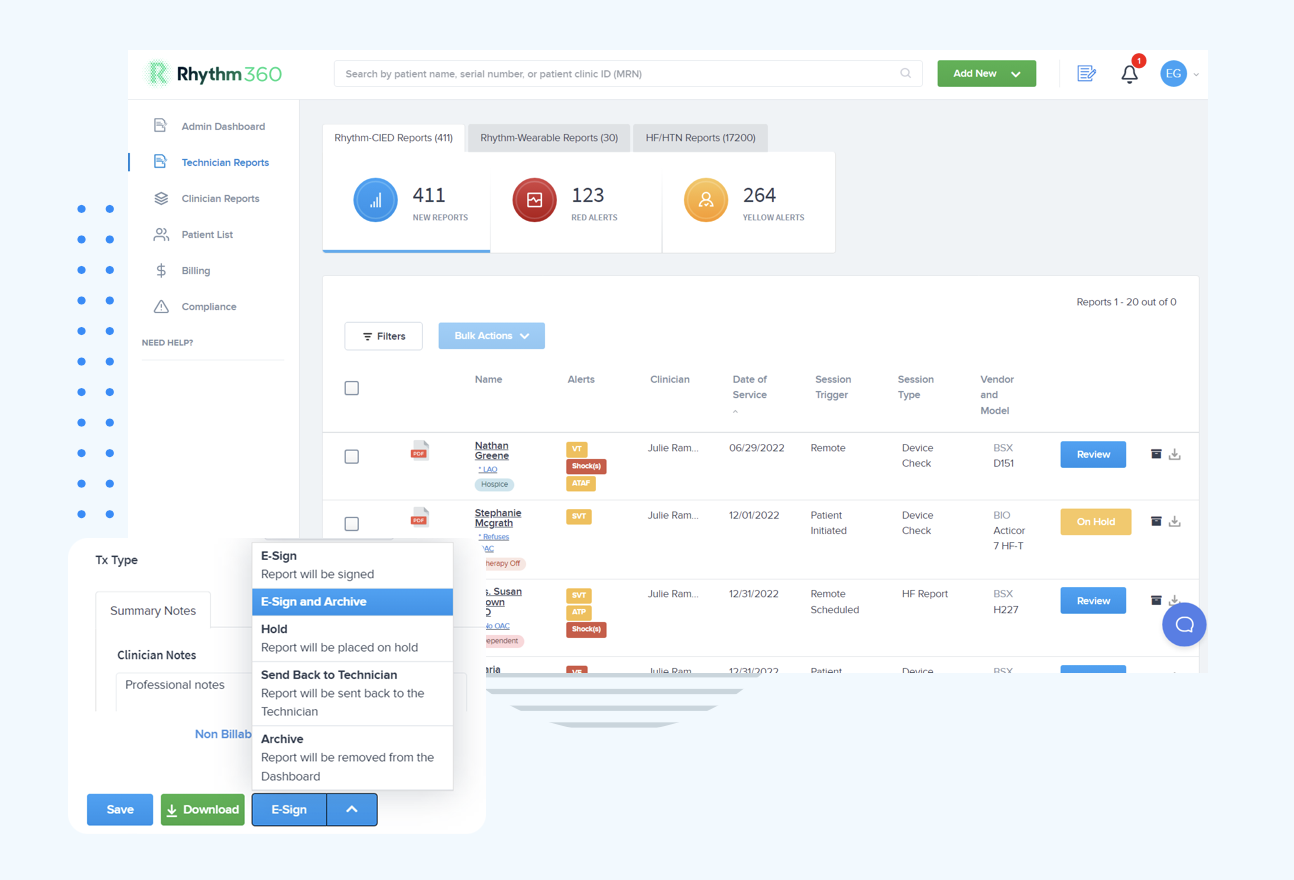
Rhythm360’s mobile platform supports full alert management from smartphones, including transmission review, report signing, and coordination of patient communication. This integrated workflow lets weekend on-call physicians assess urgent alerts, reach patients, and document interventions without office access, so continuity of care remains intact regardless of time or location.
Patient education lowers unnecessary alerts by improving device care and symptom recognition. Automated communication systems built on Twilio-like frameworks deliver consistent messages for routine reminders, appointment scheduling, and follow-up instructions. Every interaction creates a complete audit trail in the medical record for compliance and quality review.
Rhythm360’s communication hub logs all patient contacts, including automated reminders and manual calls, which prevents duplicate outreach and supports coordinated care. Patients receive clear guidance on when to seek immediate care and when to schedule routine follow-up, which reduces anxiety and improves appropriate healthcare use.
Quality improvement metrics show both clinical and financial impact from better alert management. Key performance indicators include response times for critical alerts, patient satisfaction scores, and revenue capture tied to accurate CPT code documentation. 2026 MIPS cost measures list specific cardiology benchmarks, such as inpatient PCI at 0.5% mean performance and respiratory infection hospitalization at 1.0% mean, which give practices clear targets for improvement through stronger alert workflows.
Automated billing capture for CPT codes 93298, 93299, and remote physiological monitoring codes (99453-99458) delivers the revenue gains mentioned earlier through complete documentation and fewer claim rejections. Real-time dashboards track billable events and support maximum reimbursement while staying aligned with CMS requirements and quality reporting rules.
Alert fatigue falls when AI-powered customization learns individual patient baselines and filters non-actionable notifications. Tiered protocols that sort alerts by clinical urgency, machine learning that spots patterns and reduces false positives, and clear escalation pathways together ensure critical events receive immediate attention while routine notifications are grouped for scheduled review.
Strong 24/7 coverage combines certified cardiac technicians for initial triage, registered nurses for assessment and communication, and on-call electrophysiologists for complex interventions. Rhythm360’s platform offers optional oversight by certified cardiac technicians supervised by physicians, which supports seamless coverage and can cut critical response times by 80% while maintaining clinical quality and patient safety.
Key parameters include sustained ventricular tachycardia longer than 30 seconds, new-onset atrial fibrillation, device battery warnings such as ERI or RRT, lead impedance changes that suggest malfunction, and heart failure indicators like rapid weight gain over 3 pounds or major symptom changes. Each parameter carries specific response timeframes and escalation steps based on clinical urgency and patient risk.
Sustained VT alerts require patient contact within 15 minutes, structured symptom assessment using standardized scripts, and device interrogation review to confirm arrhythmia characteristics and therapy delivery. Teams then escalate quickly to emergency services or urgent clinic evaluation based on patient stability. Documentation includes time stamps, patient responses, and clinical decisions for billing and quality assurance.
Bi-directional EHR integration imports device data and exports clinical notes automatically, which removes manual transcription and supports complete documentation. Integration with Epic, Cerner, and other major systems keeps workflows consistent, supports accurate CPT code capture for billing, and gives clinicians full patient context during alert review and response.
These seven best practices turn cardiac home monitoring from a source of anxiety and administrative overload into a streamlined, profitable service line. Tiered protocols, dedicated teams, AI customization, emergency scripts, mobile integration, patient education, and quality metrics work together to reduce alert fatigue while improving outcomes and revenue.
Rhythm360 brings all seven practices into one platform through vendor-neutral integration, AI-powered triage, and end-to-end workflow automation. The platform unifies data from all major device manufacturers, offers 24/7 oversight options, and automates billing capture for strong revenue performance. Schedule a Rhythm360 demo today to turn your cardiac monitoring alerts from daily chaos into precise, profitable patient care.