Last updated: February 4, 2026
Profitable pacemaker remote monitoring starts with the right staffing model and clear roles. Clinics that staff 3.0 full-time equivalents per 1000 patients manage both remote transmissions and in-clinic evaluations without backlogs.[1] Most high-performing programs use a two-tier review model where cardiac technicians handle initial triage and clinicians make final decisions.
Key staffing steps include:
Role ambiguity disrupts workflows because unscheduled transmissions account for 27-40% of total clinic workload.[1] Clear task assignment prevents bottlenecks and supports consistent patient care.
Early enrollment into remote monitoring within 2 weeks post-implant improves safety and long-term data quality. The HRS consensus recommends early activation to detect complications and establish baseline device parameters.[1]
Effective early enrollment playbook:
Automated onboarding checklists standardize enrollment, reduce missed steps, and lower administrative burden for clinical staff.
Strong patient education at implant sets the foundation for reliable remote monitoring. Patients who understand their apps, Bluetooth connections, and transmission schedules send more consistent data and require fewer rescue calls.
High-impact education elements include:
Disconnected scales and monitoring devices can miss heart failure alerts and contribute to avoidable hospitalizations. Regular outreach keeps devices online and preserves data integrity.
Targeted alert customization keeps teams focused on meaningful events instead of noise. AI-powered systems reduce false notifications by more than 60% with automated filtering and machine learning.[2] Programs that combine pacemaker data with clinical history can cut notification workload by up to 84%.
Stronger alert management includes:
Thoughtful threshold settings reduce alert fatigue while ensuring that clinically significant events still receive rapid attention.
Direct integration with Epic, Cerner, and other major EMRs streamlines documentation for CPT codes 93298, 93299, and 99454.[3] Rhythm360’s vendor-neutral platform pulls data from all major OEMs, generates compliant reports, and captures billable events that often go unclaimed.
EMR and billing integration delivers:
For example, a Saturday morning atrial fibrillation alert can trigger immediate review and anticoagulation, lowering stroke risk while documenting the encounter with the correct CPT codes.
Schedule a demo to see automated CPT capture in action and uncover specific revenue opportunities.
Vendor-neutral platforms simplify pacemaker monitoring by consolidating data from Medtronic, Abbott, Boston Scientific, and Biotronik. Rhythm360 uses AI-based optical character recognition and APIs to pull this data into a single, consistent view.
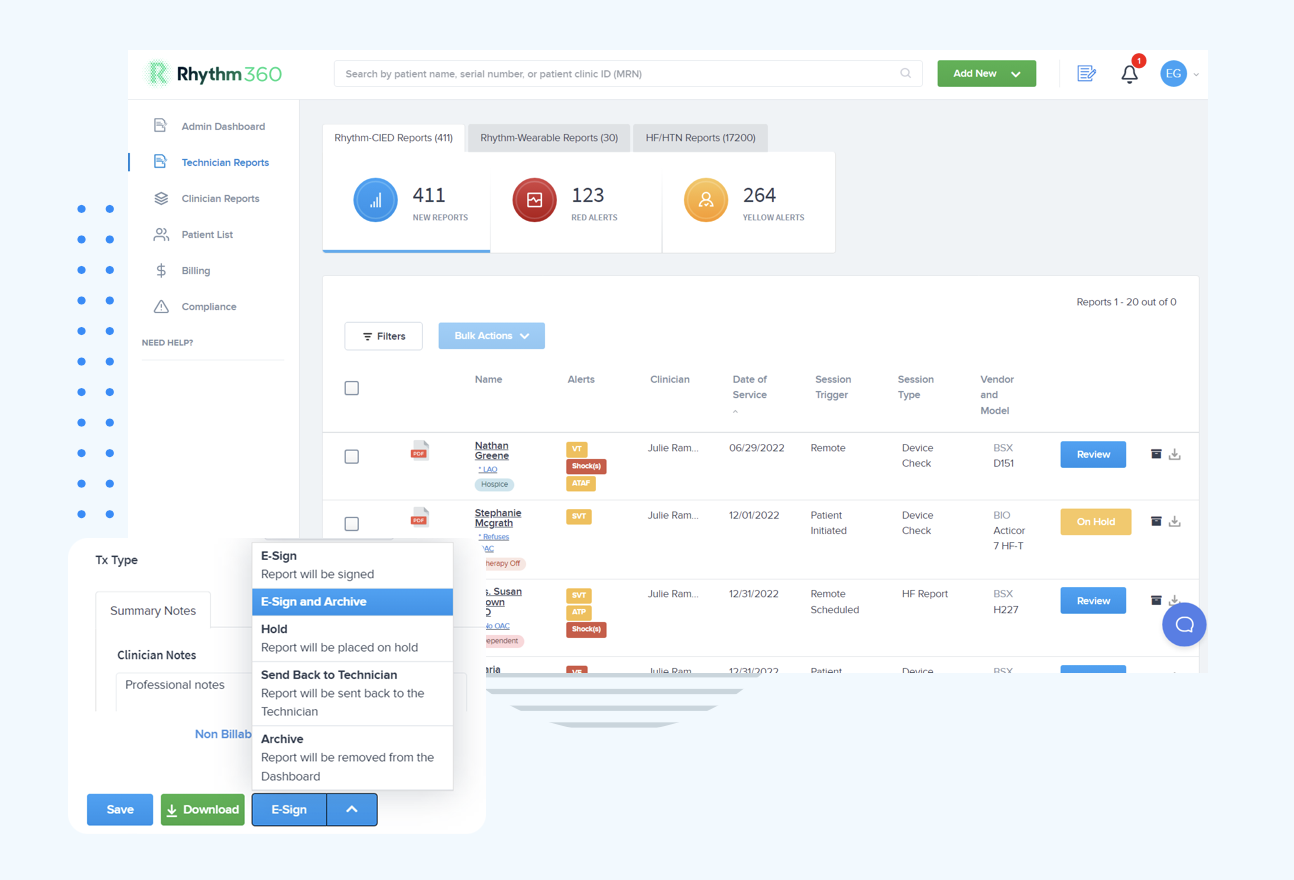
Program-level advantages include:
In practice, a Saturday ventricular tachycardia alert routed through Rhythm360 can prompt immediate device reprogramming and help prevent syncope or sudden cardiac death.
Reliable data streams keep pacemaker programs safe and billable. Rhythm360’s AI extrapolates missing data points and maintains more than 99.9% data fidelity through redundant feeds and computer vision.
Key AI capabilities include:
OEM data silos often create blind spots where critical events slip through. Unified platforms close those gaps with comprehensive aggregation and consistent triage.
Standardized workflows keep care consistent even when staff changes. Clear protocols for missed events, technical failures, and alert escalation reduce variation and protect patient safety.
Workflow improvements often include:
Quarterly reviews of these metrics support continuous improvement as patient populations and device technologies evolve.
The 2023 HRS consensus recommends remote transmissions every 3-12 months for pacemakers without continuous connectivity.[1] For stable patients with continuous monitoring, no recent alerts, and limited comorbidities, in-clinic visits can extend to 24-month intervals with at least annual in-person evaluations.
Rhythm360 supports a shift from calendar-based monitoring to alert-driven care, which improves outcomes and uses staff time more efficiently.
Pacemakers can be monitored remotely through platforms like Rhythm360 that process data from multiple OEMs in real time. Device data travels through home transmitters or smartphone apps to a central platform, where clinicians review transmissions and respond to automated alerts.
High-performing pacemaker monitoring programs show clear gains in efficiency, revenue, and response times. Leaders track reductions in administrative time, increases in billable events, and faster reactions to critical alerts.
Metric | Baseline Pitfall | Rhythm360 Gain |
Admin Time/Transmission | 38-51 min in-clinic | 9-14 min (73% less) |
Revenue from CPTs | Missed 70% claims | 300% increase |
Alert Response Time | Days due to fatigue | 80% faster |
Strong programs often reach more than 95% patient adherence and consistently capture billable events through automated documentation.
Mature programs expand beyond pacemakers into heart failure and hypertension, remote physiological monitoring. AI trend analysis flags risk earlier, which supports proactive interventions and fewer hospitalizations.
Multi-modality integration creates broader chronic disease management pathways and adds revenue through CPT codes 99453, 99454, and 99457.
The HRS 2023 consensus recommends enrollment within 2 weeks post-implant, alert-based workflows, and dedicated staffing. Programs should use two-tier review models where technicians perform initial triage and clinicians finalize management.
Remote monitoring sends device data from home transmitters or smartphone apps to platforms like Rhythm360. AI then filters non-actionable alerts, highlights critical events, and supports automated documentation for billing.
HRS guidelines call for transmissions every 3-12 months for devices without continuous connectivity. Stable patients with continuous monitoring and no recent issues can extend in-clinic visits to every 24 months.
AI customization reduces false alerts by 60-84% using machine learning that learns from clinical patterns. Three-tier triage and tailored thresholds further cut non-actionable notifications.
Key codes include 93298 for remote interrogation and 93299 for comprehensive device evaluation. Platforms like Rhythm360 generate compliant reports that support accurate reimbursement and fewer denials.
Rhythm360 integrates bi-directionally with Epic, Cerner, Athenahealth, and other major EHRs through HL7. Most implementations are completed within days to weeks and enable seamless data flow and automated notes.
Evidence-based pacemaker monitoring programs reduce OEM fragmentation while improving outcomes and financial performance. Rhythm360’s vendor-neutral platform delivers measurable gains such as 80% faster alert responses, more than 99.9% data reliability, and up to 300% revenue growth through automation and AI triage.
Programs that combine dedicated staffing, early enrollment, strong patient education, and integrated technology create sustainable, profitable remote monitoring operations. These practices protect patients while improving efficiency and revenue capture.
Ready to grow pacemaker monitoring revenue by up to 300%? Schedule a demo today and see how Rhythm360 turns fragmented monitoring into unified, profitable patient care.