Last updated: September 30, 2026
See How Rhythm360 Fits Your Current Stack
Generic RCM metrics such as clean claim rate, days in AR, denial rate, and EHR integration breadth matter. They do not explain why cardiology groups lose revenue on device monitoring and EP workflows.
EP labs and device clinics need RCM software that supports:
Cardiology practices face denial rates of 15 to 20 percent, far above the national outpatient average, driven by prior authorization gaps, unspecified diagnoses, and modifier errors. Monitoring windows frequently close unclaimed because the manufacturer portal calendar is never reconciled against the billing queue, which creates revenue loss that never appears in an AR report. A 2026 cardiology RCM software comparison that ignores these criteria misses the core problem.
For a deeper look at scalability considerations for large groups, see Scalable RCM Software for Large Cardiology Practices.
The table below maps leading core RCM platforms to the practice profiles they fit best, their cardiology strengths, and integration limits that matter for device clinics. The final column highlights a consistent pattern: none of the core platforms natively consolidate multi-OEM CIED data.
| Platform | Best-Fit Practice Profile | Cardiology-Specific Strengths | Integration Notes |
|---|---|---|---|
| athenahealth | Large independent cardiology groups seeking unified cloud EHR + RCM | Cloud-based billing, AI-native prior authorization agents, strong network-level payer tools | Bi-directional EHR integration; no native multi-OEM CIED consolidation or device-clinic CPT automation |
| Epic Resolute | Hospital-affiliated cardiology departments within large health systems | Enterprise-scale claims, real-time prior authorization checks via CRD API, deep reporting | Integrated within Epic; device data integration limited to Epic-approved devices |
| Oracle Health | Organizations on the legacy Cerner Millennium installed base | Enterprise RCM at scale, Millennium data model, FHIR R4 endpoints | Rebranded from Cerner; two-track platform strategy (Millennium plus new OCI-native EHR); no native cardiac device consolidation |
| NextGen | Mid-to-large cardiology groups with high procedure volume | Strong interventional cardiology templates, specialty PM workflows | Integrates with major EHRs; device data integration partial |
| AdvancedMD | Smaller groups or practices already using AdvancedMD in another specialty | Bundled EHR/PM economics, cardiology templates as specialty add-on | Cardiology depth depends on customization; scalability tops out around 50 providers |
| Rhythm360 | Large cardiology groups with device clinics, EP labs, or RPM programs | Vendor-neutral multi-OEM CIED consolidation, automated CPT capture for 93294–93298 and 99453–99457, AI alert triage, optional 24/7 CCT oversight | Bi-directional EHR integration with Epic, Cerner/Oracle Health, athenahealth, eClinicalWorks, Greenway via HL7; sits alongside core RCM |
athenahealth's AI-native RCM roadmap includes more than 80 AI features targeting the highest-friction revenue cycle points. Its voice agents place more than 23,000 prior authorization calls each month, and early results show a 30% increase in recovered payments on coding-related denials. It fits independent groups that want cloud-based billing tightly integrated with their EHR, but its prior authorization automation remains general RCM functionality and does not address device-clinic gaps.
Epic launched real-time prior authorization checks in August 2026 using the industry-standard Coverage Requirements Discovery (CRD) API. Clinicians can verify authorization requirements directly when placing an order. For hospital-affiliated cardiology departments already inside an Epic environment, Resolute provides enterprise-scale claims and deep reporting. Device data integration remains limited to Epic-approved devices.
Oracle Health runs two distinct EHR platforms in parallel. Legacy Cerner Millennium remains the production EHR for existing acute-care clients. A next-generation EHR, built from scratch on Oracle Cloud Infrastructure, was announced in October 2024. Organizations on the Millennium installed base have a mature enterprise RCM foundation, but neither track natively consolidates multi-OEM cardiac device feeds or automates cardiology-specific RPM billing.
NextGen offers strong interventional cardiology templates and specialty PM workflows, which makes it a practical fit for mid-to-large groups with high procedure volume. Device data integration is partial. AdvancedMD provides bundled EHR and PM economics and cardiology templates as a specialty add-on. Its cardiology depth depends heavily on customization, and scalability typically tops out around 50 providers.
For a broader comparison of cardiology RCM software options, see Cardiology RCM Software: What Rhythm360 Delivers In 2026.
That shared limitation across core platforms is the gap Rhythm360 closes. It sits alongside whichever core RCM platform a large cardiology group already runs and focuses on cardiology-specific workflows.
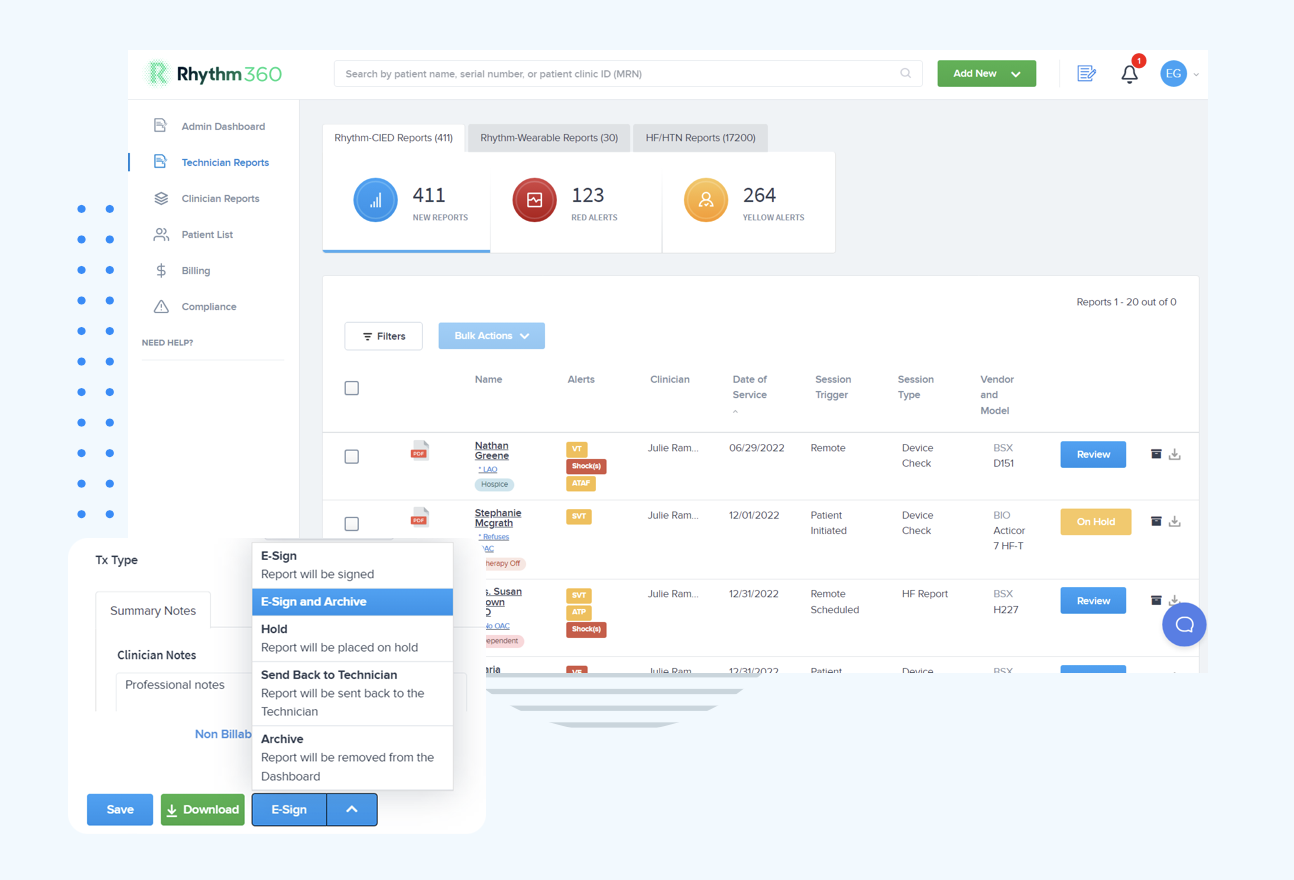
Practices using Rhythm360 have achieved up to an 80% reduction in critical alert response times and up to a 300% increase in revenue capture. At scale, University of Chicago Medicine reviewed more than 73,000 reports annually through Rhythm360 in calendar year 2025, averaging more than 18,000 reports per quarter. The same implementation reported improved billing and accountability for patients after integration and enabled clinicians to review more transmissions daily and identify more abnormalities.
See How Rhythm360 Closes Device-Clinic Gaps
Independent Multi-Site Group With A Device Clinic. A group running athenahealth or NextGen for claims and general billing adds Rhythm360 as the specialty layer for CIED consolidation and device-clinic CPT capture. Consider a 90-day pacemaker monitoring window. Without a dedicated tracking layer, staff must manually reconcile the OEM portal calendar against the billing queue to confirm the window has closed and a claim is ready. Rhythm360 tracks the window automatically, generates compliant documentation, and feeds the claim to the core RCM platform. Manual calendar reconciliation disappears from the workflow.
Hospital-Affiliated Cardiology Department. An Epic Resolute or Oracle Health environment handles enterprise revenue cycle. Rhythm360 operates as the specialty layer for multi-OEM device data that the enterprise EHR does not natively consolidate. In a hospital setting, the professional and technical split is a billing reality: the hospital bills the technical component (-TC) and the physician bills the professional component (-26). Rhythm360 supports both sides of that split and helps ensure neither component goes unbilled.
EP And Device-Heavy Practice. A practice with a high volume of EP ablation claims, RPM programs spanning 30-day and 90-day cycles, and prior authorization tracking for cardiac procedures uses Rhythm360 to automate CPT capture and flag compliance gaps before submission. Consider a representative denial scenario. A claim for CPT 93298 is submitted for a patient with an implantable defibrillator. A defibrillator delivers therapy while a rhythm monitor only records, so billing CPT 93298 for a defibrillator patient is denied as a device mismatch. Rhythm360's automated CPT pairing catches the mismatch before submission and corrects it to 93295 (ICD professional) or 93296 (technical) as appropriate.
Large cardiology groups evaluating their RCM architecture typically consider three options: fully outsourced RCM, core RCM software run in-house, or core RCM software plus a cardiology-specific specialty layer.
Outsourced RCM vendors usually price at a percentage of collections, generally 3% to 9% depending on practice size, specialty mix, and AR complexity. They can move denial rates meaningfully when billing staff are specialty-trained. Device data fragmentation and monitoring-window capture remain software problems. A billing team working inside NextGen or athenahealth cannot reconcile OEM portal calendars against a billing queue if the data never flows into a unified system.
Core RCM software alone handles claims well but leaves cardiology-specific gaps open. None of the core platforms automate device-clinic CPT capture or track 30-day and 90-day monitoring windows natively.
The core-plus-layer model addresses both the revenue cycle and the clinical data workflow. It is also faster to stand up than a full platform replacement. Rhythm360 onboarding, including EHR integration, typically takes a few days to a few weeks. Because pricing is SaaS-based and scales with clinic size and platform usage, groups avoid the high upfront implementation costs associated with enterprise EHR customization.
For a detailed look at pricing structures across RCM software options, see RCM Software Pricing For Large Cardiology & EP Practices.
Get A Rhythm360 Pricing Walkthrough
The most consequential and recurring mistakes in cardiology billing fall into several categories:
Rhythm360's automated CPT capture and window tracking address the device-type mismatch and monitoring-window categories directly by flagging mismatches before submission and tracking 30-day and 90-day windows against the billing queue automatically.
No single EHR fits every cardiology group. The right choice depends on practice profile and existing infrastructure. Epic is the dominant choice for hospital-affiliated cardiology departments operating within large health systems, where its enterprise-scale claims processing and deep reporting capabilities match the environment. athenahealth fits independent groups that want cloud-based billing tightly integrated with their EHR and accept a percentage-of-collections pricing model. NextGen suits mid-to-large groups with high interventional procedure volume, given its strong cardiology templates. Oracle Health is the practical choice for organizations already on the Cerner Millennium installed base, where a platform migration would be disruptive.
Device clinics and EP labs share a critical constraint: no EHR natively consolidates multi-OEM CIED data. Epic's device data integration is limited to Epic-approved devices. athenahealth's RPM integrations run through third-party marketplace partners rather than native functionality. Oracle Health's device data capabilities require custom development. A specialty layer remains necessary regardless of EHR choice because the EHR decision and the device data decision involve separate architecture choices.
RPM billing runs on time-based and transmission-based thresholds defined by CMS. CPT 99454 requires at least 16 days of transmitted readings within a 30-day period. CPT 99457 requires 20 minutes of treatment management per calendar month, including at least one real-time interactive communication with the patient or caregiver. CPT 99453 covers one-time device setup and patient education and is billed once per patient. CMS covers RPM broadly for both chronic and acute conditions. To qualify, the patient must use an internet-connected device that meets the FDA's definition of a medical device and transmits data automatically. Manually entered readings do not qualify.
Core RCM platforms process the claim once it is submitted. They do not track whether the 16-day transmission threshold was met or whether 20 minutes of management time was documented. The monitoring platform must handle that tracking. Without it, a practice may submit a 99454 claim for a patient who transmitted on only 12 days, which generates a denial with no clear root cause in the AR aging report.
Rhythm360 tracks transmission days and management minutes at the patient level and feeds compliant documentation to the core RCM platform. When a patient meets the 99454 threshold, the claim is supported by documented transmission data. When the threshold is not met, the claim is held instead of entering a denial queue.
Rhythm360 offers bi-directional EHR integration with Epic, Cerner/Oracle Health, athenahealth, eClinicalWorks, Greenway Health, and others via HL7. It sits alongside the core RCM platform, which continues to handle claims processing, eligibility, and general billing. Rhythm360 focuses on CIED data consolidation, CPT code automation, and monitoring-window tracking. Onboarding, including integration setup, typically takes a few days to a few weeks.
Rhythm360 supports the full remote cardiac device monitoring CPT code set across both billing cycles.
For pacemakers and ICDs on a 90-day cycle:
For physiologic monitors and loop recorders on a 30-day cycle:
For RPM programs covering heart failure and hypertension:
RCM software selection for large cardiology practices is an architecture decision rather than a single-platform choice. Core RCM platforms handle claims, eligibility, and general billing. Cardiology-specific gaps around multi-OEM CIED data, device-clinic CPT capture, and monitoring-window tracking require a specialty layer.
Rhythm360 fills that role. It integrates with Epic, Oracle Health, athenahealth, eClinicalWorks, and Greenway Health via HL7, sits alongside the core RCM platform, and automates cardiology workflows that core platforms leave open. The alert-response and revenue-capture gains noted earlier, along with the University of Chicago Medicine volume metrics, show that this architecture holds at scale.
The practical path is straightforward: select the core RCM platform that fits your practice profile, then add Rhythm360 as the specialty layer that closes cardiology-specific gaps.
Start Your Rhythm360 Evaluation