Last updated: September 22, 2026
See How Rhythm360 Handles Your Device Billing Cycles
Cardiology billing ranks among the most complex in medicine, and three structural challenges drive most avoidable denials and revenue loss.
26/TC Component Billing. Modifier 26 designates the professional component and TC designates the technical component for splittable codes such as 93297 and 93298. When a hospital owns the equipment and the cardiologist reads the study, staff must split the claim correctly. Specialty billing audits show recurring modifier 26/TC split errors on diagnostic tests, which represent recoverable revenue slipping through claim by claim. Ask vendors how their platforms handle 26/TC splits for echocardiography and nuclear studies, then compare their answers.
Global Periods. Under Medicare, global periods vary by procedure. Most PCI procedures (CPT 92920–92943) carry 0-day global periods, and diagnostic cardiac catheterization (CPT 93451–93461) carries a 10-day global period. Cardiac device implants such as pacemakers and ICDs carry the longest window, at 90 days. Modifier 78 applies to an unplanned return to the cath lab for a related procedure during the global period, and modifier 79 applies to an unrelated procedure and resets the global for the new procedure. Ask vendors how they track global periods and flag when modifier 24 or 79 applies, then confirm that logic in a live workflow.
Device and RPM Codes. CIED remote monitoring codes 93294, 93295, and 93296 run on 90-day cycles, while 93297 and 93298 are device-specific codes that run on 30-day cycles. Code 93297 applies to implantable cardiovascular physiologic monitors such as CardioMEMS, and 93298 applies to subcutaneous cardiac rhythm monitors and implantable loop recorders. Each is billable once per 30 days and each can be billed global, -26, or -TC. RPM codes 99453, 99454, and 99457 run on monthly cycles. Monitoring work documented outside those windows expires without generating a denial or alert. Ask vendors to demonstrate how their systems track device-specific billing cycles and prevent expired windows, then verify that behavior with real examples.
Cardiology-focused RCM vendors must demonstrate fluency with core device and RPM codes, because these codes drive much of the recurring revenue.
See Automated CPT Code Capture In Action
Rhythm360 by RhythmScience closes billing and operational gaps for practices that manage CIEDs and RPM programs at scale.
The platform consolidates fragmented OEM portals, reduces missed critical events, and supports accurate CPT code capture. University of Chicago Medicine reviewed more than 73,000 reports annually through Rhythm360 in calendar year 2025, averaging more than 18,000 reports per quarter. That volume demonstrates Rhythm360’s scalability for high-volume, device-heavy environments. A UCM clinical leader reported that “We have improved billing and accountability for our patients after the integration.”
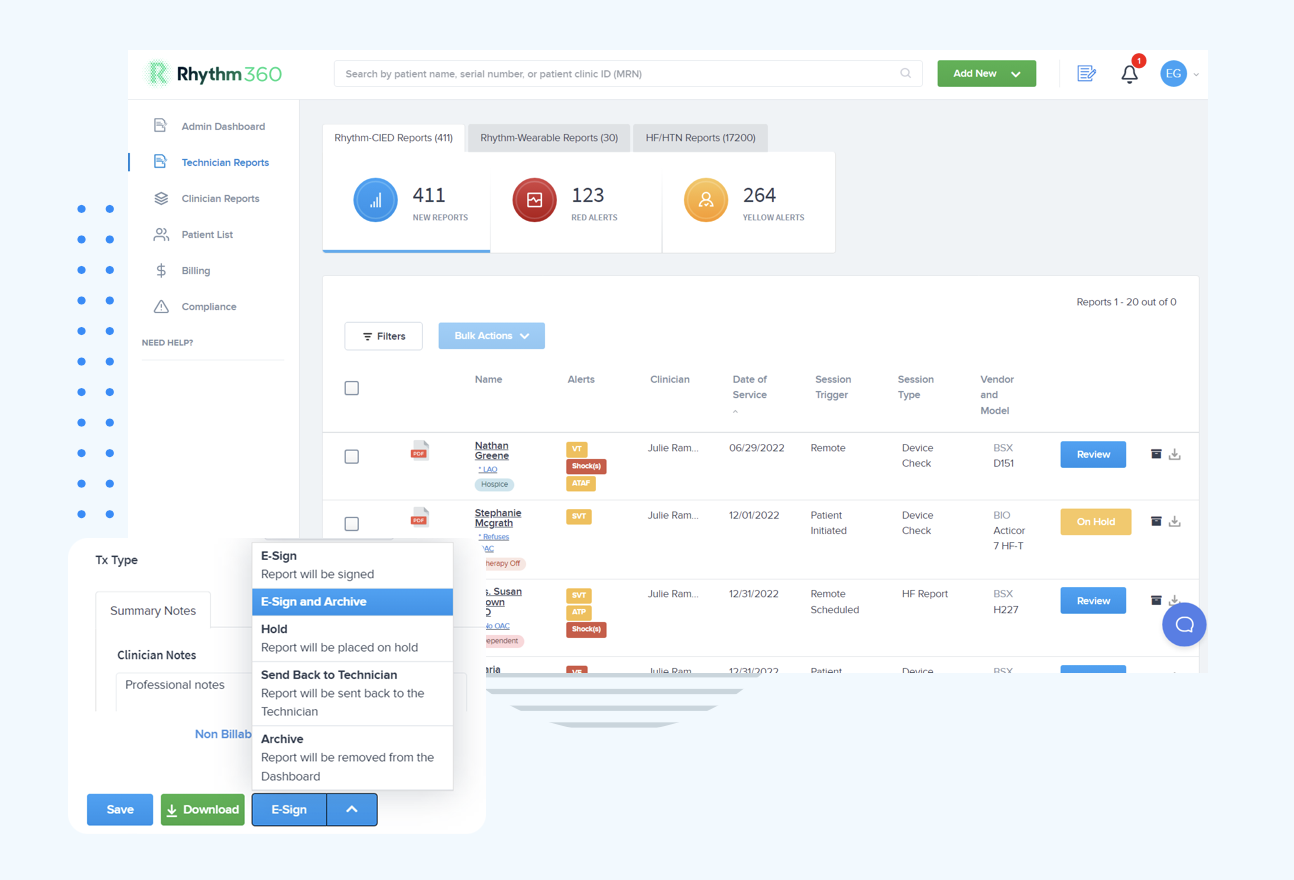
Rhythm360’s core capabilities for device and RPM-heavy practices include:
Practices that implement Rhythm360 report up to an 80% reduction in critical alert response times and up to a 300% increase in revenue capture and profitability.
Watch A Live Walkthrough Of CIED Data Integration
The right RCM delivery model depends on a practice’s staffing, billing complexity, and device program volume.
Software Platforms give practices control and real-time data visibility. A billing service performs billing work on a practice’s behalf, while software platforms give staff tools to enter charges, submit claims, and track payments. Software works best for practices with in-house billing teams that need better tools and dashboards.
Outsourced Billing Companies handle claims end to end. Examples include MC RevWorks, VeroRCM, and PACT. Most outsourced RCM is priced at 3% to 9% of collections, with larger groups clustering at the 3% to 5% range. Outsourced billing works best for practices without billing infrastructure or bandwidth to track jurisdiction-specific LCD updates.
Hybrid Models combine platform data with service oversight. Hybrid managed-RCM pricing can pair a percentage-of-collections fee with software subscription pricing in the same vendor ecosystem. Hybrid models fit practices that want technology plus expert support.
Device and RPM-heavy practices face a specific challenge. Pure outsourced medical billing services typically operate in a silo disconnected from clinical and device systems, so they cannot automatically capture device-generated billable events without added middleware or integration. A platform that tracks 30-day and 90-day billing cycles, flags expiring monitoring windows, and generates compliant documentation must come first. Outsourced billing staff can then submit accurate claims based on that data.
Targeted questions during demos help separate vendors with genuine cardiology depth from generalists using one-size-fits-all workflows.
The best RCM software depends on practice profile. For device and RPM-heavy practices that manage CIEDs, implantable loop recorders, and chronic disease RPM programs, Rhythm360 fits most closely. Its vendor-neutral device data integration normalizes data from all major manufacturers into a single dashboard, and its automated CPT code capture tracks the 90-day and 30-day cycles described above. That combination prevents many device-type mismatch denials and missed billing windows that generalist platforms allow. Independent clinics without device programs often choose all-in-one platforms such as CareCloud or CureMD for cardiology-specific coding support. Hospital-affiliated groups typically select enterprise platforms such as Waystar or NextGen Healthcare.
Cardiology practices benefit from specialized RCM because their billing rules differ from most other specialties. Most cardiac imaging splits into professional and technical components, which requires a modifier decision on nearly every such claim. Cardiology billing also involves 90-day global periods on interventional procedures, device interrogation codes with device-specific billing windows, and RPM codes with monthly time and transmission thresholds. Generalist platforms and billing services that apply a uniform workflow across specialties routinely mishandle these requirements. The result includes monitoring frequency denials, device-type mismatch denials, missed technical components, and expired billing windows. Some monitoring-related revenue leakage, including underpayments and downcoding, can disappear silently without generating a denial or alert, and practices often discover these gaps only during a billing audit.
Build a scorecard before demos begin, because vendors shape their demos around whatever you ask about. The scorecard should cover four areas. First, specialty expertise, verified by references from practices of similar size and payer mix. Second, cardiology-specific capabilities such as 26/TC split logic and device billing cycle tracking. Third, pricing transparency with scope clearly defined in writing. Fourth, integration with your existing EHR.
Once the scorecard is set, require each vendor to demonstrate a complete billing cycle for a device patient, from transmission receipt through signed report and claim submission. That walkthrough shows whether the vendor can execute the capabilities it claims. It also gives you a concrete basis for denial-reporting and prior-authorization questions. Ask for denial reporting organized by root cause rather than denial count, and confirm who handles prior authorization and during what hours. For device-heavy practices, confirm that the vendor can distinguish 93297 from 93298 and explain why applying a 90-day calendar to either code creates a billing error.
Software platforms give in-house billing staff better tools, real-time dashboards, and automated claim logic. They still require staff capacity and specialty knowledge to work the claims. Outsourced billing companies handle claims end to end and work best for practices without billing infrastructure, although cardiology-specific expertise varies significantly by vendor. Hybrid models combine a software platform with managed service oversight, which pairs technology-driven data capture with human review.
For device and RPM-heavy practices, platform capability is the primary consideration. Look for FDA-cleared cellular-connected device ecosystems, automated time tracking, and concurrent RPM and CCM billing support. The choice between software-only (SaaS) and fully managed delivery still matters for practices that lack their own care teams to handle enrollment, monitoring, and operational workload.
Ask vendors to demonstrate 93294, 93295, and 93296 on a 90-day pacemaker or ICD billing cycle. Then ask for 93297 and 93298 on separate 30-day cycles with correct device-type matching. Include 99453, 99454, and 99457 with the transmission day count and interactive communication documentation that payers require. Also ask about 26/TC split handling on echocardiography codes such as 93306 and on nuclear imaging codes, plus global period tracking for cath lab and EP procedures. A vendor that cannot walk through these scenarios in a demo is unlikely to handle them correctly in production.
The right RCM solution for a cardiology practice depends on its profile. Independent clinics benefit from all-in-one platforms with cardiology-specific coding support. Hospital-affiliated groups need enterprise claim management and payer connectivity. Device and RPM-heavy EP practices need a vendor-neutral platform that automatically captures device-generated billable events, tracks 30-day and 90-day billing cycles by device type, and generates auditable documentation for every claim.
Rhythm360 is built for that device and RPM-heavy profile. Its vendor-neutral CIED data integration, automated CPT code capture across key device and RPM codes, and bi-directional EHR connectivity address the billing gaps that drive cardiology revenue leakage before a claim reaches the payer.
Talk To Our Team About Your Practice Profile