

Last updated: July 14, 2026
Manual billing workflows leave significant revenue uncollected. A typical 1,000-patient mixed-vendor RPM panel running on individual manufacturer portals with manual EHR documentation captures only 60-75% of billable 99454 device-supply months and 50-65% of billable 99457/99458 management time, leaving $180,000-$320,000 per year on the table per 1,000 patients.
The 2026 CPT landscape adds new complexity, but also new opportunity. Among the AMA's 288 new 2026 CPT codes, two additions matter most for cardiology billing flexibility. CPT 99445 closes the prior all-or-nothing gap by covering 2-15 days of device supply at $47-$52 per month, catching patients who fall short of the 16-day threshold for 99454. CPT 99470 adds a lower-threshold management code covering the first 10-19 minutes at roughly $26 per month.
These gaps rarely happen on purpose. They happen because platforms are disconnected. Manual copy-paste of data into the EHR creates documentation gaps that translate directly into denied claims for codes including 99454, 99457, and 99458. Missing the 16-day transmission threshold is the single most common reason for 99454 denials under 2026 Medicare rules.
Rhythm360 addresses this at the source. The platform's automated CPT capture engine tracks transmission day counts in real time, flags patients approaching threshold gaps before the billing window closes, and generates compliant documentation for 93294-93298, 99445, 99454, 99457, and 99458 without manual intervention. Practices using Rhythm360 have documented up to a 300% increase in revenue generation through better CPT code capture and improved staff efficiency.
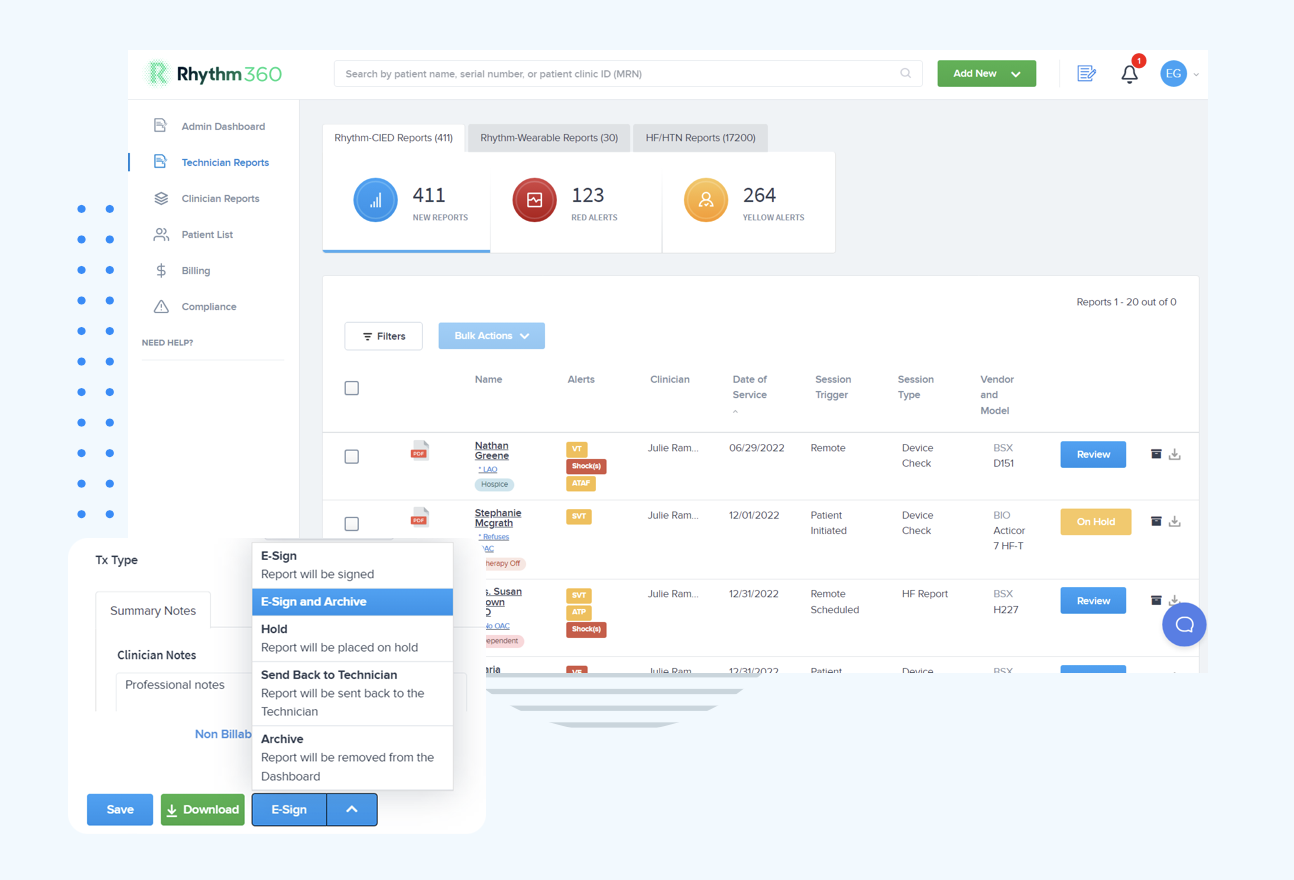
CPT 93298, the technical component for implantable loop recorder and insertable cardiac monitor remote monitoring, presents a distinct billing challenge. Medicare guidelines can allow reimbursement on ILR transmissions with shorter monitoring windows, which benefits post-ablation monitoring and AF burden assessment.
The technical barrier is data fidelity, not policy. ILR transmissions frequently arrive as unstructured PDFs from OEM servers rather than structured data feeds, making automated extraction difficult without purpose-built parsing technology. CIED transmissions received by cardiology practices but not billed within the 90-day cycle are lost permanently.
Rhythm360 solves this with redundant data feeds, computer vision OCR, and AI-powered extrapolation, achieving greater than 99.9% data transmissibility. When an OEM server goes down, the redundant feed architecture catches the transmission before it can be lost, documented, or billed. This same infrastructure supports compliant, automated 93298 capture across all major device manufacturers, and it directly reduces the false alerts covered next.
Alert fatigue creates measurable clinical and operational risk. When care teams receive too many low-value alerts, they respond slower to the ones that matter. AI triage changes that equation: it filters non-actionable transmissions and surfaces clinically significant events, so care managers handle more patients without missing critical signals.
Rhythm360's AI-powered alert triage system flags new-onset AFib, ventricular tachycardia, lead malfunction, ERI/RRT indicators, and significant weight changes in heart failure patients in near real time. Practices that need additional coverage can add optional 24/7/365 oversight by certified cardiac technicians supervised by physicians.
This approach cuts response times for critical patient alerts by 80%. University of Chicago Medicine's implementation of Rhythm360 enabled clinicians to review more transmissions daily and identify more abnormalities. The clinical team noted: "We are able to address these issues earlier; rather than waiting for a 3-month visit, we can call patients in for evaluation."
Most cardiology practices implant devices from more than one manufacturer, and that creates an immediate operational problem. Medtronic, Boston Scientific, Abbott, Biotronik, and others each maintain a separate, non-interoperable portal. Staff must log into each system individually, reconcile conflicting data formats, and manually transcribe findings into the EHR.
Practices staffing RN review through three different vendor portals either triple-count time, creating audit clawback risk, or lose track of it across portals so the patient never crosses the 20-minute billing threshold. Both outcomes cost the practice money.
Rhythm360 ingests and normalizes data from all major device manufacturers into a single dashboard using API, HL7, XML, and computer vision PDF parsing. Vendor-neutral RPM integration requires a device-agnostic aggregation layer to normalize formats across manufacturers and avoid platform lock-in. Rhythm360's architecture runs on exactly this principle. No single OEM relationship constrains the data model or the billing workflow.
University of Chicago Medicine reviewed more than 73,000 reports annually through Rhythm360 in 2025, averaging more than 18,000 reports per quarter. That volume would be unmanageable across fragmented OEM portals, which is exactly why EHR connectivity matters just as much as device connectivity.
Consolidating device data solves half the problem. The other half is getting that data, along with billing documentation, into the EHR without manual re-entry. Rhythm360 offers bi-directional integration with Epic, Cerner, Athenahealth, eClinicalWorks, and Greenway Health via HL7.
Data flows both ways. Patient demographics, active diagnoses, and device orders pull into Rhythm360, while RPM encounter notes, alert documentation, time logs, and monthly summary reports push automatically back into the patient chart. This mirrors the standard for bi-directional EHR integration in RPM platforms.
Rhythm360 also includes a Twilio-powered communication hub. Automated reminders, manual outreach, and phone call logs are tracked with a full audit trail in the patient record, satisfying the interactive communication documentation requirement for CPT 99457/99458. CMS requires that audio/video encounters automatically time-stamp and flow into the EHR to eliminate most documentation errors for these codes.
See the EHR sync and communication hub firsthand.
The table below summarizes how billing automation, vendor-neutral integration, EHR sync, and alert triage work together inside Rhythm360's platform.
| Capability | Rhythm360 |
|---|---|
| Billing automation strength | Automated CPT capture for 93294-93298, 99445, 99454, 99457, 99458; real-time threshold tracking; up to 300% revenue lift documented |
| Vendor-neutral CIED integration | Medtronic, Boston Scientific, Abbott, Biotronik, and others via API, HL7, XML, and computer vision OCR |
| Bi-directional EHR sync | Epic, Cerner, Athenahealth, eClinicalWorks, Greenway Health; inbound demographics plus outbound encounter notes, time logs, billing documentation |
| Alert triage impact | Faster response to critical alerts; AI-powered triage plus optional 24/7 CCT oversight |
| Implementation timeline | EHR integration in days to weeks; no hardware installation required |
| Pricing model | SaaS-based, scales with clinic size and usage; no rigid per-seat or high setup fees |
The numbers above translate into real dollars for a mid-size practice. This walkthrough models a cardiology practice with 500 active CIED patients generating monthly remote transmissions, using published 2026 Medicare national average rates.
Before Rhythm360, on a manual, multi-portal workflow:
After Rhythm360, with automated CPT capture and threshold monitoring:
That's roughly $14,005 in incremental monthly revenue, or $168,060 per year, for a 500-patient CIED panel, before factoring in 93298 technical component billing or HF/HTN RPM service lines. As UCM's team confirmed after implementing Rhythm360: "We have improved billing and accountability for our patients after the integration."
Rhythm360's onboarding process minimizes disruption to active clinical workflows. EHR integration with Epic, Cerner, Athenahealth, eClinicalWorks, and Greenway Health, via FHIR connection, typically wraps up within 4-8 weeks. No hardware installation or dedicated IT resources are required from the practice.
Pricing follows a SaaS model that scales with clinic size and usage. There are no high upfront setup fees and no rigid per-seat licensing that penalizes growth. Overlay automation solutions built on top of existing EHR and billing systems compress deployment to 6-8 weeks for individual modules, with most organizations reaching full break-even within 3-6 months.
Here are answers to the questions practices most often raise before making a decision.
Rhythm360 is a fully HIPAA-compliant, cloud-based platform. All data connections use TLS encryption, OAuth 2.0 server-to-server authentication, and FHIR scope restrictions. Every patient communication, including automated messages, manual outreach, and phone call logs via the Twilio framework, is stored with a complete audit trail in the patient record. Redundant data feeds ensure no transmission is lost due to OEM server downtime.
Rhythm360 is built as an overlay platform. It integrates with your existing EHR and device infrastructure rather than replacing it. Staff training is built into onboarding, and the centralized dashboard reduces reliance on a singleRead Next





