

Last updated: July 14, 2026
The operational cost of fragmented OEM portals is measurable and growing. Each manufacturer uses proprietary nomenclature, technical standards, and communication protocols, so a technician managing a mixed-device population must reconcile conflicting data formats across systems that never communicate with each other. Workflows reliant on PDFs, scanned reports, free text, or disconnected manufacturer portals make consistent extraction of clinically useful information slower, harder, and more resource-intensive.
Remote monitoring transmission volumes have grown since the COVID pandemic. Services managing higher workloads with fragmented data infrastructure become more manual and less resilient. These conditions make it difficult to scale arrhythmia monitoring programs safely. Structured remote monitoring improves technician efficiency compared to conventional in-person monitoring. Fragmented portal environments erode that efficiency gain.
The 2026 CPT landscape adds urgency to the billing problem. CPT 99445 was added in 2026 for remote physiologic monitoring device supply lasting 2–15 days, while CPT 99454 continues to describe longer-duration services of 16–30 days. CPT 99470 was also added for 10- to 19-minute remote physiologic monitoring treatment management services. Practices without automated documentation workflows are already missing these new billing windows. Around 20–30% of RPM claims are delayed or denied in 2026 due to documentation, time-tracking, and coding errors, which creates direct revenue leakage.
Given these operational and financial pressures, cardiology practices evaluating platforms in 2026 should apply a consistent set of criteria. The following dimensions determine whether a platform reduces operational burden or adds to it.
Rhythm360 unifies data from Medtronic, Boston Scientific, Abbott, Biotronik, and other manufacturers into a single cloud-based dashboard. The platform ingests diverse data types, including APIs, HL7, XML, and unstructured PDFs, and uses computer vision (OCR) and AI to normalize data, fill transmission gaps, and identify connectivity issues. A redundant data feed system acts as a fail-safe when an OEM server is unavailable.
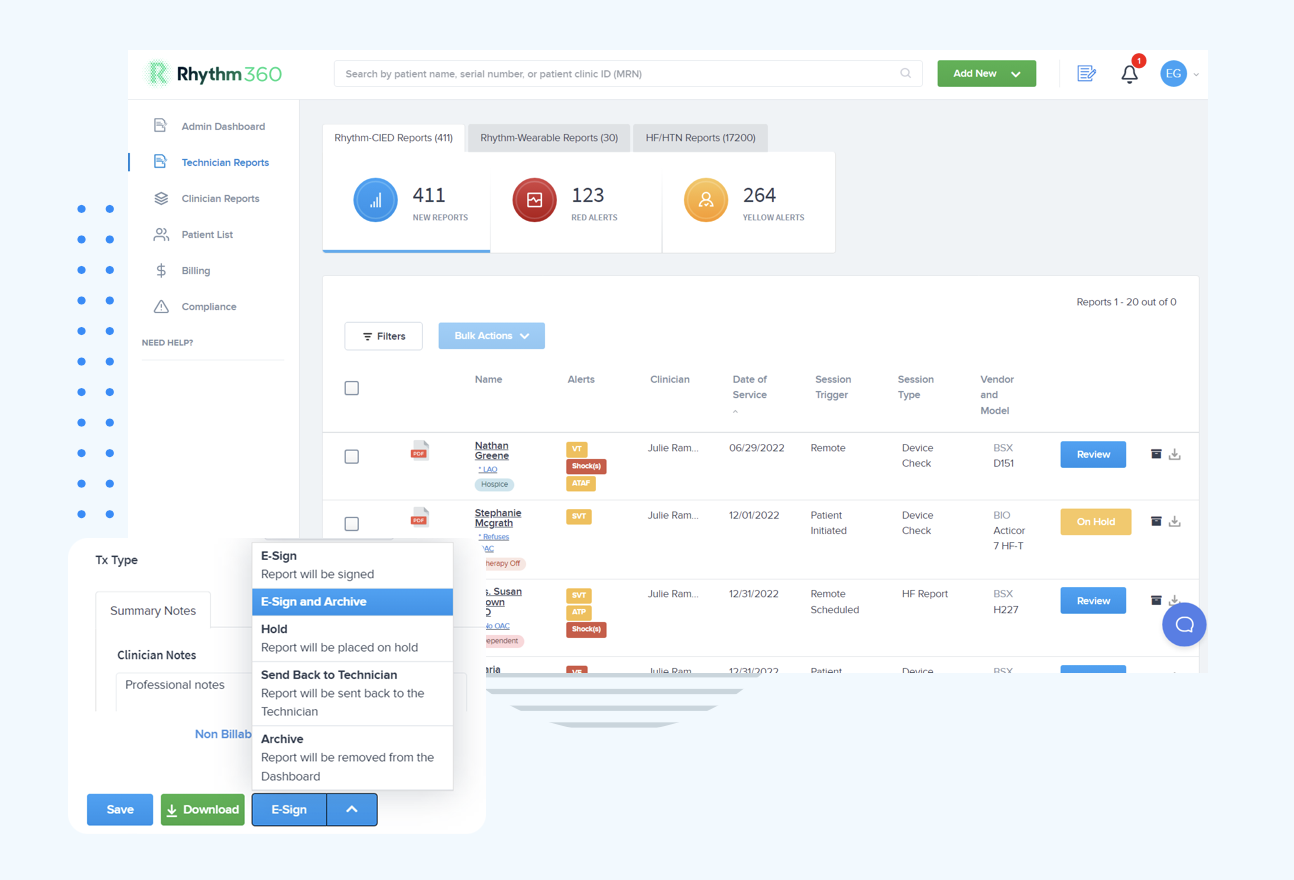
Key platform capabilities include:
The following table quantifies these capabilities with performance metrics from 2026 client deployments and third-party evaluations, showing how Rhythm360’s vendor-neutral approach produces measurable operational improvements.
| Capability | Rhythm360 Metric | Source |
|---|---|---|
| Data transmissibility rate | >99.9% | HRS 2026 Platform Comparison |
| Reduction in critical-alert response time | Up to 80% | HRS 2026 Platform Comparison |
| Revenue improvement through automated billing | Up to 300% | RhythmScience client outcomes |
| EHR integration timeline | Days to weeks | RhythmScience implementation data |
| Annual reports processed (UCM, 2025) | 73,000+ | UCM White Paper, HMP Global |
| Supported device manufacturers | Medtronic, Boston Scientific, Abbott, Biotronik, and others | RhythmScience platform documentation |
| CPT codes supported (CIED + RPM) | Applicable CIED and RPM codes | 2026 CIED CPT Reference; 2026 RPM CPT Guide |
The operational case for vendor-neutral monitoring becomes clear in scenarios where timing determines outcomes. A patient with an implanted ICD transmits a ventricular tachycardia alert on a Saturday morning. In a fragmented portal environment, that alert may sit in a manufacturer-specific inbox until a technician logs in Monday.
With Rhythm360’s AI-powered triage and mobile application, the on-call clinician receives a prioritized notification, reviews the transmission, and initiates anticoagulation or device reprogramming the same day. The difference between those two workflows often becomes the difference between a prevented stroke and an avoidable hospitalization.
University of Chicago Medicine reviewed more than 73,000 reports annually through Rhythm360 in calendar year 2025, averaging more than 18,000 reports per quarter. UCM’s implementation enabled clinicians to review more transmissions daily and identify more abnormalities. The team documented direct improvements in billing accountability after integration. As Andrew Beaser, MD, Associate Professor of Medicine at UCM, noted: "We have improved billing and accountability for our patients after the integration."
The UCM case also illustrates the scalability challenge that AI-assisted decision support addresses. One multi-clinic electrophysiology practice doubled its CIED population from 4300 patients to nearly 9000 through absorption of new clinics and increased implants. That volume exceeds what manual triage workflows can safely absorb.
Rhythm360 uses a SaaS-based pricing model that scales with clinic size and platform usage, which removes the high upfront costs and rigid licensing structures associated with legacy on-premise systems. EHR integration, including bi-directional Epic and Cerner connectivity, is completed within days to weeks, not the months-long implementations that disrupt clinical operations and delay ROI.
The revenue impact of automated billing documentation is substantial. A cardiology practice monitoring 200 RPM patients at the standard tier (99454 + 99457) generates approximately $19,800 per month or $237,600 per year from RPM alone. Practices that also capture the new 2026 codes, including CPT 99445 at a national average reimbursement of $47 for 2–15 day monitoring periods and CPT 99470 at $26 for 10–19 minute management interactions, expand that revenue base further. Rhythm360’s automated documentation workflows track transmission days, management minutes, and interactive communication events to support clean claims across all applicable codes.
The mobile application extends clinical reach beyond the workstation and allows clinicians to manage urgent patient issues from anywhere. The integrated communication hub, powered by Twilio, logs all patient interactions with a full audit trail. This reduces redundant outreach and supports the documentation requirements that 2026 CPT audits increasingly scrutinize.
Practices evaluating remote arrhythmia monitoring platforms in 2026 should work through the following questions before committing to a solution. Each question maps to a specific platform capability described earlier, and any “yes” answer highlights a gap that vendor-neutral monitoring can address.
If the answers to these questions reveal gaps in your current monitoring infrastructure, Rhythm360 is built to address each one.
Schedule a demo and walk through your specific practice environment with the Rhythm360 team.
The most significant operational disadvantage of CIED remote monitoring is alert fatigue. As patient populations grow and transmission volumes increase, clinical staff receive large numbers of notifications, and many are non-actionable. When alerts are not intelligently triaged, clinicians spend time reviewing low-priority transmissions at the expense of critical events.
This problem intensifies in multi-vendor environments where alerts arrive through separate, non-interoperable portals with inconsistent formatting and priority labeling. AI-powered triage systems that filter non-actionable transmissions and surface only clinically significant events provide the main mechanism for managing this disadvantage at scale. Rhythm360’s intelligent alerting layer addresses this directly, reducing critical response times by up to 80% while maintaining data reliability above 99.9%.
For practices managing devices from multiple manufacturers simultaneously, vendor-neutral platforms that consolidate all CIED data into a single dashboard outperform single-OEM or fragmented portal approaches on every operational dimension. The key differentiators include multi-manufacturer data ingestion without manual reconciliation, AI-powered alert triage that works across all device types, bi-directional EHR integration that eliminates manual transcription, and automated CPT documentation that captures billable events regardless of which manufacturer’s device generated them.
Rhythm360 is designed for this environment and supports Medtronic, Boston Scientific, Abbott, Biotronik, and other manufacturers through a single unified interface with greater than 99.9% transmissibility.
AI alert triage reduces response times by filtering the high volume of non-actionable transmissions that would otherwise require manual review before critical events are identified. In a typical device clinic that processes thousands of CIED transmissions annually, a large proportion of alerts carry no immediate clinical significance. Without automated filtering, technicians and clinicians must work through the full queue before reaching urgent events.
AI triage systems analyze incoming transmissions against predefined clinical criteria, classify alerts by acuity, and route only the highest-priority events for immediate human review. A clinician receiving a weekend notification can then trust that it represents a genuinely critical event, such as new-onset atrial fibrillation, ventricular tachycardia, or a lead malfunction, rather than a routine transmission that could wait. Rhythm360’s AI-powered triage achieves up to an 80% reduction in critical-alert response times by ensuring that the most urgent signals reach the right clinician immediately, regardless of time of day.
The 2026 CPT landscape for remote arrhythmia monitoring involves two distinct code families. CIED-specific remote interrogation codes (93294–93298) apply to pacemakers, ICDs, implantable loop recorders, and CRT devices, with monitoring period requirements that vary by device type. General remote physiologic monitoring codes (99453, 99454, 99445, 99457, 99458, 99470) apply to broader RPM programs, including heart failure and hypertension management.
The most significant 2026 changes affect the RPM code set. CPT 99445 was introduced for device supply covering 2–15 days of data transmission in a 30-day period and addresses the prior gap where patients transmitting fewer than 16 days generated no billable device-supply code under 99454. CPT 99470 was added for the first 10–19 minutes of clinical staff management time per month, which enables billing for shorter interactions that previously went uncompensated. Practices must choose either 99445 or 99454 per patient per billing period, not both, and either 99470 or 99457, not both.
Documentation requirements include precise tracking of transmission days, time-stamped management logs, and evidence of at least one interactive communication with the patient for codes 99457 and 99470. Automated documentation platforms that track these variables in real time are essential for clean claims and audit readiness under 2026 rules.
Fragmented OEM portals are not a minor inconvenience. They function as a structural barrier to safe, efficient, and financially sustainable cardiology practice. They create alert fatigue that puts patients at risk, administrative overhead that drives staff burnout, and documentation gaps that translate directly into lost revenue. The 2026 CPT updates expand the billing opportunity for practices that can capture it, and only those with automated, audit-ready documentation workflows will realize that potential.
Rhythm360 delivers the single source of truth that multi-vendor cardiology practices need. The platform provides one AI-powered dashboard unifying all CIED and RPM data, greater than 99.9% transmissibility, up to 80% faster critical-alert response, bi-directional EHR integration in days to weeks, and automated CPT documentation supporting the full 2026 code set. The University of Chicago Medicine’s experience, processing more than 73,000 reports annually with documented improvements in billing accountability and clinical detection, shows what this platform delivers at scale.
Schedule a demo and see how Rhythm360 performs in your specific multi-vendor environment.





