Last updated: September 29, 2026
Each monitoring category serves a distinct patient population and generates a distinct data stream. An effective remote heart failure monitoring strategy pairs device selection with an operational platform that ingests data from every manufacturer, triages alerts intelligently, and documents billable events without manual work. The table below maps each category to what it measures and which patients it best serves.
| Monitoring Category | What It Measures | Which Patients It Best Suits |
|---|---|---|
| Implantable hemodynamic monitoring (Abbott CardioMEMS) | Pulmonary artery pressure and heart rate | NYHA Class II–III with prior HF hospitalization or elevated natriuretic peptides |
| CIED remote monitoring | Heart rhythms, arrhythmias, intrathoracic impedance, device diagnostics | Patients with existing pacemakers, ICDs, CRT devices, or implantable loop recorders |
| Non-invasive RPM bundles | Weight, blood pressure, heart rate, SpO2 | Heart failure and hypertension patients without implanted devices |
| Rhythm360 integration layer | Aggregated CIED, CardioMEMS, and RPM data in one dashboard | Practices managing patients across multiple device types and manufacturers |
Abbott CardioMEMS received FDA premarket approval under P100045 as an implantable hemodynamic system that measures pulmonary artery pressure and heart rate. The sensor is roughly the size of a small paper clip, is permanently implanted in the pulmonary artery via right heart catheterization, and requires no external batteries or wires. Patients complete a daily reading at home in about 2–3 minutes by lying on the Patient Electronics System's pillow, which contains the paddle-shaped receiving antenna, and the PA pressure data transmits wirelessly to a secure website their care team reviews.
FDA approval was initially granted in May 2014 for NYHA Class III heart failure patients with a prior HF hospitalization in the preceding year. In February 2022, the indication expanded to include NYHA Class II patients and those with elevated natriuretic peptides. The 2022 AHA/ACC/HFSA guideline assigned wireless pulmonary artery pressure monitoring a Class 2b recommendation with Level B-R evidence, noting uncertain value for reducing HF hospitalizations in selected NYHA Class III patients on maximally tolerated guideline-directed medical therapy.
The pivotal CHAMPION trial (Abraham et al., 2011) enrolled 550 NYHA Class III patients with a prior HF hospitalization across 64 U.S. sites. Investigators found a statistically significant 30% reduction in heart failure hospital readmissions at six months in the PA pressure monitoring group versus standard care (HR 0.72; 95% CI 0.60–0.85; p=0.0002), along with shorter HF-related hospital stays (2.2 vs. 3.8 days; p=0.02).
Clinical candidate identification requires more than NYHA class alone. Practices should evaluate recent hospitalization history, current GDMT optimization status, natriuretic peptide levels, and the patient's demonstrated ability to transmit daily readings, because each factor helps predict benefit and adherence. Patients who cannot take antiplatelet or anticoagulant medications for one month post-implantation are contraindicated.
While implantable hemodynamic monitors serve patients without existing devices, another monitoring category focuses on patients who already have cardiac implantable electronic devices.
Patients with cardiac implantable electronic devices such as pacemakers, ICDs, CRT devices, and implantable loop recorders continuously generate diagnostic data relevant to heart failure management. That data includes arrhythmia logs, intrathoracic impedance trends, activity levels, battery status, lead integrity metrics, and therapy delivery records. CIED remote monitoring functions as one input into a unified heart failure monitoring strategy rather than a standalone program.
Practices managing patients with devices from multiple manufacturers must navigate four separate proprietary portals: Medtronic CareLink, Boston Scientific LATITUDE, Abbott Merlin.net, and Biotronik Home Monitoring. Each portal operates with its own interface, alert logic, and report format. Staff log into multiple systems, switch between alert hierarchies, and manually transfer data to the EHR. This fragmentation pattern is a documented source of inefficiency, error, and staff burnout.
For more on building a scalable CIED monitoring workflow, see How To Monitor Heart Failure Remotely: Cardiology Guide.
The standard heart failure RPM kit includes a cellular-connected scale, blood pressure cuff, and pulse oximeter. Patients transmit daily vitals, and the monitoring platform flags deviations such as significant weight gain, elevated blood pressure, or declining SpO2 for clinical review. This category also supports hypertension management, which makes it a dual-use service line for practices with mixed chronic disease populations.
Practices can launch non-invasive RPM as a turnkey service line with patient onboarding checklists and automated billing support for CPT codes 99453, 99454, and 99457. Implementation timelines are shorter than for implantable device programs, and the patient population is broader. Any heart failure or hypertension patient without an implanted device can qualify. For a step-by-step deployment framework, see the Heart Failure Remote Monitoring: 10-Step Roadmap.
Managing multiple proprietary portals creates the core operational challenge for remote heart failure programs. A practice running CardioMEMS plus Medtronic plus Abbott plus Boston Scientific devices must manage four non-interoperable portals at the same time. There is no universal standard across cardiac device remote monitoring networks, and each manufacturer's portal operates with its own proprietary interface, alert logic, and report format. Staff become the integration layer, manually re-entering demographics, copying report PDFs into the chart, and reconciling data across systems. This pattern often becomes the failure mode of remote heart failure monitoring programs.
Rhythm360 is a vendor-neutral, HIPAA-compliant, cloud-based platform that unifies CIED and RPM data into a single dashboard. It ingests and normalizes data via API, HL7, XML, and PDF parsing with computer vision, and it integrates bi-directionally with EHR systems including Epic, Cerner, Athenahealth, eClinicalWorks, and Greenway Health. For practices managing patients across CardioMEMS, CIED, and RPM device types, Rhythm360 provides one source of truth across all manufacturers.
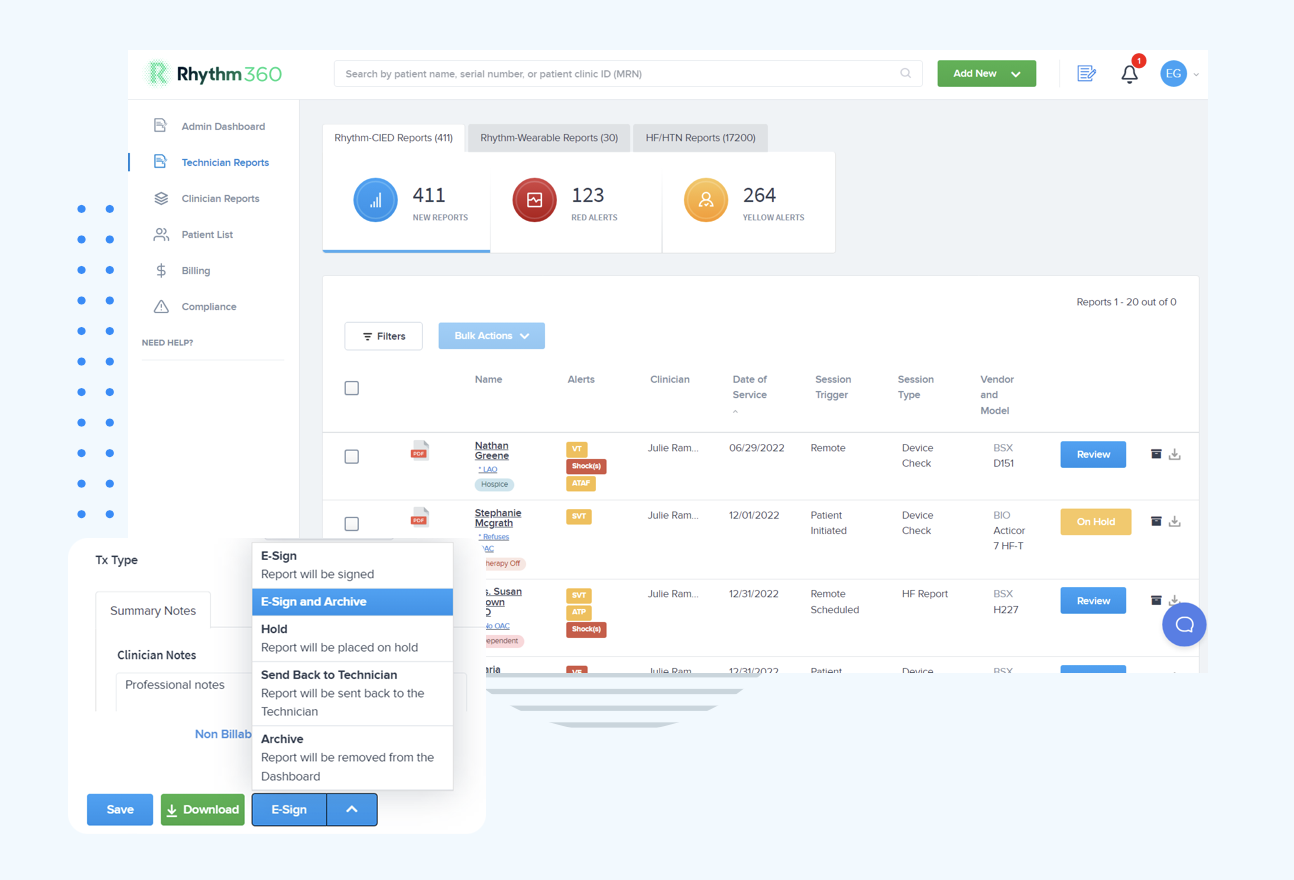
The University of Chicago Medicine implemented Rhythm360 to overhaul its cardiovascular remote monitoring program. UCM reviewed more than 73,000 reports annually through Rhythm360 in calendar year 2025, averaging more than 18,000 reports per quarter. Andrew Beaser, MD, is an Associate Professor of Medicine at the University of Chicago Medicine (UChicago Medicine). He noted that decision support, including AI-assisted decision support, will become increasingly important as data volumes grow, and UCM's 73,000-report annual volume illustrates that reality.
Best Remote Patient Monitoring Platforms For Heart Failure provides a deeper comparison of platform capabilities for practices at the evaluation stage.
Talk To A Remote Monitoring Expert
Alert volume is the operational variable most practices underestimate. A peer-reviewed study of 384,796 cardiac device transmissions found that 57% were dismissed as nonactionable, 31% were routine billable, and 13% were critical alerts requiring immediate attention. In a manual OEM-portal workflow, staff must open, review, and document every transmission before a clinician can determine whether it is actionable. At scale, that workload becomes unsustainable.
Rhythm360's AI-powered alert triage filters non-actionable noise and prioritizes clinically significant events such as new-onset atrial fibrillation, ventricular tachycardia, low battery indicators (ERI/RRT), and significant weight gain in heart failure patients. The platform reduces critical alert response times by up to 80%. For practices that require continuous coverage, Rhythm360 offers optional 24/7/365 oversight by certified cardiac technicians supervised by physicians, which ensures that a critical arrhythmia flagged on a Saturday morning receives a clinical response the same day.
Heart Failure Remote Monitoring: 8 Best Practices outlines the staffing and triage models that high-performing programs use to manage alert volume without proportionally scaling headcount.
Medicare covers remote heart failure monitoring across multiple CPT code families, and each family aligns with a specific device category, billing cycle, and documentation requirement. The table below maps the principal codes practices use in 2026.
| CPT Code | Device Type | Billing Cycle |
|---|---|---|
| 99453 | Non-invasive RPM — device setup and patient education | Once per episode of care |
| 99454 | Non-invasive RPM — device supply and data transmission | Once per 30 days (requires 16+ days of data) |
| 99457 | Non-invasive RPM — first 20 minutes of treatment management | Once per calendar month |
| 93297 | Implantable cardiovascular physiologic monitors (e.g., CardioMEMS) | Once per 30 days |
| 93298 | Subcutaneous cardiac rhythm monitors and implantable loop recorders | Once per 30 days |
| 93294 / 93295 / 93296 | Pacemaker professional / ICD professional / pacemaker-ICD technical | 90-day cycle |
Several documentation requirements apply across these codes. For non-invasive RPM, CPT 99454 requires at least 16 days of transmitted data within a 30-day period, and CPT 99457 requires at least one real-time interactive communication with the patient or caregiver during the calendar month. For implantable devices, CPT 93297 applies specifically to implantable cardiovascular physiologic monitors such as CardioMEMS, while CPT 93298 applies to subcutaneous cardiac rhythm monitors and implantable loop recorders. Both 93297 and 93298 can be billed global, with modifier -26, or with modifier -TC. Practices should verify locality-specific rates using the CMS Physician Fee Schedule Look-Up Tool.
CMS proposed in July 2026 to require RPM services to be performed by the billing entity or its direct employees, which would affect practices currently using contracted monitoring vendors. The proposal remains contested as of September 2026 and would not take effect until January 1, 2027 if finalized. Practices should monitor the CMS final rule publication, expected in early November 2026, before adjusting vendor arrangements.
Rhythm360 automates CPT code capture and documentation across all device categories, which helps practices recover previously lost revenue and increase profitability by as much as 300%. For a full breakdown of billing workflows by device type, see 7 Benefits Of Remote Heart Failure Monitoring For Practices.
Get A Personalized Billing Workflow Review
Practices evaluating remote heart failure monitoring platforms should ask vendors the following questions before committing to a deployment:
Rhythm360 addresses each of these criteria. For example, implementation, including EHR integration, typically takes from a few days to a few weeks, and the platform's data transmissibility exceeds 99.9% through redundant data feeds, computer vision, and AI-powered extrapolation. Rhythm360 is a vendor-neutral, AI-powered platform that unifies CIED and RPM data into a single dashboard. It also provides bi-directional EHR integration and automated CPT code capture.
For a side-by-side review of platform capabilities relevant to heart failure programs, see Best Heart Failure Remote Monitoring Platforms and Best Remote Heart Failure Monitoring Devices 2026 Guide.
Medicare covers remote patient monitoring for heart failure under CPT codes 99453, 99454, and 99457 for non-invasive RPM devices such as cellular scales and blood pressure cuffs. Implantable cardiovascular physiologic monitors such as CardioMEMS are covered under CPT 93297, billed once per 30 days. CIED remote monitoring for pacemakers and ICDs is covered under CPT codes 93294, 93295, and 93296 on a 90-day cycle. Coverage requires documented medical necessity, compliance with transmission-day thresholds (at least 16 days for CPT 99454), and at least one real-time interactive communication with the patient or caregiver for CPT 99457. Practices should verify locality-specific payment rates using the CMS Physician Fee Schedule Look-Up Tool, because national reference rates vary by geography.
CMS requires at least 16 days of transmitted physiologic data within a 30-day period for CPT 99454, and at least one real-time interactive communication with the patient or caregiver for CPT 99457. Documentation must establish medical necessity, identify the specific condition monitored, confirm patient consent, and record the dates and duration of each treatment-management activity. In July 2026, CMS proposed a rule that would require RPM services to be performed by the billing entity's direct employees rather than contracted vendors, with an anticipated effective date of January 1, 2027 if finalized. Practices should monitor the CMS final rule publication, expected in early November 2026, before modifying vendor arrangements. Locality-specific payment rates should be verified in the CMS Physician Fee Schedule Look-Up Tool rather than relying on national reference averages.
Telehealth is defined by CMS as two-way, real-time interactive communication between a patient and a physician or practitioner at a distant site through telecommunications equipment that includes, at a minimum, audio and visual equipment. Telehealth is a broader concept than telemedicine and can also include asynchronous communications and other remote health services. Remote patient monitoring (RPM) refers to the asynchronous, non-face-to-face collection and clinical interpretation of physiologic data such as weight, blood pressure, SpO2, or device diagnostics. Data transmits between visits by an FDA-defined, internet-connected medical device that automatically sends the data to a health care provider, without requiring the patient and clinician to be present simultaneously. RPM is billed under a distinct CPT code family (99453, 99454, 99457) and is governed by separate CMS coverage requirements from telehealth. Remote physiologic monitoring or RTM, but not both, may be billed concurrently with care management services such as chronic care management, transitional care management, behavioral health integration, principal care management, and chronic pain management for the same patient, provided each service's requirements are independently met and the same time and effort is not counted twice.
Home health agencies can bill for remote patient monitoring services such as device supply, data transmission, and treatment management using designated CPT codes. The home health G-code G0322 used to report RPM is informational only and is not separately reimbursed by CMS. The billing practitioner must use a device meeting the FDA definition of a medical device, collect at least 16 days of transmitted data within a 30-day period to bill CPT 99454 (a requirement that does not apply to treatment management codes 99457 and 99458), and provide interactive communication with the patient or caregiver to bill CPT 99457. Practices and agencies should confirm applicable billing entity rules, supervision requirements, and any locality-specific coverage policies with their compliance and billing teams before submitting claims, particularly in light of the proposed 2027 CMS rule on vendor-performed RPM services.
Several platforms operate in the cardiac remote patient monitoring space. Rhythm360 by RhythmScience is a vendor-neutral, HIPAA-compliant, AI-powered platform that unifies CIED and RPM data from major device manufacturers such as Medtronic, Boston Scientific, Abbott, and Biotronik into a single dashboard. It integrates bi-directionally with EHR systems including Epic, Cerner, Athenahealth, eClinicalWorks, and Greenway Health, and it automates CPT code capture and documentation across the full range of remote heart failure monitoring device categories.
Fragmented OEM portals, alert fatigue, and missed billable events are documented failure modes of remote heart failure monitoring programs. A practice can implant the right sensor and still lose revenue, miss critical alerts, and burn out staff if the operational infrastructure does not ingest, triage, and document data across every manufacturer and device type.
Rhythm360 delivers a vendor-neutral, AI-powered platform that handles data ingestion from CardioMEMS, CIED, and RPM devices, triages alerts with the 80% reduction in critical response times described earlier, integrates bi-directionally with major EHR systems, and automates CPT code documentation across the full billing cycle. The University of Chicago Medicine's experience with more than 73,000 reports reviewed annually through Rhythm360 shows what a unified platform makes possible at scale.
For practices building or scaling a remote heart failure program in 2026, the platform should be the starting point. See also: 6 Strategies For Better Remote Monitoring For Heart Failure Management and How Remote Monitoring Works For Heart Failure Patients.
Talk With A Rhythm360 Specialist