Last updated: September 19, 2026
Teams that need clinical-grade monitoring can move from theory to practice quickly with a guided walkthrough of Rhythm360.
Explore Rhythm360 With a Live Walkthrough
A chest strap or smartwatch cannot transmit live heart rate over the internet independently. A reliable live heart-rate stream uses a chain, with a sensor, a relay app or service, internet transport, and a remote viewer. If any link fails, the metric stops updating correctly.
The three parts of the relay chain are:
The relay layer is where most confusion starts, because two very different kinds of app often get grouped together. Heart Track Pro and Combi Fit Track are on-device viewers that display live BPM locally and never relay data over the internet. Apps such as Beat Watcher Alert Sharing and Pulsoid act as relays that send live data to a remote recipient. That viewer-versus-relay distinction is the core gap that competing guides often skip.
The Polar H10 broadcasts heart rate using the standard Bluetooth Low Energy Heart Rate Profile (0x180D), a published Bluetooth SIG specification that any compatible app can receive. The sensor itself never sends data over the internet. A relay app must receive the BLE stream and forward it.
These setups focus on fitness, coaching, and peace of mind rather than clinical care.
Polar H10 Chest Strap + Relay App
The Polar H10 delivers 99.3% cycling accuracy and supports dual Bluetooth connections plus ANT+, so it works well as the sensor in a relay setup. It can connect to two Bluetooth devices at once, such as a relay app and a bike computer. A third device cannot connect until one of them disconnects.
Apps that support live relaying to a remote viewer include Pulsoid and Beat Watcher Alert Sharing. Beat Watcher Alert Sharing, available in version 2026.23, lets a wearer invite a trusted contact who can accept and receive high or low threshold alerts in the Beat Watcher iPhone app without purchasing a subscription. Both parties opt in and can stop sharing at any time. Polar’s official Polar Beat and Polar Flow apps do not provide real-time remote sharing to another person.
Cellular Apple Watch Series 11 + Third-Party Monitoring App
An Apple Watch with an activated cellular plan can make calls, reply to messages, and stream music even when the iPhone is not nearby. It can also receive notifications without Wi‑Fi. However, Apple Watch heart rate notifications are delivered only to the wearer. Apple Health Sharing, available since iOS 15, can pass copies of heart health notifications to an invited contact, but delivery depends on iCloud background syncing and users report shared updates arriving minutes or much longer after the fact. Third-party apps such as Beat Watcher Alert Sharing give trusted contacts threshold alerts more reliably.
One key detail: Apple Watch high and low heart rate notifications fire only after heart rate stays past the configured threshold for about 10 minutes while the wearer appears inactive. This behavior reflects a periodic background check rather than continuous live monitoring.
Galaxy Watch7
The LTE variant of the Samsung Galaxy Watch7 offers cellular capabilities similar to the cellular-equipped Apple Watch Series 11, with both supporting 4G LTE and 3G/UMTS connectivity via eSIM. The Bluetooth-only Galaxy Watch7 model lacks cellular entirely. Like the Apple Watch, it depends on third-party relay apps for live remote sharing to another person. Optical PPG accuracy can degrade during high-intensity movement, and connectivity limits apply when the paired phone is out of range.
A note on “continuous” monitoring across consumer devices helps set expectations. Most wearables sample heart rate every 5 minutes in standard background mode, with continuous modes typically at 5 seconds and some brands at 10 minutes. True live streaming usually requires an active workout session or a dedicated relay app running in the foreground.
Talk With Rhythm360 About Clinical Monitoring
Streamers get the smoothest experience when they pair a chest strap or optical armband with relay software that generates a browser widget for OBS or Streamlabs. A common workflow includes creating a Pulsoid account, pairing the heart rate sensor to a smartphone via Bluetooth, generating a browser widget URL on the Pulsoid website, and adding that URL as a Browser source in OBS.
Common relay tools for streamers include:
The typical streamer relay chain works as follows. A Bluetooth heart rate sensor sends data to the Pulsoid smartphone app. Pulsoid relays that data to the internet. The resulting browser widget URL renders as an OBS Browser source for Twitch or YouTube broadcasts.
The Polar H10 is a strong chest-strap option for streamers, offering ECG-grade accuracy and dual Bluetooth connections plus ANT+. Chest strap ECG monitors typically introduce only a 1–3 second delay in the stream overlay. Budget-friendly alternatives include optical armbands such as the COOSPO HW9, which one streamer selected for its low cost and non-intrusive fit during gameplay. Optical armbands like the Polar Verity Sense may introduce 10–15 seconds of lag compared with chest straps.
This setup supports fitness and entertainment rather than clinical care. None of these configurations satisfy Medicare requirements for remote patient monitoring.
When a person has a diagnosed or suspected cardiac condition, the monitoring requirements change completely, and so does the technology.
Patients with AFib, heart failure, recent cardiac events, or implantable cardiac devices need clinical-grade monitoring instead of consumer sharing. Clinical-grade remote monitoring uses FDA-cleared devices and platforms to transmit arrhythmia data to clinicians, including episode context and diagnostic detail that a simple BPM number cannot provide.
Zio AT and Cellular-Enabled Cardiac Monitors
The Zio AT ECG Monitoring System is a prescription-only ambulatory mobile cardiac telemetry service that provides continuous monitoring for up to 14 days. Its FDA-cleared AI algorithm detects 13 types of arrhythmias with 99% analyzable time and 99% physician agreement on end-of-wear reports. The system is contraindicated for critical care patients or those with symptomatic episodes that pose immediate danger. It also has transmission limits of 100 patient-triggered and 500 automatically detected arrhythmia events per wear period. After those limits, real-time transmission stops while recording continues.
RPM Platforms and Rhythm360
Vendor-neutral cardiac remote monitoring platforms consolidate data from all major CIED manufacturers, including Medtronic, Abbott, Boston Scientific, and Biotronik, into a single workflow. Manufacturer-owned portals such as Medtronic CareLink and Abbott Merlin.net were built for single-vendor use, so running several portals in parallel fragments data instead of unifying it.
Rhythm360, developed by RhythmScience, is a vendor-neutral, HIPAA-compliant platform that ingests and normalizes data from all major CIED manufacturers into a single dashboard. The University of Chicago Medicine reviewed more than 73,000 reports annually through Rhythm360 in calendar year 2025, averaging more than 18,000 reports per quarter. Andrew Beaser, MD, Associate Professor of Medicine at UCM, noted that decision support, including AI-assisted decision support, will grow more important as data volumes increase.
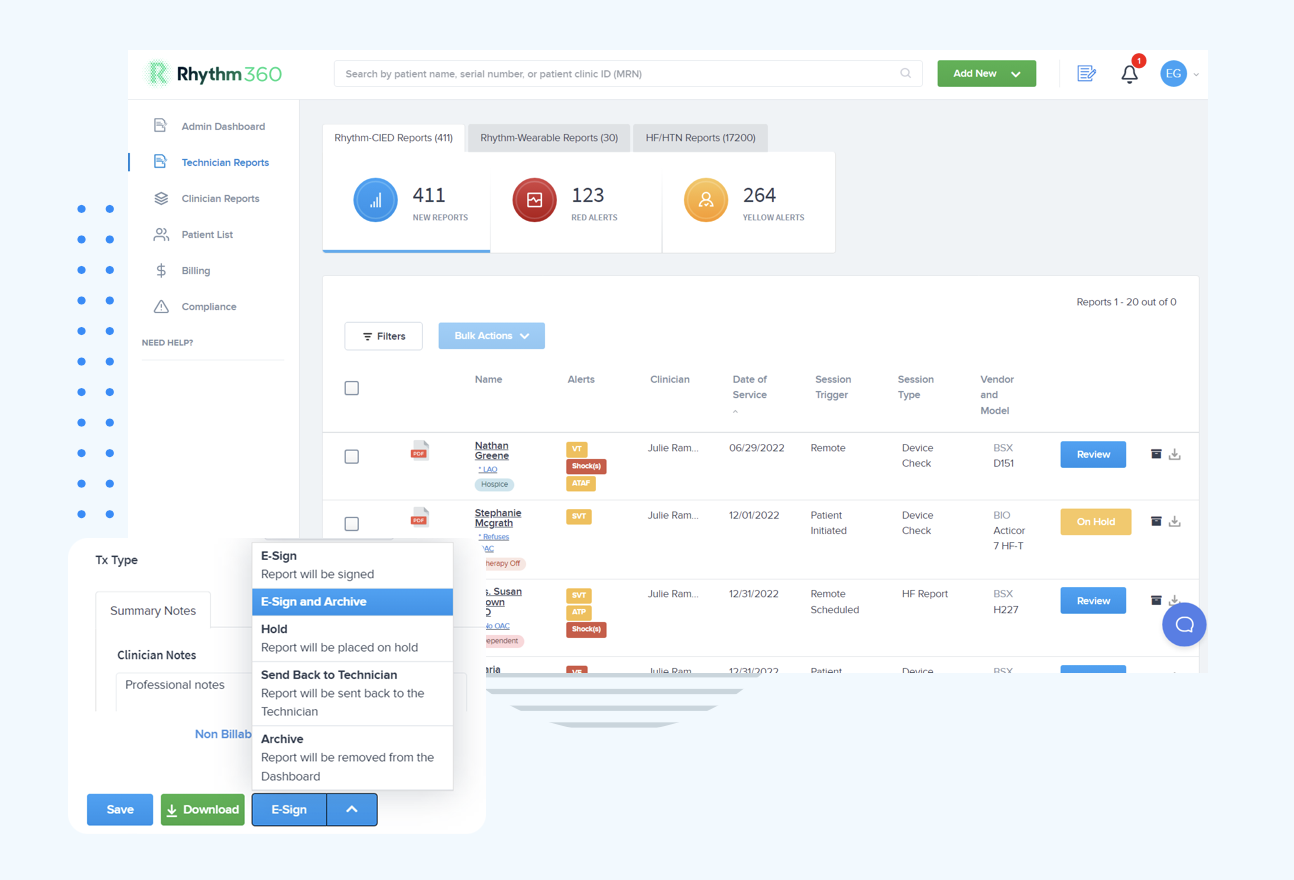
Key Rhythm360 capabilities include:
Other platforms in this space include Murj, Implicity, Rhythm Management Group, and Octagos.
See How Clinical-Grade Monitoring Works
Consumer hardware remains relatively inexpensive compared with clinical platforms, and the price gap reflects the difference in capability.
Clinical RPM platform costs vary by platform and practice size, with SaaS-based pricing that scales with clinic size and usage.
Medicare covers remote patient monitoring under specific CPT codes. RPM services generally require FDA-defined medical devices capable of electronically transmitting patient data, so consumer-grade fitness trackers often fail to meet Medicare requirements. The primary RPM codes are:
Rhythm360’s automated CPT code capture supports documentation for these codes and helps practices reduce billing gaps. CMS published a CY 2027 Physician Fee Schedule Proposed Rule on July 16, 2026, that would significantly restrict Medicare RPM reimbursement, including banning outsourced clinical staffing and adding new patient-relationship requirements. Clinical decision-makers should monitor this rulemaking closely.
The right setup depends on the viewer’s role and the patient’s clinical situation.
When the Viewer Is a Family Member or Coach, the goal usually involves fitness tracking or peace of mind. A Polar H10 paired with Pulsoid or Beat Watcher Alert Sharing provides live relay capability. A cellular Apple Watch Series 11 with a third-party monitoring app supports phone-free tracking. These consumer setups do not satisfy Medicare RPM requirements.
When the Viewer Is a Clinician Managing a Cardiac Condition, consumer wearables are not appropriate. A clinical-grade RPM platform such as Rhythm360 provides continuous data review, AI-powered alert triage, CPT code documentation support, and EHR integration.
When to Move From Consumer to Clinical Monitoring becomes clear once any known cardiac condition, recent cardiac event, or symptoms such as palpitations, syncope, or chest pain appear. Those situations call for clinical-grade monitoring rather than a consumer relay setup.
Consumer heart rate sharing cannot replace clinical monitoring when a cardiac condition is present or suspected. Clinical remote monitoring provides continuous data review by certified cardiac technicians, alert triage that filters non-actionable noise and prioritizes clinically significant events, and integration with electronic health records.
Rhythm360’s AI-driven alert triage filters non-actionable alerts and prioritizes critical arrhythmias such as ventricular tachycardia and atrial fibrillation, using the same triage engine described earlier that cuts critical-event response times from roughly 4 hours to about 45 minutes. The platform serves as the vendor-neutral consolidation layer that helps practices manage data from all major CIED manufacturers without logging into separate portals.
Streamers often use a chest strap such as the Polar H10 or a budget optical armband such as the COOSPO HW9, paired with relay software like Pulsoid or the Heart Rate OBS plugin. The sensor sends Bluetooth data to a smartphone app, which relays it to the internet. A browser widget URL generated by the relay service is then added as a Browser source in OBS, displaying live heart rate on screen during Twitch or YouTube broadcasts. Chest straps generally introduce 1–3 seconds of overlay latency, while optical armbands may add 10–15 seconds.
Consumer devices typically range from about $90 for a Polar H10 chest strap to $399 or more for a cellular Apple Watch Series 11. Clinical RPM platform costs vary by platform and practice size. Rhythm360 uses a SaaS-based pricing model that scales with clinic size and platform usage. Medicare reimbursement under CPT codes 99453, 99454, and 99457 can offset clinical RPM costs for qualifying patients, although actual reimbursement rates vary by geographic locality and payer.
Medicare reimburses remote patient monitoring under CPT codes such as 99453, 99454, and 99457. These codes cover initial device setup and education, device supply and data transmission, and treatment management time that includes at least one live interactive contact with the patient. RPM services generally require FDA-defined medical devices capable of electronically transmitting patient data. Coverage also extends to many Medicare Advantage plans, Medicaid programs in many states, and commercial insurers. Practices should track the CMS CY 2027 Physician Fee Schedule Proposed Rule, which would significantly change RPM reimbursement rules if finalized.
Fitness heart rate sharing displays live BPM for family members, coaches, or stream viewers using consumer wearables and relay apps. It fits wellness, fitness coaching, and entertainment scenarios. Clinical remote monitoring uses FDA-cleared devices and platforms to transmit arrhythmia data and related context to clinicians, with continuous data review, AI-powered alert triage, and EHR integration. Clinical platforms such as Rhythm360 support CPT code documentation and serve patients with cardiac conditions including AFib, heart failure, or implantable cardiac devices. Consumer setups do not satisfy Medicare requirements for RPM billing and do not replace clinical monitoring for these patients.
Apple’s native behavior sends heart rate notifications only to the wearer. Apple Watch high, low, and irregular rhythm notifications appear on the watch and paired iPhone. Apple Health Sharing can pass copies of heart health notifications to an invited contact, but delivery depends on iCloud background syncing and does not support immediate live delivery. Third-party apps such as Beat Watcher Alert Sharing allow a wearer to invite a trusted contact who can receive threshold alerts in the Beat Watcher iPhone app, with both parties opting in. This setup supports awareness for trusted contacts rather than emergency response or medical monitoring.
Consumer wearables always rely on a three-part relay chain of sensor, relay app or service, and remote viewer for live heart rate sharing. For family members and coaches, a Polar H10 paired with Pulsoid or Beat Watcher Alert Sharing, or a cellular Apple Watch Series 11 with a third-party monitoring app, provides a workable live sharing setup. For streamers, the same Polar H10 paired with Pulsoid and an OBS Browser source delivers a low-latency on-screen overlay.
Clinical cardiac monitoring requires a different approach. Rhythm360 functions as a vendor-neutral, AI-powered platform that consolidates data from all major CIED manufacturers, including Medtronic, Abbott, Boston Scientific, and Biotronik, into a single HIPAA-compliant dashboard. The platform uses AI triage to shorten critical alert response times, supports CPT code documentation to help practices improve billing outcomes, and maintains greater than 99.9% data transmissibility. The University of Chicago Medicine processed more than 73,000 reports annually through Rhythm360 in calendar year 2025, which illustrates the platform’s capacity at enterprise scale.
Talk to Rhythm360 About Your Monitoring Program