Last updated: September 23, 2026
See How Rhythm360 Automates All Eight Stages
An RPM platform collects and displays physiologic and device data from patients outside a clinical setting. A workflow automation platform coordinates the tasks, handoffs, documentation, and billing evidence around that data, including eligibility checks, enrollment, escalation routing, adherence outreach, and CPT capture, across the entire program.
RPM software commonly includes patient enrollment and device assignment workflows, automated data ingestion, alert thresholds, escalation workflows, clinical note documentation, secure messaging, patient reminders, and EHR integration, yet these features vary widely across platforms and often do not cover every stage. A practice that buys an RPM platform and expects it to automate eligibility verification, time tracking, and billing documentation will quickly see the gaps. A workflow automation platform fills those gaps, and the strongest programs combine both capabilities in a single unified system.
The following eight stages describe the core automation problems inside every RPM program. Each stage aligns with a distinct tool category, and leaving any stage manual creates downstream risk in billing, compliance, or patient safety. The list below introduces the stages; the paragraphs that follow walk through each stage in order.
Stage 1 — Eligibility: Every RPM program starts by confirming payer coverage, prior authorization status, and clinical suitability. RPM platforms automate CPT code tracking, time logging, and billing documentation required for Medicare reimbursement, while eligibility verification usually relies on a separate rules-based tool or clearinghouse integration. Platforms such as Notable and Healthie handle intake and eligibility workflows for healthcare organizations and wellness or multi-specialty care teams, with Notable automating registration, intake, and insurance verification and eligibility, and Healthie running a configurable org-level workflow spanning scheduling, intake, documentation, and programs. Cardiology-specific programs also need eligibility logic that accounts for CIED device type, because the applicable CPT cycle, 90-day for pacemakers and ICDs and 30-day for physiologic monitors and loop recorders, shapes billing rules from day one.
Stage 2 — Enrollment: Once eligibility is confirmed, the next stage is enrollment. Enrollment automation captures informed consent, assigns devices, and triggers the patient education session that supports CPT 99453. Documentation for RPM billing must show interactional setup and patient education for 99453, rather than a simple device shipment. Platforms such as Healthie support structured onboarding checklists. Rhythm360 unifies CIED and chronic cardiometabolic (hypertension and heart failure) data into a single workspace with simple workflows and integrated billing; the related Rhythm Management Group provides patient identification, engagement, and onboarding services for remote monitoring programs, which closes the handoff gap between enrollment and billing.
Stage 3 — Device Activation: After enrollment, the program must confirm that each device is paired, transmitting, and matched to the correct patient record. Many practices discover failures only at month-end when a billing threshold is missed. Bluetooth pairing drops can cause readings to stop for days and then resume without explanation, while the device dashboard still reports success and the EHR chart shows no data. Activation automation confirms first transmission and raises a visible alert when connectivity is lost, so staff can intervene before the billing cycle closes.
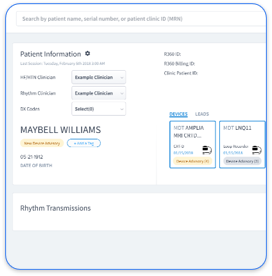
Stage 4 — Monitoring: Monitoring is where most practices invest first and where cardiology-specific complexity peaks. CIED data arrives from Medtronic, Boston Scientific, Abbott, and Biotronik in proprietary formats that require normalization before clinicians can view or act on it. Rhythm360 focuses on this problem. Rhythm360 ingests data via API, HL7, XML, and PDF parsing through computer vision and AI, and achieves greater than 99.9% transmissibility through redundant data feeds. That architecture matters at scale: University of Chicago Medicine reviewed more than 73,000 reports annually through Rhythm360 in calendar year 2025, averaging more than 18,000 reports per quarter. General RPM monitoring platforms such as CareSimple, HRS, and Optimize Health handle physiologic data well but are not designed for multi-OEM CIED workflows, which require interoperable handling of proprietary device data across multiple incompatible systems per the 2024 HRS perspective on advancing CIED remote monitoring workflows.
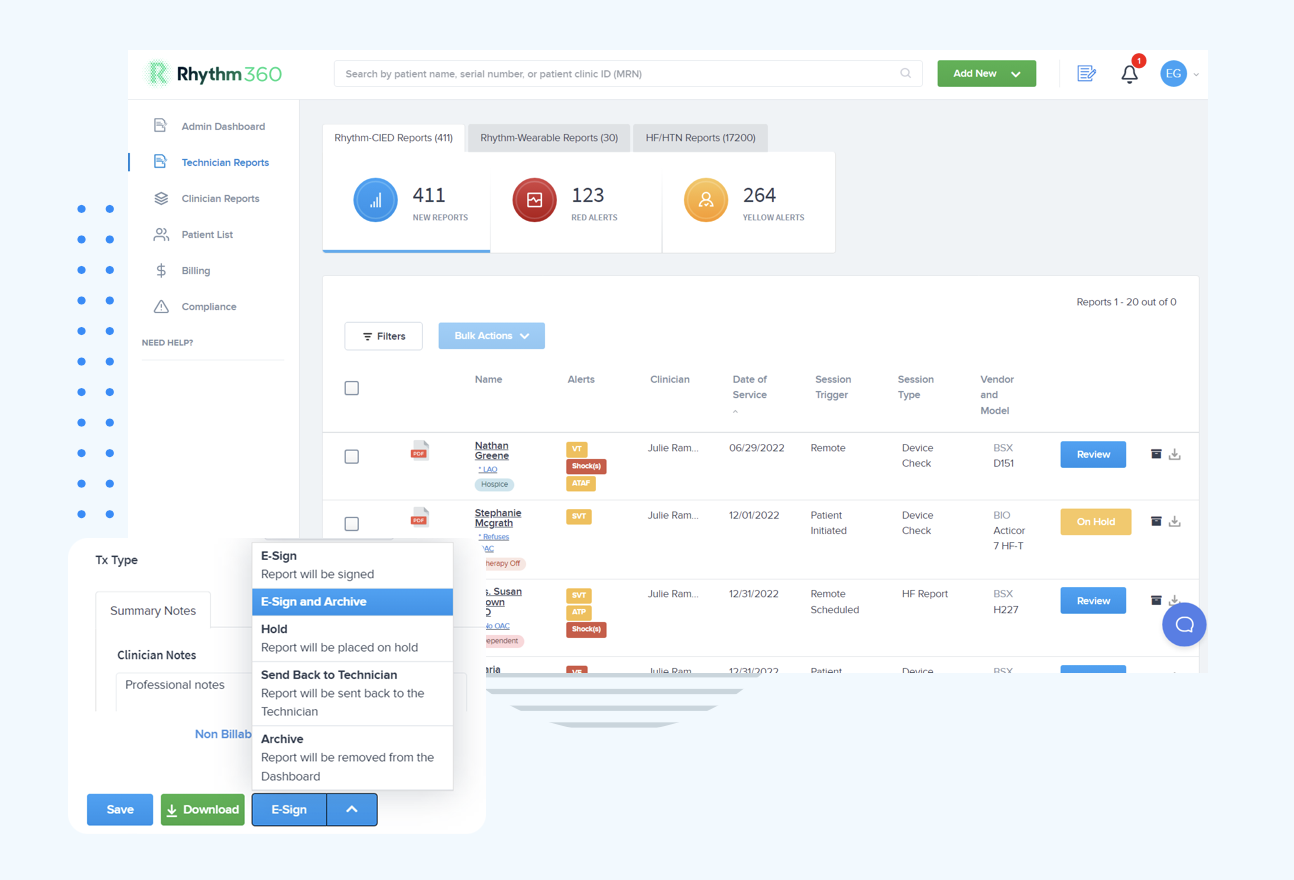
Stage 5 — Escalation: Once monitoring is stable, the program must route clinically significant events to the right clinician within a defined window. This stage is where alert fatigue causes the most harm. A systematic review in JAMIA identifies alert fatigue as a barrier to the use and impact of clinical decision support systems, with alert quantity, override rate, and acceptance rate as the most common metrics used to measure it. Rhythm360’s AI-powered alert triage filters non-actionable noise and prioritizes clinically significant events, which reduces critical alert response times by up to 80%. This improvement shows up in practice: Andrew Beaser, MD, at University of Chicago Medicine, explained, “We are able to address these issues earlier; rather than waiting for a 3-month visit, we can call patients in for evaluation.”
See Rhythm360’s AI Triage In Action
Stage 6 — Clinical Intervention: After escalation, clinicians need to document the work they perform. CPT 99457 requires at least 20 minutes of logged clinical staff or physician treatment management time per calendar month and requires interactive communication with the patient or caregiver. CPT 99458 is an add-on code for each additional 20-minute increment of treatment management time after 99457, with up to two units billable per month. Automation at this stage logs the interaction, timestamps it, and links it to the patient record in an audit-ready format. Twilio-powered messaging frameworks, like the one integrated into Rhythm360, create a full audit trail of all communications, including phone call logs, inside the patient record.
Stage 7 — Adherence: CPT 99454 requires at least 16 days of readings within a rolling 30-day window; sporadic uploads fail this threshold even when averages look clinically useful. Adherence automation tracks each patient’s transmission day count in real time and triggers outreach by SMS, in-app message, or phone when a patient falls behind. Prevounce and Optimize Health include adherence tracking for general RPM programs. Rhythm360 surfaces adherence counters tied directly to this 16-day rule and automates patient outreach through its integrated Twilio framework, so the care team sees which patients need intervention before the billing window closes.
Stage 8 — Billing And Documentation: The final stage assembles consent records, device transmission logs, time entries, and interactive communication evidence into an auditable claim. The 20-minute monthly management threshold for CPT 99457 requires a real, contemporaneous time log rather than a reconstructed estimate at month’s end. Billing automation platforms such as Prevounce handle documentation workflows for general RPM. Rhythm360 automatically tracks device-specific CPT pairings. Pacemakers and ICDs follow a 90-day cycle: 93294 (pacemaker professional), 93295 (ICD professional), and 93296 (technical). Physiologic monitors and loop recorders follow a 30-day cycle: 93297 for implantable cardiovascular physiologic monitors such as CardioMEMS, and 93298 for subcutaneous cardiac rhythm monitors and implantable loop recorders. Each is billable once per 30 days and can be split into professional (-26) and technical (-TC) components. This configuration prevents device-type mismatch denials. Gaurav A. Upadhyay, MD, at University of Chicago Medicine, observed, “We have improved billing and accountability for our patients after the integration.”
Medicare’s RPM billing stack under the Physician Fee Schedule centers on CPT codes 99453 through 99458, structured around three components: initial patient education and device setup (99453), device supply and daily recording (99454), and clinical staff review time (99457 and 99458). Workflow automation must preserve evidence of all three components independently, because a program that documents monitoring time but cannot prove the 16-day device threshold still cannot bill 99454. By 2026, CMS audits are expected to focus on 99454 thresholds and cloned time logs; practices that automate time capture from EHR clicks survive better than those rounding 20 minutes for every patient. In 2026, CMS also introduced CPT 99445 for device supply when a patient logs 2 to 15 days of readings and CPT 99470 for the first 10 minutes of management time, which lowered the threshold practices previously needed to hit before billing anything for a partial month of monitoring.
AI now sits at the center of scalable cardiology RPM workflows. Andrew Beaser, MD, at University of Chicago Medicine, noted, “Decision support, including AI-assisted decision support, will become increasingly important as data volumes grow.” In cardiology RPM programs, AI serves three primary functions: alert filtering, data normalization, and escalation routing. Rhythm360 applies computer vision to parse unstructured PDF transmissions from OEM portals, AI-powered extrapolation to fill data gaps when a vendor server is unavailable, and intelligent triage to surface clinically significant events such as new-onset atrial fibrillation, ventricular tachycardia, or device malfunction ahead of routine notifications.
The multi-OEM portal problem defines daily operations for electrophysiology clinics. A practice that manages patients with devices from Medtronic, Boston Scientific, Abbott, and Biotronik must reconcile four separate data streams, each with its own alert format and transmission schedule. AI-enabled alerting systems frequently introduce new cognitive demands and increase alert fatigue when workflows are not redesigned accordingly, so Rhythm360’s triage layer focuses on reducing alert volume to the care team rather than forwarding every transmission as a notification. Other platforms in the CIED monitoring space include Murj, Implicity, Rhythm Management Group, and Octagos.
For cardiac CPT billing, the code set remains device-specific. Pacemakers and ICDs follow a 90-day cycle with 93294, 93295, and 93296. Physiologic monitors and loop recorders follow a 30-day cycle with 93297 and 93298, each billable once per 30 days and available in global, -26, or -TC billing configurations. Rhythm360 automates the matching of device type to the correct CPT pairing and prevents mismatch denials such as applying a loop recorder code to a physiologic monitor.
Bluetooth Low Energy RPM devices pair to the patient’s smartphone and relay readings through an app, which lowers hardware cost but depends on the patient owning a smartphone, keeping the app installed, and keeping Bluetooth enabled, a fragility described as “the enemy of the 16-day rule” for older chronic-care populations. Cellular RPM devices with an embedded modem transmit readings on their own and do not require a phone or app; they cost more per unit and carry a data-plan fee but convert far better on adherence. The downstream workflow impact is direct. Research from NYU Langone Health’s Cardiology Division found that patient compliance in RPM programs averages around 55% when using non-cellular devices, causing many enrolled patients to miss the 16-day billing threshold. For a 200-patient panel, the difference between 55% and 85% compliance creates a large gap in monthly billing capture. Cellular devices reduce adherence risk at the device layer, and workflow automation resolves it at the outreach and escalation layer for patients who still fall behind.
CMS’s proposed CY2027 rule, published July 14, 2026, signals further consolidation of the RPM and RTM code sets, potentially collapsing 17 codes into four G-codes, with requirements that clinical staff providing RPM services be employed by the practice and that a separate initiating visit occur at the onset of service. Practices with automated, auditable billing documentation will adapt more easily than those relying on manual time logs.
Medicare RPM reimbursement in 2026 typically ranges from about $90 to $150+ per patient per month when CPT codes 99454, 99457, and 99458 are billed appropriately. Practices that implement Rhythm360 have achieved up to a 300% increase in revenue capture through more accurate CPT code billing and improved staff efficiency. RPM profitability is highly sensitive to per-patient operating cost and patient adherence assumptions, with payer mix, compliance rate, staffing model, and condition mix identified as the four primary drivers of ROI variation.
The primary disadvantage of remote patient monitoring is patient adherence. Cellular-enabled RPM devices often achieve higher patient compliance because they transmit data automatically without requiring Wi-Fi or smartphone pairing, yet adherence gaps still occur. Connectivity issues, device discomfort, and unclear patient instructions all contribute to missed transmission days. Staff training burden is a second honest limitation. A defensible RPM program should start with a single high-prevalence condition, enroll a small cohort under a written protocol, and measure transmission adherence weekly before scaling. Rhythm360’s implementation process, including EHR integration, typically takes from a few days to a few weeks and reduces the onboarding burden that causes early-stage programs to stall.
Practices can assemble point solutions for each of the eight RPM workflow stages, including eligibility tools, enrollment platforms, monitoring dashboards, escalation routers, adherence trackers, and billing engines. The integration overhead between those tools often recreates the manual burden the program was meant to eliminate. The most successful cardiology RPM programs rely on a unified platform that spans all eight stages. Rhythm360 fits that role as a vendor-neutral, AI-powered system built to handle CIED workflows, multi-OEM data normalization, and CPT-compliant billing documentation in one place.
Talk With Rhythm360 About Your RPM Workflow