10 Best Strategies to Improve Cardiology Revenue Cycle
Discover proven strategies to cut cardiology denials by 50% and boost RPM revenue by 300%. Rhythm360 delivers automated RCM solutions. Schedule demo!

Key Takeaways for Cardiology RCM Performance
- Cardiology practices often see 10-30% claim denial rates and A/R over 40 days because of fragmented RPM billing and OEM data silos.
- Automated prior authorizations and AI denial management can drive denials below 5% and cut processing times by up to 80%.
- Accurate CPT 93298 and 99454 coding for RPM requires 16 or more days of recordings and clear physician review documentation.
- EHR integration, real-time A/R dashboards, and routine compliance audits help practices reach under-30-day A/R.
- Rhythm360 delivers automated OEM integration and up to 300% RPM revenue uplift; schedule a demo today.
10 Proven Strategies to Improve Cardiology Revenue Cycle Management
- Automate prior authorizations to cut denials by 50% and reduce processing time by 80%.
- Strengthen ICD-10 and CPT coding accuracy for cardiac procedures and RPM services.
- Use AI-powered denial management to achieve denial rates below 5%.
- Improve patient collections with automated portals and structured payment plans.
- Build clear RPM billing protocols for CIED and heart failure monitoring.
- Run regular compliance audits and ongoing staff training programs.
- Integrate EHR and practice management systems for consistent data flow.
- Use real-time analytics dashboards to keep A/R under 30 days.
- Adopt hybrid outsourcing models for complex billing functions.
- Apply predictive AI analytics to strengthen 2026 revenue performance.
1. Automate Prior Authorizations to Cut Cardiology Denials
Prior authorization failures cause 35% of claim denials, so automation becomes essential for high-cost cardiology procedures like nuclear imaging and electrophysiology studies. Clinically integrated prior-authorization software can reduce denial rates by 65% and cut median authorization times by 34%.
Implementation checklist:
- Use AI tools that predict authorization requirements based on procedure codes.
- Connect authorization workflows directly to EHR scheduling systems.
- Track CPT 93298 eligibility automatically from CIED transmission data.
- Set automated follow-up tasks for pending authorizations.
- Review authorization approval rates by payer and procedure type.
2. Improve ICD-10 and CPT Coding Accuracy for Cardiac Procedures
Coding inaccuracies cause 24% of claim denials, and cardiology’s complex procedure combinations increase this risk. Accurate coding for cardiac catheterizations, electrophysiology studies, and device implantations directly supports clean claims and full revenue capture.
Essential coding protocols:
- Use real-time coding validation software with cardiology-specific rules.
- Define modifier guidelines for bilateral procedures and multiple interventions.
- Create coding templates for common EP procedures and device implantations.
- Run monthly coding audits on high-value procedures.
- Train staff on 2026 CPT updates that affect cardiology billing.
3. Use AI-Powered Denial Management to Reach Sub-5% Denial Rates
AI predictive automation in RCM can lower denial rates by 30-40% by spotting issues before submission. Cardiology practices gain extra value from AI because it can analyze complex cardiac procedure combinations and payer-specific rules.
AI implementation strategy:
- Train machine learning models on cardiology-specific denial patterns.
- Automate claim scrubbing for frequent cardiology denial triggers.
- Use predictive analytics to support medical necessity documentation.
- Build automated appeals workflows for overturned denials.
- Track denial trends by procedure type and payer contract terms.
4. Strengthen Patient Collections with Portals and Payment Plans
Growing patient responsibility makes efficient collection workflows critical for stable cash flow. Automated payment portals and structured payment plans increase collection rates and reduce manual work for staff.
Collection improvement tactics:
- Offer patient payment portals with automated reminders.
- Collect pre-service payments for elective procedures when appropriate.
- Provide flexible payment plans for high-cost cardiac interventions.
- Send text and email reminders with secure payment links.
- Review patient payment trends and adjust strategies regularly.
5. Build Clear RPM Billing Protocols for CIED and Heart Failure Monitoring
Remote patient monitoring creates a major revenue stream when practices follow strict coding rules. CPT 99454 requires at least 16 days of active recordings in a 30-day billing period, and CPT 93298 covers implantable cardiovascular monitor evaluations. Rhythm360 automates this complex billing through OEM integration and AI CPT capture, helping practices recover up to 300% more revenue from missed RPM billing.
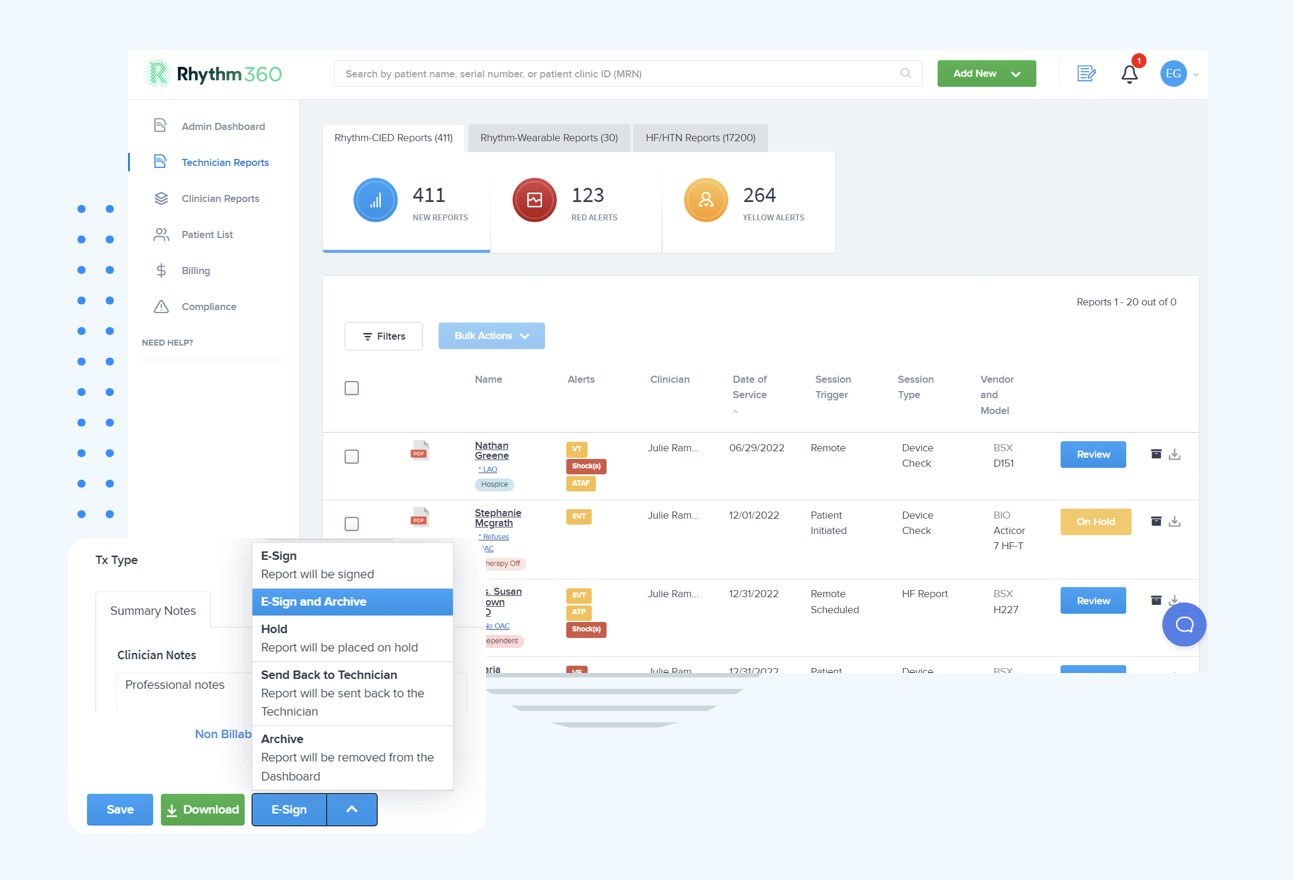
RPM billing essentials:
- Use automated tracking for the 16-day minimum recording requirement.
- Standardize physician review documentation workflows for CPT 93298.
- Maintain patient communication logs for RPM documentation.
- Set automated alerts for billable RPM events and thresholds.
- Track RPM revenue capture and flag missed billing opportunities.
Schedule a Rhythm360 demo to see how automated RPM billing can reshape your revenue cycle.
6. Run Regular Compliance Audits and Staff Training
Cardiology billing compliance requires constant attention because CPT codes, modifiers, and documentation rules change frequently. Regular audits catch risks early and help avoid penalties or negative audit findings.
Compliance framework:
- Plan quarterly internal audits that focus on high-risk procedure codes.
- Provide monthly staff training on coding updates and compliance changes.
- Review documentation for complex cardiac procedures on a routine basis.
- Use compliance checklists for common cardiology billing scenarios.
- Track regulatory updates from CMS and cardiology specialty societies.
7. Connect EHR and Practice Management Systems for Reliable Data Flow
Fragmented data between clinical and billing systems slows workflows and increases errors. Strong integration supports accurate charge capture and reduces manual data entry that often delays billing.
Integration priorities:
- Set up bi-directional data flow between EHR and billing systems.
- Automate charge capture from clinical documentation.
- Unify patient scheduling and registration workflows.
- Use real-time eligibility verification within scheduling.
- Audit data accuracy between integrated systems on a schedule.
8. Use Real-Time Analytics Dashboards to Keep A/R Under 30 Days
Real-time KPI visibility allows proactive revenue cycle management. Dashboards that show A/R aging, denial rates, and collection trends support quick action when metrics slip.
Dashboard essentials:
- Track A/R aging and trigger alerts for accounts over 30 days.
- Monitor clean claim rates and first-pass resolution percentages.
- View denial rates by payer, procedure type, and provider.
- Send automated reports for monthly RCM performance reviews.
- Compare performance against industry benchmarks and internal goals.
9. Use Hybrid Outsourcing for Complex Cardiology Billing
Targeted outsourcing of complex billing tasks can raise efficiency while the practice keeps control of core processes. Hybrid models allow internal teams to manage patient-facing work while experts handle specialized cardiology billing.
Outsourcing strategy:
- Flag high-complexity billing functions that fit specialized vendors.
- Keep patient communication and clinical workflows in-house.
- Define clear performance metrics and service level agreements.
- Hold regular performance reviews and enforce vendor accountability.
- Ensure smooth integration between internal and outsourced teams.
10. Apply Predictive AI Analytics for 2026 Revenue Growth
Advanced analytics and AI reveal detailed revenue cycle trends and improvement opportunities. Predictive models highlight patterns, forecast cash flow, and suggest targeted changes based on historical data and benchmarks. Rhythm360’s AI platform reviews OEM data and billing trends to improve revenue capture automatically and increase practice profitability.
AI analytics implementation:
- Use predictive models for cash flow forecasting and A/R management.
- Apply machine learning to refine payer contract performance.
- Run automated trend analysis on procedure profitability.
- Set predictive alerts for potential compliance risks.
- Track AI recommendations and measure their impact.
Unique Cardiology RCM Challenges and Data Fragmentation
Cardiology practices face revenue cycle challenges that differ from many other specialties. Data silos and fragmentation across hospital privileging offices, state medical boards, and NPPES create gaps and bottlenecks. OEM data fragmentation from multiple device manufacturers adds more complexity as teams struggle to unify information from Medtronic, Abbott, Boston Scientific, and other vendors into a single billing workflow.
Most Frequent Cardiology Billing Denials
Clear insight into denial patterns helps practices focus their improvement work. Missing or inaccurate claim data causes 50% of denials, authorization issues cause 35%, and coding inaccuracy causes 24%. Medical necessity denials account for nearly 20% of rejections, which strongly affects high-cost cardiac procedures that demand detailed documentation.
Improving RPM Billing Workflows in Cardiology
Effective RPM billing depends on strict adherence to timing and documentation rules. CPT 99454 requires at least 16 days of active recordings in a 30-day billing period, and CPT 93298 requires documented physician time for device data review and interpretation. Automated tracking systems that monitor these requirements and generate complete documentation support consistent RPM reimbursement.
| Metric | Industry Benchmark | Best Practice Target |
|---|---|---|
| A/R Days | 35-45 days | <30 days |
| Denial Rate | 10-15% | <5% |
| Clean Claim Rate | 85-90% | >95% |
| CPT Code | Description | Key Requirements |
|---|---|---|
| 93298 | Implantable cardiovascular monitor evaluation | Physician review and interpretation documentation |
| 99454 | Remote physiological monitoring | 16+ days of recordings per 30-day period |
FAQ
What are the most common cardiology RCM challenges?
Cardiology practices often struggle with OEM data fragmentation across multiple device manufacturers, complex coding rules for cardiac procedures, denial rates of 12-20%, and A/R cycles over 40 days. Teams also manage RPM billing compliance, coordinate care across several specialists, and maintain documentation standards for high-cost procedures that require prior authorization.
How does RPM impact cardiology revenue?
Remote patient monitoring drives recurring cardiology revenue through CPT codes such as 93298 for implantable device monitoring and 99454 for physiological monitoring. Practices can see revenue increases of up to 300% with strong RPM programs. Success depends on automated tracking of compliance rules, clear physician documentation, and accurate billing for every qualifying service.
What is the best software for cardiology RCM?
The most effective cardiology RCM platforms combine full billing features with deep cardiac device integration. Rhythm360 functions as a vendor-neutral platform that unifies data from all major OEM manufacturers while automating CPT capture and compliance documentation. The platform delivers over 99.9% data reliability and supports up to 300% revenue uplift through intelligent automation and integrated billing workflows.
What are the key RPM billing CPT codes in cardiology?
Core RPM CPT codes in cardiology include 93298 for implantable cardiovascular monitor evaluation, 99454 for remote physiological monitoring with at least 16 days of recordings, and 99453 for initial setup and patient education. Additional codes such as 93291-93297 cover other implantable device monitoring services. Strong performance with these codes requires automated tracking, complete physician documentation, and adherence to timing and recording rules.
How can practices reduce cardiology billing denials?
Lower cardiology billing denials with automated prior authorization tools, AI claim scrubbing, accurate coding protocols, and structured staff training. Focus on the main denial drivers: missing claim data, authorization failures, and coding errors. Predictive analytics and real-time validation can prevent many denials before submission, while automated appeals workflows help recover revenue from denied claims.
Conclusion: Automating Cardiology RCM with Rhythm360
High-impact cardiology revenue cycle strategies center on automation, tight integration, and strong compliance. Automated prior authorizations, robust RPM billing protocols, and predictive AI analytics create the largest gains for 2026. Rhythm360 operates as a unified cardiology RCM platform that combines OEM data integration with intelligent billing automation to deliver up to 300% revenue growth while reducing administrative workload.
Schedule your Rhythm360 demo today to modernize your revenue cycle and capture the full value of your RPM program.